
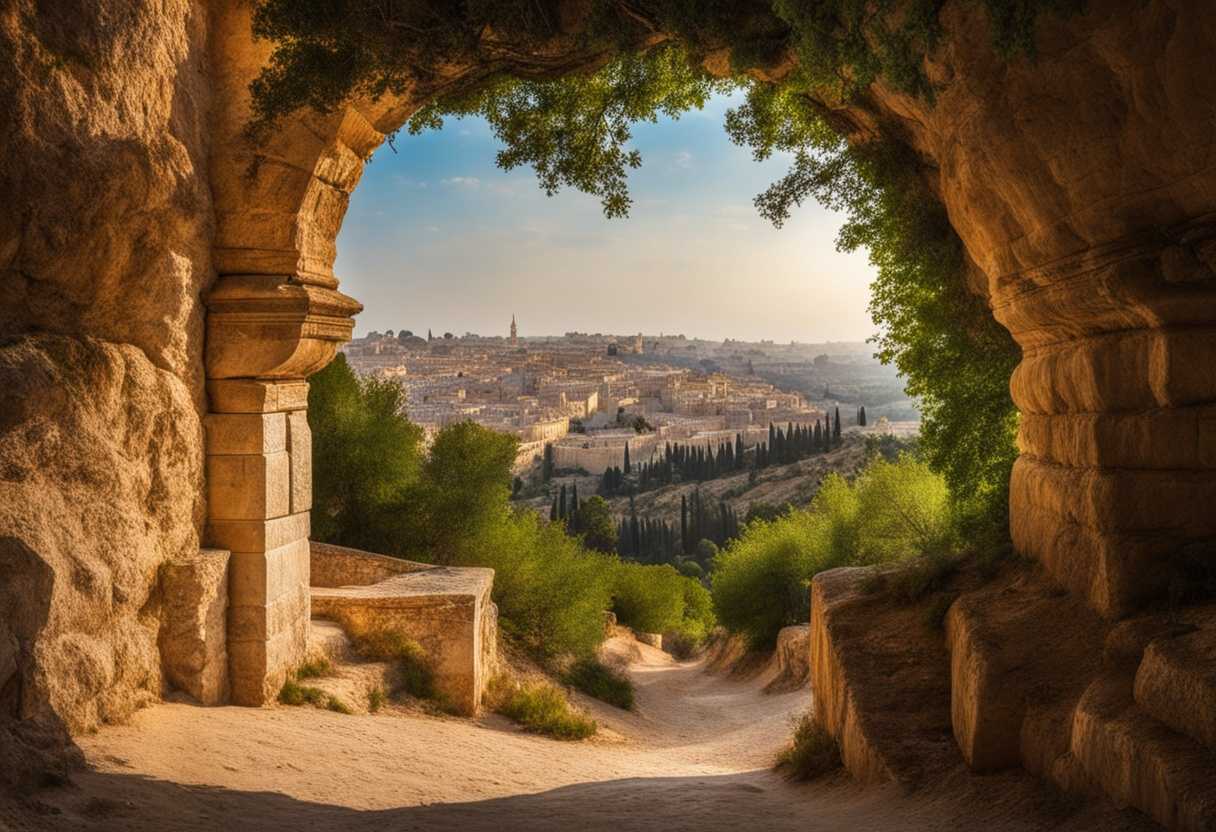
The Kidron Valley, mentioned in the Bible, is a ravine located between Jerusalem and the Mount of Olives. It is significant as a site associated with various biblical events, including King David’s flight from Absalom (2 Samuel 15:23) and the actions of Jesus during the Passion (John 18:1).
Scripture
23 And all the land wept aloud as all the people passed by, and the king crossed the brook Kidron, and all the people passed on toward the wilderness.
24 And Abiathar came up, and behold, Zadok came also with all the Levites, bearing the ark of the covenant of God. And they set down the ark of God until the people had all passed out of the city.
25 Then the king said to Zadok, “Carry the ark of God back into the city. If I find favor in the eyes of the Lord, he will bring me back and let me see both it and his dwelling place.
26 But if he says, ‘I have no pleasure in you,’ behold, here I am, let him do to me what seems good to him.”
27 The king also said to Zadok the priest, “Are you not a seer? Go back to the city in peace, with your two sons, Ahimaaz your son, and Jonathan the son of Abiathar.
28 See, I will wait at the fords of the wilderness until word comes from you to inform me.”
29 So Zadok and Abiathar carried the ark of God back to Jerusalem, and they remained there.
30 But David went up the ascent of the Mount of Olives, weeping as he went, barefoot and with his head covered. And all the people who were with him covered their heads, and they went up, weeping as they went.
Meaning of Kidron Valley in the Bible
The Kidron Valley serves as a powerful symbol throughout the Bible, epitomizing themes of transition, struggle, and divine presence. Its geographical placement between Jerusalem and the Mount of Olives enhances its role as a boundary between the sacred city and the wilderness of sin and suffering. In 2 Samuel 15:23, we read about King David fleeing from Absalom, demonstrating a moment of deep sorrow and loss. This act of crossing the Kidron Valley captures the heart of many biblical narratives which explore human tumult, the experience of exile, and the quest for redemption. Similarly, in John 18:1, the valley is again marked by significance as Jesus, post-Last Supper, leads His disciples across to the Mount of Olives, foreshadowing His impending crucifixion and eventual resurrection. This crossing signifies not only a geographical transition but a spiritual passage from betrayal and anguish towards ultimate victory.
Moreover, the Kidron Valley has additional theological implications as it was historically associated with various sacrifices and the disposal of unclean things during the Temple period. As seen in Jeremiah 31:40, the valley symbolizes both destruction and hope, where God promises restoration after judgment. The valley’s connection to both the royal lineage of David and the sacrificial system anticipates a deeper redemptive work, culminating in the ministry of Christ. Therefore, the Kidron Valley stands as a biblical metaphor for the tumultuous journey of faith, illustrating the movement from despair to hope, and reflecting God’s unwavering presence in times of transition and trial. Through its rich tapestry of events, the valley encapsulates the very essence of the biblical narrative, highlighting the perennial struggle for spiritual awakening amidst devastation and despair.
In addition to its role as a geographical boundary, the Kidron Valley serves as a poignant reminder of the consequences of sin and the longing for atonement. The valley’s proximity to Jerusalem, the center of Jewish worship, emphasizes its connection to the sacrificial system practiced within the Temple. It was within this valley that the refuse and idolatrous items were symbolically cast away, underscoring the importance of purity and the separation from sin. This act of disposal reflects the broader theme of God’s desire for His people to be holy and set apart. By juxtaposing the sacred space of Jerusalem with the unclean elements disposed of in the Kidron Valley, the biblical narrative invites individuals to consider the necessity of confession and repentance in their spiritual journeys.
The Kidron Valley also serves as a backdrop for prophetic proclamations and divine encounters. Within its confines, moments of divine judgment and grace intersect, as prophets declare God’s word to His people. The valley echoes with the conversations between God and His chosen leaders, compelling them to confront the realities of their faith and the implications of their choices. This interplay between the sacred and the secular, the transient and the eternal, further enriches our understanding of the Kidron Valley as a place of divine revelation and judgment. Indeed, its layered meanings advance the narrative of redemption by illustrating that, regardless of the trials faced within the valley’s shadows, there is always the possibility of renewed hope and reconciliation with God. Thus, the Kidron Valley embodies the ongoing call for transformation, inviting all who traverse its paths to seek restoration and deeper communion with the Divine.
Symbol of Separation and Conflict
The Kidron Valley serves as a geographical and symbolic boundary between Jerusalem and the Mount of Olives. This separation can represent the conflict between the sacred and the profane, the city of God and the wilderness. It is a place where significant events unfold, often highlighting the tension between divine purpose and human actions. The valley’s role in biblical narratives underscores the struggles faced by individuals and communities in their spiritual journeys.
A Place of Mourning and Reflection
Throughout biblical history, the Kidron Valley has been associated with moments of mourning and reflection. It is a site where significant losses and transitions occur, prompting individuals to confront their grief and seek solace. This aspect of the valley invites believers to consider their own experiences of loss and the importance of finding hope and renewal in the midst of sorrow.
A Foreshadowing of Redemption
The Kidron Valley also carries a prophetic significance, often seen as a precursor to future events in biblical eschatology. Its mention in various contexts can be interpreted as a foreshadowing of redemption and restoration. The valley’s association with pivotal moments in the life of Jesus and its connection to themes of sacrifice and resurrection highlight the overarching narrative of hope and salvation that permeates the scriptures.
How to Embrace Spiritual Growth Through Life’s Challenges
Embracing spiritual growth through life’s challenges is a transformative journey that can deepen your faith and strengthen your character. When faced with trials, it’s essential to remember that these moments are not just obstacles but opportunities for growth. Reflect on James 1:2-4, which encourages us to consider it pure joy when we encounter difficulties, as they produce perseverance and maturity in our faith. Take time to pray and seek God’s guidance during tough times, allowing His wisdom to shape your perspective. Journaling your thoughts and feelings can also help you process your experiences and recognize the lessons God is teaching you. Surround yourself with a supportive community that uplifts you and shares in your struggles, reminding you that you are not alone. Ultimately, approach each challenge with an open heart, trusting that God is using these experiences to mold you into the person He created you to be.
Bible References to Kidron Valley Meaning:
1 Kings 2:36-46: 36 Then the king sent and summoned Shimei and said to him, “Build yourself a house in Jerusalem and dwell there, and do not go out from there to any place whatever.
37 For on the day you go out and cross the brook Kidron, know for certain that you shall die. Your blood shall be on your own head.”
38 And Shimei said to the king, “What you say is good; as my lord the king has said, so will your servant do.” So Shimei lived in Jerusalem many days.
39 But three years later, two of Shimei’s servants ran away to Achish, son of Maacah, king of Gath. And when it was told Shimei, “Behold, your servants are in Gath,”
40 So Shimei arose and saddled a donkey and went to Gath to Achish to seek his servants. And Shimei went and brought his servants from Gath.
41 But the king Solomon shall be blessed, and the throne of David shall be established before the Lord forever.”
42 the king sent and summoned Shimei and said to him, “Did I not make you swear by the Lord and solemnly warn you, saying, ‘Know for certain that on the day you go out and go to any place whatever, you shall die’? And you said to me, ‘What you say is good; I will obey.’
43 Why then have you not kept your oath to the Lord and the commandment with which I commanded you?”
44 The king also said to Shimei, “You know in your own heart all the harm that you did to David my father. So the Lord will bring back your harm on your own head.
45 But King Solomon shall be blessed, and the throne of David shall be established before the Lord forever.”
46 Then the king commanded Benaiah the son of Jehoiada, and he went out and struck him down, and he died. So the kingdom was established in the hand of Solomon.
2 Kings 23:4-6: 4 And the king commanded Hilkiah the high priest and the priests of the second order and the keepers of the threshold to bring out of the temple of the Lord all the vessels made for Baal, for Asherah, and for all the host of heaven. He burned them outside Jerusalem in the fields of the Kidron and carried their ashes to Bethel.
5 And he deposed the priests whom the kings of Judah had ordained to make offerings in the high places at the cities of Judah and around Jerusalem; those also who burned incense to Baal, to the sun and the moon and the constellations and all the host of the heavens.
6 And he brought out the Asherah from the house of the Lord, outside Jerusalem, to the brook Kidron, and burned it at the brook Kidron and beat it to dust and cast the dust of it upon the graves of the common people.
2 Chronicles 29:15-16: 15 They gathered their brothers and consecrated themselves and went in as the king had commanded, by the words of the Lord, to cleanse the house of the Lord.
16 The priests went into the inner part of the house of the Lord to cleanse it, and they brought out all the uncleanness that they found in the temple of the Lord into the court of the house of the Lord. And the Levites took it and carried it out to the brook Kidron.
Jeremiah 31:38-40: 38 “Behold, the days are coming, declares the Lord, when the city shall be rebuilt for the Lord from the Tower of Hananel to the Corner Gate.”
39 The measuring line shall go out farther straight to the hill Gareb, and shall then turn to Goah.
40 The whole valley of the dead bodies and the ashes, and all the fields as far as the brook Kidron, to the corner of the Horse Gate toward the east, shall be sacred to the Lord. It shall not be plucked up or overthrown anymore forever.”
John 18:1-2: 1 When Jesus had spoken these words, he went out with his disciples across the Kidron Valley, where there was a garden, which he and his disciples entered.
2 Now Judas, who betrayed him, also knew the place, for Jesus often met there with his disciples.

Reverend Ogunlade is a seasoned Church Minister with over three decades of experience in guiding and nurturing congregations. With profound wisdom and a serene approach, Reverend Ogunlade has carried out various pastoral duties, including delivering uplifting sermons, conducting religious ceremonies, and offering sage counsel to individuals seeking spiritual guidance. Their commitment to fostering harmony and righteousness within their community is exemplified through their compassionate nature, making them a beloved and trusted figure among the congregation.