
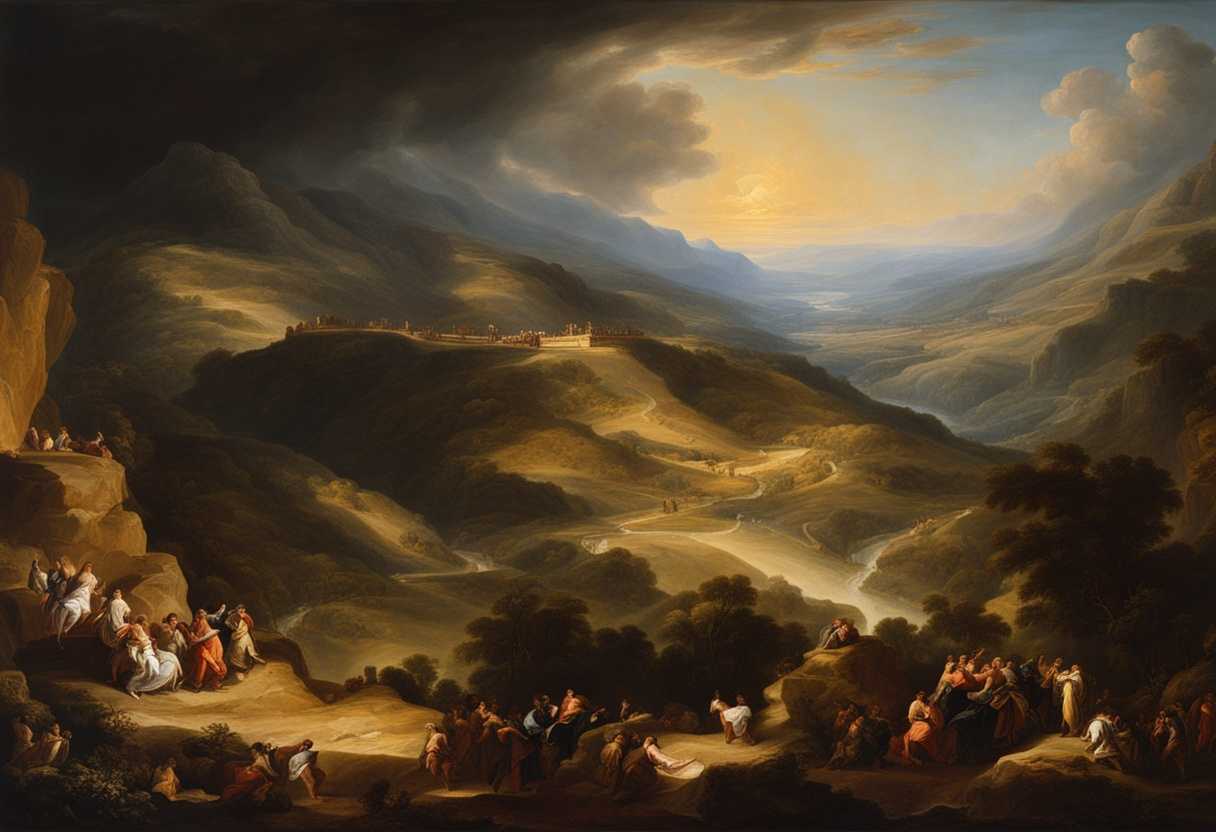
Mount Carmel is a significant biblical location in northern Israel, known for its association with the prophet Elijah and the contest against the prophets of Baal (1 Kings 18). It symbolizes the struggle between true worship of God and idolatry, reflecting themes of faith, divine power, and the sovereignty of the Lord.
Scripture
19 Now therefore send and gather all Israel to me at Mount Carmel, and the 450 prophets of Baal and the 400 prophets of Asherah, who eat at Jezebel’s table.”
20 So Ahab sent to all the people of Israel and gathered the prophets together at Mount Carmel.
21 And Elijah came near to all the people and said, “How long will you go limping between two different opinions? If the Lord is God, follow him; but if Baal, then follow him.” And the people did not answer him a word.
22 Then Elijah said to the people, “I, even I only, am left a prophet of the Lord, but Baal’s prophets are 450 men.
23 Let two bulls be given to us, and let them choose one bull for themselves and cut it in pieces and lay it on the wood, but put no fire to it. And I will prepare the other bull and lay it on the wood and put no fire to it.
24 And you call upon the name of your god, and I will call upon the name of the Lord, and the God who answers by fire, he is God.” And all the people answered, “It is well spoken.”
25 Then Elijah said to the prophets of Baal, “Choose for yourselves one bull and prepare it first, for you are many, and call upon the name of your god, but put no fire to it.”
26 And they took the bull that was given them, and they prepared it and called upon the name of Baal from morning until noon, saying, “O Baal, answer us!” But there was no voice, and no one answered. And they limped around the altar that they had made.
27 And at noon Elijah mocked them, saying, “Cry aloud, for he is a god. Either he is musing, or he is relieving himself, or he is on a journey, or perhaps he is asleep and must be awakened.”
28 And they cried aloud and cut themselves after their custom with swords and lances, until the blood gushed out upon them.
29 And as midday passed, they raved on until the time of the offering of the oblation, but there was no voice. No one answered; no one paid attention.
30 Then Elijah said to all the people, “Come near to me.” And all the people came near to him. And he repaired the altar of the Lord that had been thrown down.
31 Elijah took twelve stones, according to the number of the tribes of the sons of Jacob, to whom the word of the Lord came, saying, “Israel shall be your name,”
32 And with the stones he built an altar in the name of the Lord.
33 And he put the wood in order and cut the bull in pieces and laid it on the wood. And he said, “Fill four jars with water and pour it on the burnt offering and on the wood.”
34 And he said, “Fill four jars with water and pour it on the burnt offering and on the wood.”
35 And the water ran around the altar and filled the trench also with water.
36 And at the time of the offering of the oblation, Elijah the prophet came near and said, “O Lord, God of Abraham, Isaac, and Israel, let it be known this day that you are God in Israel, and that I am your servant, and that I have done all these things at your word.
37 Answer me, O Lord, answer me, that this people may know that you, O Lord, are God, and that you have turned their hearts back.”
38 Then the fire of the Lord fell and consumed the burnt offering and the wood and the stones and the dust, and licked up the water that was in the trench.
39 And when all the people saw it, they fell on their faces and said, “The Lord, he is God; the Lord, he is God.”
40 And Elijah said to them, “Seize the prophets of Baal; let not one of them escape.” And they seized them. And Elijah brought them down to the brook Kishon and slaughtered them there.
41 And Elijah said to Ahab, “Go up, eat and drink, for there is a sound of the rushing of rain.”
42 So Ahab went up to eat and to drink. And Elijah went up to the top of Mount Carmel. And he bowed himself down on the earth and put his face between his knees.
43 And he said to his servant, “Go up now, look toward the sea.” And he went up and looked and said, “There is nothing.” And he said, “Go again,” seven times.
44 And at the seventh time he said, “Behold, a little cloud like a man’s hand is rising from the sea.” And he said, “Go up, say to Ahab, ‘Prepare your chariot and go down, lest the rain stop you.’”
45 And in a little while the heavens grew black with clouds and wind, and there was a great rain. And Ahab rode and went to Jezreel.
46 And the hand of the Lord was on Elijah, and he gathered up his garment and ran before Ahab to the entrance of Jezreel.
Meaning of Mount Carmel in the Bible
Mount Carmel holds a significant position in the biblical narrative, primarily illustrated in 1 Kings 18, where the prophet Elijah confronts the prophets of Baal in a dramatic contest to showcase the true power of God. This event is emblematic of the ongoing battle between fidelity to the one true God and the prevailing idolatry of the time. In this confrontation, Elijah sets up two altars, one for the Lord and one for Baal, inviting each side to call upon their respective deity to ignite a sacrifice. The failure of the prophets of Baal to elicit a response culminates in a demonstration of God’s sovereign power when Elijah’s prayer results in fire raining down, consuming his sacrifice, the altar, and even the surrounding earth (1 Kings 18:38). This moment not only reaffirms God’s supremacy but also serves as a call to the Israelites to recommit themselves to the worship of Yahweh, thereby challenging the influence of false gods in their lives.
Beyond the historical narrative, Mount Carmel also carries broader theological implications. It symbolizes the tangible divide between faithfulness and waywardness, invoking themes of grace, repentance, and restoration. In its lush beauty, it highlights God’s providential care and the blessings of obedience, as depicted in the agricultural richness of the region (Psalm 72:16). Furthermore, in the prophetic literature, such as in Jeremiah 46:18, Mount Carmel is referenced as a place of strength, symbolizing God’s promise of presence amidst adversity. Ultimately, the significance of Mount Carmel transcends its geographical location, standing as a powerful reminder of the call to unwavering faithfulness, the rejection of idolatry, and the realization of God’s omnipotence in both the lives of individuals and the community of believers.
In addition to its pivotal role in the events surrounding Elijah, Mount Carmel also serves as a metaphorical representation of spiritual enlightenment and divine revelation throughout biblical literature. This mountainous area is often associated with God’s presence and the unfolding of His plans for His people. The region’s height can be seen as a physical embodiment of the heights of divine truth, where earthly concerns diminish in the face of God’s grandeur. For instance, prophetic visions in later texts often reflect the majesty and beauty of God through references to high places, where humans can encounter their Maker in awe-inspiring ways. This not only signifies a geographical prominence but also symbolizes the aspiration toward spiritual elevation, a recurrent biblical theme where God invites humanity to seek a closer relationship with Him.
Moreover, Mount Carmel is part of the larger narrative of Israel’s identity and their covenant relationship with God. It serves as a backdrop for understanding the need for communal dedication to God and the consequences of turning away from Him. The lush landscape, described vividly in various texts, signifies God’s blessings amid obedience, while its rugged terrain can evoke the trials and tribulations of those who stray from His path. This duality offers a critical lens through which believers can examine their relationships with God, challenging them to consider their own faithfulness in the face of societal pressures that may lead them astray. The imagery of Mount Carmel thus resonates throughout scripture, serving as a witness to both the promise of divine blessings and the necessity of repentance and return to God’s covenant.
Symbol of Divine Power and Authority
Mount Carmel is often seen as a representation of God’s sovereignty and power. The mountain serves as a backdrop for significant events in the biblical narrative, particularly the confrontation between the prophet Elijah and the prophets of Baal. This encounter highlights the supremacy of the God of Israel over false gods, illustrating that true power and authority belong to the Creator. The dramatic display of divine fire consuming the sacrifice on Mount Carmel serves as a powerful reminder of God’s ability to intervene in human affairs and assert His will.
A Place of Spiritual Renewal and Revelation
Mount Carmel is also recognized as a site of spiritual renewal and revelation. The lush landscape and natural beauty of the mountain symbolize a place where individuals can encounter God and experience transformation. Throughout biblical history, it has been a location for prayer, reflection, and divine communication. The experiences of prophets and leaders on Mount Carmel emphasize the importance of seeking God in solitude and nature, fostering a deeper relationship with the divine.
A Metaphor for the Struggle Between Good and Evil
The events that transpired on Mount Carmel can be interpreted as a metaphor for the ongoing struggle between good and evil. The confrontation between Elijah and the prophets of Baal represents the larger battle between faithfulness to God and the allure of idolatry. This theme resonates throughout the Bible, illustrating the challenges believers face in remaining steadfast in their faith amidst societal pressures and moral decay. Mount Carmel thus serves as a reminder of the importance of choosing righteousness and standing firm against opposing forces.
How to Embrace Spiritual Growth for a Victorious Life
Embracing spiritual growth is a transformative journey that can lead to a more victorious life, and it begins with a sincere desire to deepen your relationship with God. Start by immersing yourself in Scripture, allowing the Word to guide your thoughts and actions; it’s in those quiet moments of reflection that you’ll find clarity and strength. Prayer is your lifeline—make it a daily practice, not just a ritual, but a heartfelt conversation with your Creator. Surround yourself with a community of believers who can uplift and challenge you, as iron sharpens iron. Remember, spiritual growth isn’t a sprint but a marathon; be patient with yourself and celebrate the small victories along the way. As you cultivate a heart of gratitude and service, you’ll find that your life becomes a testament to God’s love and grace, empowering you to face challenges with unwavering faith.
Bible References to Mount Carmel’s Significance:
1 Kings 18:1-18: 1 After many days the word of the Lord came to Elijah, in the third year, saying, “Go, show yourself to Ahab, and I will send rain upon the earth.”
2 So Elijah went to show himself to Ahab. Now the famine was severe in Samaria.
3 And Ahab called Obadiah, who was over the household. (Now Obadiah feared the Lord greatly, )
4 And when Jezebel cut off the prophets of the Lord, Obadiah took a hundred prophets and hid them by fifties in a cave and fed them with bread and water.
5 And Ahab said to Obadiah, “Go through the land to all the springs of water and to all the valleys. Perhaps we may find grass and save the horses and mules alive, and not lose some of the animals.”
6 So they divided the land between them to pass through it. Ahab went in one direction by himself, and Obadiah went in another direction by himself.
7 And as Obadiah was on the way, behold, Elijah met him. And Obadiah recognized him and fell on his face and said, “Is it you, my lord Elijah?”
8 And he answered him, “I am the prophet of the Lord. But how have I sinned, that you would deliver your servant into the hand of Ahab, to kill me?
9 And he said, “What have I sinned, that you would give your servant into the hand of Ahab, to kill me?
10 As the Lord your God lives, there is no nation or kingdom where my lord has not sent to seek you. And when they would say, ‘He is not here,’ he would take an oath of the kingdom or nation, that they had not found you.
11 And now you say, ‘Go, tell your lord, “Behold, Elijah is here.”‘
12 And as soon as I have gone from you, the Spirit of the Lord will carry you I know not where. So, when I come and tell Ahab and he cannot find you, he will kill me, although I your servant have feared the Lord from my youth.
13 Has it not been told my lord what I did when Jezebel killed the prophets of the Lord, how I hid a hundred men of the Lord’s prophets by fifties in a cave and fed them with bread and water?
14 And now you say, ‘Go, tell your lord, “Behold, Elijah is here”‘; and he will kill me.”
15 And Elijah said, “As the Lord of hosts lives, before whom I stand, I will surely show myself to him today.”
16 So Obadiah went to meet Ahab, and told him. And Ahab went to meet Elijah.
17 When Ahab saw Elijah, Ahab said to him, “Is it you, you troubler of Israel?”
18 And he answered, “I have not troubled Israel, but you have, and your father’s house, because you have abandoned the commandments of the Lord and followed the Baals.
2 Kings 2:25-3:3: 25 He went up from there to Bethel, and while he was going up on the way, some small boys came out of the city and jeered at him, saying, “Go up, you baldhead! Go up, you baldhead!”
3 Now Jehoram the son of Ahab became king over Israel in Samaria in the eighteenth year of Jehoshaphat king of Judah, and reigned twelve years.
2 He did what was evil in the sight of the Lord, though not like his father and mother, for he put away the pillar of Baal that his father had made.
3 Nevertheless, he clung to the sins of Jeroboam the son of Nebat, which he made Israel to sin; he did not depart from them.
2 Kings 4:25-27: 25 So she set out and came to the man of God at Mount Carmel.
26 Run at once to meet her and say to her, ‘Is all well with you? Is all well with your husband? Is all well with the child?’ And she answered, ‘All is well.’
27 And when she came to the mountain to the man of God, she caught hold of his feet. And Gehazi came to push her away. But the man of God said, “Leave her alone, for she is in bitter distress, and the Lord has hidden it from me and has not told me.”
Amos 1:1-2: 1 The words of Amos, who was among the shepherds of Tekoa, which he saw concerning Israel in the days of Uzziah king of Judah and in the days of Jeroboam the son of Joash, king of Israel, two years before the earthquake.
2 And he said: “The Lord roars from Zion and utters his voice from Jerusalem; the pastures of the shepherds mourn, and the top of Carmel withers.”
Amos 9:1-3: 1 I saw the Lord standing beside the altar, and he said: “Strike the capitals until the thresholds shake, and shatter them on the heads of all the people; and those who are left of them I will kill with the sword; not one of them shall flee away; not one of them shall escape.”
2 “If they dig into Sheol, from there shall my hand take them; if they climb up to heaven, from there I will bring them down.”
3 “If they hide themselves on the top of Carmel,
from there I will search them out and take them;
and if they hide from my sight at the bottom of the sea,
there I will command the serpent, and it shall bite them.”
Isaiah 33:9-10: 9 The land mourns and languishes;
Lebanon is confounded and withers away;
Sharon is like a desert,
and Bashan and Carmel shake off their leaves.
10 “Now I will arise,” says the Lord;
“now I will lift myself up;
now I will be exalted.
Isaiah 35:1-2: 1 The wilderness and the dry land shall be glad;
the desert shall rejoice and blossom like the crocus;
2 It shall blossom abundantly and rejoice with joy and singing. The glory of Lebanon shall be given to it, the majesty of Carmel and Sharon. They shall see the glory of the Lord, the majesty of our God.
Jeremiah 46:18-19: 18 As I live, declares the King, whose name is the Lord of hosts, like Tabor among the mountains and like Carmel by the sea, shall one come.
19 Prepare yourselves baggage for exile, O inhabitants of Egypt! For Memphis shall become a waste, a ruin, without inhabitant.
Jeremiah 50:19-20: 19 I will restore Israel to his pasture, and he shall feed on Carmel and in Bashan, and his desire shall be satisfied on the hills of Ephraim and Gilead.
20 In those days and in that time, declares the Lord, iniquity shall be sought in Israel, and there shall be none, and sin in Judah, and none shall be found, for I will pardon those whom I leave as a remnant.
Song of Solomon 7:5-6: 5 Your stature is like a palm tree, and your breasts are like its clusters.
6 How beautiful and pleasant you are, O loved one, with all your delights!
Micah 7:14-15: 14 Shepherd your people with your staff,
the flock of your inheritance,
who dwell alone in a forest
in the midst of a garden land;
let them graze in Bashan and Gilead
as in the days of old.
15 As in the days when you came out of the land of Egypt, I will show them marvelous things.

Reverend Ogunlade is a seasoned Church Minister with over three decades of experience in guiding and nurturing congregations. With profound wisdom and a serene approach, Reverend Ogunlade has carried out various pastoral duties, including delivering uplifting sermons, conducting religious ceremonies, and offering sage counsel to individuals seeking spiritual guidance. Their commitment to fostering harmony and righteousness within their community is exemplified through their compassionate nature, making them a beloved and trusted figure among the congregation.