
1 The divisions of the sons of Aaron were these. The sons of Aaron: Nadab, Abihu, Eleazar, and Ithamar.
2 But Nadab and Abihu died before their father and had no children, so Eleazar and Ithamar became the priests.
3 With the help of Zadok of the sons of Eleazar, and Ahimelech of the sons of Ithamar, David organized them according to the appointed duties in their service.
4 Since more chief men were found among the sons of Eleazar than among the sons of Ithamar, they organized them under sixteen heads of fathers’ houses of the sons of Eleazar, and eight of the sons of Ithamar.
5 Thus they were divided by lot, one as well as another, for there were officers of the sanctuary and officers of God among both the sons of Eleazar and the sons of Ithamar.
6 And the scribe Shemaiah, the son of Nethanel, a Levite, recorded them in the presence of the king and the princes and Zadok the priest and Ahimelech the son of Abiathar and the heads of the fathers’ houses of the priests and of the Levites, one father’s house being chosen for Eleazar and one chosen for Ithamar.
7 The first lot fell to Jehoiarib, the second to Jedaiah,
8 the third to Harim, the fourth to Seorim,
9 the fifth to Malchijah, the sixth to Mijamin,
10 the seventh to Hakkoz, the eighth to Abijah,
11 the ninth to Jeshua, the tenth to Shecaniah,
12 the eleventh to Eliashib, the twelfth to Jakim,
13 the thirteenth to Huppah, the fourteenth to Jeshebeab,
14 The fifteenth to Bilgah, the sixteenth to Immer,
15 The seventeenth to Hezir, the eighteenth to Happizzez,
16 The nineteenth to Pethahiah, the twentieth to Jehezkel,
17 the twenty-third to Delaiah, the twenty-fourth to Maaziah.
18 the twenty-third to Delaiah, the twenty-fourth to Maaziah.
19 These had as their appointed duty in their service to come into the house of the Lord according to the procedure established for them by Aaron their father, as the Lord God of Israel had commanded him.
20 And the rest of the sons of Levi: of the sons of Amram, Shubael; of the sons of Shubael, Jehdeiah.
21 The sons of Merari: Mahli and Mushi. The sons of Mahli: Eleazar and Kish.
22 As for the Izharites: Shelomoth; from the sons of Shelomoth: Jahath.
23 As for the rest of the sons of Kohath, their duties involved the care of the sanctuary: they were in charge of the bread of the Presence.
24 These had the sons of Levi: the sons of Gershom, Kohath, and Merari.
25 The brother of Michah, Isshiah; of the sons of Isshiah, Zechariah.
26 The sons of Merari: Mahli and Mushi. The sons of Mahli: Eleazar and Kish.
27 the twenty-first to Jachin, the twenty-second to Gamul,
28 The duty of the Levites was to help Aaron the priest in the service of the house of the Lord, to care for the courts and the chambers, the cleansing of all that is holy, and any work for the service of the house of God.
29 As for the Izharites: Chenaniah and his sons were appointed to external duties for Israel, as officers and judges.
30 And the rest of the Kohathites were allotted by the casting of lots, out of the family of the tribe, out of the half-tribe, the half of Manasseh.
31 These also, the head of each father’s house and his younger brother alike, cast lots, just as their brothers the sons of Aaron, in the presence of King David, Zadok, Ahimelech, and the heads of fathers’ houses of the priests and of the Levites. The fathers’ houses of the chief as well as those of his younger brother.
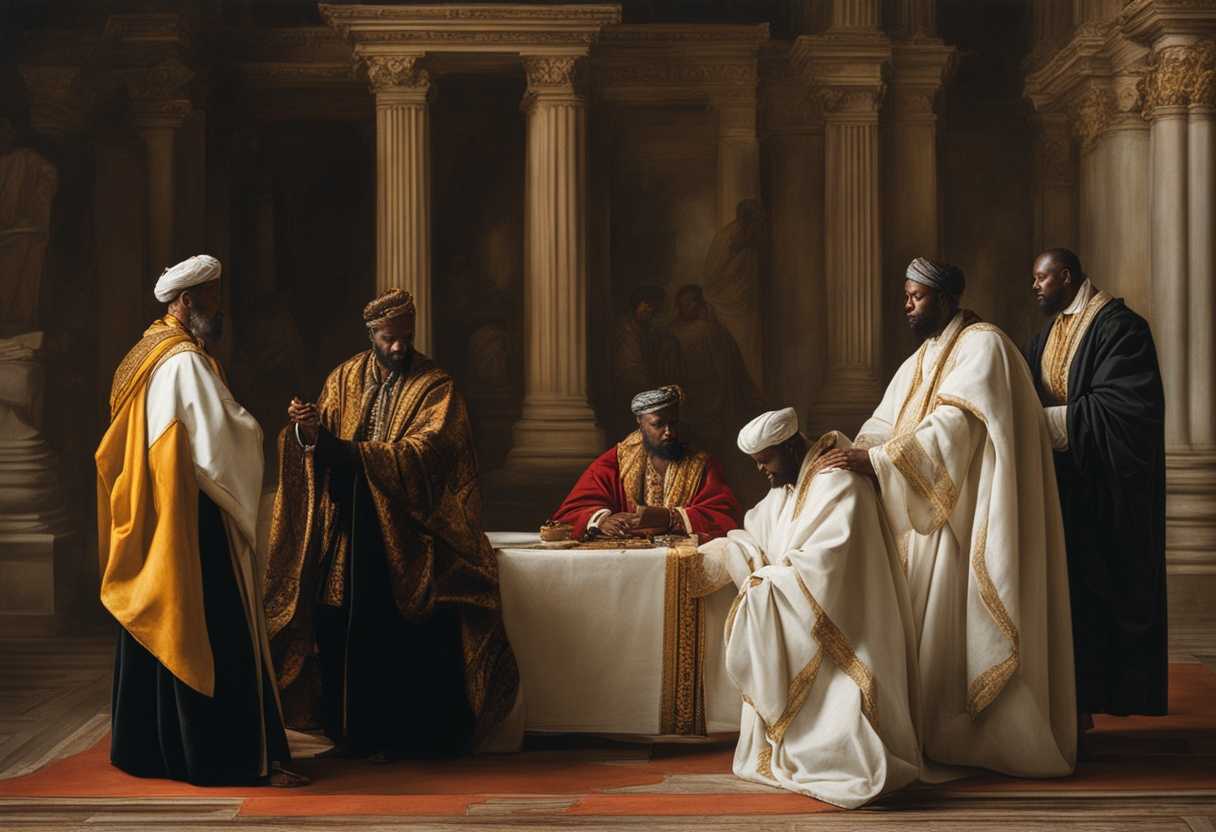
The True Meaning of 1 Chronicles 24
The Book of 1 Chronicles was written by the prophet Ezra, who lived during the time of the Babylonian exile and the return of the Israelites to their homeland. Ezra’s purpose in writing this book was to provide a historical account of the Israelite monarchy, focusing on the reign of King David and the establishment of the temple worship. King David’s leadership organizes the Levitical priesthood in this particular chapter. The Levites, who were responsible for the temple’s sacred duties, were divided into various groups to ensure the smooth running of the temple’s operations. This chapter foreshadows the importance of proper worship and the role of the Levites in maintaining the holiness of the temple, as emphasized in other biblical passages such as Numbers 3:5-13 and Deuteronomy 10:8. Divine wisdom guided King David as he established a system that would ensure the continuity of the Levitical priesthood and the uninterrupted worship of the Lord as we delve into this chapter. This organization would lay the foundation for the temple’s future operations, as the Israelites returned from exile and sought to rebuild their spiritual and national identity.
1 Chronicles 24:1-6
The passage in 1 Chronicles 24:1-6 discusses the organization of the priests, known as the sons of Aaron, into 24 divisions according to the house of their fathers. Each division would serve in the temple for a designated time, ensuring that the duties of the priests were carried out regularly and in an orderly manner. This division of the priests was essential for the functioning of the temple and the worship of the Lord.
This system is significant as it illustrates the importance of order and structure within the worship of God. It ensured that the responsibilities of the priests were evenly distributed and that the temple service ran smoothly by appointing specific times for each division to serve. This organization also highlights the meticulous attention to detail that was given to the worship of God, emphasizing the reverence and respect that the Israelites held for their God.
Furthermore, this passage reflects the idea of serving God willingly and with dedication. Each priest was assigned a specific time to serve, and it was their responsibility to fulfill their duties faithfully during that time. This concept of faithful service is echoed throughout the Bible, such as in Colossians 3:23-24, which encourages believers to work heartily, as for the Lord and not for men.
The mention of Aaron, the high priest and brother of Moses, is significant in this passage as well. Aaron played a crucial role in the establishment of the priesthood in Israel, and his descendants continued to serve as priests in the temple. The lineage of Aaron was considered sacred and was entrusted with the responsibility of carrying out the rituals and sacrifices on behalf of the people. The organization of the priests into 24 divisions in 1 Chronicles 24 serves as a reminder of the importance of order, dedication, and faithful service in the worship of God. It highlights the meticulous details that were involved in the temple service and demonstrates the reverence that the Israelites had for their God. This passage also emphasizes the significance of the priesthood and the role that Aaron and his descendants played in carrying out the worship of the Lord.
1 Chronicles 24:7-19
The passage in 1 Chronicles 24:7-19 discusses the allocation of duties among the priestly descendants of Aaron. This section is significant as it outlines the organization and division of responsibilities within the priesthood, highlighting the importance of order and structure in carrying out the worship rituals and offerings in the temple.
The division of priests into 24 groups was established by King David to ensure each group had a designated time to serve in the temple. This system helped prevent any one group from becoming overburdened with duties and ensured all priests had equal opportunity to serve. This demonstrates the importance of fairness and equity within the service of God, emphasizing the idea that all individuals have a role to play in the religious community.
Furthermore, this passage emphasizes God’s meticulous planning and attention to detail in setting up the priesthood. Each priestly division was assigned specific responsibilities, highlighting the importance of order and discipline in serving God. This meticulous organization reflects God’s desire for things to be done decently and in order, as mentioned in 1 Corinthians 14:40.
The mention of the lots being cast before King David, Zadok the priest, Ahimelech, and the heads of families of the priests and the Levites underscores the importance of seeking God’s guidance and direction in making decisions. The casting of lots was a common practice in the Old Testament used to discern God’s will (Proverbs 16:33), and it shows the belief that God is sovereign over all things, including the selection of duties among the priests.
The priests mentioned in this passage, such as Zadok and Ahimelech, were key figures in the religious leadership of Israel during King David’s reign. Zadok, in particular, played a significant role in anointing Solomon as king (1 Kings 1:32-39), showcasing his loyalty and obedience to God’s chosen king. Ahimelech was also a faithful priest who served both David and Saul, displaying his commitment to his priestly duties despite the political turmoil in Israel. This passage not only provides a glimpse into the organization of the priesthood in ancient Israel but also underscores the importance of order, fairness, and seeking God’s guidance in serving Him. It reminds readers of the significance of each individual’s role in the larger community of believers and the need for faithful execution of duties in worship and service to God.
1 Chronicles 24:20-31
The detailed account of the divisions of the sons of Levi, specifically the descendants of Aaron, who was the first high priest of Israel, is seen in 1 Chronicles 24:20-31. This portion of the chapter delineates the twenty-four divisions of priests who were responsible for serving in the temple, each division serving for a specified period of time.
The mention of the sons of Levi is significant as the tribe of Levi was chosen by God for the priestly duties in Israel. Aaron, the brother of Moses, was chosen by God to be the first high priest, and his descendants continued the priestly lineage. This lineage is crucial in understanding the establishment of the priesthood in Israel and the importance of the Levites in the religious structure of the nation.
The organization of the priests into twenty-four divisions served an important function in ensuring that there was a rotational system in place for priestly duties. Each division was assigned specific tasks and times for serving in the temple, which helped in the smooth functioning of the worship services and offerings. This system also prevented any single group from monopolizing the priestly duties, ensuring fairness and equity among the priests.
The attention to detail in listing the names of the divisions and their leaders highlights the importance of order, organization, and divine appointment in the worship of God. It also emphasizes the idea that God is a God of order and not chaos. This meticulous record-keeping demonstrates the care with which God’s work was carried out in the temple and serves as a reminder to us today that we should also approach our service to God with reverence and order.
This passage reminds us of the significance of the priesthood in the Old Testament and points forward to the ultimate High Priest, Jesus Christ, in the New Testament. Jesus is described as a priest forever in the order of Melchizedek in Hebrews 7, surpassing the Levitical priesthood and offering Himself as the perfect sacrifice for the sins of humanity. This foreshadowing of Jesus as the ultimate High Priest highlights the importance of the priestly lineage in preparing the way for the arrival of the Savior. This passage in 1 Chronicles 24 serves as a historical record of the organization of the priests in Israel and showcases the precision and orderliness with which God’s work was carried out in the temple. It also points to the ultimate fulfillment of the priesthood in Jesus Christ, who offered Himself as the perfect sacrifice, once and for all, for the redemption of mankind.
After 1 Chronicles 24
The Lord had spoken, and the priests were divided into their respective duties. Each family was assigned a specific role, ensuring the smooth operation of the temple’s sacred rituals. The reverend knew that the next chapter would reveal how these newly established responsibilities would unfold, shaping the lives of the people and their relationship with the divine as the chapter drew to a close. The reverend could not help but wonder what challenges and triumphs lay ahead, as the chosen servants of God continued their sacred work within the hallowed walls of the temple.

Reverend Michael Johnson is an experienced Church Minister with a profound expertise in spirituality and guidance. With a serene presence and a compassionate heart, he has faithfully served his congregation for over 20 years, leading them on a spiritual journey towards inner peace and enlightenment. Reverend Johnson’s extensive knowledge of religious philosophies and profound understanding of human nature have made him a trusted confidant and mentor to many, as he seamlessly weaves his profound wisdom into life teachings. Reverend Johnson’s calming demeanor and empathetic nature continue to uplift and heal souls, nurturing a sense of unity and tranquility within his community.