
1 Kings 10:1-13 is about the Queen of Sheba visiting King Solomon to test his wisdom, prompting Solomon to showcase his wealth, wisdom, and the glory of God in fulfilling his promises.
23 Thus King Solomon excelled all the kings of the earth in riches and in wisdom.
2 She came to Jerusalem with a very great retinue, with camels bearing spices and very much gold and precious stones. And when she came to Solomon, she told him all that was on her mind.
3 And Solomon answered all her questions; there was nothing hidden from the king that he could not explain to her.
4 And when the queen of Sheba had seen all the wisdom of Solomon, the house that he had built,
5 the food of his table, the seating of his officials, and the attendance of his servants, and their clothing, his cupbearers, and his burnt offerings that he offered at the house of the Lord, there was no more breath in her.
6 She said to the king, “The report was true that I heard in my own land of your words and of your wisdom,
7 So I did not believe the reports until I came and my own eyes had seen it. And behold, the half was not told me. Your wisdom and prosperity surpass the report that I heard.
8 Happy are your men! Happy are your servants, who continually stand before you and hear your wisdom!
9 Then she gave the king 120 talents of gold, and a very great quantity of spices and precious stones. Never again came such an abundance of spices as these that the queen of Sheba gave to King Solomon.
10 Then she gave the king 120 talents of gold, and a very great quantity of spices and precious stones. Never again came such an abundance of spices as these that the queen of Sheba gave to King Solomon.
11 Moreover, the fleet of Hiram, which brought gold from Ophir, brought from Ophir a very great amount of almug wood and precious stones.
12 The king also made of the almug wood supports for the house of the Lord and for the king’s house, lyres also and harps for the singers. No such almug wood has come or been seen to this day.
13 King Solomon gave to the queen of Sheba all that she desired, whatever she asked, besides what was given her by the bounty of King Solomon. So she turned and went back to her own land with her servants.
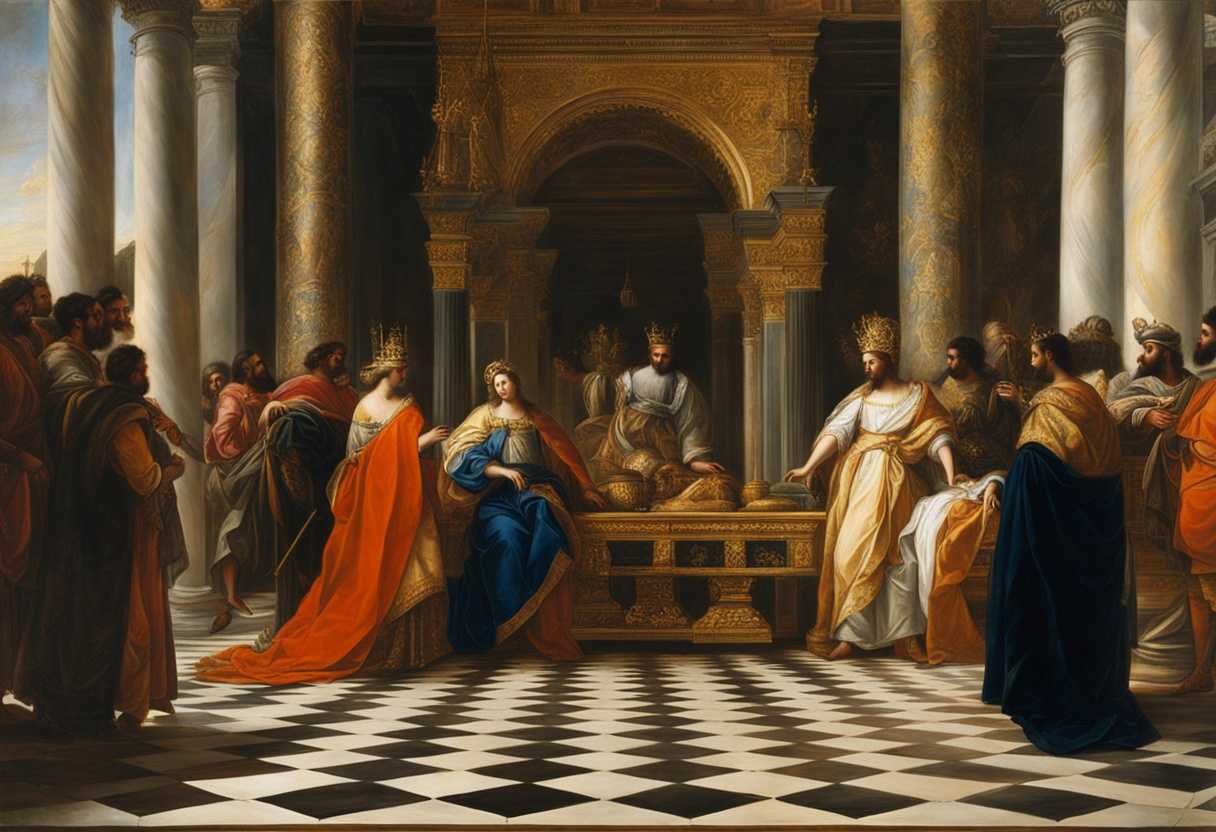
Setting the Scene for 1 Kings 10:1-13
In 1 Kings chapter 10, we find the Queen of Sheba making a grand entrance into Jerusalem to visit King Solomon. The Queen of Sheba, known for her wisdom and wealth, had heard of Solomon’s great wisdom and wanted to test him with hard questions. She arrived with a large entourage, including camels carrying spices, gold, and precious stones as gifts for the king.
The scene is set in the opulent palace of King Solomon, filled with luxurious furnishings and adorned with gold and precious stones. As the Queen of Sheba enters the palace, she is struck by its grandeur and the wisdom of Solomon’s court officials. The air is filled with the scent of exotic spices brought as gifts from her kingdom.
King Solomon, known for his wisdom and wealth, welcomes the Queen of Sheba with open arms. The two engage in deep conversations, with the Queen posing challenging questions to test Solomon’s wisdom. The atmosphere is one of respect and admiration as these two powerful and wise leaders come together in a meeting of minds and cultures.
What is 1 Kings 10:1-13 about?
Wow, imagine being so impressed by someone’s wisdom and wealth that you can’t help but praise God! The Queen of Sheba is visiting King Solomon in this verse, and she is completely in awe of his intelligence and the grandeur of his kingdom. This encounter is a powerful example of how someone’s abilities can showcase the greatness of God.
The Queen of Sheba’s response shows us the importance of recognizing and appreciating the gifts and talents of others. It also emphasizes the idea that wisdom and wealth are gifts from God, and should be used to bring glory to Him. This verse challenges us to reflect on how we can use our own strengths and resources to honor God and inspire others.
Next time you witness someone’s exceptional abilities or success, think about how you can see God’s hand at work in their lives. And remember, just like the Queen of Sheba, let’s not hesitate to give praise where it is due – to God who is the source of all wisdom and wealth.
Understanding what 1 Kings 10:1-13 really means
The passage in 1 Kings 10:1-13 recounts the intriguing encounter between the Queen of Sheba and King Solomon, where she tests his wisdom with challenging questions and is left in awe of his profound understanding and the opulence of his kingdom. This visit serves as a testament to Solomon’s renowned wisdom, a gift bestowed upon him by God Himself, as previously promised in 1 Kings 3:12-13. It unfolds during the pinnacle of Israel’s prosperity under Solomon’s reign, showcasing the divine blessings showered upon the nation.
The Queen of Sheba’s “hard questions” symbolize the deep inquiries that probe into philosophical and practical matters, reflecting humanity’s innate quest for knowledge and truth. The phrase “There was nothing hidden from the king” underscores Solomon’s exceptional wisdom, granted by God, enabling him to provide insightful answers to all the Queen’s inquiries, signifying divine insight and discernment. Her exclamation, “The half was not told me,” conveys her astonishment at the extent of Solomon’s wisdom and the grandeur of his kingdom, surpassing her preconceived notions.
In related biblical passages, Proverbs 2:6 emphasizes that wisdom originates from the Lord, reinforcing the divine source of Solomon’s exceptional understanding. Similarly, James 1:5 in the New Testament encourages believers to seek wisdom from God, who generously bestows it upon those who earnestly seek it. The narrative of Solomon and the Queen of Sheba resonates with contemporary audiences, reminding us of the paramount importance of discerning true wisdom amidst the deluge of information in today’s world.
Consider a scenario where a young professional faces a complex decision at work and seeks counsel from a wise mentor. The mentor’s sagacious advice not only resolves the immediate issue but also imparts valuable insights that shape the professional’s perspective in the long term. This anecdote mirrors the Queen of Sheba’s encounter with Solomon, illustrating the transformative influence of genuine wisdom sought from divine sources.
In conclusion, the Queen of Sheba’s visit to Solomon transcends mere historical documentation; it serves as a poignant illustration of the pursuit of wisdom and the abundant blessings that flow from embracing and applying divine understanding in our lives. Just as Solomon’s wisdom astounded the Queen, may we too be inspired to seek wisdom from God, the ultimate source of all knowledge and insight, in our daily endeavors.
How can we seek wisdom from God like the Queen of Sheba?
We can seek wisdom from God like the Queen of Sheba by approaching Him with humility, seeking truth and understanding. We can earnestly seek wisdom from God through prayer, meditation, and studying His word, just as the Queen of Sheba traveled a great distance to seek wisdom from King Solomon. We can open ourselves up to receiving divine guidance and insight by acknowledging our own limitations and recognizing the infinite wisdom of God.
Furthermore, seeking wisdom from God also involves being willing to act upon the knowledge and understanding He provides. The Queen of Sheba not only sought wisdom from King Solomon but she also acted upon what she learned, implementing changes in her own kingdom. We should be ready to heed God’s guidance and incorporate it into our lives when we seek wisdom from Him, allowing it to shape our thoughts, actions, and decisions. Through this process of seeking, receiving, and applying wisdom from God, we can grow in our understanding of His ways and ultimately draw closer to Him.
Application
Just as the Queen of Sheba sought wisdom from King Solomon, let us also seek knowledge and understanding in our daily lives. Let this story be a metaphor for our own quest for growth and enlightenment in our work and family life. Embrace the challenge of seeking wisdom, ask the tough questions, and strive for a deeper understanding. How will you embrace the path of wisdom today?

Reverend Michael Johnson is an experienced Church Minister with a profound expertise in spirituality and guidance. With a serene presence and a compassionate heart, he has faithfully served his congregation for over 20 years, leading them on a spiritual journey towards inner peace and enlightenment. Reverend Johnson’s extensive knowledge of religious philosophies and profound understanding of human nature have made him a trusted confidant and mentor to many, as he seamlessly weaves his profound wisdom into life teachings. Reverend Johnson’s calming demeanor and empathetic nature continue to uplift and heal souls, nurturing a sense of unity and tranquility within his community.