
1 Kings 7:13-51 is about the detailed description of the craftsmanship and construction of the pillars, capitals, and bronze furnishings in King Solomon’s temple, symbolizing the grandeur and dedication to worship in the house of the Lord.
13 And King Solomon sent and brought Hiram from Tyre.
14 He was the son of a widow of the tribe of Naphtali, and his father was a man of Tyre, a worker in bronze. And he was full of wisdom, understanding, and skill for making any work in bronze. He came to King Solomon and did all his work.
15 He cast two pillars of bronze. Eighteen cubits was the height of one pillar, and a line of twelve cubits measured its circumference. It was hollow, and its thickness was four fingers. The second pillar was the same.
16 He also made two capitals of cast bronze to set on the tops of the pillars. The height of the one capital was five cubits, and the height of the other capital was five cubits.
17 There were lattices of checker work with wreaths of chain work for the capitals on the tops of the pillars, a lattice for the one capital and a lattice for the other capital.
18 So he made the pillars, and two rows around on the one network to cover the capitals that were on the top of the pomegranates. And so he did for the other capital.
19 So he set the pillars at the entrance of the temple, one on the south, the other on the north.
20 There were capitals on the two pillars, above the rounded projection next to the latticework.
21 And he set up the pillars at the vestibule of the temple. He set up the pillar on the south and called its name Jachin, and he set up the pillar on the north and called its name Boaz.
22 And on the tops of the pillars was lily-work. Thus the work of the pillars was finished.
23 Then he made the sea of cast metal. It was round, ten cubits from brim to brim, and five cubits high, and a line of thirty cubits measured its circumference.
24 And under the brim of it round about there were knops, compassing it, ten in a cubit, compassing the sea all around. The knops were cast in two rows when it was cast.
25 It stood on twelve oxen, three facing north, three facing west, three facing south, and three facing east. The sea was set on them, and all their rear parts were inward.
26 It was a handbreadth thick, and its brim was made like the brim of a cup, like the flower of a lily. It held two thousand baths.
27 He made ten stands of bronze. Each stand was four cubits long, four cubits wide, and three cubits high.
28 And the four wheels were underneath the panels. The axles of the wheels were of one piece with the panels, and the height of a wheel was a cubit and a half.
29 And on the panels that were set in the frames were lions, oxen, and cherubim. Upon the frames, both above and below the lions and oxen, there were wreaths of beveled work.
30 And each stand had four bronze wheels and axles of bronze, and at the four corners were supports for a basin. The supports were cast with wreaths at the side of each.
31 Its opening was within a crown that projected upward one cubit from it. Its opening was round, as a pedestal is made, a cubit and a half deep. And also on its opening there were engravings, and their panels were square, not round.
32 And the four wheels were underneath the panels. The axles of the wheels were of one piece with the stands, and the height of a wheel was a cubit and a half.
33 The wheels were made like a chariot wheel; their axles, their rims, their spokes, and their hubs were all cast.
34 And there were four supports at the four corners of each stand. The supports were of one piece with the stands.
35 He set up the stands on the right side of the house, and when he had set up the sea on the right side of the house, the south side of the house was finished.
36 For on the plates of its stays and on its panels, he carved cherubim, lions, and palm trees, according to the space of each, with wreaths all around.
37 He made the ten stands of bronze. Each stand was four cubits long, four cubits wide, and three cubits high.
38 He made ten basins of bronze. Each basin held forty baths, each basin measured four cubits, and there was a basin for each of the ten stands.
39 He set the basin between the sea and the landings; at the southeast corner.
40 Hiram also made the pots, the shovels, and the basins. So Hiram finished all the work that he did for King Solomon on the house of the Lord:
41 The two pillars, the two bowls of the capitals that were on the tops of the pillars, and the two latticeworks to cover the two bowls of the capitals that were on the tops of the pillars;
42 the four hundred pomegranates for the two networks, two rows of pomegranates for each network to cover the two bowls of the capitals that were on the tops of the pillars;
43 And the ten stands, and the ten basins on the stands;
44 and the one sea, twelve oxen underneath it.
45 and the pots, the shovels, and the basins. All these vessels that Hiram made for King Solomon for the house of the Lord were of burnished bronze.
46 In the plain of the Jordan the king cast them, in the clay ground between Succoth and Zarethan.
47 Solomon left all the vessels unweighed, because there were so many of them; the weight of the bronze was not ascertained.
48 Solomon also made all the vessels that were in the house of the Lord: the golden altar, the golden table for the bread of the Presence,
49 the lampstands of pure gold with their lamps, to burn before the inner sanctuary according to the rule;
50 the cups, snuffers, basins, dishes for incense, and fire pans, of pure gold; and the sockets of gold, for the doors of the innermost part of the house, the Most Holy Place, and for the doors of the nave of the temple.
51 Thus all the work that King Solomon did on the house of the Lord was finished. And Solomon brought in the things that David his father had dedicated, the silver, the gold, and the vessels, and stored them in the treasuries of the house of the Lord.
Setting the Scene for 1 Kings 7:13-51
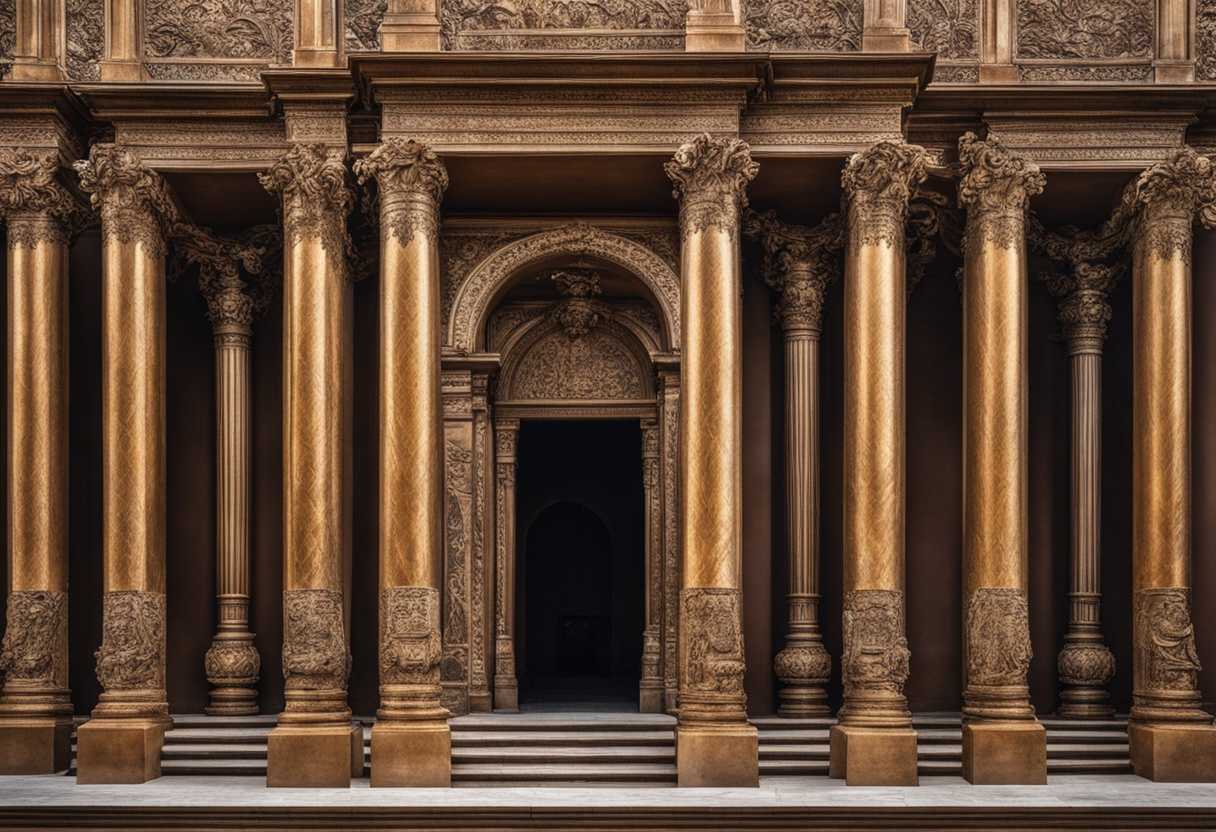
In 1 Kings 7:13-51, we find ourselves in the bustling city of Jerusalem during the reign of King Solomon. The scene is set in the grand courtyard of the newly constructed Temple, a magnificent structure that took seven years to build. The courtyard is adorned with intricately designed bronze pillars, a massive bronze sea supported by twelve oxen, and various other bronze furnishings crafted by the skilled artisan, Hiram.
King Solomon, known for his wisdom and wealth, is present, overseeing the dedication of the Temple. He is surrounded by his officials, priests, and a large gathering of Israelites who have come to witness this momentous occasion. The air is filled with the sound of prayers, music, and the clanging of bronze as the offerings are being presented to the Lord.
As the ceremony progresses, the people marvel at the splendor of the Temple and the craftsmanship of the bronze furnishings. The dedication is a symbol of the close relationship between God and His chosen people, a reminder of the covenant made with their ancestors. The scene is one of reverence, awe, and celebration as the Israelites come together to worship and honor their God in this magnificent place of worship.
What is 1 Kings 7:13-51 about?
This verse from the Bible provides a detailed description of the construction of Solomon’s temple, emphasizing the grandeur and magnificence of the sanctuary. The verse outlines the meticulous efforts put into every aspect of the temple’s construction, including the finely crafted decorations, furnishings, and materials used. It paints a picture of a place of worship that is rich in symbolism, beauty, and reverence. Reflect on this verse as you consider the significance of the temple as a holy place where people could gather to worship and connect with the divine. Think about the dedication and craftsmanship required to build such a grand structure and the attention to detail in creating a sacred space. Contemplate the spiritual and religious significance of Solomon’s temple and how it served as a central place for communal worship and religious rituals for the Israelites. What can we learn from the example of such meticulous attention to detail in our own lives and spiritual practices?
Understanding what 1 Kings 7:13-51 really means
The passage in 1 Kings 7:13-51 delves into the intricate details of Solomon’s Temple construction, with a particular focus on the skilled craftsmanship of Hiram, a craftsman from Tyre. Hiram’s expertise is highlighted as he is tasked with creating various bronze works for the temple, such as the two pillars, the Sea, stands, and other items essential for the sanctuary’s functionality and beauty.
One key theme that emerges from this passage is the emphasis on God-given talents and their utilization for His glory. The description of Hiram being “filled with wisdom, understanding, and skill” underscores the idea that our abilities are gifts from God, meant to be employed in service to Him and others. This notion prompts reflection on how we can leverage our own talents for the betterment of the community and the advancement of God’s kingdom.
The symbolism embedded in the construction of the temple elements also offers profound insights. The two pillars, Jachin and Boaz, represent stability and strength, serving as a reminder of the importance of a firm foundation in both personal and communal endeavors. Similarly, the Sea, a large basin for purification, symbolizes the need for spiritual cleanliness and the removal of impurities, echoing the concept of inner renewal and sanctification.
Drawing connections to related biblical passages, such as Exodus 31:1-6 and 1 Corinthians 12:4-11, further reinforces the idea of God equipping individuals with specific gifts and talents for His work. This continuity across scriptures underscores the universality of God’s call for His people to actively engage in His mission, each contributing their unique abilities for the common good.
In a contemporary context, the message of this passage remains relevant and impactful. It challenges us to consider how we can apply our skills and talents in service to others, transcending mere personal achievement to contribute meaningfully to something greater than ourselves. Just as Hiram’s craftsmanship brought beauty and functionality to the temple, our efforts, no matter how seemingly ordinary, can have a profound impact on those around us, fostering dignity, hope, and spiritual growth.
Ultimately, the narrative of Hiram’s craftsmanship serves as a poignant reminder of the transformative power of dedicating our abilities to God’s service. By aligning our talents with His purposes, we not only enrich our own lives but also play a vital role in advancing God’s kingdom and building up the community. This passage invites us to reflect on the significance of our contributions, urging us to strive for excellence and faithfulness in all that we do, for the glory of God.
How can we offer our best talents to God?
We can offer our best talents to God by using them in service to others and for His glory. We can dedicate our skills and talents to serving God and His people, just as the skilled craftsmen dedicated their abilities to building the temple in the verse. This can include using our gifts in roles within the church, volunteering in the community, or simply being a source of encouragement and support to those around us.
Additionally, we can offer our best talents to God by continually seeking to improve and develop them. We can strive to grow in our abilities and talents to offer the best of ourselves to God, just as the craftsmen in the verse honed their skills to create intricate and beautiful works for the temple. This may involve seeking out opportunities for growth and learning, practicing and refining our skills, and being open to feedback and guidance from others. We ultimately offer our best talents to God as an act of worship and a way to express our gratitude for the gifts He has given us. We can fulfill our purpose and contribute to His kingdom in a meaningful way by using our abilities to make a positive impact and bring glory to God.
Application
Just like King Solomon did not hold back in constructing a grand temple for God, let’s put our heart and soul into serving Him. Take a moment to think about how you can contribute your skills, time, and energy to make a difference in God’s kingdom. Let’s strive to build something beautiful for the divine just as we do for our careers and loved ones. Will you rise up to the challenge and give your all in honor of God today?

Reverend Michael Johnson is an experienced Church Minister with a profound expertise in spirituality and guidance. With a serene presence and a compassionate heart, he has faithfully served his congregation for over 20 years, leading them on a spiritual journey towards inner peace and enlightenment. Reverend Johnson’s extensive knowledge of religious philosophies and profound understanding of human nature have made him a trusted confidant and mentor to many, as he seamlessly weaves his profound wisdom into life teachings. Reverend Johnson’s calming demeanor and empathetic nature continue to uplift and heal souls, nurturing a sense of unity and tranquility within his community.