
2 Kings 18-19 is about the Assyrian siege of Jerusalem during King Hezekiah’s reign, highlighting themes of faith, divine intervention, and the power of prayer, as Hezekiah seeks God’s help in the face of overwhelming odds and is ultimately delivered from the threat of conquest.
1 In the third year of Hoshea son of Elah, king of Israel, Hezekiah the son of Ahaz, king of Judah, began to reign.
2 And he did what was right in the eyes of the Lord, according to all that David his father had done.
3 And he did what was right in the eyes of the Lord, according to all that David his father had done.
4 He removed the high places and broke the pillars and cut down the Asherah. And he broke in pieces the bronze serpent that Moses had made, for until those days the people of Israel had made offerings to it (it was called Nehushtan).
5 He trusted in the Lord, the God of Israel, so that there was none like him among all the kings of Judah after him, nor among those who were before him.
6 For he held fast to the Lord. He did not depart from following him, but kept the commandments that the Lord commanded Moses.
7 And the Lord was with him; wherever he went out, he prospered. He rebelled against the king of Assyria and would not serve him.
8 He struck down the Philistines as far as Gaza and its territory, from watchtower to fortified city.
9 In the fourth year of King Hezekiah, which was the seventh year of Hoshea son of Elah, king of Israel, Shalmaneser king of Assyria came up against Samaria and besieged it.
10 And at the end of three years they captured it.
11 The king of Assyria carried the Israelites away to Assyria and put them in Halah, and on the Habor, the river of Gozan, and in the cities of the Medes,
12 because they did not obey the voice of the Lord their God but transgressed his covenant, even all that Moses the servant of the Lord commanded. They neither listened nor obeyed.
13 In the fourteenth year of King Hezekiah, Sennacherib king of Assyria came up against all the fortified cities of Judah and took them.
14 And Hezekiah king of Judah sent to the king of Assyria at Lachish, saying, “I have done wrong; withdraw from me. Whatever you impose on me I will bear.” And the king of Assyria required of Hezekiah king of Judah three hundred talents of silver and thirty talents of gold.
15 And Hezekiah gave him all the silver that was found in the house of the Lord and in the treasuries of the king’s house.
16 At that time Hezekiah stripped the gold from the doors of the temple of the Lord and from the doorposts that he had overlaid and gave it to the king of Assyria.
17 And the king of Assyria sent the Tartan, the Rab-saris, and the Rabshakeh with a great army from Lachish to King Hezekiah at Jerusalem. And they went up and came to Jerusalem. When they arrived, they came and stood by the conduit of the upper pool, which is on the highway to the Washer’s Field.
18 And when they called for the king, there came out to them Eliakim the son of Hilkiah, who was over the household, and Shebnah the secretary, and Joah the son of Asaph, the recorder.
19 And the Rabshakeh said to them, “Say to Hezekiah, ‘Thus says the great king, the king of Assyria: On what do you rest this trust of yours?
20 You say (but they are but empty words), ‘I have counsel and strength for war.’ Now on whom do you rely, that you have rebelled against me?
21 Behold, you are trusting now in Egypt, that broken reed of a staff, which will pierce the hand of any man who leans on it. Such is Pharaoh king of Egypt to all who trust in him.
22 But if you say to me, “We trust in the Lord our God,” is it not he whose high places and altars Hezekiah has removed, saying to Judah and to Jerusalem, “You shall worship before this altar in Jerusalem”?
23 Come now, make a wager with my master the king of Assyria: I will give you two thousand horses, if you are able on your part to set riders on them.
24 How then can you repulse a single captain among the least of my master’s servants, when you trust in Egypt for chariots and for horsemen?
25 Am I now come up without the Lord against this place to destroy it? The Lord said to me, “Go up against this land and destroy it.”
26 Then Eliakim the son of Hilkiah, and Shebnah, and Joah, said to the Rabshakeh, “Please speak to your servants in Aramaic, for we understand it. Do not speak to us in the language of Judah within the hearing of the people who are on the wall.”
27 But the Rabshakeh said to them, “Has my master sent me to speak these words to your master and to you, and not to the men sitting on the wall, who are doomed with you to eat their own dung and drink their own urine?”
28 Then the Rabshakeh stood and called out in a loud voice in the language of Judah: “Hear the word of the great king, the king of Assyria!
29 Thus says the king: ‘Do not let Hezekiah deceive you, for he will not be able to deliver you out of my hand.
30 “Do not let Hezekiah make you trust in the Lord by saying, ‘The Lord will surely deliver us, and this city will not be given into the hand of the king of Assyria.’”
31 Do not listen to Hezekiah, for thus says the king of Assyria: ‘Make your peace with me and come out to me. Then each one of you will eat of his own vine, and each one of his own fig tree, and each one of you will drink the water of his own cistern,
32 until I come and take you away to a land like your own land, a land of grain and wine, a land of bread and vineyards, a land of olive trees and honey, that you may live, and not die. And do not listen to Hezekiah when he misleads you by saying, “The Lord will deliver us.”
33 Has any of the gods of the nations ever delivered his land out of the hand of the king of Assyria?
34 Where are the gods of Hamath and Arpad? Where are the gods of Sepharvaim, Hena, and Ivvah? Have they delivered Samaria out of my hand?
35 Who among all the gods of the lands have delivered their lands out of my hand, that the Lord should deliver Jerusalem out of my hand?’”
36 But the people were silent and answered him not a word, for the king’s command was, “Do not answer him.”
37 Then Eliakim the son of Hilkiah, who was over the household, and Shebna the secretary, and Joah the son of Asaph, the recorder, came to Hezekiah with their clothes torn, and told him the words of the Rabshakeh.
1 As soon as King Hezekiah heard it, he tore his clothes and covered himself with sackcloth and went into the house of the Lord.
2 And he sent Eliakim, who was over the household, and Shebna the secretary, and the senior priests, covered with sackcloth, to the prophet Isaiah the son of Amoz.
3 And they said to him, “Thus says Hezekiah, This day is a day of distress, of rebuke, and of disgrace; children have come to the point of birth, and there is no strength to bring them forth.
4 It may be that the Lord your God heard all the words of the Rabshakeh, whom his master the king of Assyria has sent to mock the living God, and will rebuke the words that the Lord your God has heard; therefore lift up your prayer for the remnant that is left.
5 When the servants of King Hezekiah came to Isaiah,
6 Isaiah said to them, “Thus shall you say to your master, ‘Thus says the Lord: Do not be afraid because of the words that you have heard, with which the young men of the king of Assyria have reviled me.
7 Behold, I will put a spirit in him, so that he shall hear a rumor and return to his own land, and I will make him fall by the sword in his own land.
8 Then the Rabshakeh returned, and found the king of Assyria fighting against Libnah, for he had heard that the king had left Lachish.
9 Now the king heard concerning Tirhakah king of Cush, “Behold, he has set out to fight against you.” So he sent messengers again to Hezekiah, saying,
10 “Thus shall you speak to Hezekiah king of Judah: ‘Do not let your God in whom you trust deceive you by promising that Jerusalem will not be given into the hand of the king of Assyria.
11 Behold, you have heard what the kings of Assyria have done to all lands, devoting them to destruction. And shall you be delivered?
12 have the gods of the nations delivered them, the nations that my fathers destroyed, Gozan, Haran, Rezeph, and the people of Eden who were in Telassar?
13 Where is the king of Hamath, the king of Arpad, the king of the city of Sepharvaim, the king of Hena, or the king of Ivvah?”
14 Hezekiah received the letter from the hand of the messengers and read it; and Hezekiah went up to the house of the Lord and spread it before the Lord.
15 And Hezekiah prayed before the Lord and said: “O Lord, the God of Israel, enthroned above the cherubim, you are the God, you alone, of all the kingdoms of the earth; you have made heaven and earth.
16 Incline your ear, O Lord, and hear; open your eyes, O Lord, and see; and hear the words of Sennacherib, which he has sent to mock the living God.
17Truly, O Lord, the kings of Assyria have laid waste the nations and their lands
18 and have cast their gods into the fire. For they were no gods, but the work of men’s hands, wood and stone. Therefore they were destroyed.
19 So now, O Lord our God, save us, please, from his hand, that all the kingdoms of the earth may know that you, O Lord, are God alone.”
20 Then Isaiah the son of Amoz sent to Hezekiah, saying, “Thus says the Lord, the God of Israel: Your prayer to me about Sennacherib king of Assyria I have heard.
21 This is the word that the Lord has spoken concerning him: “‘She despises you, she scorns you— the virgin daughter of Zion; she wags her head behind you— the daughter of Jerusalem.
22 Whom have you mocked and reviled?
Against whom have you raised your voice
and lifted your eyes to the heights?
Against the Holy One of Israel!
23 By your messengers you have mocked the Lord, and you have said, ‘With my many chariots I have gone up the heights of the mountains, to the far recesses of Lebanon; I felled its tallest cedars, its choicest cypresses; I entered its farthest lodging place, its most fruitful forest.
24 I dug wells and drank foreign waters, and I dried up with the sole of my foot all the streams of Egypt.
25 “Have you not heard
that I determined it long ago?
I planned from days of old
what now I bring to pass,
that you should make fortified cities
crash into heaps of ruins,
26 Therefore their inhabitants were of small power;
they were dismayed and confounded;
they were like the grass of the field
and like the green herb,
like the grass on the housetops
and like a field of grain
before it is grown.
27 “But I know your sitting down and your going out and coming in, and your raging against me.
28 Because your rage against me and your complacency has come up to my ears, I will put my hook in your nose and my bit in your mouth, and I will turn you back on the way by which you came.
29 “And this shall be the sign for you: this year you shall eat what grows of itself, and in the second year what springs from that. Then in the third year sow and reap, and plant vineyards, and eat their fruit.
30 And the surviving remnant of the house of Judah shall again take root downward and bear fruit upward.
31 For out of Jerusalem shall go a remnant, and out of Mount Zion a band of survivors. The zeal of the Lord will do this.
32 Therefore thus says the Lord concerning the king of Assyria: He shall not come into this city or shoot an arrow there, or come before it with a shield or cast up a siege mound against it.
33 By the way that he came, by the same he shall return, and he shall not come into this city, declares the Lord.
34 For I will defend this city to save it, for my own sake and for the sake of my servant David.
35 And that night the angel of the Lord went out and struck down 185,000 in the camp of the Assyrians. And when people arose early in the morning, behold, these were all dead bodies.
36 And Sennacherib the king of Assyria departed and went home and lived at Nineveh.
37 And as he was worshiping in the house of Nisroch his god, Adrammelech and Sharezer, his sons, struck him down with the sword. And after they escaped into the land of Ararat, Esarhaddon his son reigned in his place.
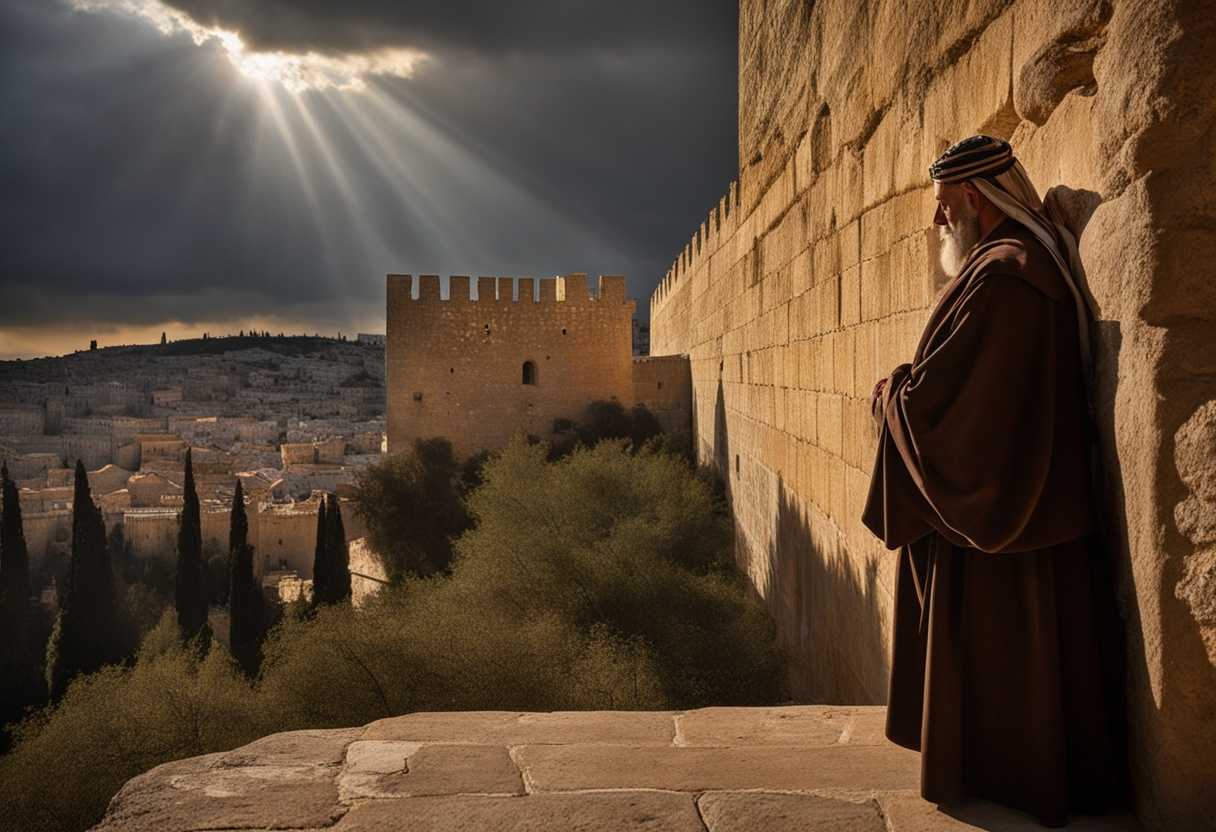
Setting the Scene for 2 Kings 18-19
In the ancient kingdom of Judah, the air was thick with tension and uncertainty as King Hezekiah faced a formidable threat from the Assyrian Empire. The sun hung low in the sky, casting long shadows over the city of Jerusalem, where the walls stood tall and fortified, a testament to the strength and resilience of its people. Hezekiah, a king known for his faithfulness to God and his reforms to restore true worship, found himself in a dire situation. The Assyrian king, Sennacherib, had unleashed a campaign of terror, conquering neighboring territories and now setting his sights on Jerusalem. The sound of distant war drums echoed ominously, a reminder of the impending siege that loomed over the city.
In the royal palace, Hezekiah gathered his advisors, including the prophet Isaiah, who had been a steadfast voice of guidance and prophecy during these tumultuous times. The atmosphere was charged with anxiety as the king laid out the dire news: Sennacherib had sent a letter, taunting the people of Judah and challenging their faith in God. The advisors exchanged worried glances, knowing that the fate of their city rested on the decisions made in this moment. Hezekiah, however, was resolute. He took the letter and spread it out before the Lord in the temple, seeking divine intervention. The flickering oil lamps cast a warm glow, illuminating the sacred space where prayers were offered, and the air was filled with the scent of incense, a symbol of the people’s cries rising to heaven.
Outside the palace, the city was alive with activity, but a palpable fear gripped the hearts of its inhabitants. Families huddled together, whispering prayers for deliverance, while soldiers patrolled the walls, their eyes scanning the horizon for signs of the enemy. The streets, usually bustling with merchants and children playing, felt eerily quiet as the threat of war loomed large. In this moment of crisis, the people of Jerusalem looked to their king and their God, hoping for a miracle that would save them from the impending doom. The scene was set for a dramatic confrontation between faith and fear, as the fate of Jerusalem hung in the balance, and the promise of divine deliverance awaited its moment to unfold.
What is 2 Kings 18-19 about?
The narrative of King Hezekiah gives us a vivid account of faith in action, especially during a time of crisis. Have you ever faced a situation that felt insurmountable, where the odds seemed overwhelmingly against you? King Hezekiah was a ruler who found himself confronted by the mighty Assyrian empire, a formidable adversary known for its ruthless conquests. Rather than succumbing to fear, Hezekiah turned to God, showcasing how faith can be a lifeline in tumultuous times. His actions prompt us to reflect on our own lives: do we, like Hezekiah, prioritize our relationship with God when faced with daunting challenges? Divine intervention serves as a powerful reminder of the miraculous deliverance of Jerusalem when we lean on faith. The narrative illustrates not just the power of God but also the role of human resolve to seek help from the divine. When the Assyrian king sent threats and mocked the God of Israel, Hezekiah responded with prayer and humility, laying out his fears before the Lord in the temple. Are we often as earnest in our prayers when faced with adversity? The subsequent divine response—God’s promise of protection—underscores a profound truth: our faithfulness can create a space for God’s miraculous work in our lives. How might this story inspire us to confront our own struggles with a similar faith and reliance on God? We recognize the triumph of faith over fear, and we see that we, too, can experience deliverance, whether in our personal battles or broader societal challenges.
Understanding what 2 Kings 18-19 really means
In 2 Kings 18-19, we find ourselves in a tumultuous period during the reign of King Hezekiah of Judah. This narrative unfolds against the backdrop of the Assyrian Empire’s looming threat, a time when fear and uncertainty gripped the hearts of the people. Hezekiah stands out as a beacon of faithfulness, committed to reforming worship practices and seeking God amidst the chaos. His story invites us to reflect on how we respond to our own adversities.
One of the key themes in this passage is faith in adversity. Hezekiah’s reaction to the Assyrian invasion is a profound example of unwavering trust in God. When faced with overwhelming odds, he does not resort to panic or despair. Instead, he turns to prayer, demonstrating that true strength lies in reliance on God. How often do we find ourselves in situations that seem insurmountable? Hezekiah’s example challenges us to consider where we place our trust when life becomes difficult.
The narrative also emphasizes divine deliverance. As Hezekiah prays, he acknowledges God’s sovereignty and pleads for His intervention. This act of humility and dependence on God leads to a miraculous outcome. The story reminds us that God is not only aware of our struggles but is also powerful enough to deliver us from them. Have you ever experienced a moment when you felt God’s presence in your life during a crisis? Such experiences can deepen our understanding of His faithfulness.
Related passages, such as Isaiah 37 and Psalm 46:1-3, further illuminate the themes found in 2 Kings. Isaiah provides additional context for Hezekiah’s prayer, while Psalm 46 reassures us that God is our refuge and strength. These scriptures collectively reinforce the idea that turning to God in prayer is essential, especially in times of trouble. Philippians 4:6-7 echoes this sentiment, encouraging believers to present their requests to God, promising peace in return. How can we incorporate this practice into our daily lives?
In today’s world, the relevance of Hezekiah’s story is striking. Many of us face personal crises—be it health issues, financial struggles, or relational conflicts. The assurance that God hears our prayers and acts on our behalf offers hope. I recall a member of our congregation who faced a dire health diagnosis. In the midst of fear, her family chose to gather for prayer, mirroring Hezekiah’s reliance on God. Their experience of finding peace through prayer illustrates the transformative power of faith in challenging times.
Meaningful phrases from this passage, such as “He trusted in the Lord” and “Hezekiah prayed,” encapsulate the essence of the narrative. Trusting in the Lord means placing our confidence in His sovereignty rather than our own understanding. It prompts us to evaluate where we place our trust in our lives. Additionally, the title “The God of Israel” emphasizes God’s intimate relationship with His people, reminding us that He is not a distant deity but a personal God involved in our lives. How does this understanding shape your relationship with God?
In conclusion, the narrative of 2 Kings 18-19 serves as a powerful testament to the importance of faith and prayer in adversity. It encourages us to trust in God’s promises and seek Him earnestly, knowing that He is our refuge and strength. As we navigate our own challenges, may we remember Hezekiah’s example and find comfort in the assurance that God is always with us, ready to listen and respond to our prayers. How might you apply these lessons in your own life today?
What does true faith in God look like today?
True faith in God today involves unwavering trust in His power and promises, especially in the face of overwhelming challenges. It means looking beyond immediate circumstances and believing that God is in control, even when situations appear dire. This faith is characterized by sincere prayer and reliance on God’s guidance, much like a person who seeks a deeper understanding of their relationship with the divine amid trials. Such faith acknowledges the reality of problems but chooses to focus on God’s capacity to deliver and protect. True faith manifests through acts of courage and resilience in adversity in contemporary life. It reflects a commitment to maintaining integrity and righteousness, even when the pressures of life seem insurmountable. Individuals with such faith often act as agents of hope, encouraging others to remain steadfast and to trust in God’s plan. They engage in community and support systems that uplift those around them, illustrating that faith is not just a personal journey but a collective strength that nurtures spirit and resolves. True faith today is active and demonstrative, reflecting a lifestyle that aligns with one’s beliefs. It involves consistent practice of one’s values, engaging in acts of kindness, compassion, and justice. This kind of faith is not passive; it encourages believers to stand firm against injustice, to advocate for those in need, and to live out their convictions boldly, showcasing their trust in a higher power that transcends their circumstances. Individuals who embody this faith not only deepen their own relationship with God but also inspire others to seek and experience His faithfulness.
Application
Think of King Hezekiah as a captain facing a stormy sea. When troubles hit, he didn’t panic; he prayed and found strength in faith. In your own life—whether at work, with family, or in personal struggles—where’s your anchor? Are you relying on quick fixes or truly trusting in something greater? Like Hezekiah, you have the power to turn towards that strength. Will you choose to seek it when the waves get high?

Reverend Michael Johnson is an experienced Church Minister with a profound expertise in spirituality and guidance. With a serene presence and a compassionate heart, he has faithfully served his congregation for over 20 years, leading them on a spiritual journey towards inner peace and enlightenment. Reverend Johnson’s extensive knowledge of religious philosophies and profound understanding of human nature have made him a trusted confidant and mentor to many, as he seamlessly weaves his profound wisdom into life teachings. Reverend Johnson’s calming demeanor and empathetic nature continue to uplift and heal souls, nurturing a sense of unity and tranquility within his community.