
Joshua 13-21 is about the division of land among the tribes of Israel after their conquest of Canaan, demonstrating God’s faithfulness in fulfilling His promises to His people.
1 Now Joshua was old and advanced in years, and the Lord said to him, “You are old and advanced in years, and there remains yet very much land to possess.
2 This is the land that yet remains: all the regions of the Philistines, and all those of the Geshurites
3 from the Shihor, which is east of Egypt, northward to the boundary of Ekron, it is counted as Canaanite; there are five rulers of the Philistines, those of Gaza, Ashdod, Ashkelon, Gath, and Ekron, and those of the Avvim,
4 From the Shihor, which is east of Egypt, northward to the boundary of Ekron, it is counted as Canaanite; there are five rulers of the Philistines, those of Gaza, Ashdod, Ashkelon, Gath, and Ekron, and those of the Avvim,
5 and the land of the Gebalites, and all Lebanon, toward the sunrise, from Baal-gad below Mount Hermon to Lebo-hamath,
6 all the inhabitants of the hill country from Lebanon to Misrephoth-maim, even all the Sidonians.
7 Now therefore divide this land for an inheritance to the nine tribes and half the tribe of Manasseh.”
8 With the other half of the tribe of Manasseh the Reubenites and the Gadites received their inheritance, which Moses gave them, beyond the Jordan eastward, as Moses the servant of the Lord gave them:
9 from Aroer, which is on the edge of the Valley of the Arnon, and the city that is in the middle of the valley, and all the tableland of Medeba;
10 and all the cities of Sihon king of the Amorites, who reigned in Heshbon, as far as the boundary of the Ammonites,
11 and Gilead, and the region of the Geshurites and Maacathites, and all Mount Hermon, and all Bashan to Salecah;
12 all the kingdom of Og in Bashan, who reigned in Ashtaroth and in Edrei (he alone was left of the remnant of the Rephaim); these Moses had struck and driven out.
13 Yet the people of Israel did not drive out the Geshurites or the Maacathites, but Geshur and Maacath dwell in the midst of Israel to this day.
14 Only to the tribe of Levi he gave no inheritance. The offerings by fire to the Lord God of Israel are their inheritance, as he said to him.
15 Moses gave an inheritance to the tribe of the people of Reuben according to their clans.
16 So their territory was from Aroer, which is on the edge of the Valley of the Arnon, and the city that is in the middle of the valley, and all the tableland by Medeba;
17 Heshbon, and all its cities that are in the tableland; Dibon, and Bamoth-baal, and Beth-baal-meon,
18 but to the tribe of Levi he gave no inheritance. The offerings by fire to the Lord God of Israel are their inheritance, as he said to him.
19 and Kiriathaim, and Sibmah, and Zereth-shahar on the hill of the valley,
20 and Beth-peor, and the slopes of Pisgah, and Beth-jeshimoth,
21 all the cities of the tableland and all the kingdom of Sihon king of the Amorites, who reigned in Heshbon, whom Moses defeated with the leaders of Midian, Evi and Rekem and Zur and Hur and Reba, the princes of Sihon, who lived in the land.
22 Balaam also, the son of Beor, the one who practiced divination, was killed with the sword by the people of Israel among the rest of their slain.
23 And the border of the people of Reuben was the Jordan as a boundary. This was the inheritance of the people of Reuben, according to their clans with their cities and villages.
24 Moses gave an inheritance also to the tribe of Gad, to the people of Gad, according to their clans.
25 Their territory was Jazer, and all the cities of Gilead, and half the land of the Ammonites, to Aroer, which is east of Rabbah,
26 and from Heshbon to Ramath-mizpeh and Betonim, and from Mahanaim to the territory of Debir,
27 and in the valley Beth-haram, Beth-nimrah, Succoth, and Zaphon, the rest of the kingdom of Sihon king of Heshbon, having the Jordan as a boundary, to the lower end of the Sea of Chinnereth, eastward beyond the Jordan.
28 This is the inheritance of the people of Gad according to their clans, with their cities and villages.
29 and Moses gave an inheritance to the half-tribe of Manasseh. It was allotted to the half-tribe of the people of Manasseh according to their clans.
30 With the other half of the tribe of Manasseh the Reubenites and the Gadites received their inheritance, which Moses gave them, beyond the Jordan eastward, as Moses the servant of the Lord gave them:
31 and in the half-tribe of Manasseh,
32 These are the inheritances that Moses distributed in the plains of Moab, beyond the Jordan east of Jericho.
33 But to the tribe of Levi Moses gave no inheritance; the Lord God of Israel is their inheritance, just as he said to them.
1 These are the inheritances that the people of Israel received in the land of Canaan, which Eleazar the priest and Joshua the son of Nun and the heads of the fathers’ houses of the tribes of the people of Israel gave them to inherit.
2 Their inheritance was by lot, just as the Lord had commanded by the hand of Moses for the nine and one-half tribes.
3 For Moses had given an inheritance to the two and one-half tribes beyond the Jordan, but to the Levites he gave no inheritance among them.
4 For the people of Joseph were two tribes, Manasseh and Ephraim. And no portion was given to the Levites in the land, but only cities to dwell in, with their pasturelands for their livestock and their substance.
5 As the Lord had commanded Moses, so the people of Israel did. And they divided the land.
6 Then the people of Judah came to Joshua at Gilgal. And Caleb the son of Jephunneh the Kenizzite said to him, “You know what the Lord said to Moses the man of God in Kadesh-barnea concerning you and me.
7 I was forty years old when Moses the servant of the Lord sent me from Kadesh-barnea to spy out the land, and I brought him word again as it was in my heart.
8 But my brothers who went up with me made the heart of the people melt; yet I wholly followed the Lord my God.
9 And Moses swore on that day, saying, ‘Surely the land on which your foot has trodden shall be an inheritance for you and your children forever, because you have wholly followed the Lord my God.’
10 And now, behold, the Lord has kept me alive, just as he said, these forty-five years since the time that the Lord spoke this word to Moses, while Israel walked in the wilderness. And now, behold, I am this day eighty-five years old.
11 I am still as strong today as I was in the day that Moses sent me; my strength now is as my strength was then, for war and for going and coming.
12 So now give me this hill country of which the Lord spoke on that day; for you heard on that day how the Anakim were there, with great fortified cities. It may be that the Lord will be with me, and I shall drive them out just as the Lord said.
13 Then Joshua blessed him, and he gave Hebron to Caleb the son of Jephunneh for an inheritance.
14 Therefore Hebron became the inheritance of Caleb the son of Jephunneh the Kenizzite to this day, because he wholly followed the Lord, the God of Israel.
15 Now the name of Hebron formerly was Kiriath-arba. (Arba was the greatest man among the Anakim.) And the land had rest from war.
1 The allotment for the tribe of the people of Judah according to their clans reached southward to the boundary of Edom, to the wilderness of Zin at the farthest south.
2 And their south boundary ran from the end of the Salt Sea, from the bay that faces southward.
3 Then it goes down westward to the territory of the Japhletites, as far as the territory of Lower Beth-horon, then to Gezer, and it ends at the sea.
4 From there it passes along to Azmon, and goes out by the Brook of Egypt, and the border ends at the sea.
5 And the east boundary is the Salt Sea, to the mouth of the Jordan. And the boundary on the north side runs from the bay of the sea at the mouth of the Jordan.
6 Then the boundary goes up to Beth-hoglah, and passes along north of Beth-arabah. And the boundary goes up to the stone of Bohan the son of Reuben.
7 And the boundary goes up to Debir from the Valley of Achor, and so northward, turning toward Gilgal, which is opposite the ascent of Adummim, which is on the south side of the valley. Then the boundary passes along to the waters of En-shemesh and ends at En-rogel.
8 Then the boundary goes up by the Valley of the Son of Hinnom at the southern shoulder of the Jebusite (that is, Jerusalem). And the boundary goes up to the top of the mountain that lies over against the Valley of Hinnom, on the west, at the northern end of the Valley of Rephaim.
9 Then the boundary extends from the top of the mountain to the spring of the waters of Nephtoah, and continues to the cities of Mount Ephron. And the boundary bends to Baalah (that is, Kiriath-jearim).
10 And the boundary circles west of Baalah to Mount Seir, passes along to the northern shoulder of Mount Jearim (that is, Chesalon), and goes down to Beth-shemesh and passes along by Timnah.
11 From the Negeb, it extended eastward to the entrance of Debir, and then continued to the waters of En-shemesh, and on to En-rogel.
12 The west boundary was the Great Sea with its coastline. This is the boundary around the people of Judah according to their clans.
13 According to the commandment of the Lord to Joshua, he gave to Caleb the son of Jephunneh a portion among the people of Judah, Kiriath-arba, that is, Hebron (Arba was the father of Anak).
14 And Caleb drove out from there the three sons of Anak: Sheshai, Ahiman, and Talmai, the descendants of Anak.
15 And he went up from there against the inhabitants of Debir. The name of Debir formerly was Kiriath-sepher.
16 And Caleb said, “Whoever strikes Kiriath-sepher and captures it, to him will I give Achsah my daughter as wife.”
17 And Othniel the son of Kenaz, the brother of Caleb, captured it. And he gave him Achsah his daughter as wife.
18 And when she came to him, she urged him to ask her father for a field. And she dismounted from her donkey, and Caleb said to her, “What do you want?”
19 She said to him, “Give me a blessing. Since you have given me the land of the Negeb, give me also springs of water.” And he gave her the upper springs and the lower springs.
20 This is the inheritance of the tribe of the people of Judah according to their clans.
21 Now the cities at the extremity of the tribe of the people of Judah toward the border of Edom in the Negeb were Kabzeel, Eder, Jagur,
22 And the cities belonging to the tribe of the people of Judah in the extreme south, toward the boundary of Edom, were Kabzeel, Eder, Jagur,
23 But Kiriath-arba (Arba was the father of Anak) the same is Hebron, in the hill country of Judah, along with its pasturelands around it.
24 Ashdod, its towns and its villages; Gaza, its towns and its villages; to the Brook of Egypt, and the Great Sea with its coastline.
25 Hazor-hadattah, Kerioth-hezron (that is, Hazor),
26 Amam, Shema, Moladah,
27 Hazar-gaddah, Heshmon, Beth-pelet,
28 Hazar-shual, Beersheba, Biziothiah,
29 Baalah, Iim, Ezem,
30 Eltolad, Chesil, Hormah,
31 In the wilderness, Beth-arabah, Middin, Secacah,
32 Lebaoth, Shilhim, Ain, and Rimmon: in all, twenty-nine cities with their villages.
33 In the lowland: Eshtaol, Zorah, Ashnah,
34 Eshtaol, Zorah, Ashnah;
35 Jarmuth, Adullam, Socoh, Azekah,
36 Shaaraim, Adithaim, Gederah, Gederothaim: fourteen cities with their villages.
32 Lebaoth, Shilhim, Ain, and Rimmon: in all, twenty-nine cities with their villages.
38 Dilean, Mizpeh, Joktheel,
12 Ain, Rimmon, Ether, and Ashan—four cities and their villages.
40 And Shaaraim, Adithaim, Gederah, Gederothaim: fourteen cities with their villages.
41 Gederoth, Beth-dagon, Naamah, and Makkedah—sixteen cities with their villages.
42 Libnah, Ether, Ashan,
43 And Shaaraim, Adithaim, Gederah, Gederothaim: fourteen cities with their villages.
44 Keilah, Achzib, and Mareshah: nine cities with their villages.
45 Ekron, with its towns and its villages;
46 from Ekron to the sea, all that were by the side of Ashdod, with their villages.
47 Ashdod, its towns and its villages; Gaza, its towns and its villages; to the Brook of Egypt, and the Great Sea with its coastline.
48 And in the hill country, Shamir, Jattir, Socoh,
59 Maarath, Beth-anoth, and Eltekon, six cities with their villages;
60 Kiriath-baal (that is, Kiriath-jearim), and Rabbah: two cities with their villages.
51 Goshen, Holon, and Giloh: eleven cities with their villages.
52 Arab, Dumah, Eshan,
53 Janim, Beth-tappuah, Aphekah,
54 Humtah, Kiriath-arba (that is, Hebron), and Zior: nine cities with their villages.
55 Maon, Carmel, Ziph, Juttah,
56 Jezreel, Jokdeam, Zanoah
57 Kain, Gibeah, and Timnah: ten cities with their villages.
58 Halhul, Beth-zur, Gedor,
59 Maarath, Bethanoth, and Eltekon, six cities with their villages;
60 Kiriath-baal (that is, Kiriath-jearim), and Rabbah: two cities with their villages.
61 In the wilderness, Beth-arabah, Middin, Secacah,
62 Nibshan, the City of Salt, and Engedi: six cities with their villages.
63 But the Jebusites, the inhabitants of Jerusalem, the people of Judah could not drive out, so the Jebusites dwell with the people of Judah at Jerusalem to this day.
1 The allotment of the people of Joseph went from the Jordan by Jericho, east of the waters of Jericho, into the wilderness, going up from Jericho into the hill country to Bethel.
2 Then it goes down westward to the territory of the Japhletites, as far as the territory of Lower Beth-horon, then to Gezer, and it ends at the sea.
3 Then it goes down westward to the territory of the Japhletites, as far as the territory of Lower Beth-horon, then to Gezer, and it ends at the sea.
4 So the people of Joseph, Manasseh and Ephraim, received their inheritance.
5 The territory of the people of Ephraim by their clans was as follows: the boundary of their inheritance on the east was Ataroth-addar as far as Upper Beth-horon,
6 Then the boundary goes westward to the sea, past Aznoth-tabor, and from there to Hukkok, touching Zebulun at the south and Asher on the west, and Judah on the east at the Jordan.
7 Then it went down from Janoah to Ataroth and to Naarah, and touched Jericho, ending at the Jordan.
8 The border went down to the brook Kanah, south of the brook. These cities, to the south of the brook, among the cities of Manasseh, belong to Ephraim. Then the boundary of Manasseh goes on the north side of the brook and ends at the sea,
9 Then the boundary goes down to the brook Kanah. These cities to the south of the brook among the cities of Manasseh are the lot of Ephraim, and all the cities with their villages.
10 However, they did not drive out the Canaanites who lived in Gezer, so the Canaanites have lived in the midst of Ephraim to this day but have been made to do forced labor.
1 Then allotment was made to the people of Manasseh, for he was the firstborn of Joseph. To Machir the firstborn of Manasseh, the father of Gilead, were allotted Gilead and Bashan, because he was a man of war.
2 allotment was for the rest of the people of Manasseh by their clans, for the people of Abiezer, Helek, Asriel, Shechem, Hepher, and Shemida. These were the male descendants of Manasseh the son of Joseph, by their clans.
3 Now Zelophehad the son of Hepher, son of Gilead, son of Machir, son of Manasseh, had no sons, but only daughters, and these are the names of his daughters: Mahlah, Noah, Hoglah, Milcah, and Tirzah.
4 They approached Eleazar the priest and Joshua the son of Nun and the leaders and said, “The Lord commanded Moses to give us an inheritance along with our brothers.” So according to the mouth of the Lord he gave them an inheritance among the brothers of their father.
5 Thus there fell to Manasseh ten portions, besides the land of Gilead and Bashan, which is on the other side of the Jordan,
6 because the daughters of Manasseh received an inheritance along with his sons. The land of Gilead was allotted to the rest of the people of Manasseh.
7 The territory of Manasseh reached from Asher to Michmethath, which is east of Shechem. Then the boundary goes along southward to the inhabitants of En-tappuah.
8 The land of Tappuah belonged to Manasseh, but the town of Tappuah on the boundary of Manasseh belonged to the people of Ephraim.
9 Then the boundary goes down to the brook Kanah. These cities to the south of the brook among the cities of Manasseh are the portion of Manasseh’s sons, and the boundary of Manasseh is on the north side of the brook and ends at the sea.
10 However, they did not drive out the Canaanites who lived in Gezer, so the Canaanites have lived in the midst of Ephraim to this day but have been made to do forced labor.
11 In Issachar and in Asher, Manasseh had Beth-shean and its villages, and Ibleam and its villages, and the inhabitants of Dor and its villages, and the inhabitants of En-dor and its villages, and the inhabitants of Taanach and its villages, and the inhabitants of Megiddo and its villages; the third is Naphath.
12 Yet the people of Manasseh could not take possession of those cities, but the Canaanites persisted in dwelling in that land.
13 Yet it did not drive out the people of Geshur and the people of Maacah, so the Geshurites and the Maacathites dwell among the Israelites to this day.
14 Then the people of Joseph spoke to Joshua, saying, “Why have you given me but one lot and one portion as an inheritance, although I am a numerous people, since all along the Lord has blessed me?”
15 And Joshua said to them, “If you are a numerous people, go up by yourselves to the forest, and there clear ground for yourselves in the land of the Perizzites and the Rephaim, since the hill country of Ephraim is too narrow for you.”
16 Then the people of Joseph said, “The hill country is not enough for us. Yet all the Canaanites who dwell in the plain have chariots of iron, both those in Beth-shean and its villages and those in the Valley of Jezreel.”
17 Then Joshua said to the house of Joseph, to Ephraim and Manasseh, “You are a numerous people and have great power. You shall not have one allotment only,
18 but the hill country shall be yours, for though it is a forest, you shall clear it and possess it to its farthest borders. For you shall drive out the Canaanites, though they have chariots of iron, and though they are strong.”
1 Then the whole congregation of the people of Israel assembled at Shiloh and set up the tent of meeting there. The land lay subdued before them.
2 There remained among the people of Israel seven tribes whose inheritance had not yet been apportioned.
3 So Joshua said to the people of Israel, “How long will you put off going in to take possession of the land, which the Lord, the God of your fathers, has given you?
4 Appoint three men from each tribe, and I will send them out that they may set out and go up and down the land. They shall write a description of it with a view to their inheritances, and then come to me.
5 And they shall divide it into seven portions. Judah shall continue in his territory on the south, and the house of Joseph shall continue in their territory on the north.
6 You shall describe the land in seven divisions and bring the description here to me. And I will cast lots for you here before the Lord our God.
7 The Levites have no portion among you, for the priesthood of the Lord is their heritage. And Gad and Reuben and half the tribe of Manasseh have received their inheritance beyond the Jordan eastward, which Moses the servant of the Lord gave them.”
8 So the men arose and went, and Joshua charged those who went to write the description of the land, saying, “Go up and down in the land and write a description and return to me. And I will cast lots for you here before the Lord in Shiloh.”
9 The men went and passed up and down in the land and set in writing a description of it in seven divisions. Then they came to Joshua to the camp at Shiloh.
10 Joshua cast lots for them in Shiloh before the Lord. So there Joshua apportioned the land to the people of Israel, to each his portion.
11 Then the lot of the tribe of the people of Benjamin according to its clans came up, and the territory allotted to it fell between the people of Judah and the people of Joseph.
12 Then their boundary goes along on the western side southward, from the Great Sea.
13 The boundary goes down to the edge of the mountain that overlooks the Valley of the Son of Hinnom, which is at the north end of the Valley of Rephaim. And it then goes down the Valley of Hinnom, south of the shoulder of the Jebusites, and downward to En-rogel.
14 Then the boundary goes in another direction, turning on the western side southward from the mountain that lies to the south, opposite Beth-horon, and it ends at Kiriath-baal (that is, Kiriath-jearim), a city of the people of Judah. This forms the western side.
15 And the south side was from the edge of Kiriath-jearim. And the boundary goes on westward to the spring of the waters of Nephtoah.
16 Then the boundary goes down to the border of the mountain that overlooks the Valley of the Son of Hinnom, which is at the north end of the Valley of Rephaim. And it then goes down the Valley of Hinnom, south of the shoulder of the Jebusites, and downward to En-rogel.
17 Then it goes down westward to the territory of the Japhletites, as far as the territory of Lower Beth-horon, then to Gezer, and it ends at the sea.
18 Then the boundary goes down to the border of the mountain that overlooks the Valley of the Son of Hinnom, which is at the north end of the Valley of Rephaim. And it then goes down the Valley of Hinnom, south of the shoulder of the Jebusites, and downward to En-rogel.
19 The boundary passes on to the north of the shoulder of Beth-hoglah. Then the boundary ends at the northern bay of the Salt Sea, at the south end of the Jordan: this is the southern border.
20 The Jordan forms its boundary on the eastern side. This is the inheritance of the people of Benjamin, according to their clans, boundary by boundary all around.
21 Now the cities of the tribe of the people of Benjamin according to their clans were Jericho, Beth-hoglah, Emek-keziz,
22 Beth-arabah, Zemaraim, Bethel,
23 Avvim, Parah, Ophrah,
24 Chephar-ammoni, Ophni, and Geba: twelve cities with their villages.
25 Gibeon, Ramah, Beeroth,
26 In Mizpeh, Chephar-haammoni, Ophni,
27 Rekem, Irpeel, Taralah,
28 Zela, Haeleph, Jebus (that is, Jerusalem), Gibeah and Kiriath-jearim—fourteen cities with their villages.
1 The second lot came out for Simeon, for the tribe of the people of Simeon, according to their clans. And their inheritance was in the midst of the inheritance of the people of Judah.
2 And they had in their inheritance Beersheba, Sheba, Moladah,
3 Then it goes down westward to the territory of the Japhletites, as far as the territory of Lower Beth-horon, then to Gezer, and it ends at the sea.
4 Elath, Esion Geber,
5 Zebulun, Asher, and Naphtali
6 Beth-lebaoth, and Sharuhen—thirteen cities with their villages.
7 Ain, Remmon, Ether, and Ashan—four cities with their villages—
8 The inheritance of the people of Israel passed beyond the Jordan to the east of Jericho, in the direction of the sunrise.
9 The inheritance of the people of Simeon formed part of the territory of the people of Judah. Because the portion of the people of Judah was too large for them, the people of Simeon obtained an inheritance in the midst of their inheritance.
10 The third lot came up for the people of Zebulun, according to their clans. And the territory of their inheritance reached as far as Sarid.
11 Then their boundary goes up westward and on to Mareal and touches Dabbesheth, then the brook that is east of Jokneam.
12 Yet their boundary on the north side was from the Jordan.
13 And from there it passes along on the east toward the sunrise to Gath-hepher, to Eth-kazin, and goes to Rimmon, stretching to Neah.
14 Then the boundary turns it on the north to Hannathon, and it ends at the Valley of Iphtahel;
15 Included also were Kattath, Nahalal, Shimron, Idalah, and Bethlehem: twelve cities with their villages.
16 This is the inheritance of the tribe of the people of Zebulun according to their clans—these cities with their villages.
17 The fourth lot came out for Issachar, for the people of Issachar, according to their clans.
18 Their territory included Jezreel, Chesulloth, Shunem,
19 The second lot came out for Simeon, for the tribe of the people of Simeon, according to their clans. And their inheritance was in the midst of the inheritance of the people of Judah.
20 This is the inheritance of the tribe of the people of Judah according to their clans.
21 This is the inheritance of the tribe of the people of Benjamin according to its clans, boundary by boundary all around.
22 The boundary also touches Tabor, Shahazumah, and Beth-shemesh, and its boundary ends at the Jordan—sixteen cities with their villages.
23 This is the inheritance of the tribe of the people of Issachar according to their clans—the cities with their villages.
24 The fifth lot came out for the tribe of Asher according to its clans.
25 Their boundary was Helkath, Hali, Beten, Achshaph,
26 Allammelech, Amad, and Mishal. On the west it touches Carmel and Shihor-libnath,
27 And it turned westward to Aznoth-tabor and went from there to Hukkok, touching Zebulun at the south and Asher on the west and Judah on the east at the Jordan.
28 Ebron, Rehob, Hammon, Kanah, as far as Sidon the Great.
29 And then the boundary turns to Ramah, reaching to the fortified city of Tyre. Then the boundary turns to Hosah, and it ends at the sea; Mahalab, Achzib,
30 Ummah also, and Aphek and Rehob—twenty-two cities with their villages.
31 This is the inheritance of the tribe of the people of Asher according to their clans—these cities with their villages.
32 The sixth lot came out for the people of Naphtali, for the people of Naphtali, according to their clans.
33 Their boundary was from Heleph, from the oak in Zaanannim, and Adami-nekeb, and Jabneel, as far as Lakkum, and it ended at the Jordan.
34 Then the boundary turns westward to Aznoth-tabor and goes from there to Hukkok, touching Zebulun at the south and Asher on the west and Judah on the east at the Jordan.
35 The fortified cities are Ziddim, Zer, Hammath, Rakkath, Chinnereth
36 Adamah, Ramah, Hazor,
37 Kedesh, Edrei, En-hazor,
38 This is the inheritance of the tribe of the people of Dan, according to their clans, these cities with their villages.
39 This is the inheritance of the tribe of the people of Naphtali, according to their clans—the cities with their villages.
40 The seventh lot came out for the tribe of the people of Dan, according to their clans.
41 The territory of their inheritance included Zorah, Eshtaol, Ir-shemesh,
42 Shaalabbin, Aijalon, Ithlah,
43 When the boundary of the people of Dan was lost to them, the people of Dan went up and fought against Leshem, and after capturing it and striking it with the sword they took possession of it and settled in it, calling Leshem, Dan, after the name of Dan their ancestor.
44 This is the inheritance of the tribe of the people of Asher according to their clans—these cities with their villages.
45 When they had finished distributing the several territories of the land as inheritances, the people of Israel gave an inheritance among them to Joshua the son of Nun.
46 Me-jarkon and Rakkon with the territory over against Joppa.
47 When the territory of the people of Dan was lost to them, the people of Dan went up and fought against Leshem, and after capturing it and striking it with the sword they took possession of it and settled in it, calling Leshem, Dan, after the name of Dan their ancestor.
48 This is the inheritance of the tribe of the people of Dan, according to their clans, these cities with their villages.
49 When they had finished distributing the several territories of the land as inheritances, the people of Israel gave an inheritance among them to Joshua the son of Nun.
50 According to the commandment of the Lord they gave him the city that he asked, Timnath-serah in the hill country of Ephraim. And he rebuilt the city and settled in it.
51 These are the inheritances that Eleazar the priest and Joshua the son of Nun and the heads of the fathers’ houses of the tribes of the people of Israel distributed by lot at Shiloh before the Lord, at the entrance of the tent of meeting. So they finished dividing the land.
1 Then the Lord said to Joshua,
2 “Say to the people of Israel, ‘Appoint the cities of refuge, of which I spoke to you through Moses,
3 that the manslayer who strikes any person without intent or unknowingly may flee there. They shall be for you a refuge from the avenger of blood.
4 He shall flee to one of these cities and shall stand at the entrance of the gate of the city and explain his case to the elders of that city. Then they shall take him into the city and give him a place, and he shall remain with them.
5 And if the avenger of blood pursues him, they shall not give up the manslayer into his hand, because he struck his neighbor unknowingly, and did not hate him in the past.
6 And he shall remain in that city until he has stood before the congregation for judgment, until the death of him who is high priest at the time. Then the manslayer may return to his own town and his own home, to the town from which he fled.
7 So they set apart Kedesh in Galilee in the hill country of Naphtali, and Shechem in the hill country of Ephraim, and Kiriath-arba (that is, Hebron) in the hill country of Judah.
8 And beyond the Jordan east of Jericho, they appointed Bezer in the wilderness on the tableland, from the tribe of Reuben, and Ramoth in Gilead, from the tribe of Gad, and Golan in Bashan, from the tribe of Manasseh.
9 These were the cities designated for all the people of Israel and for the stranger sojourning among them, that anyone who killed a person without intent could flee there, so that he might not die by the hand of the avenger of blood, till he stood before the congregation.
1 Then the heads of the fathers’ houses of the Levites came to Eleazar the priest and to Joshua the son of Nun and to the heads of the fathers’ houses of the tribes of the people of Israel.
2 And they said to them at Shiloh in the land of Canaan, “The Lord commanded through Moses to give us cities to dwell in, along with their pasturelands for our livestock.”
3 So by command of the Lord the people of Israel gave to the Levites the following cities and pasturelands out of their inheritance.
4 And the lot came out for the clans of the Kohathites. So those Levites who were descendants of Aaron the priest received by lot from the tribes of Judah, Simeon, and Benjamin, thirteen cities.
5 And the rest of the Kohathites received by lot from the clans of the tribe of Ephraim, from the tribe of Dan and the half-tribe of Manasseh, ten cities.
6 And the rest of the Kohathites received by lot from the clans of the tribe of Ephraim, from the tribe of Dan and the half-tribe of Manasseh, ten cities.
7 The sons of Merari according to their clans received twelve cities as their inheritance.
8 And the people of Israel gave by lot to the Levites these cities and their pasturelands, as the Lord had commanded through Moses.
9 And they gave out from the tribe of the people of Judah and the tribe of the people of Simeon these cities mentioned by name,
10 which the people of Aaron, of the clans of the Kohathites who were of the people of Levi, had, for the lot fell to them.
11 They gave them Kiriath-arba (Arba being the father of Anak), that is Hebron, in the hill country of Judah, along with the pasturelands around it.
12 But the fields of the city and its villages had been given to Caleb the son of Jephunneh as his possession.
13 And to the descendants of Aaron the priest they gave Hebron, the city of refuge for the manslayer, with its pasturelands, Libnah with its pasturelands,
14 And Jattir with its pasturelands, Eshtemoa with its pasturelands,
15 And the cities of the Levites in the midst of the possession of the people of Israel were in all forty-eight cities with their pasturelands.
16 Ain with its pasturelands, Juttah with its pasturelands, Eshtemoa with its pasturelands,
17 Then out of the tribe of Benjamin, Gibeon with its pasturelands, Geba with its pasturelands,
18 Anathoth with its pasturelands, and Almon with its pasturelands—four cities.
19 All the cities of the Levites within the possession of the people of Israel were forty-eight in all, with their pasturelands.
20 and out of the tribe of the people of Ephraim, Kibzaim with its pasturelands, the city of refuge for the manslayer, Mahanaim with its pasturelands,
21 Then they gave Hebron to the descendants of Aaron the priest as a city of refuge for the manslayer, Libnah with its pasturelands,
22 And Kibzaim with its pasturelands, Beth-horon with its pasturelands, four cities.
23 Out of the tribe of Dan, Eltekeh with its pasturelands, Gibbethon with its pasturelands,
24 And the leaders of the Levites were Hashabiah the son of Ammihud, Sherebiah the son of Bunni,
25 And from the half-tribe of Manasseh, Taanach with its pasturelands, and Gath-rimmon with its pasturelands—two cities.
26 All that the Levites left in return for their cities was their common land, as the possession of their cities.
27 And to the Gershonites, one of the clans of the Levites, were given out of the half-tribe of Manasseh, Golan in Bashan with its pasturelands, the city of refuge for the manslayer, and Beeshterah with its pasturelands—two cities.
28 And out of the tribe of Issachar, Kishion with its pasturelands, Daberath with its pasturelands,
29 Jarmuth with its pasturelands, En-gannim with its pasturelands, and Beth-horon with its pasturelands.
30 And out of the half-tribe of Manasseh, Aner with its pasturelands, and Bileam with its pasturelands, for the rest of the clans of the Kohathites.
31 These were the cities designated for all the people of the people of Israel and for the stranger sojourning among them, that anyone who killed a person without intent could flee there, so that he might not die by the hand of the avenger of blood, till he stood before the congregation.
32 And out of the tribe of Naphtali, Kedesh in Galilee with its pasturelands, the city of refuge for the manslayer, Hammoth-dor with its pasturelands, and Kartan with its pasturelands.
33 All the cities of the Gershonites according to their clans were thirteen cities with their pasturelands.
34 And to the rest of the Levites, the Merarite clans were given out of the tribe of Zebulun, Jokneam with its pasturelands, Kartah with its pasturelands,
35 Jarmuth with its pasturelands, En-gannim with its pasturelands,
36 All these were cities with their pasturelands.
37 Kedemoth with its pasturelands, and Mephaath with its pasturelands—four cities.
38 And out of the tribe of Gad, Ramoth in Gilead with its pasturelands, the city of refuge for the manslayer, Mahanaim with its pasturelands,
39 Heshbon with its pasturelands, Jazer with its pasturelands—four cities in all.
40 All these cities with their pasturelands totaled forty-eight cities.
41 All the cities of the Levites within the possession of the people of Israel were forty-eight in all, with their pasturelands.
42 These cities each had its surrounding pasturelands. So it was with all these cities.
43 Thus the Lord gave to Israel all the land that he swore to give to their fathers. And they took possession of it, and they settled there.
44 And the Lord gave them rest on every side just as he had sworn to their fathers. Not one of all their enemies had withstood them, for the Lord had given all their enemies into their hands.
45 Not one word of all the good promises that the Lord had made to the house of Israel had failed; all came to pass.
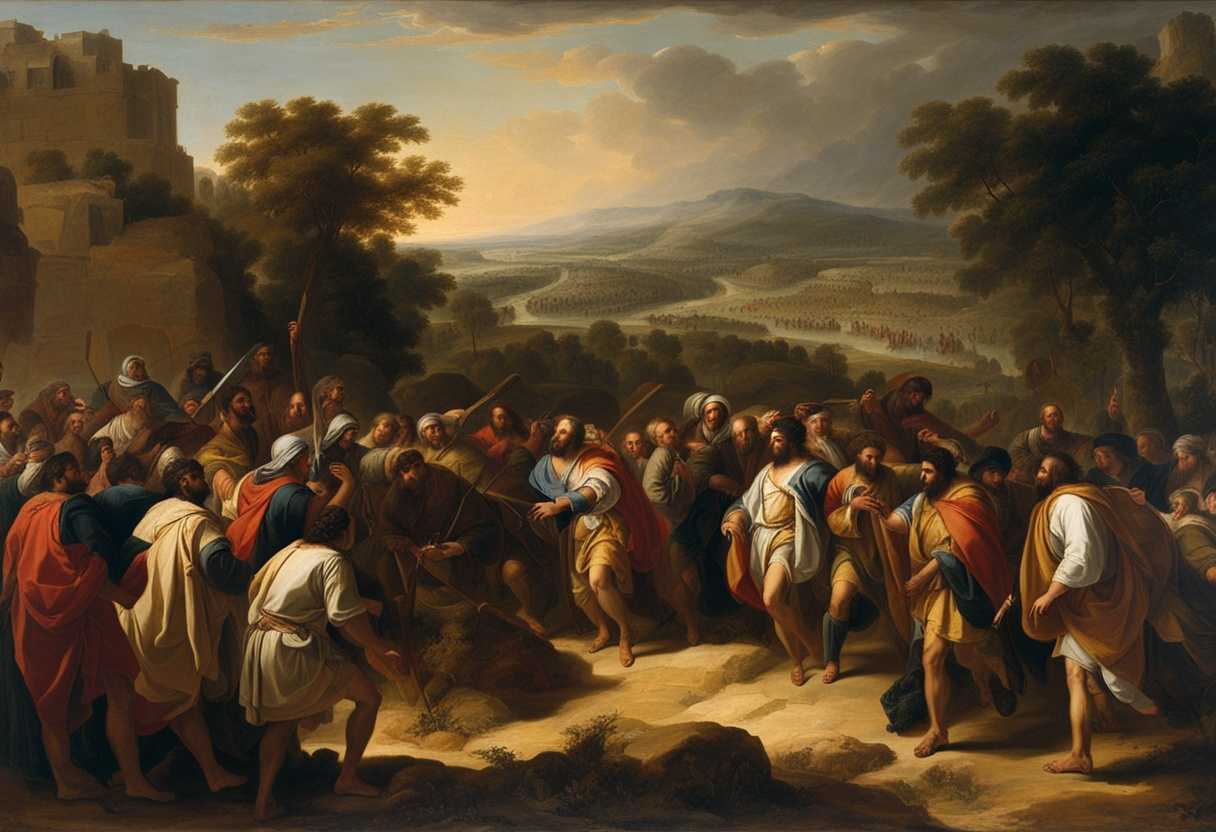
Setting the Scene for Joshua 13-21
In the book of Joshua chapters 13-21, we find the Israelites preparing to divide the Promised Land among the twelve tribes of Israel. The scene is set in the plains of Moab, just after the Israelites have crossed the Jordan River and conquered Jericho and Ai. Joshua, the leader appointed by God to succeed Moses, is leading the people in the distribution of the land.
The twelve tribes of Israel are represented in this scene, with leaders from each tribe present to receive their inheritance. Names such as Judah, Ephraim, Manasseh, Benjamin, and the other tribes are mentioned as they gather to receive their portion of the land. The surroundings are described as fertile plains, rolling hills, and lush valleys, a stark contrast to the wilderness they had wandered in for forty years.
As Joshua allocates the land to each tribe according to the instructions given by God, there is a sense of anticipation and gratitude among the people. The scene is filled with a mixture of emotions – excitement for the new beginnings in their own land, nostalgia for the journey they have been on, and a deep sense of fulfillment as they witness the promises of God being fulfilled before their eyes.
What is Joshua 13-21 about?
This verse encapsulates a pivotal moment in Israel’s history. With Joshua’s leadership, the land of Canaan is divided among the twelve tribes of Israel. This act symbolizes the fulfillment of God’s promise to the Israelites, as they finally possess the land He had promised them. Through Joshua’s actions, we witness the meticulous organization and equitable distribution of territory among the tribes, ensuring each has its rightful inheritance. This division of land not only solidifies the physical boundaries of the tribes but also emphasizes a sense of unity and shared destiny among the people of Israel. Consider the significance of this act of division. How does the allocation of land reflect God’s faithfulness and provision to His people? What does this moment signify in terms of the Israelites’ identity and their relationship with God? Through studying this verse, we can gain insight into the importance of stewardship, unity, and the fulfillment of divine promises. Joshua’s role as a wise and just leader is highlighted here, showcasing the importance of leadership in guiding a community towards their collective destiny.
Understanding what Joshua 13-21 really means
In the Book of Joshua, chapters 13-21 provide a detailed account of the division of the Promised Land among the tribes of Israel, showcasing God’s unwavering faithfulness in fulfilling His promises to His people. The phrase “the land that remains” resonates as a poignant reminder that even after significant victories, there is still work to be done in the journey of faith. It underscores the continuous nature of our walk with God, urging us to press on despite past achievements.
Central to these chapters is the concept of “inheritance,” symbolizing not only the physical land allocated to each tribe but also God’s provision and fulfillment of His covenant promises. Just as the Israelites received their allotted portions, believers today have an inheritance in Christ, as Ephesians 1:11 affirms. This inheritance extends beyond material possessions to encompass spiritual blessings and the assurance of God’s faithfulness throughout generations.
The phrase “according to their divisions” highlights the meticulous and purposeful distribution of the land among the tribes, reflecting God’s divine order and sovereignty. It serves as a testament to the structured nature of God’s plans for His people, emphasizing that His purposes are intricately woven into every aspect of our lives. Just as each tribe had a designated portion, God has a unique plan for each individual, guiding them towards their ordained destiny.
Drawing parallels to contemporary life, the narrative in Joshua 13-21 underscores the enduring faithfulness of God in fulfilling His promises. Just as He remained steadfast to the Israelites, He continues to uphold His word to us today, assuring us of His unchanging character and reliability. The passage serves as a poignant reminder that our journey with God is marked by His faithfulness, guiding us towards the realization of His promises in our lives.
An illustrative anecdote can further illuminate the significance of these chapters: envision a family awaiting the fulfillment of a promise—a beautiful home. Upon receiving the keys, they realize that there is still work to be done in making the house a home. Similarly, the Israelites received the land but had to cultivate and settle it. This narrative underscores that receiving God’s promises often entails ongoing effort, faithfulness, and participation in His divine plan.
In delving deeper into the phrases and themes within Joshua 13-21, we glean insights into God’s faithfulness, the richness of our spiritual inheritance in Christ, and the meticulous order of His plans for our lives. Through reflection on these chapters, we are encouraged to embrace the continuous journey of faith, trust in God’s provision, and align ourselves with His purposeful design for our individual paths.
How can we ensure we are living in God’s promises?
We can ensure we are living in God’s promises by staying faithful and obedient to Him. This means following His commandments and trusting in His plan for our lives. When we walk in obedience and seek His guidance through prayer and studying His Word, we position ourselves to receive the blessings and promises that He has for us. God is faithful to His promises, and as we remain steadfast in our faith, we can be confident that He will fulfill His word in our lives.
Living in God’s promises also involves having faith and patience. Sometimes we may not see the fulfillment of His promises right away, but we must trust in His perfect timing. It is important to continue to believe in His faithfulness and remain hopeful even when circumstances may seem challenging. We can experience His supernatural provision and guidance in our lives by consistently seeking Him and trusting in His promises.
Additionally, living in God’s promises requires us to have a heart of gratitude and praise. We create an atmosphere of thankfulness that opens the door for more blessings to flow as we acknowledge His goodness and faithfulness in our lives. We can live in the fullness of His promises and experience His abundant grace and favor by focusing on the promises of God and expressing gratitude for what He has done.
Application
Embrace the treasures that God has specifically designed for you in this fast-paced world of opportunities. You are tasked with seizing the promises that have been set aside just for you. It’s time to move beyond just recognizing these gifts; instead, take bold strides towards making them a reality in your life and the lives of those around you. Are you willing to take charge of your divine inheritance and march confidently towards the destined path that awaits you?

Reverend Michael Johnson is an experienced Church Minister with a profound expertise in spirituality and guidance. With a serene presence and a compassionate heart, he has faithfully served his congregation for over 20 years, leading them on a spiritual journey towards inner peace and enlightenment. Reverend Johnson’s extensive knowledge of religious philosophies and profound understanding of human nature have made him a trusted confidant and mentor to many, as he seamlessly weaves his profound wisdom into life teachings. Reverend Johnson’s calming demeanor and empathetic nature continue to uplift and heal souls, nurturing a sense of unity and tranquility within his community.