
2 Kings 22-25 is about the discovery of the Book of the Law during King Josiah’s reign, the subsequent religious reforms he implements in Judah, the tragic decline and destruction of Jerusalem and the temple due to the people’s unfaithfulness, and the eventual exile of the Israelites to Babylon, illustrating the consequences of disobedience to God’s covenant.
1 Josiah was eight years old when he began to reign, and he reigned thirty-one years in Jerusalem. His mother’s name was Jedidah the daughter of Adaiah of Bozkath.
2 And he did what was right in the eyes of the Lord and walked in all the way of David his father, and he did not turn aside to the right or to the left.
3 And in the eighteenth year of King Josiah, the king sent Shaphan the son of Azaliah, son of Meshullam, the secretary, to the house of the Lord, saying,
4 “Go up to Hilkiah the high priest, that he may count the money that has been brought into the house of the Lord, which the keepers of the threshold have collected from the people.
5 And let it be given into the hand of the workmen who have the oversight of the house of the Lord, and let them give it to the workmen who are at the house of the Lord, repairing the house,
6 to the carpenters, and the builders, and the masons, and to buy timber and quarried stone to repair the house.
7 But no accounting shall be asked from them for the money that is delivered into their hand, for they deal honestly.”
8 And Hilkiah the high priest said to Shaphan the secretary, “I have found the Book of the Law in the house of the Lord.” And Hilkiah gave the book to Shaphan, and he read it.
9 And Shaphan the secretary came to the king, and reported to the king, “Your servants have emptied out the money that was found in the house and have delivered it into the hand of the workmen who have the oversight of the house of the Lord.”
10 Then Shaphan the secretary told the king, “Hilkiah the priest has given me a book.” And Shaphan read it before the king.
11 When the king heard the words of the Book of the Law, he tore his clothes.
12 And the king commanded Hilkiah the priest, and Ahikam the son of Shaphan, and Achbor the son of Micaiah, and Shaphan the secretary, and Asaiah the king’s servant, saying,
13 “Go, inquire of the Lord for me, and for the people, and for all Judah, concerning the words of this book that has been found. For great is the wrath of the Lord that is kindled against us, because our fathers have not obeyed the words of this book, to do according to all that is written concerning us.”
14 So Hilkiah the priest, Ahikam, Achbor, Shaphan, and Asaiah went to Huldah the prophetess, the wife of Shallum the son of Tikvah, son of Harhas, keeper of the wardrobe. She lived in Jerusalem in the Second Quarter, and they talked with her.
15 And she said to them, “Thus says the Lord, the God of Israel: ‘Tell the man who sent you to me,
16 Thus says the Lord, Behold, I will bring disaster upon this place and upon its inhabitants, all the words of the book that the king of Judah has read.
17 Because they have forsaken me and have made offerings to other gods, that they might provoke me to anger with all the work of their hands, therefore my wrath will be kindled against this place, and it will not be quenched.
18 But to the king of Judah, who sent you to inquire of the Lord, thus shall you say to him, Thus says the Lord, the God of Israel: Regarding the words that you have heard,
19 because your heart was penitent, and you humbled yourself before the Lord, when you heard how I spoke against this place and against its inhabitants, that they should become a desolation and a curse, and you have torn your clothes and wept before me, I also have heard you, declares the Lord.
20 Therefore, behold, I will gather you to your fathers, and you shall be gathered to your grave in peace, and your eyes shall not see all the disaster that I will bring upon this place.’” And they brought back word to the king.
23 Then the king sent, and all the elders of Judah and Jerusalem were gathered to him.
2 And the king went up to the house of the Lord, and with him all the men of Judah and all the inhabitants of Jerusalem and the priests and the prophets, all the people, both small and great. And he read in their hearing all the words of the Book of the Covenant that had been found in the house of the Lord.
3 And the king stood by the pillar and made a covenant before the Lord, to walk after the Lord and to keep his commandments and his testimonies and his statutes with all his heart and all his soul, to perform the words of this covenant that were written in this book. And all the people joined in the covenant.
4 And the king commanded Hilkiah the high priest and the priests of the second order and the keepers of the threshold to bring out of the temple of the Lord all the vessels made for Baal, for Asherah, and for all the host of heaven. He burned them outside Jerusalem in the fields of the Kidron and carried their ashes to Bethel.
5 And he deposed the priests whom the kings of Judah had ordained to make offerings in the high places at the cities of Judah and around Jerusalem; those also who burned incense to Baal, to the sun and the moon and the constellations and all the host of the heavens.
6 And he brought out the Asherah from the house of the Lord, outside Jerusalem, to the brook Kidron, and burned it at the brook Kidron and beat it to dust and cast the dust of it upon the graves of the common people.
7 And he broke down the houses of the male cult prostitutes who were in the house of the Lord, where the women wove hangings for the Asherah.
8 And he brought all the priests out of the cities of Judah, and defiled the high places where the priests had made offerings, from Geba to Beersheba. And he broke down the high places of the gates that were at the entrance of the gate of Joshua the governor of the city, which were on one’s left at the gate of the city.
9 Yet the priests of the high places did not come up to the altar of the Lord in Jerusalem, but they ate unleavened bread among their brothers.
10 And he defiled Topheth, which is in the Valley of the Son of Hinnom, that no one might burn his son or his daughter as an offering to Molech.
11 And he removed the horses that the kings of Judah had dedicated to the sun, at the entrance to the house of the Lord, by the chamber of Nathan-melech the chamberlain, which was in the precincts. And he burned the chariots of the sun with fire.
12 And the altars on the roof of the upper chamber of Ahaz, which the kings of Judah had made, and the altars that Manasseh had made in the two courts of the house of the Lord, he pulled down and broke in pieces and cast the dust of them into the brook Kidron.
13 And the king defiled the high places that were east of Jerusalem, to the south of the mount of corruption, which Solomon the king of Israel had built for Ashtoreth the abomination of the Sidonians, and for Chemosh the abomination of Moab, and for Milcom the abomination of the Ammonites.
14 And he broke in pieces the pillars and cut down the Asherim and filled their places with the bones of men.
15 Moreover, the altar at Bethel, the high place erected by Jeroboam the son of Nebat, who made Israel to sin, that altar with the high place he pulled down and burned, reducing it to dust. He also burned the Asherah.
16 And as Josiah turned, he saw the tombs there on the mount. And he sent and took the bones out of the tombs and burned them on the altar and defiled it, according to the word of the Lord that the man of God proclaimed, who had predicted these things.
17 Then he said, “What is that monument that I see?” And the men of the city told him, “It is the tomb of the man of God who came from Judah and predicted these things that you have done against the altar at Bethel.”
18 And he said, “Let him be; let no man move his bones.” So they let his bones alone, with the bones of the prophet who came out of Samaria.
19 And Josiah removed all the shrines also of the high places that were in the cities of Samaria, which kings of Israel had made, provoking the Lord to anger. He did to them according to all that he had done at Bethel.
20 He sacrificed all the priests of the high places on the altars and burned human bones on them. Then he returned to Jerusalem.
21 And the king commanded all the people, “Keep the Passover to the Lord your God, as it is written in this Book of the Covenant.”
22 Neither in the days of the judges who judged Israel, nor in the days of the kings of Israel and the kings of Judah had any such Passover been kept.
23 But in the eighteenth year of King Josiah this Passover was kept to the Lord in Jerusalem.
24 Moreover, Josiah put away the mediums and the necromancers and the household gods and the idols and all the abominations that were seen in the land of Judah and in Jerusalem, that he might establish the words of the law that were written in the book that Hilkiah the priest found in the house of the Lord.
25 Before him there was no king like him, who turned to the Lord with all his heart and with all his soul and with all his might, according to all the Law of Moses, nor did any like him arise after him.
26 Still the Lord did not turn from the burning of his great wrath, by which his anger was kindled against Judah, because of all the provocations with which Manasseh had provoked him.
27 And the Lord said, “I will remove Judah also out of my sight, as I have removed Israel, and I will cast off this city that I have chosen, Jerusalem, and the house of which I said, My name shall be there.”
28 Now the rest of the acts of Josiah and all that he did, are they not written in the Book of the Chronicles of the Kings of Judah?
29 In his days Pharaoh Neco king of Egypt went up to the king of Assyria to the river Euphrates. King Josiah went to meet him, and Pharaoh Neco killed him at Megiddo as soon as he saw him.
30 And his servants carried him dead in a chariot from Megiddo and brought him to Jerusalem and buried him in his own tomb. And the people of the land took Jehoahaz the son of Josiah, and anointed him, and made him king in his father’s place.
31 Jehoahaz was twenty-three years old when he began to reign, and he reigned three months in Jerusalem. His mother’s name was Hamutal the daughter of Jeremiah of Libnah.
32 And he did what was evil in the sight of the Lord, according to all that his fathers had done.
33 And Pharaoh Neco put him in bonds at Riblah in the land of Hamath, that he might not reign in Jerusalem, and laid on the land a tribute of a hundred talents of silver and a talent of gold.
34 And Pharaoh Neco made Eliakim the son of Josiah king in the place of Josiah his father, and changed his name to Jehoiakim. But he took Jehoahaz away, and he came to Egypt and died there.
35 And Jehoiakim gave the silver and the gold to Pharaoh, but he taxed the land to give the money according to the command of Pharaoh. He exacted the silver and the gold of the people of the land, from everyone according to his assessment, to give it to Pharaoh Neco.
36 Jehoiakim was twenty-five years old when he began to reign, and he reigned eleven years in Jerusalem. His mother’s name was Zebidah the daughter of Pedaiah of Rumah.
37 And he did what was evil in the sight of the Lord, according to all that his fathers had done.
2 And the Lord sent against him bands of the Chaldeans and bands of the Syrians and bands of the Moabites and bands of the Ammonites, and sent them against Judah to destroy it, according to the word of the Lord that he spoke by his servants the prophets.
2 And the Lord sent against him bands of the Chaldeans and bands of the Syrians and bands of the Moabites and bands of the Ammonites, and sent them against Judah to destroy it, according to the word of the Lord that he spoke by his servants the prophets.
3 Surely this came upon Judah at the command of the Lord, to remove them out of his sight, for the sins of Manasseh, according to all that he had done,
4 And also for the innocent blood that he had shed. For he filled Jerusalem with innocent blood, and the Lord would not pardon.
5 Now the rest of the deeds of Jehoiakim and all that he did, are they not written in the Book of the Chronicles of the Kings of Judah?
6 So Jehoiakim slept with his fathers, and Jehoiachin his son reigned in his place.
7 And the king of Egypt did not come again out of his land, for the king of Babylon had taken all that belonged to the king of Egypt from the Brook of Egypt to the river Euphrates.
8 Jehoiachin was eighteen years old when he became king, and he reigned three months in Jerusalem. His mother’s name was Nehushta the daughter of Elnathan of Jerusalem.
9 And he did what was evil in the sight of the Lord, according to all that his father had done.
10 At that time the servants of Nebuchadnezzar king of Babylon came up to Jerusalem, and the city was besieged.
11 And Nebuchadnezzar king of Babylon came to the city while his servants were besieging it.
12 and Jehoiachin the king of Judah gave himself up to the king of Babylon, himself and his mother and his servants and his officials and his palace officials. The king of Babylon took him prisoner in the eighth year of his reign,
13 And he carried off all the treasures of the house of the Lord and the treasures of the king’s house, and cut in pieces all the vessels of gold in the temple of the Lord, which Solomon king of Israel had made, as the Lord had foretold.
14 He carried away all Jerusalem and all the officials and all the mighty men of valor, 10,000 captives, and all the craftsmen and the smiths. None remained, except the poorest people of the land.
15 And he carried away Jehoiachin to Babylon. The king’s mother, the king’s wives, his officials, and the chief men of the land he took into captivity from Jerusalem to Babylon.
16 All the men of valor, seven thousand, and the craftsmen and the smiths, one thousand, all of them strong and fit for war, the king of Babylon brought captive to Babylon.
17 And the king of Babylon made Mattaniah, Jehoiachin’s uncle, king in his place, and changed his name to Zedekiah.
18 Zedekiah was twenty-one years old when he became king, and he reigned eleven years in Jerusalem. His mother’s name was Hamutal the daughter of Jeremiah of Libnah.
19 And he did what was evil in the sight of the Lord, according to all that Jehoiakim had done.
20 For because of the anger of the Lord it came to the point in Jerusalem and Judah that he cast them out from his presence. And Zedekiah rebelled against the king of Babylon.
1 And in the ninth year of his reign, in the tenth month, on the tenth day of the month, Nebuchadnezzar king of Babylon came with all his army against Jerusalem and laid siege to it. And they built siegeworks all around it.
2 And the city was besieged till the eleventh year of King Zedekiah.
3 On the ninth day of the fourth month the famine was so severe in the city that there was no food for the people of the land.
4 Then the city was breached, and all the men of war fled by night by the way of the gate between the two walls, by the king’s garden, and the Chaldeans were around the city. And they went in the direction of the Arabah.
5 But the army of the Chaldeans pursued the king and overtook him in the plains of Jericho, and all his army was scattered from him.
6 Then they captured the king and brought him up to the king of Babylon at Riblah, and they passed sentence on him.
7 And they slaughtered the sons of Zedekiah before his eyes, and put out the eyes of Zedekiah and bound him in chains and took him to Babylon.
8 In the fifth month, on the seventh day of the month—that was the nineteenth year of King Nebuchadnezzar, king of Babylon—Nebuzaradan, the captain of the bodyguard, a servant of the king of Babylon, came to Jerusalem.
9 And he burned the house of the Lord and the king’s house and all the houses of Jerusalem; every great house he burned down.
10 And all the army of the Chaldeans, who were with the captain of the guard, broke down the walls around Jerusalem.
11 And the rest of the people who were left in the city and the deserters who had deserted to the king of Babylon, together with the rest of the multitude, Nebuzaradan the captain of the guard carried into exile.
12 But the captain of the guard left some of the poorest of the land to be vinedressers and plowmen.
13 And the bronze pillars that were in the house of the Lord, and the stands and the bronze sea that were in the house of the Lord, the Chaldeans broke in pieces and carried the bronze to Babylon.
14 And he carried away all Jerusalem and all the officials and all the mighty men of valor, 10,000 captives, and all the craftsmen and the smiths. None remained, except the poorest people of the land.
15 The fire pans also and the bowls. What was of gold the captain of the guard took away as gold, and what was of silver, as silver.
16 The two pillars, the one sea, and the stands that Solomon had made for the house of the Lord, the bronze of all these vessels was beyond weight.
17 The height of the one pillar was eighteen cubits, and on it was a capital of bronze. The height of the capital was three cubits. A latticework and pomegranates, all of bronze, were all around the capital. And the second pillar had the same, with the latticework.
18 And the captain of the guard took Seraiah the chief priest and Zephaniah the second priest and the three keepers of the threshold.
19 And from the city he took an officer who had been in command of the men of war, and five men of the king’s council who were found in the city, and the secretary of the commander of the army who mustered the people of the land, and sixty men of the people of the land who were found in the city.
20 Nebuzaradan, the captain of the guard, took them and brought them to the king of Babylon at Riblah.
21 And the king of Babylon struck them down and put them to death at Riblah in the land of Hamath. So Judah was taken into exile out of its land.
22 And over the people who remained in the land of Judah, whom Nebuchadnezzar king of Babylon had left, he appointed Gedaliah the son of Ahikam, son of Shaphan, governor.
23 Now when all the captains and their men heard that the king of Babylon had appointed Gedaliah governor, they came with their men to Gedaliah at Mizpah, namely, Ishmael the son of Nethaniah, Johanan the son of Kareah, Seraiah the son of Tanhumeth the Netophathite, and Jaazaniah the son of the Maacathite.
24 And Gedaliah swore to them and their men, saying, “Do not be afraid because of the Chaldean officials. Live in the land and serve the king of Babylon, and it shall be well with you.”
25 But in the seventh month, Ishmael the son of Nethaniah, son of Elishama, of the royal family, came with ten men and struck down Gedaliah and put him to death along with the Judeans and the Chaldeans who were with him at Mizpah.
26 And all the people, both small and great, and the captains of the forces arose and went to Egypt, for they were afraid of the Chaldeans.
27 And in the thirty-seventh year of the exile of Jehoiachin king of Judah, in the twelfth month, on the twenty-seventh day of the month, Evil-merodach king of Babylon, in the year that he began to reign, graciously freed Jehoiachin king of Judah from prison.
28 and he spoke kindly to him and gave him a seat above the seats of the kings who were with him in Babylon.
29 So Jehoiachin put off his prison garments. And every day of his life he dined regularly at the king’s table.
30 and his allowance, a regular allowance was given him by the king, according to his daily needs, as long as he lived.
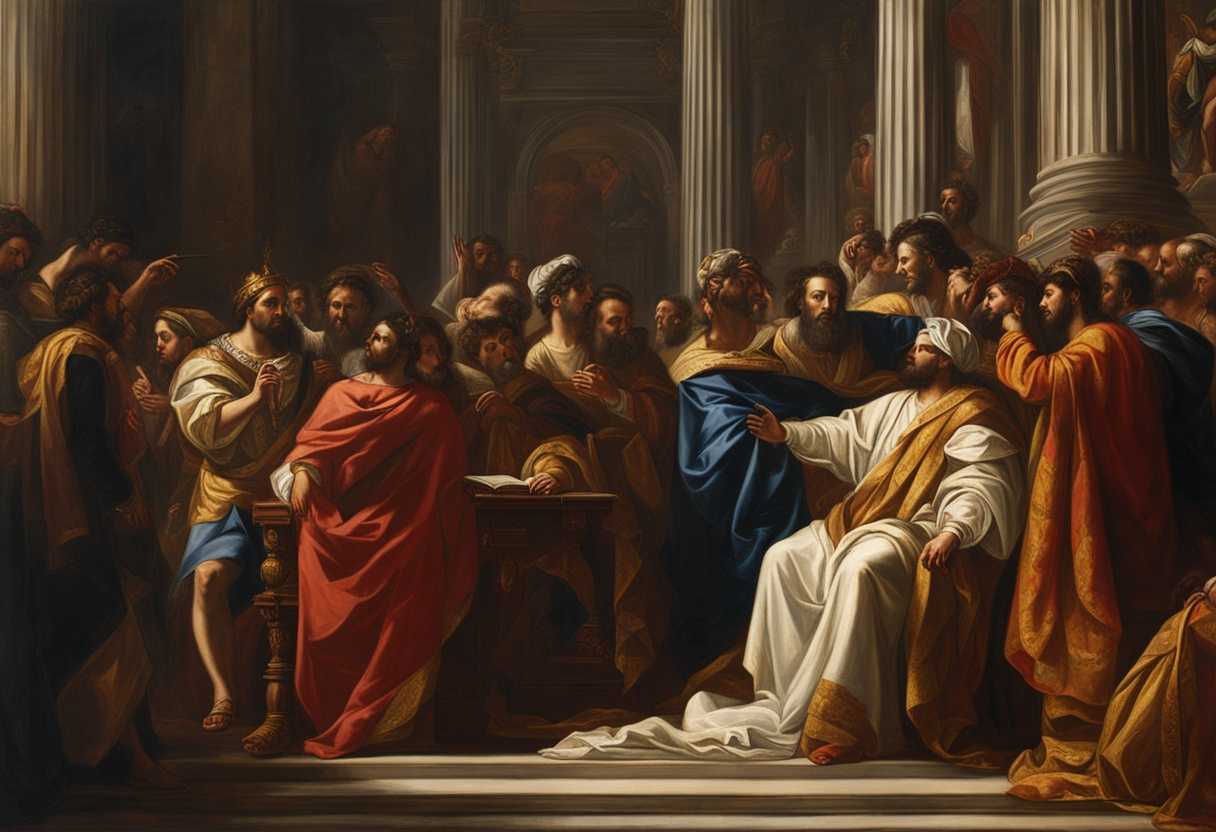
Setting the Scene for 2 Kings 22-25
In the heart of Jerusalem, the air is thick with tension and uncertainty as the kingdom of Judah stands on the brink of collapse. The once-mighty city, with its towering walls and grand temple, is now a shadow of its former glory. The streets are lined with the remnants of a proud nation, but the echoes of despair resonate through the hearts of its people. King Josiah, a young ruler who ascended to the throne at just eight years old, has been striving to restore the worship of Yahweh and cleanse the land of idolatry. His recent discovery of the Book of the Law in the temple has ignited a fervor for reform, but the weight of the nation’s sins looms heavily over him.
In the dimly lit chambers of the palace, Josiah gathers his trusted advisors, including the high priest Hilkiah, who played a pivotal role in the discovery of the sacred scroll. The atmosphere is charged with urgency as they discuss the implications of the newfound scripture. The scroll reveals the covenant between God and His people, a covenant that has been neglected for generations. As they pore over the words, the realization dawns upon them that the nation’s disobedience has provoked divine wrath, and impending judgment is imminent. The high priest, with a furrowed brow, speaks of the need for national repentance, while the king, resolute yet anxious, contemplates the path ahead.
Outside, the city is alive with the sounds of daily life, but an undercurrent of fear permeates the air. The distant rumble of Babylonian forces can be heard, a reminder of the looming threat that seeks to conquer Jerusalem. The people, unaware of the discussions taking place within the palace walls, go about their routines, some clinging to hope, while others are paralyzed by despair. The temple, once a beacon of worship, stands as a stark reminder of the nation’s failures. As the sun sets over the city, casting long shadows across the streets, the weight of history hangs heavy, and the fate of Judah teeters on the edge of a knife, with the decisions made in the palace destined to shape the future of the people.
What is 2 Kings 22-25 about?
We are invited to reflect on the profound impact of divine revelation and the importance of spiritual integrity within a community as we explore the chapters concerning King Josiah’s reforms and the discovery of the Book of the Law. Can you imagine the transformative power of rediscovering a sacred text that had long been forgotten? When King Josiah comes across the Book of the Law, it prompts a national awakening, leading to sweeping reforms aimed at restoring moral order. His actions remind us of the necessity of returning to our foundational principles, whether in our personal lives or within the larger societal framework. How often do we disregard the core values that guide us? The fall of Jerusalem, which follows these reforms, highlights a sobering reality: even the most righteous efforts can be met with resistance and consequence. Josiah’s deep commitment to the covenant with God demonstrates his desire to lead his people toward righteousness, yet it also raises questions about the limits of human action in the face of overarching divine plans. Is it not a stark reminder that we may strive for goodness and justice, yet still find ourselves confronted with forces larger than ourselves? This paradox of striving for redemption while facing inevitable challenges is a potent theme that continues to resonate. Through these narratives, we are encouraged to examine the tensions within our lives—how can we remain steadfast in our convictions even when the outcome is uncertain? Let us delve deeper into these chapters to consider the meaning of being custodians of our beliefs and values. How can the lessons from King Josiah’s story guide us in our own journeys? His reforms serve as a powerful metaphor for personal and societal renewal, urging us to seek truth and act upon it fervently. What can we learn from ensuring that our actions align with our principles, and how can we create an environment that fosters such alignment in our communities?
Understanding what 2 Kings 22-25 really means
In 2 Kings 22-25, we witness a pivotal moment in Israel’s history through the reign of King Josiah. His discovery of the Book of the Law ignites a national revival, highlighting the profound impact that returning to God’s Word can have on a community. This passage serves as a reminder that restoration often begins with a rediscovery of foundational truths. Have you ever experienced a moment where a forgotten truth reignited your faith?
Josiah’s reforms are a powerful testament to the theme of restoration. When the Book of the Law was read to him, he was deeply moved, leading him to initiate sweeping changes aimed at realigning the nation with God’s commands. This act of returning to Scripture is not merely historical; it resonates with our contemporary struggles. In a world filled with distractions and competing ideologies, how can we, like Josiah, prioritize the teachings of Scripture in our lives?
The fall of Jerusalem, however, starkly contrasts the hope found in Josiah’s reforms. It serves as a sobering reminder of the consequences that arise from turning away from God. The narrative illustrates that while restoration is possible, neglecting our spiritual responsibilities can lead to dire outcomes. This duality prompts us to reflect on our own lives: Are there areas where we have drifted away from God’s guidance, and what might the consequences be?
Related passages, such as Deuteronomy 30:1-3 and Jeremiah 29:10-14, further enrich our understanding of this theme. They emphasize the importance of returning to God after disobedience and the hope of restoration even in exile. These connections remind us that God’s desire for us is not just to follow rules but to engage in a relationship that fosters growth and healing. How can we cultivate this relationship in our daily lives?
An anecdote from a church member illustrates the personal impact of rediscovering Scripture. They shared how finding an old Bible in their attic led to a profound reconnection with their faith. This mirrors the communal awakening experienced by the people of Judah when they heard the Law read. Such stories remind us that revival can begin in the most unexpected places. Have you had a similar experience that reignited your spiritual journey?
Key phrases from this passage, such as “The Book of the Law,” “tear their robes,” and “seek the Lord,” encapsulate the essence of Josiah’s reforms. The Book of the Law represents God’s covenant and guidance, urging us to recognize the importance of Scripture in shaping our lives. The act of tearing robes symbolizes genuine repentance, a necessary step in acknowledging our shortcomings. Finally, the call to “seek the Lord” emphasizes the active pursuit of a relationship with God, challenging us to engage with our faith intentionally.
In conclusion, the events of 2 Kings 22-25 remind us of the cyclical nature of faith. Turning away from God leads to consequences, while returning to Him brings restoration. As we navigate our spiritual journeys, may we draw inspiration from Josiah’s example. Let us seek God earnestly and embrace His Word as our guiding light, ensuring that we remain anchored in the truths that sustain us. What steps can you take today to deepen your connection with God and His Word?
How do we seek God’s guidance in our lives?
Seeking God’s guidance in our lives involves a sincerity of heart and the commitment to align our actions with His will. One of the fundamental ways to receive guidance is through earnest prayer, where individuals express their intentions, desires, and seek clarity on the path they should take. Engaging in prayer allows for an open dialogue with God, fostering a deeper relationship and creating space for His wisdom to penetrate our thoughts and decisions.
Additionally, the exploration of sacred texts and scripture serves as a powerful tool for understanding God’s principles and directives. Through study, we can find wisdom and discernment that can illuminate our choices. Reflecting on these texts, combined with meditation and contemplation, can bring comfort and direction, especially in challenging times. It is essential to approach this study with an open and teachable spirit, ready to accept insights that might challenge our preconceived notions or desires.
Lastly, seeking counsel from others within a community of faith can provide invaluable perspectives. Engaging with trusted mentors, spiritual leaders, or friends who share similar beliefs can help clarify our thoughts and reveal God’s guidance through their insights and shared experiences. Together, these practices create a holistic approach to aligning our lives with God’s plan, nurturing both our spiritual journey and personal growth.
Application
Think of your life like a thriving garden; if you neglect it, weeds will take over. 2 Kings 22-25 teaches us that straying from God can lead to chaos, just as a garden can wither without care. Now is the time to reconnect with your spiritual roots and nurture your faith. You can be the one to spark renewal in your family, workplace, or community through kindness, accountability, and by living out your values. Will you take that step and become a beacon of hope for those around you?

Reverend Michael Johnson is an experienced Church Minister with a profound expertise in spirituality and guidance. With a serene presence and a compassionate heart, he has faithfully served his congregation for over 20 years, leading them on a spiritual journey towards inner peace and enlightenment. Reverend Johnson’s extensive knowledge of religious philosophies and profound understanding of human nature have made him a trusted confidant and mentor to many, as he seamlessly weaves his profound wisdom into life teachings. Reverend Johnson’s calming demeanor and empathetic nature continue to uplift and heal souls, nurturing a sense of unity and tranquility within his community.