
2 Samuel 7:1-17 is about God’s covenant with King David, promising him an eternal dynasty and lineage, symbolizing God’s faithfulness and establishing the foundation for Jesus Christ as the ultimate fulfillment of this covenant.
1 Now when the king lived in his house and the Lord had given him rest from all his surrounding enemies,
2 that the king said to Nathan the prophet, “See now, I dwell in a house of cedar, but the ark of God dwells in a tent.”
3 And Nathan said to the king, “Go, do all that is in your heart, for the Lord is with you.”
4 But that same night the word of the Lord came to Nathan,
5 “Go and tell my servant David, ‘Thus says the Lord: Would you build me a house to dwell in?
6 I have not lived in a house since the day I brought up the people of Israel from Egypt to this day, but I have been moving about in a tent for my dwelling.
7 In all the places where I have moved with all the people of Israel, did I speak a word with any of the judges of Israel, whom I commanded to shepherd my people Israel, saying, “Why have you not built me a house of cedar?”
8 Now, therefore, thus you shall say to my servant David, ‘Thus says the Lord of hosts, I took you from the pasture, from following the sheep, that you should be prince over my people Israel.
9 And I have been with you wherever you went and have cut off all your enemies from before you. And I will make for you a great name, like the name of the great ones of the earth.
10 And I will appoint a place for my people Israel and will plant them, so that they may dwell in their own place and be disturbed no more. And violent men shall afflict them no more, as formerly,
11 from the time that I appointed judges over my people Israel. And I will give you rest from all your enemies. Moreover, the Lord declares to you that the Lord will make you a house.
12 When your days are fulfilled and you lie down with your fathers, I will raise up your offspring after you, who shall come from your body, and I will establish his kingdom.
13 He shall build a house for my name, and I will establish the throne of his kingdom forever.
14 I will be to him a father, and he shall be to me a son. When he commits iniquity, I will discipline him with the rod of men, with the stripes of the sons of men,
15 but my steadfast love will not depart from him, as I took it from Saul, whom I put away from before you.
16 And your house and your kingdom shall be made sure forever before me. Your throne shall be established forever.
17 In accordance with all these words, and in accordance with all this vision, Nathan spoke to David.
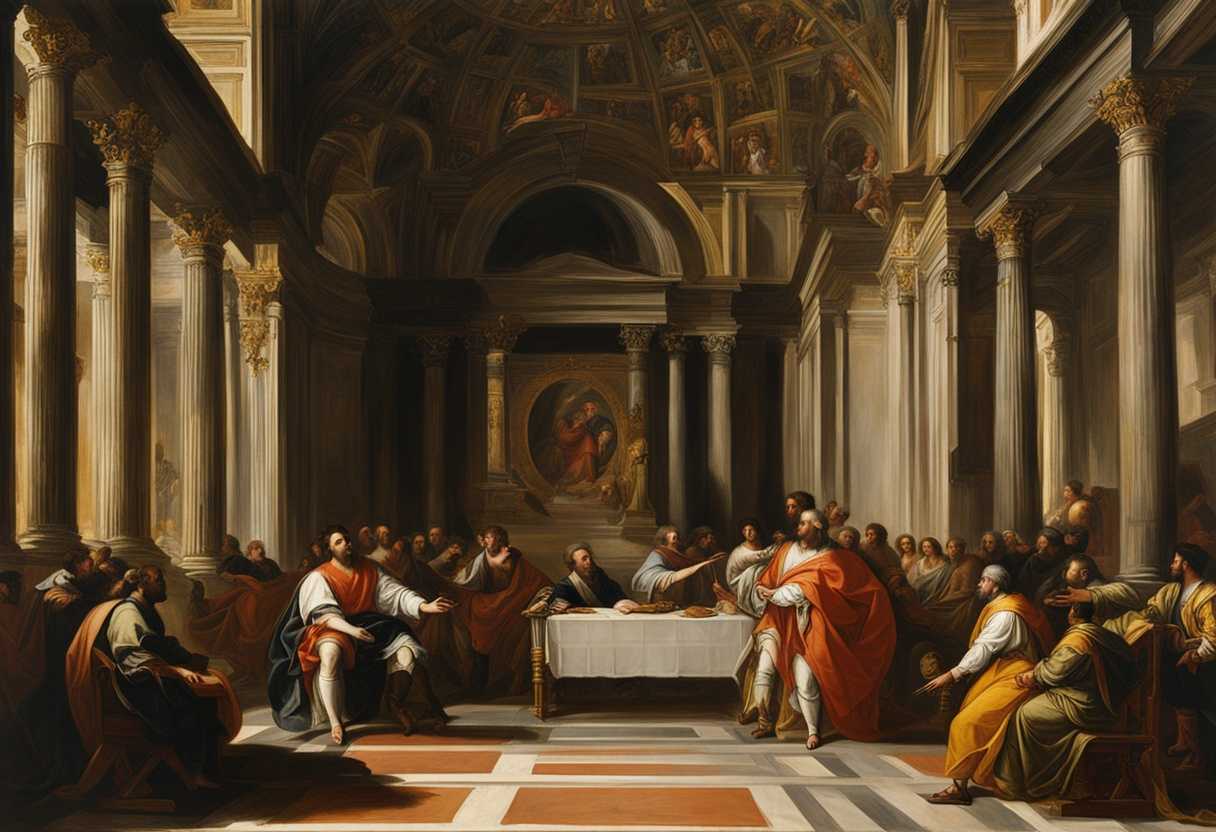
Setting the Scene for 2 Samuel 7:1-17
The scene in 2 Samuel chapter 7 takes place in the royal court of King David in Jerusalem. King David, having settled into his reign and enjoying a period of peace and prosperity, decides to build a permanent house for the Ark of the Covenant. Nathan the prophet, a trusted advisor to the king, is also present in the scene. Nathan had a close relationship with David and often provided him with counsel and guidance.
The setting is grand and regal, with rich tapestries adorning the walls and the scent of incense lingering in the air. King David, known for his love of music and poetry, may have had musicians playing in the background as he discussed his plans with Nathan. The two men are engaged in a deep conversation about David’s desire to build a temple for the Lord, reflecting the king’s reverence and devotion to God. Nathan listens attentively as David shares his intentions, eventually receiving a divine message from the Lord that alters the course of David’s plans and reveals God’s promise to establish an everlasting kingdom through David’s descendants. The scene is filled with a sense of awe and reverence as the weight of God’s covenant with David is revealed.
What is 2 Samuel 7:1-17 about?
Isn’t it incredible how God’s promises are fulfilled in such a magnificent way throughout history? This verse speaks to the unbreakable covenant God made with King David, ensuring that his lineage would lead to the establishment of an eternal kingdom. This promise finds its ultimate fulfillment in Jesus Christ, a descendant of David who establishes a spiritual kingdom that transcends earthly boundaries and time itself.
Through this verse, we see the faithfulness of God in keeping His word and the intricate way in which He weaves together the tapestry of redemption throughout generations. It is a reminder that God’s plans are far-reaching and extend beyond what our human minds can comprehend. Reflecting on this verse encourages us as we trust in the assurance that God’s promises are trustworthy and that His ultimate plan for salvation and restoration is perfectly orchestrated through the line of David, culminating in the redemptive work of Jesus Christ.
Understanding what 2 Samuel 7:1-17 really means
In 2 Samuel 7:1-17, we witness a pivotal moment in biblical history where God establishes the Davidic Covenant through the prophet Nathan. This covenant holds immense significance as it sets the stage for the lineage of Jesus Christ, highlighting God’s intricate plan for salvation. The passage begins with David experiencing a period of rest from his enemies, symbolizing God’s provision and protection in times of peace. This tranquility serves as a backdrop for the divine promise that follows, emphasizing God’s faithfulness amidst the ebb and flow of human affairs.
One key phrase in this passage, “I have not dwelt in a house since the day I brought the Israelites up out of Egypt,” underscores God’s omnipresence and His choice to dwell among His people beyond the confines of a physical temple. This statement reveals a profound truth about God’s nature – He is not limited by human structures but actively engages with His creation in a personal and intimate manner. Through this declaration, God invites us to recognize His continual presence in our lives, transcending earthly boundaries and structures.
The covenantal promise of an eternal kingdom and an enduring throne for David’s descendants echoes throughout the biblical narrative, finding fulfillment in the person of Jesus Christ. Isaiah 9:6-7, Luke 1:32-33, and Revelation 22:16 all point to the culmination of God’s promise in the Messiah, who reigns with justice and righteousness on David’s throne. This interconnected web of prophecies underscores the meticulous planning and fulfillment of God’s redemptive purposes through the ages.
As we contemplate the relevance of this passage in our lives today, we are reminded of God’s unwavering faithfulness and His sovereign plans that transcend our limited understanding. Just as David’s desire to build a temple was surpassed by God’s greater plan for an eternal kingdom, we are encouraged to trust in God’s providence and embrace His divine purposes for our lives. This narrative prompts us to reflect on our own legacy and purpose, recognizing that our actions and faithfulness can have enduring impacts beyond our earthly existence.
Consider a scenario where a person’s vision to build a community center is fulfilled by their child, expanding into a nationwide initiative. This anecdote mirrors David’s experience, where his aspiration to build a temple pales in comparison to God’s grand design for an eternal dynasty culminating in Jesus Christ. Through these reflections, we glean insights into God’s faithfulness, His dynamic presence in our lives, and His overarching plan for redemption. May we draw strength and inspiration from the Davidic Covenant, trusting in God’s promises and embracing His eternal purposes for humanity.
How can we seek God’s guidance in decision-making?
We can look to the example of King David in 2 Samuel 7:1-17 when seeking God’s guidance in decision-making. David sought guidance from God through prayer and listening for His voice. David recognized that God’s plans were greater than his own and humbly submitted to God’s will. We can invite God to lead us and provide direction in our decision-making processes by humbling ourselves before Him and acknowledging His sovereignty.
Another way to seek God’s guidance is through studying His Word. The Bible contains principles and teachings that can help us discern His will and make wise decisions. We can gain insight and clarity on the direction we should take by meditating on Scripture and seeking to align our decisions with God’s Word. God’s Word serves as a guiding light, illuminating our path and leading us in the way we should go.
Lastly, seeking counsel from wise and godly individuals can also be a way to seek God’s guidance. Proverbs 15:22 tells us that plans fail for lack of counsel, but with many advisers they succeed. We can gain perspective and wisdom to make informed decisions that are in line with God’s will by seeking input from trusted mentors, pastors, or friends who are grounded in their faith. God can speak to us through others, providing confirmation and guidance as we navigate important choices in our lives.
Application
Think of your life as a project you’re managing or a family you’re nurturing. Reflect on 2 Samuel 7:1-17, and see how God kept His promises to King David like a reliable partner. This isn’t just ancient history; it’s about God’s unwavering commitment to you. Let this example fill you with awe and gratitude. Are you ready to trust God and align your plans with His? Will you take the step to surrender your dreams to His greater purpose?

Reverend Michael Johnson is an experienced Church Minister with a profound expertise in spirituality and guidance. With a serene presence and a compassionate heart, he has faithfully served his congregation for over 20 years, leading them on a spiritual journey towards inner peace and enlightenment. Reverend Johnson’s extensive knowledge of religious philosophies and profound understanding of human nature have made him a trusted confidant and mentor to many, as he seamlessly weaves his profound wisdom into life teachings. Reverend Johnson’s calming demeanor and empathetic nature continue to uplift and heal souls, nurturing a sense of unity and tranquility within his community.