
7 Then Elisha said, “Hear the word of the Lord: thus says the Lord, Tomorrow about this time a seah of fine flour shall be sold for a shekel, and two seahs of barley for a shekel, at the gate of Samaria.”
2 Then the captain on whose hand the king leaned said to the man of God, “If the Lord himself should make windows in heaven, could this thing be?” But he said, “You shall see it with your own eyes, but you shall not eat of it.”
3 Now there were four men who were lepers at the entrance of the gate. And they said to one another, “Why are we sitting here until we die?
4 If we say, ‘Let us enter the city,’ the famine is in the city, and we shall die there. And if we sit here, we die also. So now come, let us go over to the camp of the Syrians. If they spare our lives we shall live, and if they kill us we shall but die.”
5 And they rose at twilight to go to the camp of the Syrians. But when they came to the edge of the camp of the Syrians, behold, there was no one there.
6 For the Lord had made the army of the Syrians hear the sound of chariots and of horses, the sound of a great army, so that they said to one another, “Behold, the king of Israel has hired against us the kings of the Hittites and the kings of Egypt to come against us.”
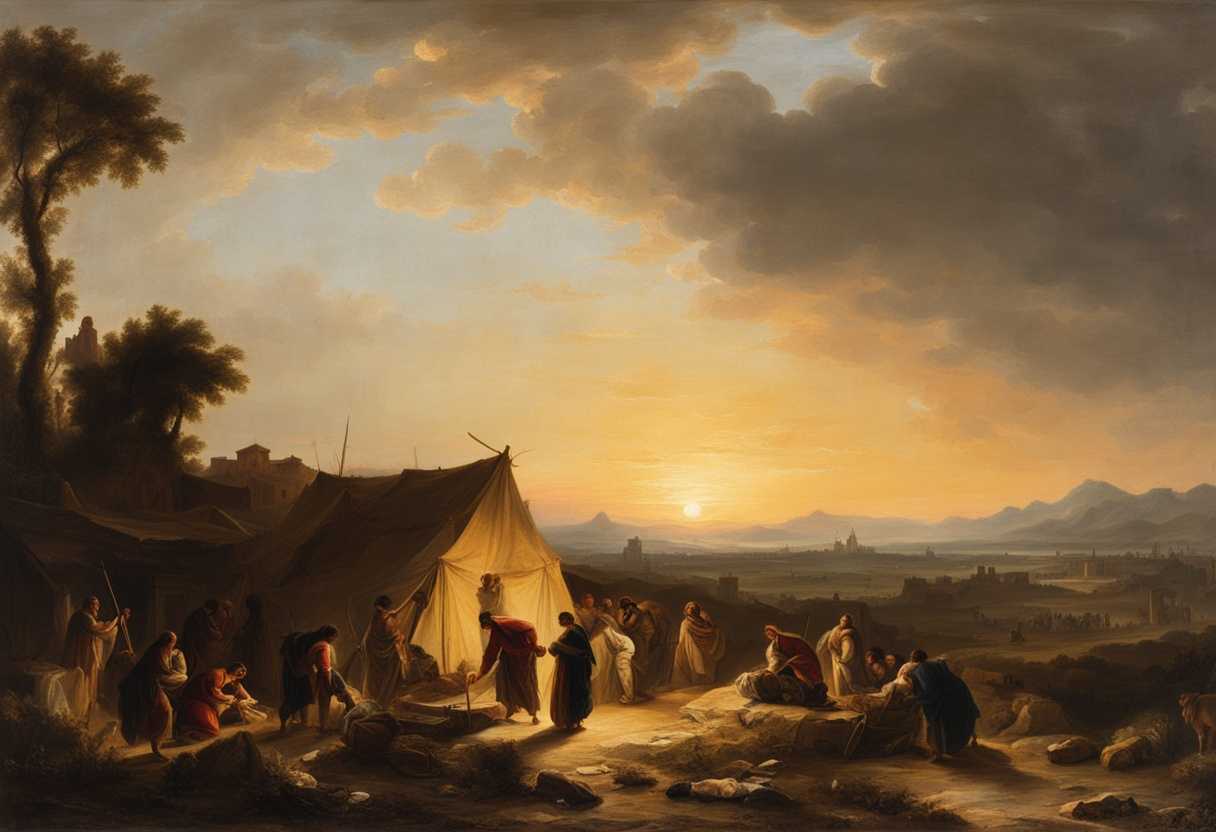
7 So they fled away in the twilight and abandoned their tents, their horses, and their donkeys, leaving the camp as it was, and fled for their lives.
8 And when these lepers came to the edge of the camp, they went into a tent and ate and drank, and they carried off silver and gold and clothing and went and hid them. Then they came back and entered another tent and carried off things from it and went and hid them.
9 Then they said to one another, “We are not doing right. This day is a day of good news. If we are silent and wait until the morning light, punishment will overtake us. Now therefore come; let us go and tell the king’s household.”
10 So they came and called to the gatekeepers of the city and told them, “We came to the camp of the Syrians, and behold, there was no one to be seen or heard there, nothing but the horses tied and the donkeys tied and the tents as they were.”
11 Then the gatekeepers called out, and it was told within the king’s household.
12 And the king rose in the night and said to his servants, “I will tell you what the Syrians have done to us. They know that we are hungry. So they have gone out of the camp to hide themselves in the open country, thinking, ‘When they come out of the city, we shall take them alive and get into the city.’”
13 And one of his servants said, “Let some men take five of the remaining horses, seeing that those who are left here will fare like the whole multitude of Israel who have already perished. Let us send and see.”
14 So they took two horsemen, and the king sent them after the army of the Syrians, saying, “Go and see.”
15 They went after them as far as the Jordan, and behold, all the way was littered with garments and equipment that the Syrians had thrown away in their haste. And the messengers returned and told the king.
16 So the people went out and plundered the camp of the Syrians. So a seah of fine flour was sold for a shekel, and two seahs of barley for a shekel, according to the word of the Lord.
17 Now the king had appointed the captain on whose hand he leaned to have charge of the gate. And the people trampled him in the gate, so that he died, as the man of God had said when the king came down to him.
18 And it happened just as the man of God had said to the king: “Two seahs of barley shall be sold for a shekel, and a seah of fine flour for a shekel, at this time tomorrow in the gate of Samaria.”
19 The officer had answered the man of God, “Look, even if the Lord should open the floodgates of the heavens, could this happen?” But Elisha had said, “You will see it with your own eyes, but you will not eat any of it.”
20 And so it happened to him, for the people trampled him in the gate and he died.
The True Meaning of 2 Kings 7
The author of this chapter is the prophet Elisha, who was a successor to the great prophet Elijah. Elisha was known for his miracles and his guidance to the kings of Israel during a tumultuous time in the nation’s history. The unfolding of a remarkable event took place during a siege of the city of Samaria by the Aramean army in this chapter. The people of Samaria were facing a devastating famine, and the situation seemed hopeless. However, Elisha’s prophetic words would soon bring about a miraculous turn of events that would not only provide relief to the people but also demonstrate the power of God’s intervention. We delve into this chapter and fulfill Elisha’s prophecy of abundance in the midst of scarcity, leading to a remarkable reversal of fortunes for the people of Samaria as the Aramean army retreats. This event echoes the words of the psalmist in Psalm 107:9, “For he satisfies the thirsty and fills the hungry with good things.”
2 Kings 7:1-2
A fascinating account during a time of great famine in Samaria, the capital of the northern kingdom of Israel, is seen in 2 Kings 7:1-2. The passage begins with Elisha, the prophet of God, declaring that by the next day, there would be an abundance of food in the city. This statement may have seemed incredulous at the time, considering the dire circumstances the people were facing with severe food shortage due to a long siege by the Arameans.
Elisha’s proclamation of imminent relief amidst such scarcity can be seen as a demonstration of God’s power and faithfulness. It serves as a reminder that God is not limited by human circumstances or logic but can bring about miraculous provision even in the most desperate situations. This theme of divine intervention and provision runs throughout the Bible, from the manna in the wilderness during the time of Moses to Jesus feeding the multitude with a few loaves and fish in the New Testament.
The response to Elisha’s declaration is met with skepticism from an officer on whose arm the king leaned. Here we see a contrast between doubt and faith. The officer doubted the possibility of such abundance overnight, while Elisha, as the mouthpiece of God, spoke with unwavering faith in the fulfillment of God’s promise. This interaction highlights the importance of trusting in God’s word even when it seems improbable to human understanding. Jesus in the New Testament also emphasized the significance of faith in God’s power to move mountains (Matthew 17:20).
Furthermore, the officer’s doubt led Elisha to declare that while he would see the abundance promised by God with his own eyes, he would not partake of it. This serves as a cautionary reminder of the consequences of unbelief. The officer’s doubt cost him the opportunity to benefit from God’s blessing, illustrating the principle that faith opens the door to God’s miracles and provision (Hebrews 11:6). This passage in 2 Kings 7:1-2 emphasizes the importance of faith in God’s promises, even in the face of seemingly insurmountable challenges. It reminds us that God is always faithful to His word and can turn scarcity into abundance in an instant. It prompts us to reflect on our level of faith and trust in God’s provision in our own lives, knowing that He is able to do exceedingly abundantly above all that we ask or think (Ephesians 3:20).
2 Kings 7:3-4
A significant event unfolds during a time of extreme famine in Samaria in 2 Kings 7:3-4. Four men with leprosy, considered unclean and outcasts in society, are at the city gate where they are faced with a desperate situation. Inside the city, the people were reduced to such dire straits that they were eating their own children due to the severe food shortage resulting from the Aramean siege on Samaria.
These four lepers, having nothing to lose, decide to take a chance and surrender themselves to the Aramean camp, hoping for mercy or possibly even death. God intervenes in a miraculous way in their act of desperation. When the lepers arrive at the camp, they find it deserted. The Lord had caused the Arameans to hear what sounded like a mighty army advancing, driving them to flee in fear, leaving behind their tents, horses, donkeys, and provisions.
This event of the lepers discovering the deserted camp and sharing the good news with the starving city of Samaria symbolizes several timeless messages found in the Bible. Firstly, it demonstrates God’s ability to turn the most dire situations around in ways that human understanding cannot fathom. Just as in this story, God’s deliverance can come from unexpected places and people, showing His sovereignty over all circumstances.
Secondly, the inclusion of the lepers as the unlikely agents of this good news highlights God’s heart for the marginalized and outcast. Throughout the Bible, we see God consistently using the weak and despised to accomplish His purposes, emphasizing that His power is made perfect in our weakness (2 Corinthians 12:9).
The story of the lepers in 2 Kings 7 serves as a reminder that God’s promises and provision are not limited by human circumstances or societal norms. It encourages us to trust in God’s faithfulness even in the midst of impossible odds, knowing that He is able to do exceedingly abundantly above all that we ask or think (Ephesians 3:20).
2 Kings 7:5-7
They set out for the camp of the Arameans at twilight in 2 Kings 7:5-7. But when they reached the edge of the camp, no one was there, for the Lord had caused the Arameans to hear the sound of chariots and horses and a great army, so that they said to one another, ‘Look, the king of Israel has hired the Hittite and Egyptian kings to attack us!’ So they got up and fled in the dusk and abandoned their tents and their horses and donkeys. They left the camp as it was and ran for their lives. We witness the miraculous deliverance by the hand of God in this section. The city of Samaria was under siege by the Arameans, resulting in a severe famine and distress among the Israelites. Four lepers, outcasts from the city, were in a dire situation, facing starvation. However, driven by desperation, they took a chance and decided to go to the camp of the Arameans, hoping for mercy or provision.
The divine intervention that follows is remarkable. God caused the Arameans to hear what sounded like a mighty army advancing towards them. This auditory illusion struck fear into the hearts of the Aramean soldiers, leading them to believe that multiple powerful armies were coming to attack them. This caused them to flee in panic, leaving behind all their possessions, including their tents, horses, and donkeys.
This event underscores several timeless messages found throughout the Bible. Firstly, it serves as a powerful demonstration of God’s sovereignty and power over all circumstances. No matter how dire the situation may seem, God has the ability to intervene and bring about deliverance in ways that surpass human understanding. This aligns with Isaiah 55:8-9, “For my thoughts are not your thoughts, neither are your ways my ways… My ways are higher than your ways and my thoughts are higher than your thoughts, just as the heavens are higher than the earth.”
Additionally, this event echoes the theme of faith and obedience in the face of adversity. The four lepers, despite their seemingly hopeless condition, took a step of faith by venturing towards the Aramean camp. Their willingness to take action, even in the midst of uncertainty, led to the unfolding of God’s miraculous plan. This resonates with Hebrews 11:6, “And without faith, it is impossible to please God because anyone who comes to him must believe that he exists and that he rewards those who earnestly seek him. This passage reinforces the biblical principle of God’s provision for His people. Just as God provided for the Israelites by causing the Arameans to flee and leaving behind abundance for the starving city, God assures believers of His faithfulness in providing for their needs. This aligns with Matthew 6:26, where Jesus reminds His followers to consider the birds of the air, as they are fed by God’s hand, emphasizing that believers are of much more value to God. The narrative in 2 Kings 7:5-7 serves as a profound illustration of God’s power, faithfulness, and provision. It encourages readers to trust in God’s sovereignty, step out in faith, and rest assured that He is capable of orchestrating miraculous deliverance even in the most desperate of circumstances.
2 Kings 7:8-9
A pivotal moment in the history of Samaria during a time of great famine is seen in 2 Kings 7:8-9. The passage states, “When the men with leprosy reached the edge of the camp, they went into one tent after another, eating and drinking wine; and they carried off silver, gold, and clothes and went and hid them. Then they returned and entered another tent and carried off things from it and hid them.” This scene unfolds as four men afflicted with leprosy, outcasts in society, take a bold step towards the enemy camp of the Arameans. These men, facing a dire situation in the besieged city of Samaria, decide to take a risk and seek help from the nearby camp.
The men’s actions of entering the enemy camp demonstrate their desperation and courage despite their lowly status. Ironically, it is these outcasts who end up being the catalyst for a miraculous turn of events. The Lord caused the Arameans to hear what sounded like a great army approaching as they entered the camp, causing them to flee in fear and leave their possessions behind. The lepers, who were marginalized in their own society, become the recipients of unexpected abundance due to their willingness to step out in faith.
This passage underscores the theme of God’s provision and deliverance in unexpected ways. It emphasizes how God can use the most unlikely individuals to bring about His purposes. The story of the men with leprosy serves as a reminder that God’s power is not limited by societal standards or human expectations. It is a testament to the fact that God often works through the marginalized and the overlooked to bring about His plans, as seen in other biblical accounts such as the story of David, a lowly shepherd boy chosen by God to be king (1 Samuel 16).
The lesson from this passage encourages believers to trust in God’s sovereignty and be open to His leading, even when circumstances seem dire. It challenges us to have faith like the men with leprosy, who dared to believe that God could intervene in their hopeless situation. This story also parallels the spiritual truth that Jesus often reached out to the marginalized and outcasts during His ministry on earth, showing compassion and grace to those society rejected (Luke 5:12-16). The narrative in 2 Kings 7:8-9 ultimately serves as a powerful illustration of God’s faithfulness, provision, and His ability to bring about deliverance in the most unlikely of ways. It encourages believers to step out in faith, trusting that God can turn even the bleakest of circumstances into opportunities for His glory and our good.
2 Kings 7:10-11
They went and called out to the city gatekeepers and told them in 2 Kings 7:10-11, “We went into the Aramean camp and no one was there—not a sound of anyone—only tethered horses and donkeys, and the tents left just as they were.”‘ The gatekeepers shouted the news, and it was reported within the palace. The Aramean army laid siege to the city of Samaria, causing a severe famine among the Israelites, and we witness the unfolding of a miraculous event in these verses. Four men affected by leprosy took a bold step of faith to go to the camp of the Arameans, only to discover that the entire camp had been abandoned in haste, leaving behind their possessions and animals.
This turn of events was a fulfillment of the prophecy by Elisha in the preceding chapter (2 Kings 7:1), where he proclaimed that by the next day there would be an abundance of food in Samaria. The narrative highlights the power of God to deliver His people in unexpected and miraculous ways, even when the situation seems dire and hopeless.
The behavior of the lepers, who shared their discovery with the gatekeepers of the city despite their societal status as outcasts, is a testament to the theme of unexpected heroes and instruments of God’s will throughout the Bible. Their actions not only saved themselves from starvation but also brought about the salvation of the entire city.
This account serves as a reminder that God’s plans and deliverance can come from the most unlikely sources, and that faith and obedience to God’s word can lead to unimaginable blessings. It also emphasizes the importance of sharing good news and testifying to the works of God, as the gatekeepers did by spreading the word within the palace.
Furthermore, the events in 2 Kings 7 also echo themes of redemption, mercy, and provision that run throughout the Bible. Just as God provided manna to the Israelites in the wilderness (Exodus 16) and fed the multitudes with five loaves and two fish (Matthew 14:13-21), here we see Him miraculously providing for His people in a time of great need. God’s sovereignty, faithfulness, and compassion towards His people are showcased through the account of the empty Aramean camp and the subsequent deliverance of Samaria, highlighting the importance of trusting in Him even in the face of seemingly insurmountable challenges.
2 Kings 7:12-13
The servants of the king begin the section in 2 Kings 7:12-13 by discussing the Aramean army’s sudden disappearance from their camp. They recount how they fled in fear during the night, leaving behind everything in haste, including their tents, horses, donkeys, and supplies. The servants inform the king of Israel that the Arameans had abandoned their camp, leaving only silence and emptiness behind.
This sudden turn of events, where an entire army vanishes overnight, was a miraculous intervention by God in response to Elisha’s prophecy of deliverance for the people of Samaria. This incident serves as a reminder of God’s power and faithfulness to His people, even in the face of seemingly insurmountable odds. The story highlights the theme of divine intervention and how God can turn the tide of any situation in ways that defy human understanding.
This event also mirrors the theme of God’s provision and deliverance found throughout the Bible. Just as God provided manna for the Israelites in the desert (Exodus 16), here He provides abundance for the people of Samaria through the spoils left behind by the fleeing Aramean army. It emphasizes the principle that God is able to supply all our needs according to His riches and glory (Philippians 4:19).
Furthermore, the contrast between the abundance in the deserted Aramean camp and the dire circumstances of famine in Samaria serves as a reflection of the consequences of faith and unbelief. While the people in the besieged city were initially skeptical of Elisha’s prophecy (2 Kings 7:2), those who stepped out in faith to investigate were rewarded with an overflow of blessings. This serves as a lesson on the importance of trusting in God’s promises even when circumstances seem bleak.
It is also worth noting that the marginalized and unlikely characters in this narrative, such as the four lepers who first discovered the abandoned camp, were used by God to bring about a great victory and deliverance for the people. This aligns with the biblical theme of God using the weak and foolish things of the world to confound the wise (1 Corinthians 1:27). God’s power, provision, faithfulness, and the importance of faith in His promises are showcased in the events described in 2 Kings 7:12-13. They serve as a powerful reminder that no situation is beyond God’s control, and He is always working behind the scenes for the good of those who trust in Him (Romans 8:28).
2 Kings 7:14-15
Four lepers who were outside the besieged city of Samaria discover in 2 Kings 7:14-15 that the Aramean army, who had surrounded the city, had fled, leaving their tents, horses, and donkeys behind. The lepers eventually enter one of the deserted tents, eat and drink, take silver, gold, and clothing, then decide to hide some of the spoil before going to inform the city about what they had found.
The significance of this passage lies in the unexpected deliverance of the city of Samaria through the actions of these marginalised individuals. The four lepers, considered outcasts in society due to their condition, become the unlikely messengers of God’s salvation to the starving city. This emphasizes the theme of God using the weak and despised things of the world to confound the strong (1 Corinthians 1:27). God’s faithfulness and righteousness highlight the consequences of this event. The Aramean army’s inexplicable flight was a direct result of God fulfilling the prophecy of Elisha in 2 Kings 7:1, where he declared a sudden end to the siege and a miraculous provision of food despite the impossible circumstances. The fulfillment of this prophecy not only demonstrated God’s power but also reiterated the importance of trust in His word and promises.
The actions of the lepers, particularly in choosing to share the good news with the city, reveal a lesson in compassion and communal responsibility. Instead of hoarding the treasure for themselves, they recognized the moral obligation to share the newfound abundance with their fellow citizens. This echoes the teachings of Jesus, emphasizing the principles of selflessness, generosity, and caring for others in need (Matthew 25:35-40). The account of the four lepers in 2 Kings 7:14-15 serves as a powerful reminder of God’s sovereignty, His surprising choice of instruments to accomplish His will, and the importance of faith, obedience, and communal support in times of trial. It encourages believers to remain steadfast in their trust in God’s providence, to be open to His unexpected interventions, and to demonstrate love and compassion towards others, especially in times of abundance or scarcity.
2 Kings 7:16-17
The verses in 2 Kings 7:16-17 describe the fulfillment of the prophecy given by Elisha about the abundance of food in Samaria. These verses recount how the people trampled the Aramean camp in their rush to gather the supplies that the fleeing Arameans left behind. There was suddenly an overabundance of food in a city that was previously suffering from a severe famine. The prices of goods dropped dramatically, reflecting the sudden shift from scarcity to abundance that occurred as a result of God’s intervention through Elisha’s prophecy.
The events in these verses highlight the power and faithfulness of God to fulfill His promises. Even in times of despair and desperation, God can bring about miraculous deliverance. Elisha, as a prophet of God, served as a conduit for God’s message and displayed the importance of faith and obedience in receiving blessings from the Lord. The people’s initial skepticism and doubt were met with a tangible demonstration of God’s provision, teaching them to trust in the Lord and His word.
This story serves as a reminder of God’s sovereignty and His ability to turn the most dire situations around for His glory. It echoes the sentiment expressed in Luke 18:27, where Jesus says, “What is impossible with man is possible with God.” The sudden turn of events in Samaria not only met the physical needs of the people but also served as a spiritual lesson about the faithfulness of God and the importance of heeding the words of His messengers. Unbelief and disobedience are illustrated in 2 Kings 7 through the consequences of this event. Earlier in 2 Kings 6:33, we see the king’s disbelief in Elisha’s prophecy and his subsequent anger towards God’s messenger. This lack of faith could have resulted in the king missing out on the blessings that God had in store for the people of Samaria. It serves as a cautionary tale about the dangers of not trusting in God’s word and the missed opportunities that come from rejecting His promises. The contrast between the consequences of faith and unbelief is stark in this account and provides a lesson for readers to trust in God’s provision and promises even when circumstances seem dire.
2 Kings 7:18-20
The lord answered the man of God and said, “Now, behold, if the Lord should make windows in heaven, might such a thing be?” And he said, Behold, thou shalt see it with thine eyes, but shalt not eat thereof. And so it fell out unto him: for the people trode upon him in the gate, and he died.”
This passage follows a significant event in the narrative of 2 Kings 7, where Elisha, the man of God, prophesies victory and abundance to the starving city of Samaria, besieged by the Arameans. God caused the Arameans to hear the sound of chariots and horses in the verses before, leading them to flee, leaving their camp intact with abundant provisions for the starving Israelites. The man of God, Elisha, delivers a message of hope to the people, promising the sudden availability of food at an unbelievably low price.
The significance of this passage lies in the fulfillment of God’s promise through Elisha’s prophecy. Despite the doubt expressed by the lord mentioned in these verses, the outcome aligns precisely with what Elisha foretold. This serves as a testament to the faithfulness and power of God to provide for His people even in the most desperate circumstances. It also highlights the consequences of disbelief and doubt, as seen in the lord who questioned whether such a miraculous provision could occur.
Through this story, we see a theme running through the Bible: the importance of faith and trust in God’s promises. Hebrews 11:6 reinforces this idea, stating, “And without faith it is impossible to please God because anyone who comes to him must believe that he exists and that he rewards those who earnestly seek him.” The lord in 2 Kings 7 serves as a cautionary example of the consequences of lack of faith, as he witnesses the fulfillment of the prophecy but is denied its benefits due to his disbelief.
Furthermore, the sudden death of the lord, trampled in the gate as people rushed to partake in the abundance, symbolizes a stark reminder of the consequences of rejecting God’s word. This event reflects the biblical principle of reaping what one sows, as found in Galatians 6:7, “Do not be deceived: God cannot be mocked. A man reaps what he sows.” It serves as a sobering warning about the dangers of dismissing God’s promises or acting in defiance of His word. 2 Kings 7:18-20 encapsulates a powerful message about faith, obedience, and the consequences of disbelief. It showcases God’s reliability in fulfilling His promises, the dangers of doubt and unbelief, and the importance of aligning our hearts with God’s will to partake in His blessings. This passage invites readers to reflect on their own trust in God’s word and the importance of wholehearted faith in Him, regardless of the circumstances.
After 2 Kings 7
The people of Samaria had suffered greatly during the siege. They had resorted to eating the most unimaginable things just to survive. But now, the Lord had provided a miraculous deliverance. The Aramean army had fled in terror, leaving behind an abundance of supplies. The people were able to eat their fill and even store up provisions for the future. The reverend knew that their trials were not yet over as the people rejoiced in their newfound freedom and abundance. The road ahead would still be difficult, and they would need to rely on their faith in the Lord to guide them. But in this moment of triumph, the reverend could see the hand of God at work, and he knew that greater blessings were yet to come.

Reverend Michael Johnson is an experienced Church Minister with a profound expertise in spirituality and guidance. With a serene presence and a compassionate heart, he has faithfully served his congregation for over 20 years, leading them on a spiritual journey towards inner peace and enlightenment. Reverend Johnson’s extensive knowledge of religious philosophies and profound understanding of human nature have made him a trusted confidant and mentor to many, as he seamlessly weaves his profound wisdom into life teachings. Reverend Johnson’s calming demeanor and empathetic nature continue to uplift and heal souls, nurturing a sense of unity and tranquility within his community.