
Acts 19:23-41 is about the uproar caused in Ephesus by the silversmiths who were concerned about their business of making idols being threatened by the spread of Christianity, highlighting the clash between the economic interests and the teachings of the new faith.
23 About that time there arose no little disturbance concerning the Way.
24 For a man named Demetrius, a silversmith, who made silver shrines of Artemis, brought no little business to the craftsmen.
25 These he gathered together, with the workmen in similar trades, and said, “Men, you know that from this business we have our wealth.
26 And you see and hear that not only in Ephesus but in almost all of Asia this Paul has persuaded and turned away a great many people, saying that gods made with hands are not gods.
27 And there is danger not only that this trade of ours may come into disrepute but also that the temple of the great goddess Artemis may be counted as nothing, and that she may even be deposed from her magnificence, she whom all Asia and the world worship.”
28 When they heard this they were enraged and were crying out, “Great is Artemis of the Ephesians!”
And the city was filled with the confusion, and they rushed together into the theater, dragging with them Gaius and Aristarchus, Macedonians who were Paul’s companions in travel.
30 But when Paul wished to go in among the crowd, the disciples would not let him.
31 Now some cried out one thing, some another, for the assembly was in confusion, and most of them did not know why they had come together.
And when the town clerk had quieted the crowd, he said, “Men of Ephesus, who is there who does not know that the city of the Ephesians is temple keeper of the great Artemis, and of the sacred stone that fell from the sky?”
33 Some of the crowd prompted Alexander, whom the Jews had put forward. And Alexander, motioning with his hand, wanted to make a defense to the crowd.
34 But when they recognized that he was a Jew, for about two hours they all cried out with one voice, “Great is Artemis of the Ephesians!”
35 And when the town clerk had quieted the crowd, he said, “Men of Ephesus, who is there who does not know that the city of the Ephesians is temple keeper of the great Artemis, and of the sacred stone that fell from the sky?
36 So, since these things cannot be denied, you ought to be quiet and do nothing rash.
37 For you have brought these men here who are neither sacrilegious nor blasphemers of our goddess.
38 If therefore Demetrius and the craftsmen with him have a complaint against anyone, the courts are open, and there are proconsuls. Let them bring charges against one another.
39 But if you seek anything further, it shall be settled in the regular assembly.
40 For we really are in danger of being charged with rioting today, since there is no cause that we can give to justify this commotion.”
And when he had said these things, he dismissed the assembly.
Setting the Scene for Acts 19:23-41
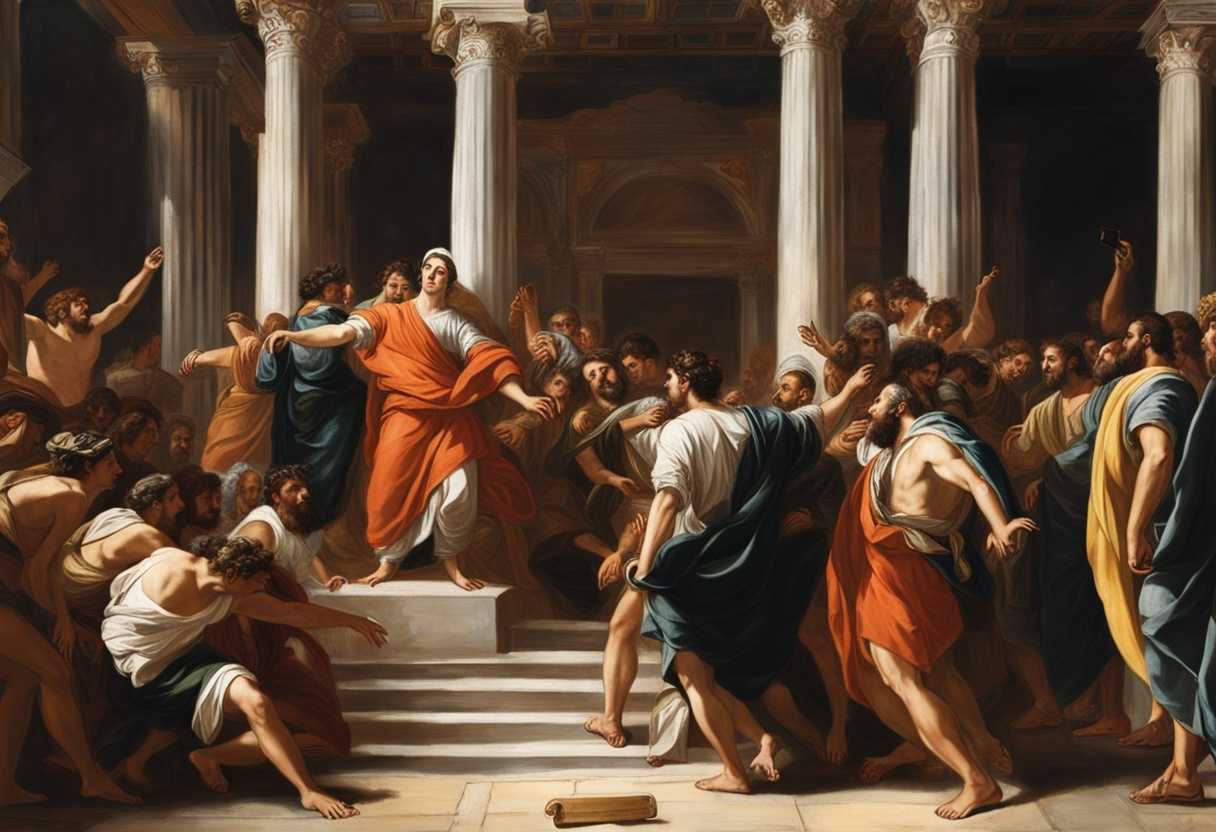
In Acts chapter 19, we find the scene set in the city of Ephesus, a bustling commercial center in the Roman province of Asia. The city is known for its grand temple dedicated to the goddess Artemis, one of the Seven Wonders of the Ancient World. The streets are filled with merchants selling silver shrines of Artemis, and the air is thick with the scent of incense and the sounds of bustling crowds.
In this particular passage, we see a riot breaking out in Ephesus. The silversmiths, led by a man named Demetrius, are furious because they are losing business due to the teachings of the apostle Paul. Paul had been preaching about the one true God, causing many to turn away from idol worship, including the worship of Artemis. The silversmiths, fearing for their livelihood, gather in the theater of Ephesus, shouting and causing a commotion.
The uproar attracts a large crowd, with some people confused about the reason for the riot. The city clerk, a man named Alexander, steps in to calm the crowd and explain the situation. He reminds the people that Ephesus is under Roman rule and that they should not resort to violence. The scene is tense, with emotions running high as the crowd eventually disperses, bringing an end to the chaos in Ephesus.
What is Acts 19:23-41 about?
Let’s dive into the context of this verse to better understand its meaning. A thriving business centered around the worship of the goddess Artemis, known for the temple dedicated to her, existed in Ephesus. This idolatry was deeply ingrained in the culture and economy of the city. When Paul preached against idolatry and converted many people to Christianity, it threatened the livelihood of those who made a profit from selling idols and goods related to idol worship.
The riot that erupted in Ephesus was a direct result of the uproar caused by the threat to the business of the idol makers. This event showcases the intense opposition that early Christians faced when spreading the message of the gospel in environments entrenched in idolatry and pagan worship. It also demonstrates the courage and dedication of Paul in his mission to share the teachings of Christ, even in the face of violent opposition. We can ask ourselves: How committed are we to our beliefs, even when faced with challenges and opposition, as we reflect on this verse? How does this story inspire us to stand firm in our faith and share the message of love and truth, even in difficult circumstances? Paul’s experience in Ephesus serves as a powerful reminder of the importance of staying true to our convictions and trusting in God’s strength to overcome adversity in our own lives and ministries.
Understanding what Acts 19:23-41 really means
The passage in Acts 19:23-41 unveils a tumultuous event in Ephesus, where a riot erupts due to the profound impact of Paul’s ministry. Demetrius, a silversmith crafting shrines of Artemis, feels threatened by the rising influence of Christianity, which diverts people from idol worship. This riot signifies both economic and religious upheaval triggered by the Gospel’s spread.
The phrase “No little disturbance” underscores the widespread and potent nature of the uproar, showcasing the Gospel’s profound influence. The chant “Great is Artemis of the Ephesians!” reflects the intense devotion to Artemis and the fear gripping those reliant on her worship for sustenance. “The city was filled with confusion” vividly portrays the disorder stemming from conflicting beliefs and economic interests.
In Acts 16:16-24, akin to Ephesus, Paul and Silas encounter opposition in Philippi after expelling a spirit from a slave girl, leading to their incarceration. Matthew 10:34-36 echoes the societal discord caused by Jesus’ message, even within close relationships. 1 Thessalonians 1:9 praises the Thessalonians for forsaking idols to serve the living God, showcasing the Gospel’s transformative power.
This narrative resonates today, illustrating the clash between financial gain and spiritual truth. It underscores the Gospel’s transformative might and the resistance it faces from entrenched systems and beliefs. Believers are urged to stand resolute in their faith amidst adversity and societal pressures.
Consider a contemporary scenario where advocating for change threatens an industry vital to a community, akin to Ephesus’ economic reliance on idol worship. This narrative prompts introspection on the “idols” we cling to, be it possessions, status, or security, challenging us to embrace authentic faith despite disruptions.
Reflect on how the Gospel might challenge our comfort zones and prompt us to live more authentically in our beliefs. The bravery of Paul and his companions inspires us to uphold our convictions steadfastly, even amid societal opposition. Exploring this passage offers insight into early church struggles, prompting us to boldly and genuinely live out our faith.
How can we guard against idolatry and defend the truth?
We can guard against idolatry and defend the truth by staying grounded in the knowledge and worship of the one true God. When we focus on developing a deep relationship with God through prayer, studying the Scriptures, and seeking His will in all areas of our lives, we are less likely to be swayed by false idols or teachings. We can discern right from wrong and stand firm in defending the truth against any form of idolatry by knowing the truth found in God’s Word.
Additionally, we can guard against idolatry by being aware of the influences around us. We must be vigilant in recognizing when our own desires or the pressures of society may lead us astray, just as the craftsmen in Ephesus were motivated by their love for money and power. We can stand united in defending the truth and upholding the values of our faith by cultivating a strong faith community and surrounding ourselves with fellow believers who can provide accountability and support. We can guard ourselves against idolatry and serve as beacons of light in a world filled with darkness and false idols by staying rooted in the truth of God’s Word and seeking to live out His teachings in our daily lives.
Application
In this digital age where opinions are like data, it’s crucial to remain unwavering in our beliefs amidst the noise. Let Acts 19:23-41 serve as a guiding beacon, urging you to stay steadfast in your convictions and resist the influence of the crowd. Will you rise above the online chaos and hold firm to your values, bravely standing up against the injustices that surround us today?

Reverend Michael Johnson is an experienced Church Minister with a profound expertise in spirituality and guidance. With a serene presence and a compassionate heart, he has faithfully served his congregation for over 20 years, leading them on a spiritual journey towards inner peace and enlightenment. Reverend Johnson’s extensive knowledge of religious philosophies and profound understanding of human nature have made him a trusted confidant and mentor to many, as he seamlessly weaves his profound wisdom into life teachings. Reverend Johnson’s calming demeanor and empathetic nature continue to uplift and heal souls, nurturing a sense of unity and tranquility within his community.