
1 The allotment of the people of Joseph went from the Jordan by Jericho, east of the waters of Jericho, into the wilderness, going up from Jericho into the hill country to Bethel.
2 Then it goes down westward to the territory of the Japhletites, as far as the territory of Lower Beth-horon, then to Gezer, and it ends at the sea.
3 Then it goes down westward to the territory of the Japhletites, as far as the territory of Lower Beth-horon, then to Gezer, and it ends at the sea.
4 So the people of Joseph, Manasseh and Ephraim, received their inheritance.
5 The territory of the people of Ephraim by their clans was as follows: the boundary of their inheritance on the east was Ataroth-addar as far as Upper Beth-horon,
6 Then the boundary goes westward to the sea, past Aznoth-tabor, and from there to Hukkok, touching Zebulun at the south and Asher on the west, and Judah on the east at the Jordan.
7 Then it went down from Janoah to Ataroth and to Naarah, and touched Jericho, ending at the Jordan.
8 The border went down to the brook Kanah, south of the brook. These cities, to the south of the brook, among the cities of Manasseh, belong to Ephraim. Then the boundary of Manasseh goes on the north side of the brook and ends at the sea,
9 Then the boundary goes down to the brook Kanah. These cities to the south of the brook among the cities of Manasseh are the lot of Ephraim, and all the cities with their villages.
10 However, they did not drive out the Canaanites who lived in Gezer, so the Canaanites have lived in the midst of Ephraim to this day but have been made to do forced labor.
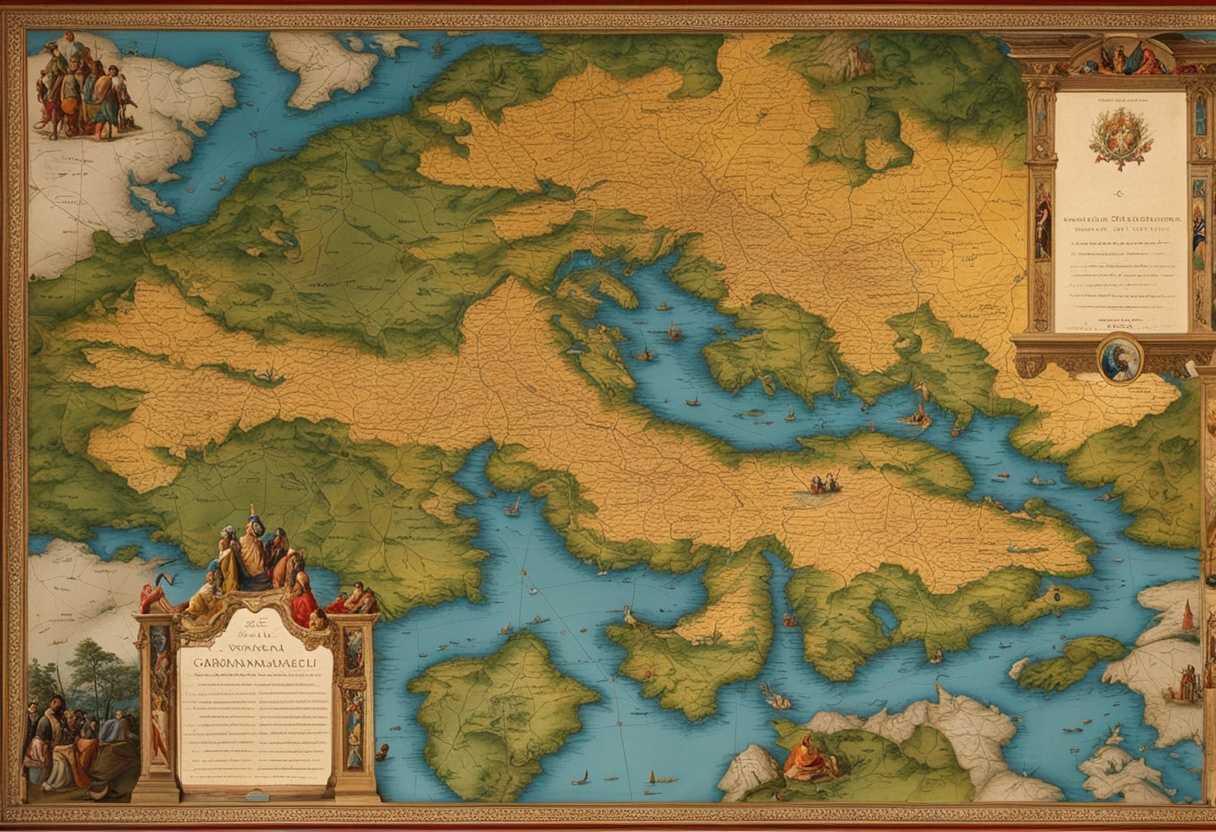
The True Meaning of Joshua 16
This chapter of the Book of Joshua recounts the allotment of the Promised Land to the tribes of Ephraim and Manasseh, the two sons of Joseph. The author of the Book of Joshua is traditionally believed to be Joshua himself, the successor to the great prophet Moses, who led the Israelites into the land of Canaan after their exodus from Egypt. The Israelites take possession of the land that was rightfully theirs, fulfilling God’s promise to Abraham, Isaac, and Jacob. The tribes of Ephraim and Manasseh, being the descendants of Joseph, receive their inheritance in the central hill country, a strategic location that would play a crucial role in the unification and defense of the Israelite nation.
The chapter also foreshadows the challenges the Israelites will face in fully driving out the Canaanite inhabitants, as we see in the book of Judges, where the Israelites struggle to maintain control over the land. This echoes the warning given in Deuteronomy 7, where the Israelites are instructed to completely destroy the Canaanite nations, lest they be led astray by their false gods and idolatrous practices.
Joshua 16:1-4
The division of the land of Canaan among the tribes of Israel continues in Joshua 16:1-4. This section specifically focuses on the inheritance of the descendants of Joseph – the tribes of Ephraim and Manasseh. The passage begins by stating that the lot fell to the children of Joseph, signifying the divine allocation of territories to each tribe. The boundaries of the territory given to the descendants of Joseph are outlined, stretching from the Jordan River to the waters of Jericho in the east, encompassing the wilderness that goes up from Jericho through the hill country to Bethel in the west.
This division of land according to tribes is significant as it fulfills the promise made by God to Abraham, Isaac, and Jacob regarding the land of Canaan as recorded in various parts of the Bible, including Genesis 15:18-21. This demonstrates God’s faithfulness in fulfilling His promises to His people, a theme reiterated throughout the Bible. The distribution of land not only provided physical inheritance but also served as a spiritual promise of God’s faithfulness and provision to the Israelites. The inheritance of Ephraim and Manasseh, the sons of Joseph, highlights the importance of family and lineage in the Old Testament. Joseph’s story, found in the book of Genesis, showcases forgiveness, reconciliation, and God’s faithfulness through trials. Joseph’s life, marked by betrayal by his brothers, slavery, and imprisonment in Egypt, ultimately leads to his elevation as a ruler, saving his family during a time of famine. This inheritance reflects the restoration and blessing that came out of Joseph’s initially challenging circumstances, illustrating God’s ability to turn hardships into blessings.
The mention of Bethel in the borders of the territory allotted to the descendants of Joseph is significant as Bethel held historical and spiritual importance throughout the Bible. Bethel, meaning “house of God,” was a place where Jacob had a significant encounter with God (Genesis 28:10-22). It became a place of worship and encounter with the divine. The tribes of Ephraim and Manasseh were reminded of their connection to God and the importance of maintaining a relationship with Him by incorporating Bethel within the boundaries of their inheritance. Joshua emphasizes the divine provision, faithfulness, and the fulfillment of promises to God’s people. The division of the land among the tribes not only met their physical needs for inheritance but also served as a reminder of God’s covenant and the importance of staying faithful to Him through generations. It showcases the intricate tapestry of God’s plan unfolding through the land distribution, connecting the present generation with the faith and promises of the past.
Joshua 16:5-10
The recounting of the territory given to the people of Ephraim is seen in Joshua 16:5-10. This passage describes the boundaries of their inheritance, starting from the eastern border of Ataroth-addar to Lower Beth Horon in the west. It then continues northward to Gezer, with more specific landmarks mentioned along the way. Like many other passages in Joshua, this account serves as a record of the distribution of the promised land among the tribes of Israel.
The allocation of land to each tribe was not just a geographical division but held deep significance in the biblical narrative. It represented God’s faithfulness in fulfilling His promises to the descendants of Abraham, Isaac, and Jacob. Each tribe received its portion according to God’s plan, reflecting His sovereignty and provision for His people. The division of land was a tangible symbol of God’s covenant relationship with Israel, reinforcing the concept of inheritance and blessing seen throughout the Bible.
Ephraim, one of the sons of Joseph, received a significant portion of land in this distribution. This is noteworthy because Ephraim became a powerful tribe in Israel’s history, often mentioned alongside Judah as a prominent tribal leader. The tribe of Ephraim played a crucial role in the establishment of the monarchy in Israel, as Jeroboam, the first king of the northern kingdom, was from Ephraim (1 Kings 11:26).
The mention of Gezer in this passage is also significant. Gezer was a strategic city that played a role in Israel’s history, particularly during the time of Solomon. It was one of the cities that Solomon fortified and rebuilt (1 Kings 9:15-17). Additionally, the city was later given to the Levites as a city of refuge (Joshua 21:21). God’s faithfulness in fulfilling His promises is reminded to us as we reflect on the distribution of land to the tribes of Israel. This narrative underscores the importance of obedience, trust, and patience in waiting for God’s timing and provision. It also highlights the theme of inheritance, not only in terms of physical land but also the spiritual inheritance we have in Christ as believers (Ephesians 1:11-14). We too can trust in God’s faithfulness to provide for our needs and guide us in His perfect plan for our lives, just as the Israelites received their allotted portions.
After Joshua 16
The Allotment for Ephraim and Manasseh
The people of Joseph received their inheritance. The boundary of their allotment began at the Jordan near Jericho, east of the waters of Jericho, and went up from there through the desert into the hill country of Bethel. It continued on to Luz and joined the border of the Archites at Ataroth. It then went down westward to the territory of the Japhletites as far as the region of Lower Beth-horon and on to Gezer, ending at the Mediterranean Sea.
Manasseh and Ephraim, the two sons of Joseph, each received their inheritance. But the Canaanites continued to live in Gezer. However, when the Israelites grew stronger, they subjected the Canaanites to forced labor, though they did not drive them out completely.
The people of Ephraim were not satisfied with the land they had received. They demanded more, and the Lord granted their request. But as we shall see in the next chapter, their desire for more land would lead to conflict with their fellow Israelites.

Reverend Michael Johnson is an experienced Church Minister with a profound expertise in spirituality and guidance. With a serene presence and a compassionate heart, he has faithfully served his congregation for over 20 years, leading them on a spiritual journey towards inner peace and enlightenment. Reverend Johnson’s extensive knowledge of religious philosophies and profound understanding of human nature have made him a trusted confidant and mentor to many, as he seamlessly weaves his profound wisdom into life teachings. Reverend Johnson’s calming demeanor and empathetic nature continue to uplift and heal souls, nurturing a sense of unity and tranquility within his community.