
Acts 8:25-40 is about Philip encountering an Ethiopian eunuch, explaining the prophecy of Isaiah to him, baptizing him, and ultimately illustrating the inclusivity of God’s kingdom by welcoming him, regardless of his background or status.
25 Now when they had testified and spoken the word of the Lord, they returned to Jerusalem, preaching the gospel to many villages of the Samaritans.
26 Now an angel of the Lord said to Philip, “Rise and go toward the south to the road that goes down from Jerusalem to Gaza.” This is a desert place.
27 And he rose and went. And there was an Ethiopian, a eunuch, a court official of Candace, queen of the Ethiopians, who was in charge of all her treasure. He had come to Jerusalem to worship
28 And he was returning, seated in his chariot, and he was reading the prophet Isaiah.
And the Spirit said to Philip, “Go over and join this chariot.”
30 So Philip ran to him and heard him reading Isaiah the prophet and asked, “Do you understand what you are reading?”
31 And he said, “How can I, unless someone guides me?” And he invited Philip to come up and sit with him.
32 Now the passage of the Scripture that he was reading was this: “Like a sheep he was led to the slaughter and like a lamb before its shearer is silent, so he opens not his mouth.
33 In his humiliation justice was denied him. Who can describe his generation? For his life is taken away from the earth.
34 And the eunuch said to Philip, “About whom, I ask you, does the prophet say this, about himself or about someone else?”
35 Then Philip opened his mouth, and beginning with this Scripture he told him the good news about Jesus.
36 And as they were going along the road they came to some water, and the eunuch said, “See, here is water! What prevents me from being baptized?”
37 And Philip said, “If you believe with all your heart, you may.” And he replied, “I believe that Jesus Christ is the Son of God.”
38 And he commanded the chariot to stop, and they both went down into the water, Philip and the eunuch, and he baptized him.
39 And when they came up out of the water, the Spirit of the Lord carried Philip away, and the eunuch saw him no more, and went on his way rejoicing.
40 Philip found himself at Azotus, and as he passed through he preached the gospel to all the towns until he came to Caesarea.
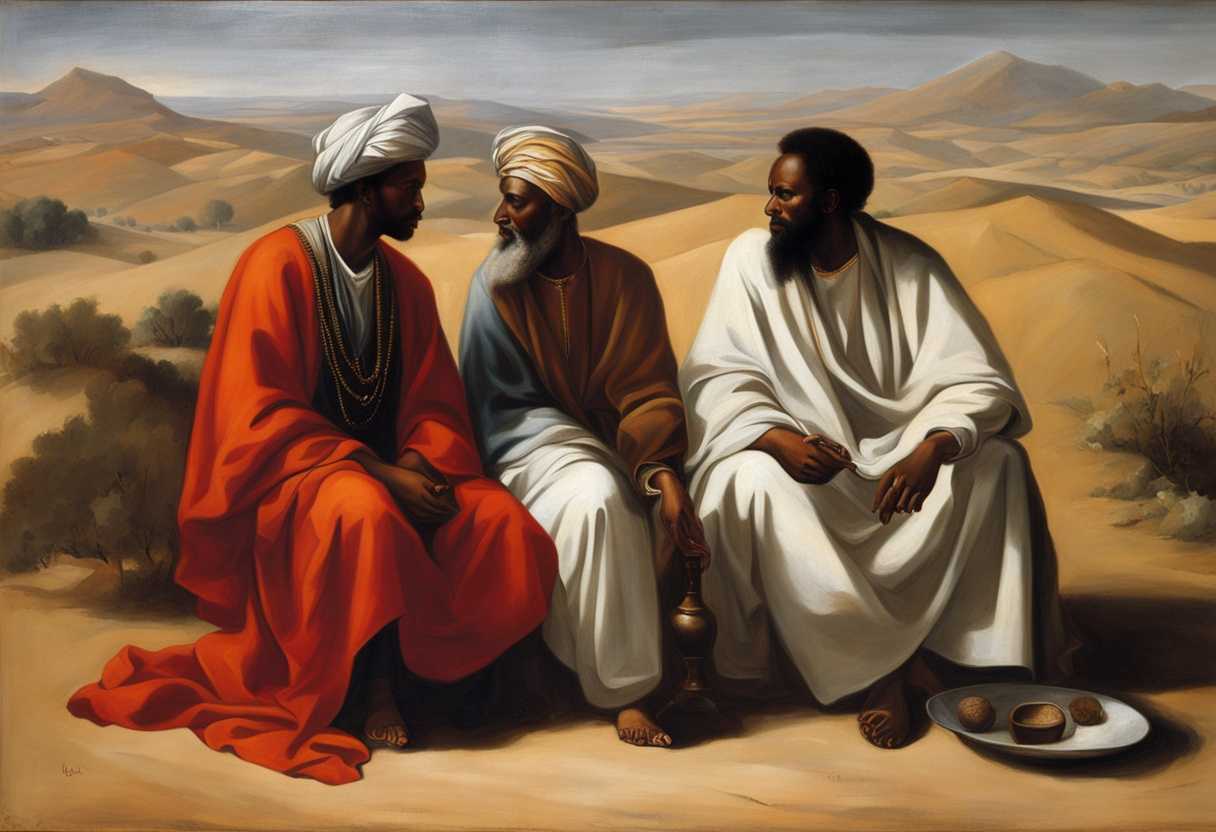
Setting the Scene for Acts 8:25-40
In Acts chapter 8, we find Philip, one of the seven chosen to serve the early Christian community, being directed by an angel of the Lord to go south from Jerusalem to Gaza. As Philip travels along the road, he encounters an Ethiopian eunuch, a high-ranking official in charge of all the treasury of the queen of Ethiopia. The eunuch had been to Jerusalem to worship and was now returning home, sitting in his chariot, reading from the book of Isaiah.
The scene is set in the desert along the road from Jerusalem to Gaza. The hot sun beats down on the travelers as Philip approaches the chariot and hears the eunuch reading aloud. Philip asks the eunuch if he understands what he is reading, and the eunuch invites Philip to join him. This leads to a conversation about the passage from Isaiah, which the eunuch does not fully comprehend. Philip seizes the opportunity to explain the good news about Jesus, and as they continue their journey, they come to some water. The eunuch asks to be baptized, and Philip baptizes him before being miraculously taken away by the Spirit of the Lord, leaving the eunuch rejoicing and continuing on his way, now a follower of Christ.
What is Acts 8:25-40 about?
This verse highlights the universality of God’s salvation through Jesus Christ. The act of Philip baptizing an Ethiopian eunuch illustrates that God’s grace is available to all, regardless of nationality, ethnicity, or social status. The Ethiopian eunuch, often marginalized in society, is welcomed and accepted into the faith community through baptism, signaling that God’s love knows no bounds.
This story challenges us to reflect on our own understanding of inclusivity and acceptance within our faith communities. Do we truly embrace all individuals with open arms, just as Philip did with the Ethiopian eunuch? Are we willing to break down barriers and extend the message of salvation to everyone, regardless of their background or circumstances? This verse reminds us of the radical inclusivity of God’s love, calling us to emulate this love in our own interactions with others.
Understanding what Acts 8:25-40 really means
In Acts 8:25-40, we witness the intriguing encounter between Philip and the Ethiopian eunuch, showcasing divine guidance and the transformative power of understanding scripture. Philip, directed by an angel, meets the eunuch on the road to Gaza, where he explains the book of Isaiah, leading to the eunuch’s conversion and baptism. This passage highlights the importance of obedience to God’s guidance and the role of mentors in clarifying the Word.
The phrase “Go south to the road—the desert road—that goes down from Jerusalem to Gaza” underscores the divine guidance Philip receives, emphasizing God’s specific instructions for His servants. It prompts reflection on how believers today can seek and follow God’s direction in their lives through prayer and discernment. Similarly, Philip’s question to the eunuch, “Do you understand what you are reading?” emphasizes the significance of comprehending scripture, not merely reading it, and the role of teachers in guiding others in their faith journey.
The eunuch’s immediate response to Philip’s teaching, exclaiming, “What can stand in the way of my being baptized?” highlights the urgency and readiness to commit to faith. This eagerness serves as a reminder for modern believers to act promptly on their convictions and not delay in responding to God’s call. The passage resonates with the Great Commission in Matthew 28:19-20, emphasizing the importance of baptism and teaching in the Christian faith.
Isaiah 53:7-8, the passage the eunuch was reading, prophesies about Jesus as the suffering servant, connecting his encounter with Philip to the fulfillment of Old Testament prophecies. Romans 10:14-15 further reinforces the necessity of preaching and teaching for individuals to come to faith, echoing Philip’s pivotal role in the eunuch’s conversion. These related passages deepen our understanding of the significance of sharing the Gospel and guiding others in their spiritual journey.
In today’s context, believers can draw parallels from this narrative by seeking divine guidance, delving into scripture for deeper understanding, and responding promptly to their faith. The story of Philip and the eunuch serves as a compelling illustration of God’s transformative work through ordinary encounters, urging believers to be open to His leading and actively engage in sharing the Gospel with others.
Imagine a contemporary scenario where a chance encounter on a train leads to a profound discussion about the Bible, ultimately resulting in someone’s decision to embrace faith and be baptized. This anecdote mirrors Philip and the eunuch’s interaction, illustrating how God can use everyday situations and individuals to bring about spiritual transformation. Acts 8:25-40, therefore, serves as a poignant reminder of God’s guidance, the importance of scriptural understanding, and the significance of immediate obedience to faith commitments, urging believers to walk in obedience and share the Good News with boldness.
How can we respond to God’s direction obediently?
We can respond to God’s direction obediently by actively listening and heeding his guidance, just like Philip did in this passage. When we have a clear understanding of God’s instruction, we can follow it with a willing heart and a faith-filled attitude, trusting that his plan is perfect. We should also be open to prompt and wholehearted obedience, even when it requires us to step out of our comfort zones or engage with unfamiliar situations. Remaining sensitive to the Holy Spirit’s leading and guidance in our lives is essential. We can discern God’s voice and direction more clearly by staying connected to Him through prayer and seeking His will through His Word. Obedience to God should be our priority, and we should be ready to act upon his commands promptly and fervently, just as Philip did without hesitation. We can walk in obedience and experience the blessings that come from following God’s perfect plan for our lives by fully surrendering our will to Him and aligning our desires with His.
Application
Dear reader, like Philip boldly shared the Gospel with the Ethiopian eunuch, let us also fearlessly spread the word of God with passion and zeal. Take inspiration from their encounter and actively look for chances to share the joy of Jesus in your daily life. Despite any challenges that come your way, be determined to break down walls and share the love of Christ with everyone you meet. Are you prepared to step out in faith and shine the light of Christ in the world today?

Reverend Michael Johnson is an experienced Church Minister with a profound expertise in spirituality and guidance. With a serene presence and a compassionate heart, he has faithfully served his congregation for over 20 years, leading them on a spiritual journey towards inner peace and enlightenment. Reverend Johnson’s extensive knowledge of religious philosophies and profound understanding of human nature have made him a trusted confidant and mentor to many, as he seamlessly weaves his profound wisdom into life teachings. Reverend Johnson’s calming demeanor and empathetic nature continue to uplift and heal souls, nurturing a sense of unity and tranquility within his community.