
Acts 9:1-20 is about the conversion of Saul, a persecutor of Christians, who encounters Jesus on the road to Damascus, is struck with blindness, led to Ananias, regains his sight, is baptized, and becomes a devoted follower of Christ, illustrating the transformative power of encountering Jesus and the ability for even the most fervent opposers to be changed by His grace.
1 But Saul, still breathing threats and murder against the disciples of the Lord, went to the high priest
2 and asked him for letters to the synagogues at Damascus, so that if he found any belonging to the Way, men or women, he might bring them bound to Jerusalem.
3 Now as he went on his way, he approached Damascus, and suddenly a light from heaven shone around him.
4 And falling to the ground, he heard a voice saying to him, “Saul, Saul, why are you persecuting me?”
5 And he said, “Who are you, Lord?” And he said, “I am Jesus, whom you are persecuting.
6 But rise and enter the city, and you will be told what you are to do.”
7 The men who were traveling with him stood speechless, hearing the voice but seeing no one.
8 Saul rose from the ground, and although his eyes were opened, he saw nothing. So they led him by the hand and brought him into Damascus.
9 And for three days he was without sight, and neither ate nor drank.
10 Now there was a disciple at Damascus named Ananias. The Lord said to him in a vision, “Ananias.” And he said, “Here I am, Lord.”
11 And the Lord said to him, “Rise and go to the street called Straight, and at the house of Judas look for a man of Tarsus named Saul, for behold, he is praying,
12 and he has seen in a vision a man named Ananias come in and lay his hands on him so that he might regain his sight.”
13 But Ananias answered, “Lord, I have heard from many about this man, how much evil he has done to your saints in Jerusalem.
14 And here he has authority from the chief priests to bind all who call on your name.”
15 But the Lord said to him, “Go, for he is a chosen instrument of mine to carry my name before the Gentiles and kings and the children of Israel.
16 For I will show him how much he must suffer for the sake of my name.
17 So Ananias departed and entered the house. And laying his hands on him he said, “Brother Saul, the Lord Jesus who appeared to you on the road by which you came has sent me so that you may regain your sight and be filled with the Holy Spirit.”
18 And immediately something like scales fell from his eyes, and he regained his sight. Then he rose and was baptized.
19 and taking food, he was strengthened.
20 And immediately he proclaimed Jesus in the synagogues, saying, “He is the Son of God.”
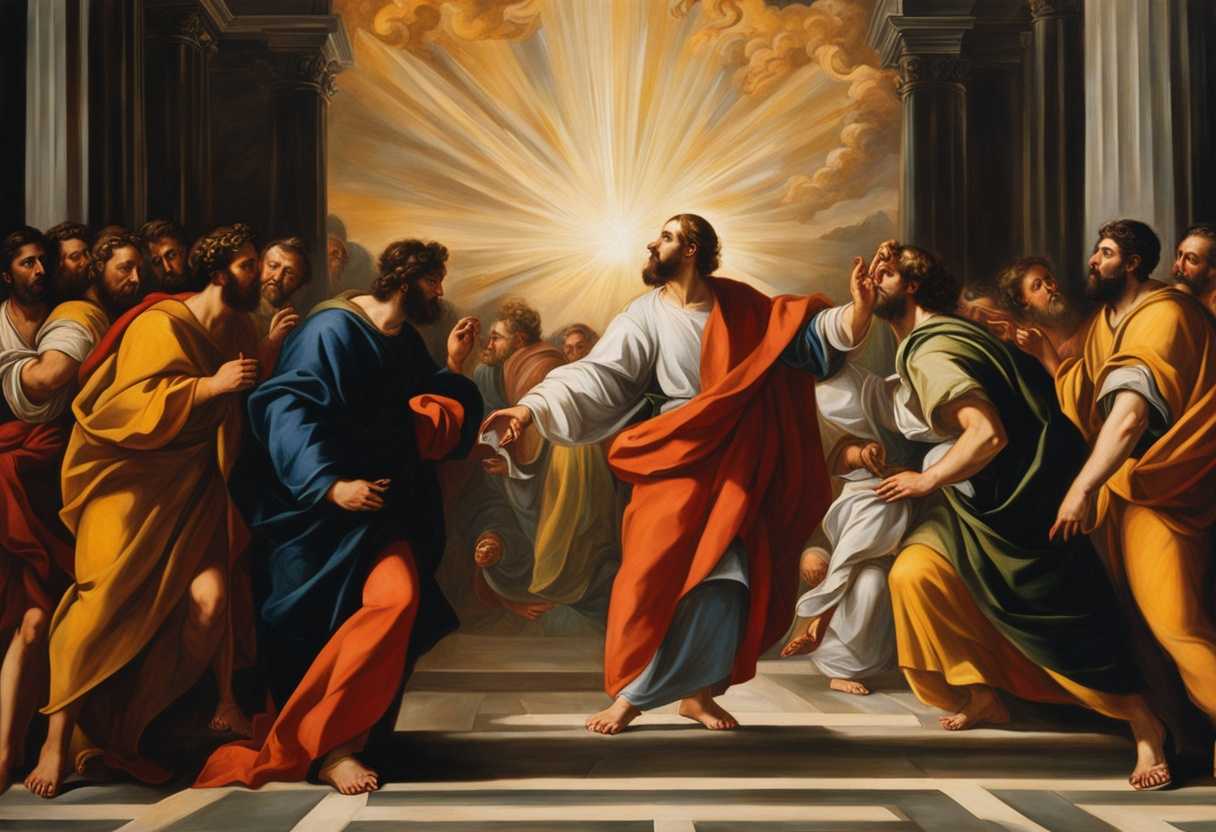
Setting the Scene for Acts 9:1-20
In Acts chapter 9, we find Saul of Tarsus, a zealous Pharisee known for persecuting early Christians, on his way to Damascus. As he travels, a bright light from heaven suddenly surrounds him, causing him to fall to the ground. In this dramatic moment, Saul hears a voice saying, “Saul, Saul, why are you persecuting me?”
Accompanying Saul are his companions, who are also struck by the light but do not hear the voice. They stand in shock and confusion as Saul, now blinded by the encounter, is led by the hand into Damascus. The group arrives at the house of a man named Judas, where Saul remains for three days without sight, fasting and praying.
The scene is tense and filled with a sense of divine intervention. The atmosphere is charged with the realization that something extraordinary has just occurred. Saul’s companions are bewildered by the events, while Saul himself is left in a state of vulnerability and introspection as he awaits further instructions from the Lord. This pivotal moment marks the beginning of Saul’s transformation into the apostle Paul, a key figure in the spread of Christianity.
What is Acts 9:1-20 about?
Imagine Saul, a devout persecutor of Christians, suddenly encountering a blinding light on his journey to Damascus. This divine intervention transforms him in an instant, and he becomes a believer in Jesus Christ. This profound experience leads to a complete change in his life and beliefs, causing him to take on the name Paul and become one of the most influential figures in early Christianity.
This verse exemplifies the power of redemption and transformation. It shows that no one is beyond the reach of God’s grace and that even the most hardened hearts can be softened and changed. Saul’s conversion serves as a reminder that God’s love and mercy are limitless, and that through faith and repentance, anyone can experience a radical spiritual transformation. It also highlights the importance of being open to new perspectives and being willing to let go of old ways in order to embrace a new path guided by faith and righteousness. Paul’s story is a testament to the transformative power of God’s love and serves as an inspiration for all believers to strive for spiritual growth and renewal in their own lives.
Understanding what Acts 9:1-20 really means
Introduction
In Acts 9:1-20, we witness the remarkable transformation of Saul, a zealous persecutor of Christians, into the devoted follower of Christ known as Paul. This passage showcases the profound impact of divine intervention and the unfathomable depth of God’s grace, offering hope and redemption to even the most unlikely individuals.
Key Phrases and Their Meanings
As Saul “breathed out murderous threats against the Lord’s disciples,” we see the intensity of his hostility and his relentless pursuit to eradicate the early Christian community. The “light from heaven” that flashed around him symbolizes the unmistakable presence of God and His divine intervention in Saul’s life. When Jesus confronts Saul, asking, “Why do you persecute me?” He underscores the intimate connection between Himself and His followers, emphasizing that harming them is akin to harming Christ. By declaring, “I am Jesus, whom you are persecuting,” Christ reveals His living presence and protection over His followers. God’s proclamation that Saul is His chosen instrument to proclaim His name to all people underscores His sovereignty in using even the most unlikely individuals for His divine purposes.
Related Bible Passages
In 2 Corinthians 5:17, we are reminded that in Christ, we become new creations, echoing Saul’s transformation from persecutor to apostle. 1 Timothy 1:15-16 reflects on Paul’s past and God’s mercy, reinforcing the message of redemption and grace. Galatians 1:13-16 provides further insight into Paul’s conversion and mission, shedding light on the depth of God’s transformative power.
Relevance to People Today
The narrative of Saul’s conversion offers a powerful message of transformation and redemption, assuring us that God’s grace knows no bounds. It serves as a reminder that God has a purpose for each of us, regardless of our past, and encourages us to trust in His plan. This passage also inspires perseverance in faith, urging believers to remain steadfast even in the face of challenges.
Anecdote
Consider a modern-day individual who, like Saul, has strayed far from God but experiences a profound encounter that leads to a radical transformation. This individual’s journey, much like Saul’s, can serve as a beacon of hope and a testament to the transformative power of God’s love and redemption. For instance, envision a former gang member who, after a life-altering experience, turns their life around to become a source of hope and inspiration for others, mirroring Saul’s journey of redemption and renewal.
Conclusion
Acts 9:1-20 stands as a poignant reminder of God’s boundless grace and transformative power. It challenges us to believe in the possibility of redemption, trust in God’s plan for our lives, and persevere in faith, knowing that even our darkest moments can be used by God for His greater purpose. This passage invites us to embrace the hope of new beginnings and the assurance that God can work miracles in the lives of all who turn to Him.
How can God transform a persecutor into a disciple?
God can transform a persecutor into a disciple through a powerful encounter and revelation of Himself. This transformation often involves a supernatural intervention that opens the persecutor’s eyes to the reality of who God is and His purpose for their life. Through this encounter, the persecutor’s heart and mind are changed, leading them to repentance and a desire to follow God wholeheartedly. God dramatically intervened in Saul of Tarsus’ life while he was on the road to Damascus to persecute Christians, and he later became the apostle Paul. Through a blinding light and a voice from heaven, Saul encountered Jesus Christ and was forever changed. This encounter not only transformed Saul’s beliefs but also redirected his entire life’s mission. From being a fierce persecutor of Christians, Saul became a devoted follower of Christ and one of the most influential apostles of the early church.
The key takeaway is that God’s transformative power is limitless, and He can turn even the hardest of hearts towards Himself. Through His mercy and grace, God can take someone who was once an enemy of the faith and use them mightily for His kingdom, demonstrating His power to change lives and bring about redemption.
Application
Discover the power of God’s grace, as seen in Acts 9:1-20. Like Saul’s transformation on the road to Damascus, let’s allow God to renew our lives. Embrace change fearlessly, stepping out in faith and trusting in His divine plan. Will you open your heart to transformation today?

Reverend Michael Johnson is an experienced Church Minister with a profound expertise in spirituality and guidance. With a serene presence and a compassionate heart, he has faithfully served his congregation for over 20 years, leading them on a spiritual journey towards inner peace and enlightenment. Reverend Johnson’s extensive knowledge of religious philosophies and profound understanding of human nature have made him a trusted confidant and mentor to many, as he seamlessly weaves his profound wisdom into life teachings. Reverend Johnson’s calming demeanor and empathetic nature continue to uplift and heal souls, nurturing a sense of unity and tranquility within his community.