
John 1:1-45 is about the introduction of Jesus Christ as the divine Word made flesh, the fulfillment of prophecy, and the calling of his disciples to follow him.
1 In the beginning was the Word, and the Word was with God, and the Word was God.
2 He was in the beginning with God.
3 All things were made through him, and without him was not any thing made that was made.
4 In him was life, and the life was the light of men.
5 The light shines in the darkness, and the darkness has not overcome it.
6 There was a man sent from God, whose name was John.
7 He came as a witness, to bear witness about the light, that all might believe through him.
8 He was not the light, but came to bear witness about the light.
9 The true light, which gives light to everyone, was coming into the world.
10 He was in the world, and the world was made through him, yet the world did not know him.
11 He came to his own, and his own people did not receive him.
12 But to all who did receive him, who believed in his name, he gave the right to become children of God,
13 who were born, not of blood nor of the will of the flesh nor of the will of man, but of God.
14 And the Word became flesh and dwelt among us, and we have seen his glory, glory as of the only Son from the Father, full of grace and truth.
15 (John bore witness about him, and cried out, “This was he of whom I said, ‘He who comes after me ranks before me, because he was before me.’”)
16 For from his fullness we have all received, grace upon grace.
17 For the law was given through Moses; grace and truth came through Jesus Christ.
18 No one has ever seen God; the only God, who is at the Father’s side, he has made him known.
19 And this is the testimony of John, when the Jews sent priests and Levites from Jerusalem to ask him, “Who are you?”
20 He confessed, and did not deny, but confessed, “I am not the Christ.”
21 And they asked him, “What then? Are you Elijah?” He said, “I am not.” “Are you the Prophet?” And he answered, “No.”
22 So they said to him, “Who are you? We need to give an answer to those who sent us. What do you say about yourself?”
23 He said, “I am the voice of one crying out in the wilderness, ‘Make straight the way of the Lord,’ as the prophet Isaiah said.”
24 (Now they had been sent from the Pharisees.)
25 They asked him, “Then why are you baptizing, if you are neither the Christ, nor Elijah, nor the Prophet?”
26 John answered them, “I baptize with water, but among you stands one you do not know,
27 He it is who coming after me is preferred before me, whose shoe’s latchet I am not worthy to unloose.
28 These things took place in Bethany across the Jordan, where John was baptizing.
29 The next day he saw Jesus coming toward him, and said, “Behold, the Lamb of God, who takes away the sin of the world!
30 This is he of whom I said, ‘After me comes a man who ranks before me, because he was before me.’
31 I myself did not know him, but for this purpose I came baptizing with water, that he might be revealed to Israel.”
32 And John bore witness: “I saw the Spirit descend from heaven like a dove, and it remained on him.
33 I myself did not know him, but he who sent me to baptize with water said to me, ‘He on whom you see the Spirit descend and remain, this is he who baptizes with the Holy Spirit.’
34 And I have seen and have borne witness that this is the Son of God.”
35 The next day again John was standing with two of his disciples,
36 and he looked at Jesus as he walked by and said, “Behold, the Lamb of God!”
37 The two disciples heard him say this, and they followed Jesus.
38 Jesus turned and saw them following and said to them, “What are you seeking?” And they said to him, “Rabbi” (which means Teacher), “where are you staying?”
39 He said to them, “Come and you will see.” So they came and saw where he was staying, and they stayed with him that day, for it was about the tenth hour.
40 One of the two who heard John speak and followed Jesus was Andrew, Simon Peter’s brother.
41 He first found his own brother Simon and said to him, “We have found the Messiah” (which means Christ).
42 He brought him to Jesus. Jesus looked at him and said, “You are Simon the son of John. You shall be called Cephas” (which means Peter).
43 The next day Jesus decided to go to Galilee. He found Philip and said to him, “Follow me.”
44 Now Philip was from Bethsaida, the city of Andrew and Peter.
45 Philip found Nathanael and said to him, “We have found him of whom Moses in the Law and also the prophets wrote, Jesus of Nazareth, the son of Joseph.”
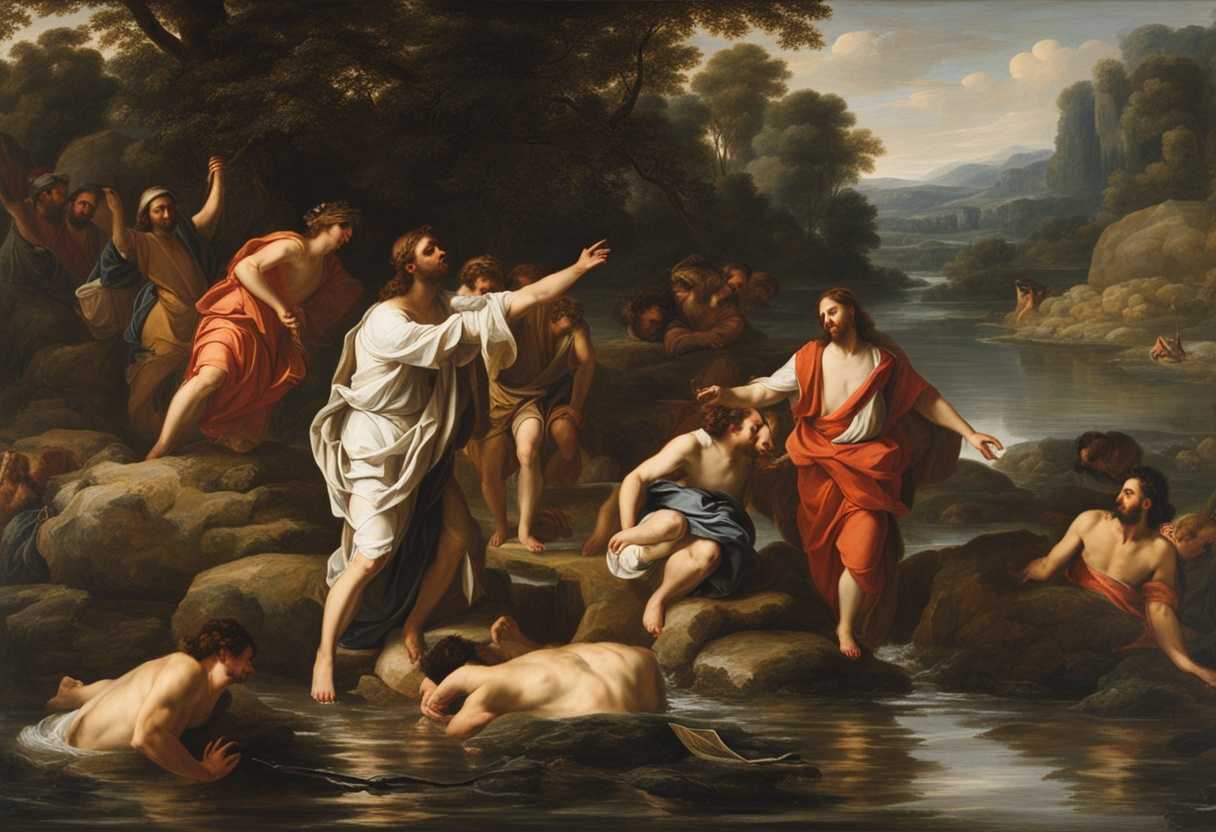
Setting the Scene for John 1:1-45
The scene in John chapter 1 opens with John the Baptist standing by the Jordan River, where he is baptizing people who come to him seeking repentance. The atmosphere is charged with anticipation as word spreads about this prophet who is preparing the way for the Messiah. Among those who come to be baptized is a man named Andrew, who is accompanied by another man, later revealed to be John, the beloved disciple.
As Andrew and John watch John the Baptist at work, their curiosity is piqued when he points to a figure in the distance and declares, “Behold, the Lamb of God!” Intrigued, they follow Jesus and engage in conversation with Him. This encounter marks the beginning of a transformative journey for Andrew and John, as they become two of Jesus’ closest disciples.
The setting is serene, with the gentle flow of the Jordan River providing a backdrop to this pivotal moment in the lives of Andrew and John. The air is filled with a sense of divine purpose as they stand on the banks of the river, unaware of the profound impact that their decision to follow Jesus will have on the course of history.
What is John 1:1-45 about?
The author introduces us to Jesus in a powerful and symbolic way in John 1:1-45. The text emphasizes the divine nature of Jesus as the expression of God’s message and the embodiment of God’s will on Earth by calling him the “Word made flesh.” This concept highlights the importance of Jesus as the ultimate revelation of God to humanity, showing us the way to salvation and eternal life.
Furthermore, by referring to Jesus as the “Lamb of God,” the text alludes to Jesus’ sacrificial role in redeeming humanity from sin. Just like the sacrificial lambs in the Jewish tradition symbolized atonement and forgiveness, Jesus, as the Lamb of God, represents the ultimate sacrifice that brings about reconciliation between God and humanity.
Lastly, in calling Jesus the promised Messiah, the text fulfills the Old Testament prophecies of a savior who would bring salvation and deliverance to God’s people. The author establishes Jesus’ authority and divinity by recognizing him as the fulfillment of these prophecies, inviting readers to place their faith and trust in him. This passage sets the stage for the rest of the Gospel of John, showing us who Jesus is and inviting us to believe in him as the Son of God and the source of eternal life.
Understanding what John 1:1-45 really means
John 1:1-4 serves as a foundational passage in the Gospel of John, unveiling the divine essence of Jesus Christ and His pivotal involvement in creation and life. These verses not only introduce us to the theological underpinnings of Jesus’ identity but also establish His profound connection with God the Father. The opening phrase, “In the beginning was the Word,” resonates with the creation narrative in Genesis 1:1, signifying the eternal existence of Jesus (the Word) before the inception of the world. This declaration underscores the timeless and uncreated nature of Christ, emphasizing His eternal presence.
Moreover, the assertion that “The Word was with God, and the Word was God” illuminates the intimate relationship between Jesus and the Father, affirming the divine nature of Christ. This statement encapsulates the mystery of the Trinity, portraying Jesus as distinct from the Father yet fully divine in essence. The subsequent proclamation, “Through him all things were made,” not only positions Jesus as the agent of creation but also underscores His sovereignty over all existence. This aligns seamlessly with the teachings in Colossians 1:16-17, which elucidate that all things were brought into being through Christ and for His divine purpose.
Furthermore, the assertion that “In him was life, and that life was the light of all mankind” unveils Jesus as the ultimate source of life, encompassing both physical and spiritual vitality. The metaphorical depiction of Jesus as the light that illuminates humanity underscores His role as the revealer of truth and salvation. This imagery is further expounded in John 8:12, where Jesus proclaims Himself as the “light of the world,” signifying His transformative power and guidance for all humanity. Understanding Jesus as the eternal Word and Creator not only deepens our appreciation for His sacrificial love but also offers a beacon of hope and direction in a world yearning for meaning and truth.
By internalizing the profound truths encapsulated in John 1:1-4, believers can anchor their faith in the divine authority of Jesus and His intimate involvement in their lives. Just as a skilled artist enters into his masterpiece to interact with his creation, Jesus, the Creator, steps into His creation to infuse it with life and light. This passage resonates with individuals seeking purpose and direction, offering a profound revelation that their lives derive meaning from being intricately crafted and sustained by Jesus. Through parallel passages like Genesis 1:1, Colossians 1:16-17, and John 8:12, the narrative of Jesus as the eternal Word and light of the world is reinforced, providing a solid foundation for believers to navigate their spiritual journey with confidence and assurance.
How can we truly see and follow Christ daily?
To truly see and follow Christ daily, we must first recognize Him as the Word made flesh, the Son of God who became human to dwell among us. This recognition requires us to have a deep understanding of His teachings, His character, and the significance of His sacrifice for mankind. We can begin to see Him clearly in our lives by immersing ourselves in the Word of God and seeking to understand Christ’s message of love, forgiveness, and salvation.
Following Christ daily also involves actively walking in His footsteps and living out His teachings in our own lives. This means showing love and compassion to others, forgiving those who wrong us, and striving to be faithful and obedient in all that we do. We can truly follow Him and reflect His light to those around us by aligning our actions and attitudes with the example set by Jesus. Through prayer, reading the Scriptures, and seeking guidance from the Holy Spirit, we can stay connected to Christ and be empowered to live out His calling in our daily lives.
Application
Imagine your workweek and family life as a bustling city. You’re a beacon of hope in that city, and like the disciples, you have the power to light up the darkest corners with Jesus’ message. Don’t let that valuable glow dim; share His love and salvation actively, wherever you go. Each interaction can be a spark that ignites someone’s life. Will you step up and be that guiding light in your community?

Reverend Michael Johnson is an experienced Church Minister with a profound expertise in spirituality and guidance. With a serene presence and a compassionate heart, he has faithfully served his congregation for over 20 years, leading them on a spiritual journey towards inner peace and enlightenment. Reverend Johnson’s extensive knowledge of religious philosophies and profound understanding of human nature have made him a trusted confidant and mentor to many, as he seamlessly weaves his profound wisdom into life teachings. Reverend Johnson’s calming demeanor and empathetic nature continue to uplift and heal souls, nurturing a sense of unity and tranquility within his community.