
Esther 1:1-12 is about the grand and opulent celebration held by King Xerxes in Susa where he displayed his wealth and power, but also revealed his arrogance and disregard for the significance of his queen, Vashti, leading to unforeseen consequences.
1 Now in the days of Ahasuerus, the Ahasuerus who reigned from India to Ethiopia over 127 provinces,
2 in those days when King Ahasuerus sat on his royal throne in Susa, the citadel,
3 in the third year of his reign he gave a feast for all his officials and servants. The army of Persia and Media and the nobles and governors of the provinces were before him,
4 He displayed the riches of his royal glory and the splendor and pomp of his greatness for many days, 180 days.
5 And when these days were completed, the king gave for all the people present in Susa the citadel, both great and small, a feast lasting for seven days in the court of the garden of the king’s palace.
6 There were white cotton curtains and violet hangings fastened with cords of fine linen and purple to silver rods and marble pillars, and also couches of gold and silver on a mosaic pavement of porphyry, marble, mother-of-pearl, and precious stones.
7 Drinks were served in golden vessels, vessels of different kinds, and the royal wine was lavished according to the bounty of the king.
8 By the king’s command they served drinks in golden vessels, each one different from the other, and the royal wine was lavished according to the king’s bounty.
9 Queen Vashti also gave a feast for the women in the palace that belonged to King Ahasuerus.
10 On the seventh day, when the heart of the king was merry with wine, he commanded Mehuman, Biztha, Harbona, Bigtha and Abagtha, Zethar and Carkas, the seven eunuchs who served in the presence of King Ahasuerus,
11 to bring Queen Vashti before the king with her royal crown, in order to show the peoples and the princes her beauty, for she was lovely to look at.
12 But Queen Vashti refused to come at the king’s command delivered by the eunuchs. At this the king became enraged, and his anger burned within him.
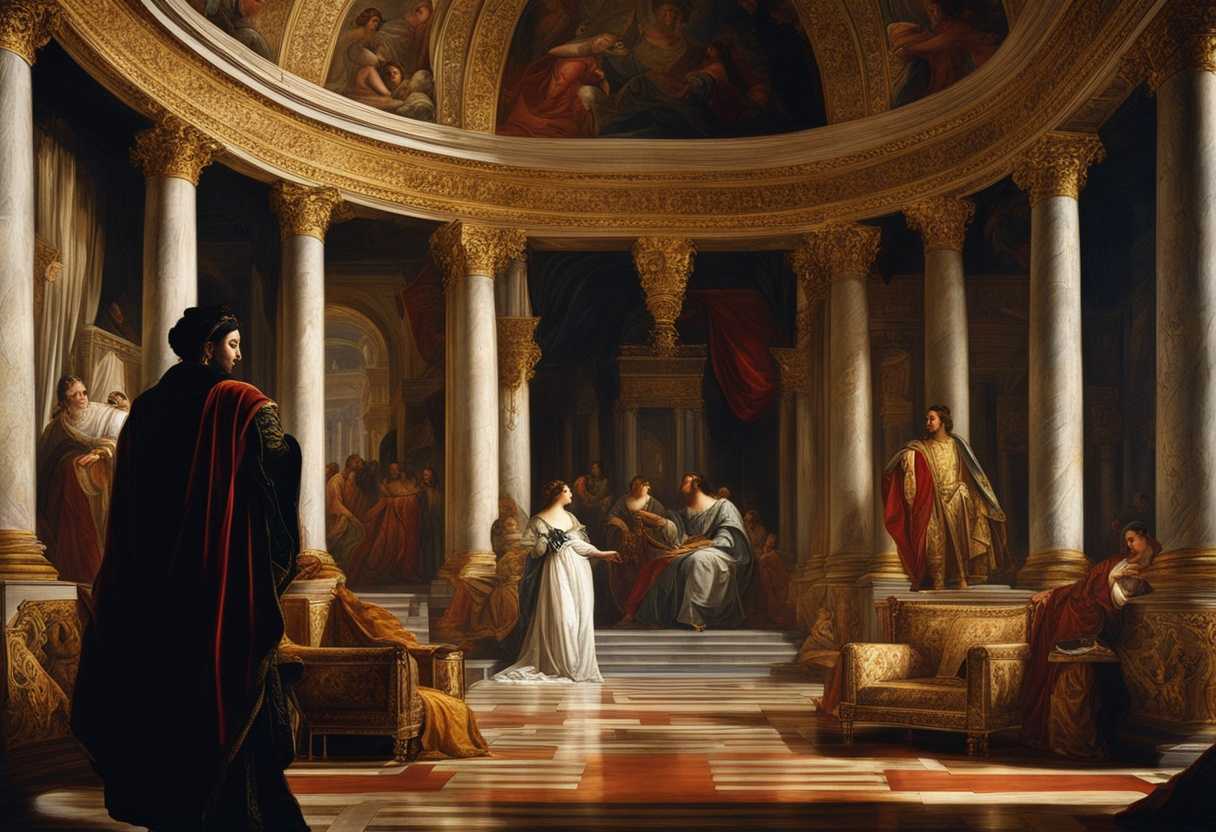
Setting the Scene for Esther 1:1-12
The scene in Esther chapter 1 opens in the opulent palace of King Xerxes in the ancient city of Susa. The king, also known as Ahasuerus, is hosting a grand banquet to showcase his wealth and power to his nobles, officials, and military leaders. The banquet hall is adorned with luxurious decorations, including fine linen, gold and silver couches, and goblets of gold. The atmosphere is filled with music and the aroma of exotic perfumes.
Among the guests are the most influential men in the Persian Empire, including Memucan, Biztha, Harbona, Bigtha, Abagtha, Zethar, and Carcas. These men have been summoned by the king to partake in the lavish feast and revel in the splendor of his court. They have arrived dressed in their finest attire, eager to indulge in the king’s hospitality and enjoy the entertainment provided for the occasion.
As the banquet progresses, King Xerxes becomes increasingly intoxicated by wine and orders his queen, Vashti, to come before the guests and display her beauty. However, Queen Vashti refuses to obey the king’s command, sparking a chain of events that will ultimately lead to her removal as queen and set the stage for the rise of Esther, a Jewish orphan who will become the new queen and play a pivotal role in saving her people from destruction.
What is Esther 1:1-12 about?
The opulence and extravagance of King Xerxes’ banquet in this verse demonstrate his wealth and power. The king seeks to showcase his status and authority, reinforcing his position as a ruler of great influence by hosting such a lavish event for his officials. This public display of affluence can be seen as a form of political symbolism, projecting an image of strength and prosperity to his subjects and allies. This verse prompts us to consider the importance of appearances and displays of material wealth in positions of power as we reflect on it. How do grand gestures and extravagant events shape perceptions of leadership and authority? What role does ostentation play in establishing dominance and influence in society? We can gain insight into the dynamics of power and prestige in historical contexts and contemporary settings alike by delving into the motivations behind such displays. This verse serves as a reminder of how visual symbols and showcases of wealth can wield significant influence in the realms of politics and leadership.
Understanding what Esther 1:1-12 really means
The Book of Esther unfolds in the lavish setting of the Persian Empire, under the rule of King Xerxes, also known as Ahasuerus. This initial passage sets the stage for the opulence and extravagance of the king’s court, where grand banquets and displays of wealth are commonplace. The narrative kicks off with a significant event: Queen Vashti’s refusal to appear before the king at his command. This act of defiance by Vashti becomes a crucial turning point that paves the way for Esther’s eventual ascension to the throne.
During the third year of his reign, King Xerxes hosts a banquet for all his nobles and officials, showcasing the immense wealth and splendor of his kingdom. The extravagant celebration lasting 180 days underscores the king’s desire to flaunt his power and riches to all in attendance. In parallel, Queen Vashti holds her own banquet for the women in the royal palace, indicating her position of influence and authority within the court. However, when the king’s attendants summon her to appear before the guests, Vashti boldly refuses, defying the king’s command and challenging his authority.
The refusal of Queen Vashti to comply with the king’s orders raises questions about power dynamics, integrity, and the consequences of standing up against unjust demands. This narrative resonates with contemporary discussions on personal ethics and the courage required to uphold one’s principles in the face of adversity. Drawing parallels to biblical passages like Proverbs 31 and Daniel 3, Vashti’s defiance can be viewed as an act of integrity and self-respect, akin to the virtuous qualities described in other scriptures.
In modern contexts, individuals often encounter dilemmas where they must choose between conformity and standing firm on their beliefs or rights. Just as Queen Vashti faced a pivotal decision, individuals today may find themselves in situations that test their integrity and moral compass. Reflecting on Vashti’s courage can inspire individuals to evaluate their values and make principled choices, even when faced with potential repercussions.
The passage from Esther 1:1-12 serves as a poignant reminder of the intricate interplay between power, authority, and personal integrity. It challenges readers to contemplate the significance of upholding what is right, even when confronted with adversity or potential loss. By contemplating Vashti’s bold stance, individuals can find encouragement to navigate their own moral dilemmas with integrity and conviction, drawing strength from her example to act in accordance with their values.
How can we maintain humility and avoid pride?
To maintain humility and avoid pride, we should reflect on the verse’s message of acknowledging that all our blessings and achievements come from God. We are less likely to become prideful by recognizing that our talents, successes, and any good in us are gifts from above. Gratitude towards God for all that we have helps us stay humble and grounded. The verse teaches us the importance of remembering our own limitations and weaknesses. Understanding that we are flawed human beings who are in constant need of God’s guidance and mercy can help us prevent pride from taking root in our hearts. We can guard against arrogance and self-righteousness by staying humble and acknowledging our dependence on God.
Additionally, seeking to serve and uplift others can be a powerful way to cultivate humility. When we shift our focus from ourselves to helping those around us, we are less likely to prioritize our own ego and desires. We can maintain a humble attitude and avoid becoming prideful by embodying kindness, generosity, and compassion towards others.
Application
Empower yourself by embodying Queen Vashti’s courage in the face of adversity. Take a stand against injustice and corruption, just as she did. Embrace your inner strength and refuse to be complicit in actions that compromise your principles. The world needs your voice and your actions to spark positive change. Will you join the fight for a better, more just society?

Reverend Michael Johnson is an experienced Church Minister with a profound expertise in spirituality and guidance. With a serene presence and a compassionate heart, he has faithfully served his congregation for over 20 years, leading them on a spiritual journey towards inner peace and enlightenment. Reverend Johnson’s extensive knowledge of religious philosophies and profound understanding of human nature have made him a trusted confidant and mentor to many, as he seamlessly weaves his profound wisdom into life teachings. Reverend Johnson’s calming demeanor and empathetic nature continue to uplift and heal souls, nurturing a sense of unity and tranquility within his community.