
Exodus 12:1-30 is about the institution of the Passover ritual as a means of redemption and protection for the Israelites from God’s judgment, emphasizing the importance of faith and obedience in receiving God’s deliverance.
1 The Lord said to Moses and Aaron in the land of Egypt,
2 “This month shall be for you the beginning of months. It shall be the first month of the year for you.
3 Tell all the congregation of Israel that on the tenth day of this month every man shall take a lamb according to their fathers’ houses, a lamb for a household.
4 And if the household is too small for a lamb, then he and his nearest neighbor shall take according to the number of persons; according to what each can eat you shall make your count for the lamb.
5 Your lamb shall be without blemish, a male a year old.
6 and you shall keep it until the fourteenth day of this month, when the whole assembly of the congregation of Israel shall kill their lambs at twilight.
7 Then they shall take some of the blood and put it on the two doorposts and the lintel of the houses in which they eat it.
8 They shall eat the flesh that night, roasted on the fire; with unleavened bread and bitter herbs they shall eat it.
9 Do not eat any of it raw or boiled in water, but roasted, its head with its legs and its inner parts.
10 And you shall let none of it remain until the morning; anything that remains until the morning you shall burn.
11 In this manner you shall eat it: with your belt fastened, your sandals on your feet, and your staff in your hand. And you shall eat it in haste. It is the Lord’s Passover.
12 For I will pass through the land of Egypt that night, and I will strike all the firstborn in the land of Egypt, both man and beast; and on all the gods of Egypt I will execute judgments: I am the Lord.
13 The blood shall be a sign for you, on the houses where you are. And when I see the blood, I will pass over you, and no plague will befall you to destroy you when I strike the land of Egypt.
14 “This day shall be for you a memorial day, and you shall keep it as a feast to the Lord; throughout your generations, as a statute forever, you shall keep it as a feast.”
15 Seven days you shall eat unleavened bread. On the first day you shall remove leaven out of your houses, for if anyone eats what is leavened, from the first day until the seventh day, that person shall be cut off from Israel.
16 On the first day you shall hold a holy assembly, and on the seventh day a holy assembly. No work shall be done on those days. But what everyone needs to eat, that alone may be prepared by you.
17 And you shall observe the Feast of Unleavened Bread, for on this very day I brought your hosts out of the land of Egypt. Therefore you shall observe this day, throughout your generations, as a statute forever.
18 In the first month, from the fourteenth day of the month at evening, you shall eat unleavened bread until the twenty-first day of the month at evening.
19 For seven days no leaven is to be found in your houses. If anyone eats what is leavened, that person will be cut off from the congregation of Israel, whether he is a sojourner or a native of the land.
20 You shall eat nothing leavened; in all your dwelling places you shall eat unleavened bread.”
21 Then Moses called all the elders of Israel and said to them, “Go and select lambs for yourselves according to your clans, and kill the Passover lamb.
22 Take a bunch of hyssop and dip it in the blood that is in the basin, and touch the lintel and the two doorposts with the blood that is in the basin. None of you shall go out of the door of his house until the morning.
23 For the Lord will pass through to strike the Egyptians, and when he sees the blood on the lintel and on the two doorposts, the Lord will pass over the door and will not allow the destroyer to enter your houses to strike you.
24 You shall observe this rite as a statute for you and for your sons forever.
25 And when you come to the land that the Lord will give you, as he has promised, you shall keep this service.
26 And when your children say to you, ‘What do you mean by this service?’
27 Then you shall say, ‘It is the sacrifice of the Lord’s Passover, for he passed over the houses of the people of Israel in Egypt, when he struck the Egyptians but spared our houses.’” And the people bowed their heads and worshiped.
28 Then the people of Israel went and did so; as the Lord had commanded Moses and Aaron, so they did.
29 At midnight the Lord struck down all the firstborn in the land of Egypt, from the firstborn of Pharaoh who sat on his throne to the firstborn of the captive who was in the dungeon, and all the firstborn of the livestock.
30 And Pharaoh rose up in the night, he and all his servants and all the Egyptians. And there was a great cry in Egypt, for there was not a house where someone was not dead.
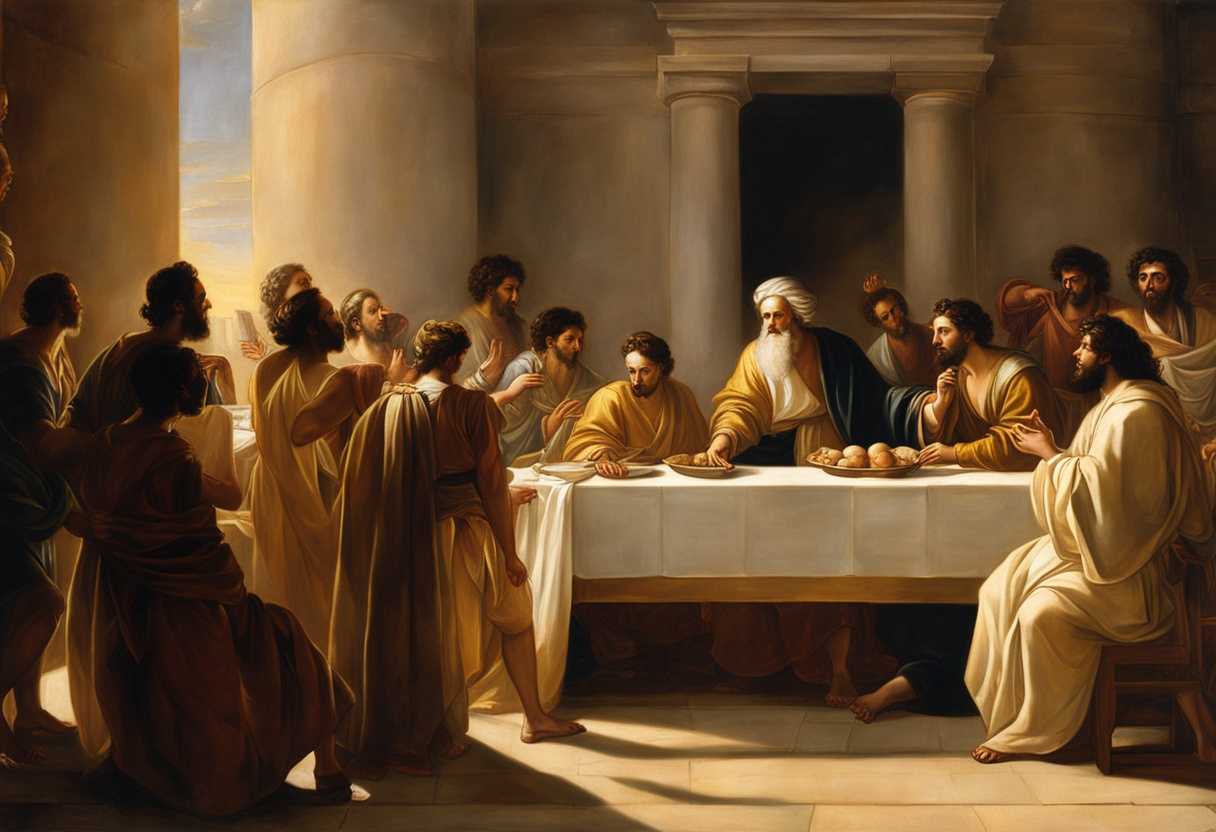
Setting the Scene for Exodus 12:1-30
The scene in Exodus 12:1-30 takes place in the land of Egypt, specifically in the midst of the final plague that God sends upon the Egyptians to secure the release of the Israelites from their bondage. The main characters in this scene are Moses, Aaron, Pharaoh, and the Israelites.
Moses and Aaron have been sent by God to deliver a message to Pharaoh, demanding the release of the Israelites. Despite numerous warnings and previous plagues, Pharaoh refuses to let the Israelites go. As a result, God sends the final and most devastating plague – the death of the firstborn in every Egyptian household.
The Israelites are instructed to mark their doorposts with the blood of a sacrificial lamb so that the angel of death will pass over their homes. The night is filled with wailing and mourning as the Egyptians suffer the loss of their firstborn, while the Israelites are spared. This event ultimately leads to Pharaoh finally allowing the Israelites to leave Egypt, marking the beginning of their exodus to freedom.
What is Exodus 12:1-30 about?
Imagine being in a time where sacrifice was a significant part of rituals. Picture the scene when the Israelites were preparing for Passover, following a specific set of instructions. The sacrifice of a lamb, spreading its blood on doorposts, and the eventual passing over of the angel of death in Egypt. How powerful and symbolic this act must have been for the Israelites, creating a clear distinction between those who obeyed the instructions and those who did not. The commemoration of an event that marked a pivotal moment in the history of the Israelites is seen in this verse. It shows the importance of obedience to God’s commands and the protection and redemption that follow. It also serves as a foreshadowing of the ultimate sacrifice of Jesus Christ, who would become the Passover Lamb for all of humanity’s sins. Reflecting on this verse urges us to think about the significance of our actions in following God’s guidance, the symbolism of redemption through sacrifice, and the ultimate protection that comes from aligning ourselves with God’s will.
Understanding what Exodus 12:1-30 really means
The passage in Exodus 12:1-30 unveils the institution of the Passover, a crucial event in Israel’s history. Here, God imparts instructions to Moses and Aaron regarding the Israelites’ preparation for departure from Egypt. This momentous occasion culminates in the final plague, sparing the Israelites while the firstborn in Egypt face devastation.
“This month shall be for you the beginning of months,” signifies a fresh start and new beginnings for the Israelites. The directive to “Take a lamb for each household” symbolizes sacrifice and redemption, foreshadowing the ultimate sacrifice of Jesus as the Lamb of God. The blood on the doorposts as a sign of protection and deliverance from God’s judgment underscores the urgency and readiness for God’s deliverance, as seen in the command to “Eat it in haste; it is the Lord’s Passover.”
In related biblical passages, John 1:29 identifies Jesus as the Lamb of God who takes away the sin of the world, while 1 Corinthians 5:7 draws a direct parallel between Christ and the Passover lamb. Hebrews 11:28 emphasizes the importance of faith in following God’s instructions for protection.
The relevance of the Passover extends to people today through themes of deliverance, new beginnings, sacrifice, and redemption. The universal concept of trusting in God’s promises and obeying His word resonates with the Christian faith, highlighting the significance of faith and obedience in our spiritual journey.
Consider a family facing a crisis, akin to the Israelites in Egypt, following specific instructions for safety. By adhering to these directives with faith and obedience, they experience deliverance and a fresh start. This narrative mirrors how faith and obedience to God’s word can lead to spiritual and physical deliverance in our lives today.
Reflect on areas in your life where a fresh start or deliverance is needed. Acknowledge the sacrifices made for your well-being and express gratitude. Embrace faith and obedience in your daily walk with God, trusting in His promises for protection and deliverance. By delving into the profound meanings and connections within this passage, we can grasp the enduring relevance of the Passover to our faith and lives today.
What does it mean to trust God’s protection?
Trusting God’s protection means having faith and confidence that He will shield and safeguard us from harm. It involves believing that God has the power to shield us from dangers and difficulties, even when we cannot see how it will happen. The verse reminds us that putting our trust in God’s protection allows us to feel secure and at peace, knowing that He is watching over us and guiding us through life’s challenges. We can surrender our fears and anxieties by trusting in God’s protection, knowing that He is in control and has a plan for our well-being. This trust enables us to live with courage and conviction, knowing that no matter what may come our way, God is there to protect us. It also encourages us to seek His guidance and rely on His strength in times of uncertainty and danger, knowing that His protection is a constant presence in our lives.
Application
Just as we follow instructions in our daily tasks at work, let us also heed God’s commandments in our spiritual journey. Like a compass guiding a ship through stormy seas, let God’s will lead us in the right direction. Take a moment to assess how closely you are walking in alignment with His word. Are you ready to embrace His guidance, bask in His divine protection, and witness His miraculous deliverance in your life?

Reverend Michael Johnson is an experienced Church Minister with a profound expertise in spirituality and guidance. With a serene presence and a compassionate heart, he has faithfully served his congregation for over 20 years, leading them on a spiritual journey towards inner peace and enlightenment. Reverend Johnson’s extensive knowledge of religious philosophies and profound understanding of human nature have made him a trusted confidant and mentor to many, as he seamlessly weaves his profound wisdom into life teachings. Reverend Johnson’s calming demeanor and empathetic nature continue to uplift and heal souls, nurturing a sense of unity and tranquility within his community.