
John 6:22-59 is about Jesus using the metaphor of eating his flesh and drinking his blood to symbolize the intimate relationship believers must have with him in order to receive eternal life.
22 On the next day the crowd that remained on the other side of the sea saw that there had been only one boat there, and that Jesus had not entered the boat with his disciples, but that his disciples had gone away alone.
23 Other boats from Tiberias came near the place where they had eaten the bread after the Lord had given thanks.
24 So when the crowd saw that Jesus was not there, nor his disciples, they themselves got into the boats and went to Capernaum, seeking Jesus.
25 When they found him on the other side of the sea, they said to him, “Rabbi, when did you come here?”
26 Jesus answered them, “Truly, truly, I say to you, you are seeking me, not because you saw signs, but because you ate your fill of the loaves.
27 Do not work for the food that perishes, but for the food that endures to eternal life, which the Son of Man will give to you. For on him God the Father has set his seal.”
28 Then they said to him, “What must we do, to be doing the works of God?”
29 Jesus answered them, “This is the work of God, that you believe in him whom he has sent.”
30 So they said to him, “Then what sign do you do, that we may see and believe you? What work do you perform?
31 Our fathers ate the manna in the wilderness; as it is written, ‘He gave them bread from heaven to eat.’”
32 Jesus then said to them, “Truly, truly, I say to you, it was not Moses who gave you the bread from heaven, but my Father gives you the true bread from heaven.
33 For the bread of God is he who comes down from heaven and gives life to the world.
34 They said to him, “Sir, give us this bread always.”
35 Jesus said to them, “I am the bread of life; whoever comes to me shall not hunger, and whoever believes in me shall never thirst.
36 But I said to you that you have seen me and yet do not believe.
37 All that the Father gives me will come to me, and whoever comes to me I will never cast out.
38 For I have come down from heaven, not to do my own will but the will of him who sent me.
39 And this is the will of him who sent me, that I should lose nothing of all that he has given me, but raise it up on the last day.
40 For this is the will of my Father, that everyone who looks on the Son and believes in him should have eternal life, and I will raise him up on the last day.”
41 So the Jews grumbled about him, because he said, “I am the bread that came down from heaven.”
42 They said, “Is not this Jesus, the son of Joseph, whose father and mother we know? How does he now say, ‘I have come down from heaven’?”
43 Jesus answered them, “Do not grumble among yourselves.
44 No one can come to me unless the Father who sent me draws him. And I will raise him up on the last day.
45 It is written in the Prophets, ‘And they will all be taught by God.’ So everyone who has heard and learned from the Father comes to me—
46 not that anyone has seen the Father except he who is from God; he has seen the Father.
47 Truly, truly, I say to you, whoever believes has eternal life.
48 I am the bread of life.
49 Your fathers ate the manna in the wilderness, and they died.
50 This is the bread that comes down from heaven, so that one may eat of it and not die.
51 I am the living bread that came down from heaven. If anyone eats of this bread, he will live forever. And the bread that I will give for the life of the world is my flesh.
52 The Jews then disputed among themselves, saying, “How can this man give us his flesh to eat?”
53 So Jesus said to them, “Truly, truly, I say to you, unless you eat the flesh of the Son of Man and drink his blood, you have no life in you.
54 Whoever feeds on my flesh and drinks my blood has eternal life, and I will raise him up on the last day.
55 For my flesh is true food, and my blood is true drink.
56 Whoever feeds on my flesh and drinks my blood abides in me, and I in him.
57 As the living Father sent me, and I live because of the Father, so whoever feeds on me, he also will live because of me.
58 This is the bread that came down from heaven, not like the bread the fathers ate, and died. Whoever feeds on this bread will live forever.”
59 Jesus said these things in the synagogue, as he taught at Capernaum.
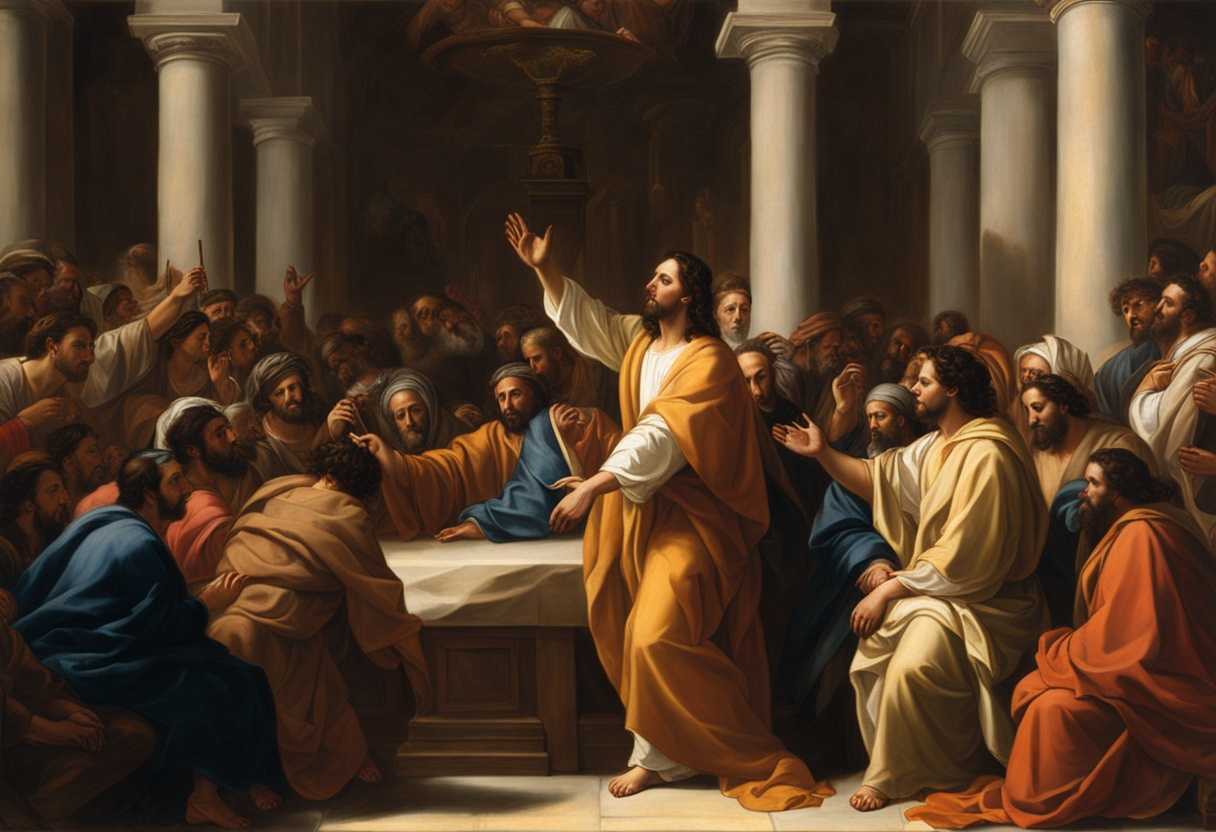
Setting the Scene for John 6:22-59
The scene in John chapter 6 opens with Jesus and his disciples on the shores of the Sea of Galilee. The day before, Jesus had performed the miracle of feeding the five thousand with just five loaves of bread and two fish. The crowd that had witnessed this miracle was amazed and sought out Jesus the next day, crossing the sea to find him.
As Jesus and his disciples stood on the shore, the crowd gathered around them, eager to hear more of his teachings and witness more miracles. The people were filled with curiosity and wonder, drawn to Jesus by his words and the signs he performed. The disciples, still processing the events of the previous day, were also present, listening intently to Jesus as he spoke to the crowd.
The setting was serene, with the Sea of Galilee shimmering in the sunlight and a gentle breeze blowing through the air. The crowd was a mix of men, women, and children, all eager to be in the presence of Jesus and learn from him. As Jesus began to speak to the crowd about being the bread of life, the atmosphere was charged with anticipation and awe, as everyone present hung on his every word.
What is John 6:22-59 about?
This verse, John 6:35, holds a powerful message about the significance of Jesus in our lives. Jesus sustains our spiritual selves just as bread sustains our physical bodies. He offers us not just temporary satisfaction, but eternal nourishment and life. When we believe in Jesus, we are aligning ourselves with the source of true life and fulfillment.
Have you ever considered the depth of meaning behind this analogy of Jesus as the bread of life? We need Jesus to truly live spiritually just as we need bread to survive physically. His teachings, love, and sacrifice provide us with the sustenance we need to grow and thrive in our faith journey. Through our belief in Him, we can experience a profound connection to God and the promise of eternal life. Isn’t it amazing to think about the transformative power of embracing Jesus as the bread of life in our hearts and minds? It is through this belief that we can find true nourishment for our souls and experience the fullness of life that God intends for us.
Understanding what John 6:22-59 really means
In John 6:22-59, we delve into a pivotal moment following Jesus’ miraculous feeding of the 5,000 and His walking on water. The crowd, intrigued by these displays of power, seeks Jesus, albeit not fully grasping the spiritual depth of His actions. Here, the main theme emerges: Jesus as the Bread of Life, emphasizing the importance of spiritual nourishment over mere physical sustenance.
“I am the bread of life,” proclaims Jesus in verse 35, drawing a parallel between Himself and the essential nature of bread for physical sustenance. This statement underscores His role as vital for spiritual life, highlighting the necessity of a relationship with Him for true fulfillment. Furthermore, Jesus promises that those who come to Him will find lasting satisfaction, never hungering or thirsting spiritually.
The imagery of bread from heaven providing life to the world in verse 33 echoes the provision of manna to the Israelites in Exodus 16:4-15. This connection signifies Jesus as the ultimate fulfillment of God’s divine provision for humanity’s deepest needs. Additionally, Matthew 4:4 reinforces the importance of spiritual nourishment, stating that man does not live by bread alone but by every word from God’s mouth. This emphasizes the significance of seeking sustenance beyond the physical realm.
In John 4:13-14, Jesus speaks to the Samaritan woman about living water, another metaphor for eternal life through Him. This dialogue further emphasizes the idea of Jesus as the source of spiritual fulfillment, offering a profound and everlasting satisfaction that transcends earthly desires. Today, amidst a world consumed by materialism and instant gratification, this passage calls for a shift towards seeking deeper spiritual fulfillment.
Consider a scenario where an individual, despite achieving wealth and success, feels a void within. Despite possessing all physical necessities, they lack a sense of purpose and contentment. Upon encountering a community of believers who introduce them to Jesus’ teachings, through prayer, study, and fellowship, they discover a profound peace and satisfaction. This transformation illustrates the truth of Jesus’ promise as the Bread of Life, offering a fulfillment beyond material wealth.
In conclusion, Jesus’ declaration as the Bread of Life beckons all to seek Him for genuine and enduring fulfillment. This passage challenges us to prioritize our spiritual well-being over immediate physical needs, urging us to cultivate a relationship with Jesus for true satisfaction and purpose in life. Let us heed this call to delve deeper into the spiritual nourishment that only Christ can provide, transcending the fleeting desires of the world.
What does it mean to truly partake in Christ?
To truly partake in Christ means to fully embrace and internalize His teachings and message. It involves an active engagement with His words and a deep understanding of the spiritual nourishment He offers. Partaking in Christ sustains our souls and strengthens our faith, just as physical food sustains our bodies.
This verse emphasizes the importance of not only believing in Christ but also actively engaging with Him. Christ invites us to experience a transformative relationship with Him by partaking in Him, allowing His teachings to guide our actions and decisions. This requires a genuine commitment to follow His path and allow His presence to shape our lives.
Truly partaking in Christ goes beyond mere surface-level belief; it requires a deep and personal connection with Him. We can truly partake in Christ and experience the fullness of His grace and salvation by nourishing our souls with His teachings and embodying His love and compassion in our interactions with others.
Application
Picture your daily grind, balancing work deadlines and family needs. Now imagine finding a source of strength that never fails. Dive into John 6:22-59 and let it push you to seek the bread of life—real, lasting nourishment. Reflect on making your connection with Christ as real as your everyday commitments. Will you answer the call to embrace the true sustenance and walk hand in hand with the Son of God?

Reverend Michael Johnson is an experienced Church Minister with a profound expertise in spirituality and guidance. With a serene presence and a compassionate heart, he has faithfully served his congregation for over 20 years, leading them on a spiritual journey towards inner peace and enlightenment. Reverend Johnson’s extensive knowledge of religious philosophies and profound understanding of human nature have made him a trusted confidant and mentor to many, as he seamlessly weaves his profound wisdom into life teachings. Reverend Johnson’s calming demeanor and empathetic nature continue to uplift and heal souls, nurturing a sense of unity and tranquility within his community.