
Exodus 17:8-16 is about the importance of faith and obedience in battling against enemies with divine assistance, symbolized by Moses’ outstretched arms and the defeat of the Amalekites when his hands were raised.
8 Then Amalek came and fought with Israel at Rephidim.
9 So Moses said to Joshua, “Choose for us men, and go out and fight with Amalek. Tomorrow I will stand on the top of the hill with the staff of God in my hand.”
10 So Joshua did as Moses told him, and fought with Amalek, while Moses, Aaron, and Hur went up to the top of the hill.
11 Whenever Moses held up his hand, Israel prevailed, and whenever he lowered his hand, Amalek prevailed.
12 But Moses’ hands grew weary, so they took a stone and put it under him, and he sat on it, while Aaron and Hur held up his hands, one on one side, and the other on the other side. So his hands were steady until the going down of the sun.
13 And Joshua overwhelmed Amalek and his people with the sword.
14 Then the Lord said to Moses, “Write this as a memorial in a book and recite it in the ears of Joshua, that I will utterly blot out the memory of Amalek from under heaven.”
15 And Moses built an altar and called the name of it, The Lord Is My Banner,
16 saying, “A hand upon the throne of the Lord! The Lord will have war with Amalek from generation to generation.”
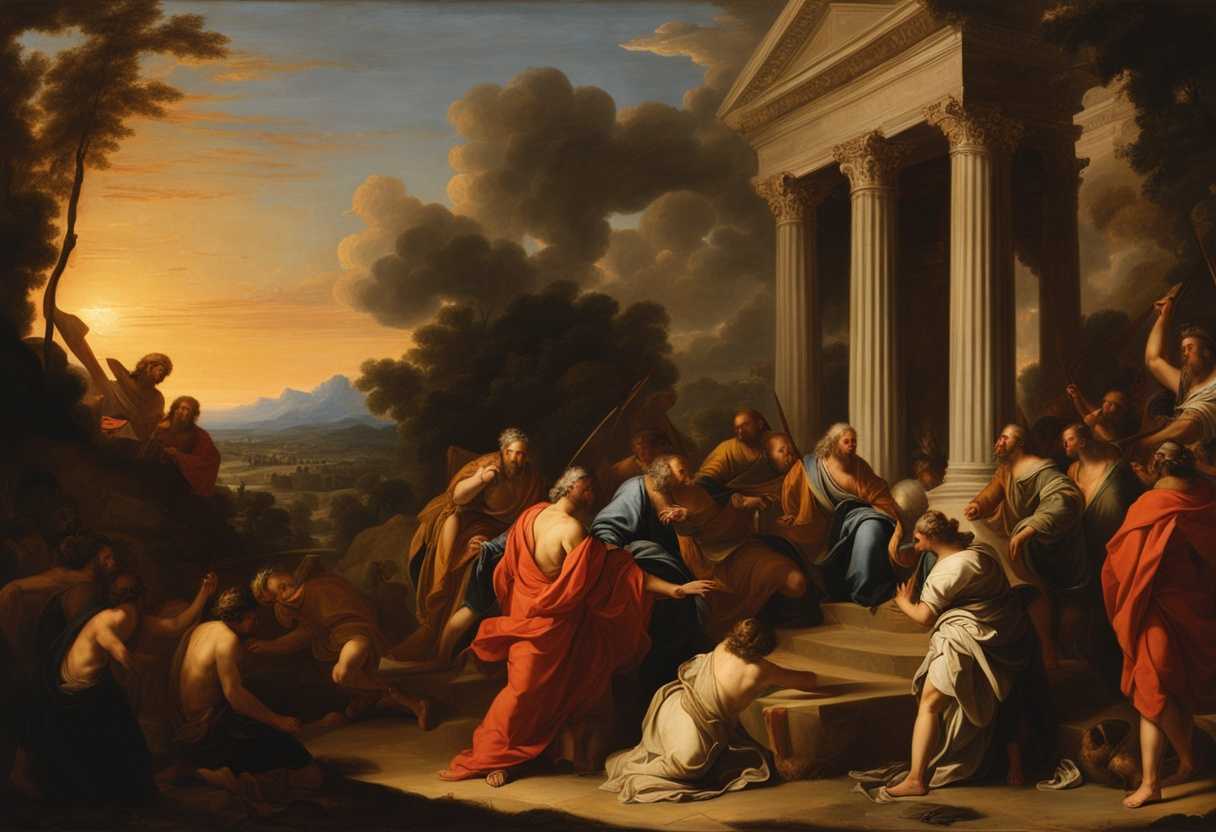
Setting the Scene for Exodus 17:8-16
In Exodus 17:8-16, we find the Israelites journeying through the wilderness after their escape from Egypt. As they traveled, they faced various challenges, including a lack of water. In this particular scene, the Israelites, led by Moses, find themselves in a fierce battle against the Amalekites.
The Israelites had just experienced God’s miraculous provision of water from a rock at Rephidim, but their faith was soon tested again as they encountered the hostile Amalekites. Moses, Aaron, and Hur climbed to the top of a nearby hill overlooking the battlefield. As the battle raged on, Moses stood with his hands raised in prayer to God. Whenever he lowered his hands, the Amalekites gained the upper hand, but as long as his hands were raised, the Israelites prevailed.
Surrounded by the harsh desert landscape, with the sounds of battle echoing in the distance, this scene captures the intense spiritual and physical warfare faced by the Israelites. Through Moses’ intercession and the bravery of the Israelite warriors, they emerged victorious, a testament to God’s faithfulness and their unwavering trust in Him.
What is Exodus 17:8-16 about?
Imagine the scene: Moses standing on a hill, arms raised high. The Israelites prevail in battle as they lift their arms. But what does this physical gesture symbolize? It’s more than just a simple act of holding up his arms; it represents a connection between Moses and God. Moses is demonstrating his faith, trust, and dependence on God’s power to bring victory in battle by raising his arms. It shows that in our weakest moments, when our strength falters, we can rely on the strength and power of God to see us through.
The imagery of Moses’ raised arms serves as a powerful reminder that victory comes not from our own might or abilities, but from God’s intervention and presence in our lives. We need to stay connected to God through prayer, faith, and trust to overcome the battles we face, just as Moses needed to keep his arms lifted to secure victory. It’s a profound lesson in surrendering our control and ego, and acknowledging that true victory is achieved when we align ourselves with God’s will and power. So, next time you face a challenge, remember the image of Moses with his arms raised high, and let it inspire you to lean on God for strength and victory.
Understanding what Exodus 17:8-16 really means
The Israelites, on their journey through the wilderness post-exodus from Egypt, encounter a new obstacle as the Amalekites engage them in battle at Rephidim. In this pivotal moment, Moses instructs Joshua to select men for combat while he positions himself on a hill, holding the staff of God. This act of delegation by Moses highlights the significance of shared responsibility and effective leadership in times of crisis. As the battle unfolds, a symbolic gesture emerges: as long as Moses raises his hands, the Israelites prevail; when his hands lower, the Amalekites gain ground. This act serves as a powerful symbol of dependence on God, with Moses’ raised hands representing prayer and reliance on divine intervention.
Aaron and Hur play a crucial role in this narrative by supporting Moses, holding his hands aloft—one on each side—until sunset. This act underscores the importance of community and mutual assistance during challenging times. The unity displayed by Aaron, Hur, and Moses exemplifies the strength found in collective support and cooperation. The passage resonates with broader themes found throughout the Bible, such as Psalm 121:1-2, emphasizing seeking help from the Lord, and 1 Timothy 2:8, which encourages prayer and faith through lifted hands.
Moreover, the story in Exodus 17:8-16 serves as a poignant reminder for contemporary audiences. It prompts reflection on the significance of depending on God amidst life’s struggles, the power of community support during adversity, and the essence of effective leadership through delegation and trust. Just as Moses relied on God for victory, individuals today are encouraged to trust in divine guidance in their daily challenges. The narrative also highlights the strength found in unity and mutual aid, echoing the sentiment of Galatians 6:2, which stresses the importance of bearing one another’s burdens.
To illustrate the relevance of this passage in modern contexts, envision a scenario where a small business owner faces a financial crisis. Through prayer and seeking divine wisdom, akin to Moses lifting his hands, he finds solace. His team, mirroring Aaron and Hur, steps in to provide support by brainstorming solutions and sharing the workload. Together, they navigate the crisis, showcasing the significance of faith, prayer, and communal assistance in overcoming obstacles. In conclusion, the account of Moses, Joshua, Aaron, and Hur in Exodus 17:8-16 underscores the vital role of faith, prayer, and community in navigating life’s battles. It serves as a testament that with God’s guidance and the backing of those around us, we can triumph over any challenge that comes our way.
How can we rely on God in times of battle?
We can rely on God in times of battle by remembering that He is our ultimate source of strength and victory. We can also turn to God for guidance, protection, and deliverance, just as Moses held up his staff to symbolize God’s presence and power in the midst of the battle against the Amalekites. We acknowledge that our battles are ultimately fought and won through His grace and providence by trusting in God and seeking His help in times of need.
Furthermore, we can rely on God in times of battle by understanding that He is always with us, fighting on our behalf. We can engage in the physical and spiritual aspects of warfare knowing that God is watching over us and working behind the scenes to bring about His purposes, just as Joshua led the Israelites in battle while Moses interceded with God. We can find courage and strength to face any challenges that come our way by maintaining faith in God’s presence and faithfulness. Surrendering our own plans and abilities to His will and sovereignty ultimately means relying on God in times of battle. We can approach battle with a confidence that transcends our own limitations by seeking His guidance, trusting in His promises, and following His leading. We can find peace and assurance that God will ultimately bring about victory in His perfect timing and ways as we acknowledge His supremacy and authority over all things.
Application
Just as Moses lifted his hands in battle, it’s time for us to raise our prayers for those in need. Let’s harness the power of intercession, becoming warriors in our modern world. Like a beacon of light in the darkness, our prayers can bring hope and strength to those facing their own battles. Will you join in the fight and lift up those around you through the power of prayer?

Reverend Michael Johnson is an experienced Church Minister with a profound expertise in spirituality and guidance. With a serene presence and a compassionate heart, he has faithfully served his congregation for over 20 years, leading them on a spiritual journey towards inner peace and enlightenment. Reverend Johnson’s extensive knowledge of religious philosophies and profound understanding of human nature have made him a trusted confidant and mentor to many, as he seamlessly weaves his profound wisdom into life teachings. Reverend Johnson’s calming demeanor and empathetic nature continue to uplift and heal souls, nurturing a sense of unity and tranquility within his community.