
1 The two angels came to Sodom in the evening, and Lot was sitting in the gate of Sodom. When Lot saw them, he rose to meet them and bowed himself with his face to the earth.
2 and said, “My lords, please turn aside to your servant’s house and spend the night and wash your feet. Then you may rise up early and go on your way.” They said, “No; we will spend the night in the town square.”
3 But he pressed them strongly; so they turned aside to him and entered his house.
4 But before they lay down, the men of the city, the men of Sodom, both young and old, all the people to the last man, surrounded the house.
5 And they called to Lot, “Where are the men who came to you tonight? Bring them out to us, that we may know them.”
6 Lot went out to the men at the entrance, shut the door after him,
7 And said, “I beg you, my brothers, do not act so wickedly.
8 Behold, I have two daughters who have not known any man. Let me bring them out to you, and do to them as you please.
9 But they said, “Stand back!” And they said, “This fellow came to sojourn, and he has become the judge! Now we will deal worse with you than with them.” Then they pressed hard against the man Lot, and drew near to break the door down.
10 But the men reached out their hands and brought Lot into the house with them and shut the door.
11 And they struck with blindness the men who were at the entrance of the house, both small and great, so that they wore themselves out groping for the door.
12 Then the men said to Lot, “Have you anyone else here? Sons-in-law, sons, daughters, or anyone you have in the city, bring them out of the place.
13 For we are about to destroy this place, because the outcry against its people has become great before the Lord, and the Lord has sent us to destroy it.
14 So Lot went out and said to his sons-in-law, who were to marry his daughters, “Up! Get out of this place, for the Lord is about to destroy the city.” But he seemed to his sons-in-law to be jesting.
15 As morning dawned, the angels urged Lot, saying, “Up! Take your wife and your two daughters who are here, lest you be swept away in the punishment of the city.”
16 But he lingered. So the men seized him and his wife and his two daughters by the hand, the Lord being merciful to him, and they brought him out and set him outside the city.
17 And as they brought them out, one said, “Escape for your life. Do not look back or stop anywhere in the valley. Escape to the hills, lest you be swept away.”
18 And Lot said to them, “Oh, no, my lords.
19 Behold, your servant has found favor in your sight, and you have shown me great kindness in saving my life.
20 Behold, this city is near enough to flee to, and it is a little one. Let me escape there—is it not a little one?—and my life will be saved!”
21 He said to him, “Behold, I grant you this favor also, that I will not overthrow the city of which you have spoken.
22 Escape there quickly, for I can do nothing till you arrive there.” Therefore the name of the city was called Zoar.
23 The sun had risen on the earth when Lot came to Zoar.
24 Then the Lord rained on Sodom and Gomorrah sulfur and fire from the Lord out of heaven.
25 And he overthrew those cities, and all the valley, and all the inhabitants of the cities, and what grew on the ground.
26 But Lot’s wife, behind him, looked back, and she became a pillar of salt.
27 And Abraham went early in the morning to the place where he had stood before the Lord.
28 And he looked down toward Sodom and Gomorrah and toward all the land of the valley, and he looked and, behold, the smoke of the land went up like the smoke of a furnace.
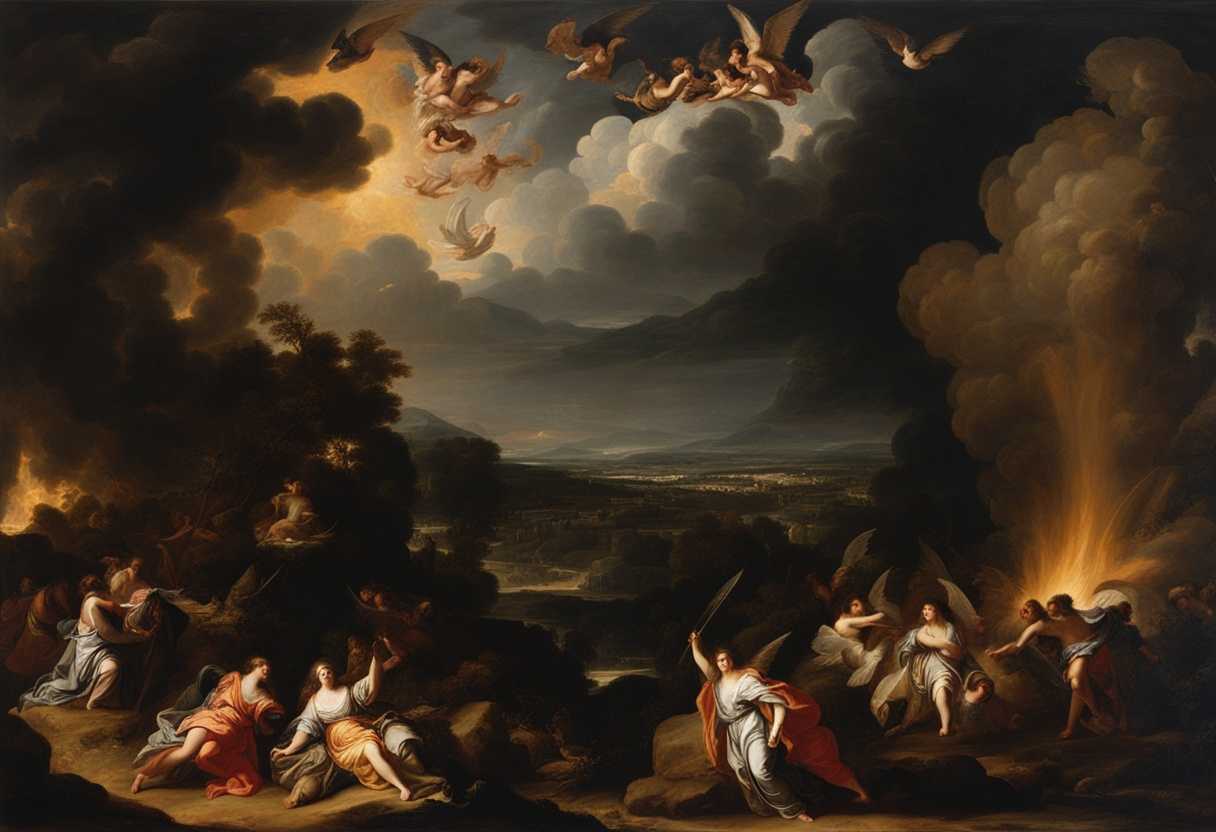
Setting the Scene for Genesis 19:1-28
In Genesis chapter 19, the scene unfolds in the ancient city of Sodom, known for its wickedness and sinfulness. Two angels, disguised as men, arrive at the city gates in the evening. Lot, the nephew of Abraham, sees them and insists they stay at his house for the night. Lot knows the dangers of the city and wants to protect the visitors from harm.
As the night progresses, the men of Sodom surround Lot’s house and demand that he bring out the two visitors so they can have relations with them. Lot, in an attempt to protect his guests, offers his two daughters instead, but the men refuse. The angels then reveal their true identities and warn Lot of the impending destruction of the city due to its great sinfulness.
The scene is tense and filled with moral dilemmas as Lot tries to navigate the wickedness of the city while also upholding his duty as a host to protect his guests. The surroundings are likely dark and foreboding, with the city of Sodom symbolizing the depths of depravity and sin. Lot’s actions in this scene will have far-reaching consequences as the story continues to unfold.
What is Genesis 19:1-28 about?
Let’s delve into the significance of this powerful verse about the destruction of Sodom and Gomorrah. This passage serves as a poignant reminder of the consequences of wickedness and moral decay. It shows us that when people choose to live in sin and turn away from God’s ways, they face destruction and judgment.
Can you imagine the extent of evil that must have been present in these cities for God to decide to bring about their complete destruction? This verse challenges us to reflect on our own actions and the state of our society. Are we following God’s teachings and living righteously, or are we allowing wickedness to prevail around us? This verse ultimately highlights the importance of living a life of virtue and righteousness, and warns against the dangers of straying from God’s path. It prompts us to examine our own conduct and make the choice to align ourselves with God’s principles, lest we too face a similar fate as Sodom and Gomorrah.
Understanding what Genesis 19:1-28 really means
Structure for Commentary:
- Introduction to the Passage
- Key Themes and Phrases
- Contextual Connections in the Bible
- Relevance Today
- Anecdote and Reflection
- Conclusion
Commentary:
Introduction to the Passage
Genesis 19:1-28 recounts the story of Sodom and Gomorrah’s destruction, focusing on Lot’s interactions with the angelic visitors and the subsequent judgment upon the cities for their wickedness. This passage highlights themes of hospitality, divine judgment, and the consequences of moral corruption.
Key Themes and Phrases
The story begins with Lot meeting the two angels at the city gate of Sodom, insisting on providing hospitality. “My lords, please turn aside to your servant’s house,” Lot says, showcasing his respect and urgency (Genesis 19:2). This phrase demonstrates Lot’s awareness of his responsibility to protect and serve the visitors, reflecting the ancient Near Eastern customs of hospitality.
Later, the townspeople’s demand to abuse the guests starkly contrasts this hospitality, signifying the depth of Sodom’s depravity. God’s decision to destroy the cities emerges from their unrepentant sinfulness, emphasizing divine justice and holiness.
Contextual Connections in the Bible
This passage correlates with other biblical texts addressing divine judgment. For example, in Luke 17:28-30, Jesus references Sodom’s fate to describe the suddenness of God’s judgment, urging preparedness and righteousness. Additionally, James 2:25 praises Rahab’s hospitality to the spies, contrasting Sodom’s inhospitality, which led to its downfall.
Lot’s story also parallels Noah’s account, where both characters are spared from divine wrath for their relative righteousness. This continuous narrative thread in the Bible underscores that while God’s judgment is righteous and inevitable, His mercy remains accessible to those who seek it.
Relevance Today
The themes of Genesis 19:1-28 are profoundly relevant today. The passage calls for a reflection on the state of our moral integrity and hospitality. Are we, like Lot, standing against the tide of societal corruption with righteousness and compassion? The story challenges us to evaluate our actions and attitudes toward strangers and the vulnerable. This story invites us to think about how we treat those seeking shelter or refuge in our modern context. Are our communities welcoming and just, or do they mirror the inhospitable and wicked behavior of Sodom’s inhabitants? Someone shows profound hospitality amidst adversity in a community experience. Recall a story from my congregation, where a family opened their home to a displaced individual after a natural disaster. This act of kindness not only provided physical shelter but also restored dignity and hope.
Such actions resonate deeply with Lot’s hospitality. Despite the imminent danger and the city’s prevailing sinful nature, he chose to do what was right. His story encourages us to embody similar courage and righteousness in our lives, regardless of societal pressures.
Conclusion
Genesis 19:1-28 challenges us to live righteously and uphold the values of hospitality and compassion. It serves as a reminder that divine judgment is real, yet so is divine mercy. How we treat others, especially the vulnerable and the stranger, reflects our commitment to God’s principles. We should strive to be beacons of light in a world often marred by darkness, mirroring the hospitality and righteousness that God desires from us.
How can we show compassion and hospitality to others?
We can show compassion and hospitality to others by being welcoming and kind towards them. We should be ready to offer hospitality and help to those in need, just as Lot did for the two strangers in Sodom. We practice compassion and show that we value their well-being by offering our resources, time, and care to others.
Being compassionate and hospitable also involves putting the needs of others before our own desires or comfort. This may require us to go out of our way to provide assistance or create a welcoming environment for those around us. By showing kindness and empathy to others, we also demonstrate our commitment to serving and loving our neighbors as ourselves. Showing compassion and hospitality to others ultimately reflects our gratitude for the blessings we have received. We are living out the values of kindness, empathy, and selflessness by extending generosity and care to those in our midst.
Application
Take a moment to think about Genesis 19:1-28—that story of Sodom and Gomorrah is our wake-up call. The outcome of their lives shows us what happens when we lose our way. In the hustle of work and the chaos of family life, staying true to our values can feel like swimming against the current. But isn’t it worth standing firm and choosing righteousness, no matter what? How are you going to stay true to your faith when the world around you pulls you in different directions?

Reverend Michael Johnson is an experienced Church Minister with a profound expertise in spirituality and guidance. With a serene presence and a compassionate heart, he has faithfully served his congregation for over 20 years, leading them on a spiritual journey towards inner peace and enlightenment. Reverend Johnson’s extensive knowledge of religious philosophies and profound understanding of human nature have made him a trusted confidant and mentor to many, as he seamlessly weaves his profound wisdom into life teachings. Reverend Johnson’s calming demeanor and empathetic nature continue to uplift and heal souls, nurturing a sense of unity and tranquility within his community.