
1 The two angels came to Sodom in the evening, and Lot was sitting in the gate of Sodom. When Lot saw them, he rose to meet them and bowed himself with his face to the earth.
2 and said, “My lords, please turn aside to your servant’s house and spend the night and wash your feet. Then you may rise up early and go on your way.” They said, “No; we will spend the night in the town square.”
3 But he pressed them strongly; so they turned aside to him and entered his house. And he made them a feast and baked unleavened bread, and they ate.
4 But before they lay down, the men of the city, the men of Sodom, both young and old, all the people to the last man, surrounded the house.
5 And they called to Lot, “Where are the men who came to you tonight? Bring them out to us, that we may know them.”
6 Lot went out to the men at the entrance, shut the door after him,
7 And said, “I beg you, my brothers, do not act so wickedly.
8 Behold, I have two daughters who have not known any man. Let me bring them out to you, and do to them as you please.
9 But they said, “Stand back!” And they said, “This fellow came to sojourn, and he has become the judge! Now we will deal worse with you than with them.” Then they pressed hard against the man Lot, and drew near to break the door down.
10 But the men reached out their hands and brought Lot into the house with them and shut the door.
11 And they struck with blindness the men who were at the entrance of the house, both small and great, so that they wore themselves out groping for the door.
12 Then the men said to Lot, “Have you anyone else here? Sons-in-law, sons, daughters, or anyone you have in the city, bring them out of the place.
13 For we are about to destroy this place, because the outcry against its people has become great before the Lord, and the Lord has sent us to destroy it.
14 So Lot went out and said to his sons-in-law, who were to marry his daughters, “Up! Get out of this place, for the Lord is about to destroy the city.” But he seemed to his sons-in-law to be jesting.
15 As morning dawned, the angels urged Lot, saying, “Up! Take your wife and your two daughters who are here, lest you be swept away in the punishment of the city.”
16 But he lingered. So the men seized him and his wife and his two daughters by the hand, the Lord being merciful to him, and they brought him out and set him outside the city.
17 And as they brought them out, one said, “Escape for your life. Do not look back or stop anywhere in the valley. Escape to the hills, lest you be swept away.”
18 And Lot said to them, “Oh, no, my lords.
19 Behold, your servant has found favor in your sight, and you have shown me great kindness in saving my life.
20 Behold, this city is near enough to flee to, and it is a little one. Let me escape there—is it not a little one?—and my life will be saved!”
21 He said to him, “Behold, I grant you this favor also, that I will not overthrow the city of which you have spoken.
22 Escape there quickly, for I can do nothing till you arrive there.” Therefore the name of the city was called Zoar.
23 The sun had risen on the earth when Lot came to Zoar.
24 Then the Lord rained on Sodom and Gomorrah sulfur and fire from the Lord out of heaven.
25 So he overthrew those cities, and all the valley, and all the inhabitants of the cities, and what grew on the ground.
26 But Lot’s wife, behind him, looked back, and she became a pillar of salt.
27 And Abraham went early in the morning to the place where he had stood before the Lord.
28 And he looked down toward Sodom and Gomorrah and toward all the land of the valley, and he looked and, behold, the smoke of the land went up like the smoke of a furnace.
29 So it was that, when God destroyed the cities of the valley, God remembered Abraham and sent Lot out of the midst of the overthrow when he overthrew the cities in which Lot had lived.
Setting the Scene for Genesis 19:1-29
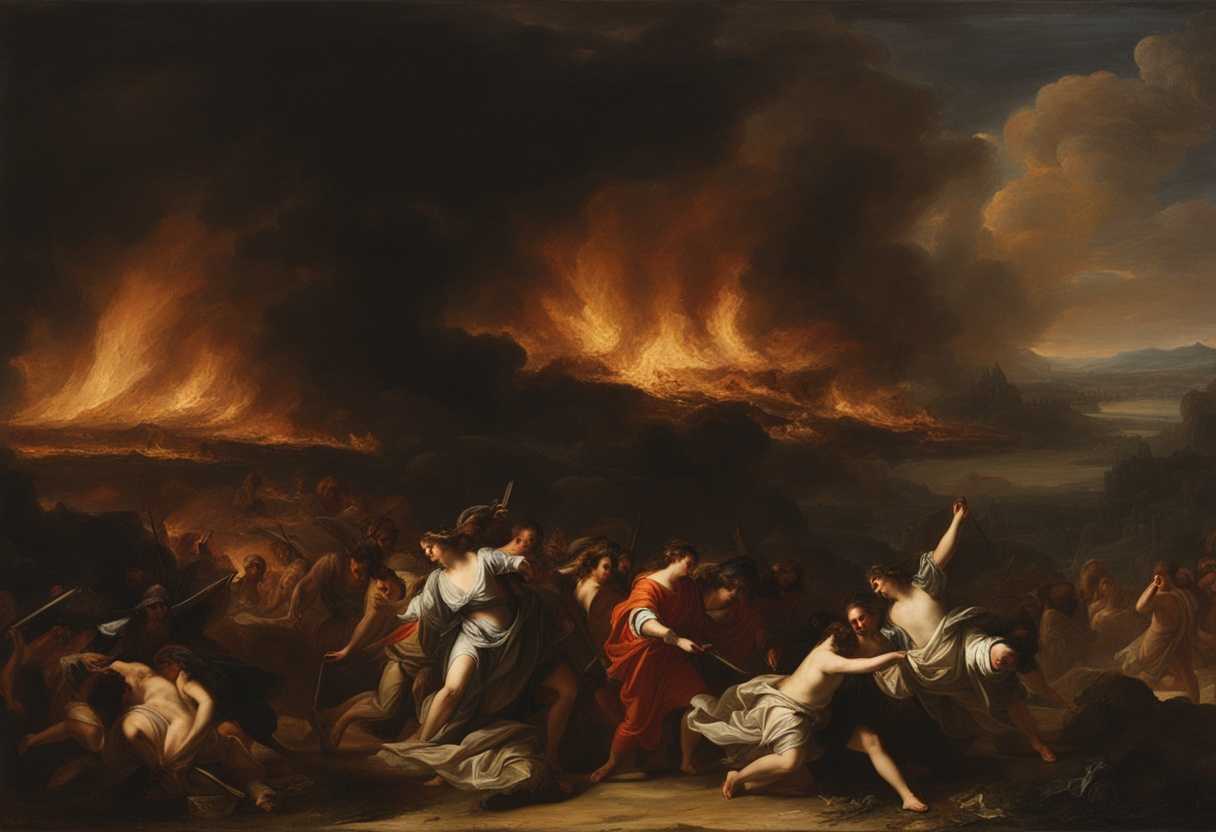
In Genesis 19:1-29, the scene is set in the ancient city of Sodom, known for its wickedness and sinfulness. Two angels, disguised as men, arrive at the city gates and are greeted by Lot, Abraham’s nephew, who is sitting at the entrance. Lot, a righteous man, insists on showing hospitality to the strangers and invites them to stay at his house for the night.
As the evening progresses, the men of Sodom surround Lot’s house and demand that he bring out the two visitors so they can have relations with them. Lot, horrified by their wicked intentions, tries to protect his guests. The angels intervene and strike the men with blindness, urging Lot to gather his family and flee the city before it is destroyed by God’s judgment.
The scene is tense and filled with moral conflict as Lot and his family are faced with the choice of following God’s command to leave the city or staying in a place consumed by sin. The surroundings are dark and foreboding, reflecting the moral decay of Sodom and the impending destruction that is about to be unleashed.
What is Genesis 19:1-29 about?
A stark contrast between the consequences of wickedness and the mercy of God is seen in this verse. Sodom and Gomorrah were two cities known for their extreme evil and sinfulness. Because of their continuous wickedness and refusal to repent, God decided to destroy them as a punishment. This destruction serves as a powerful example of the consequences of living a life devoid of morality and righteousness.
However, amidst this destruction, we also witness the compassion and mercy of God towards Lot and his family. Despite the widespread sinfulness surrounding them, Lot and his family were spared from the destruction because of their faith and righteousness. This highlights the importance of faith and obedience to God even in the midst of a corrupt society. We reflect on this verse, prompting us to consider the impact of our actions and the choices we make. Are we living a life guided by virtue and righteousness, or are we veering towards wickedness and sin? Furthermore, it challenges us to cultivate a deep relationship with God, knowing that His mercy and grace are always available to those who choose to follow Him faithfully.
Understanding what Genesis 19:1-29 really means
Structure for the Commentary:
-
Introduction
- Contextual background
- Importance of the passage
-
Detailed Analysis
- Specific phrases and their meanings
- Cross-references to other biblical texts
-
Relevance to Modern Readers
- Explanation of its contemporary implications
- Anecdote to illustrate the context
-
Conclusion
- Summarize main points
- Reflective questions for the reader
Introduction
Genesis 19:1-29 details the destruction of Sodom and Gomorrah and the rescue of Lot and his family. To understand this passage, we consider its context—the preceding events in Genesis 18, where Abraham intercedes for Sodom. This story is not just about judgment; it challenges us to reflect on themes like hospitality, righteousness, and the consequences of sin.
Detailed Analysis
One significant phrase is “two angels arrived at Sodom in the evening.” Angels symbolize God’s direct intervention. This scene recalls Hebrews 13:2, encouraging hospitality by reminding us that some have entertained angels unawares. Lot’s willingness to host the angels contrasts sharply with the townspeople’s violent intent, underlining a stark moral dichotomy.
Another weighty moment is when Lot’s wife “looked back, and she became a pillar of salt.” Her longing for what was left behind symbolizes the danger of clinging to a sinful past. Jesus himself references this in Luke 17:32, instructing to “Remember Lot’s wife!”.” It serves as a solemn warning against the peril of looking back once God has called us forward.
Lastly, “the outcry against its people has become great before the Lord” indicates that divine justice responds to the cries of the oppressed. This echoes the sentiments in Exodus 3:7, where God hears the Israelites’ suffering in Egypt, showcasing that God’s justice arises from compassion and righteousness.
Relevance to Modern Readers
Today, this passage encourages us to consider our own morality, the repercussions of our decisions, and God’s call for us to live righteously. It highlights the importance of hospitality and looking forward to God’s promises rather than dwelling on past sins. Amid contemporary societal challenges, we are reminded that divine justice extends to all forms of injustice. A community welcomes strangers and aids the disadvantaged, fostering inclusiveness and compassion in a modern-day scenario. Contrast this with a community indulgent in selfishness and exploitation. Which reflects God’s values as depicted in Genesis?
Anecdote
Imagine someone holding onto a past mistake, constantly looking back and unable to move forward. This person might feel stuck, paralyzed by regret. However, when they begin to focus on future opportunities and seek God’s guidance, they start to experience freedom and progress. This mirrors the call in Genesis 19 not to look back but to trust in God’s future.
Conclusion
Genesis 19:1-29 is not just a narrative of destruction but a profound lesson on righteousness, hospitality, and the peril of looking back. It challenges readers to consider their own lives and choices. Are we living in a way that welcomes and uplifts others? Are we moving forward in faith, heeding God’s call?
Reflect on these questions. How do you extend hospitality today? How do you respond to the recognition of past mistakes—by looking back or moving forward in faith? These reflections help us apply the lessons of Genesis to our daily lives.
How can we stay faithful in a corrupt world?
One way we can stay faithful in a corrupt world is by being mindful of the company we keep and the influences around us. Lot’s righteous behavior contrasts with the corrupt ways of the people of Sodom in the story in Genesis 19. Despite being surrounded by wickedness and corruption, Lot remained faithful to his beliefs and values. This serves as a reminder for us to choose our companions wisely and to not be swayed by the negative influences of the world.
Another way to remain faithful in a corrupt world is by holding true to our principles and beliefs, even when faced with challenges or temptations. Lot’s decision to offer hospitality to the two angels, even at great personal risk, demonstrates his commitment to righteousness in the face of corruption. We must stand firm in our convictions and not compromise our values in our own lives, even when it may be easier to go along with the prevailing corruption around us.
Lastly, staying connected to our faith community and seeking guidance and support from others who share our beliefs can help us navigate the challenges of a corrupt world. Just as Lot relied on the angels for protection and guidance, we can lean on our spiritual community for strength and encouragement in times of moral ambiguity and temptation. We can find the support we need to stay faithful in a corrupt world by staying connected to our faith and surrounding ourselves with like-minded individuals.
Application
Think of your life as balancing work deadlines and family responsibilities. Genesis 19:1-29 is a wake-up call, showing the dire consequences when a city ignored core values and laws. Just like missing a crucial deadline at work can have serious fallout, straying from God’s teachings can have lasting consequences. Are you ready to make choices that honor God’s word and steer clear of these pitfalls? Will you step up today and follow His path?

Reverend Michael Johnson is an experienced Church Minister with a profound expertise in spirituality and guidance. With a serene presence and a compassionate heart, he has faithfully served his congregation for over 20 years, leading them on a spiritual journey towards inner peace and enlightenment. Reverend Johnson’s extensive knowledge of religious philosophies and profound understanding of human nature have made him a trusted confidant and mentor to many, as he seamlessly weaves his profound wisdom into life teachings. Reverend Johnson’s calming demeanor and empathetic nature continue to uplift and heal souls, nurturing a sense of unity and tranquility within his community.