
is about the promise and blessing of God being passed down through generations, as seen in the story of Isaac receiving Abraham’s blessing and covenant with God.
1 The Lord visited Sarah as he had said, and the Lord did to Sarah as he had promised.
2 And Sarah conceived and bore Abraham a son in his old age at the time of which God had spoken to him.
3 Abraham called the name of his son who was born to him, whom Sarah bore him, Isaac.
4 And Abraham circumcised his son Isaac when he was eight days old, as God had commanded him.
5 Abraham was a hundred years old when his son Isaac was born to him.
6 And Sarah said, “God has made laughter for me; everyone who hears will laugh over me.”
7 And she said, “Who would have said to Abraham that Sarah would nurse children? Yet I have borne him a son in his old age.”
8 And the child grew and was weaned. And Abraham made a great feast on the day that Isaac was weaned.
9 But Sarah saw the son of Hagar the Egyptian, whom she had borne to Abraham, laughing.
10 So she said to Abraham, “Cast out this slave woman with her son, for the son of this slave woman shall not be heir with my son Isaac.”
11 And the thing was very displeasing to Abraham on account of his son.
12 But God said to Abraham, “Be not displeased because of the boy and because of your slave woman. Whatever Sarah says to you, do as she tells you, for through Isaac shall your offspring be named.”
13 And I will make a nation of the son of the slave woman also, because he is your offspring.
14 So Abraham rose early in the morning and took bread and a skin of water and gave it to Hagar, putting it on her shoulder, along with the child, and sent her away. And she departed and wandered in the wilderness of Beersheba.
15 When the water in the skin was gone, she put the child under one of the bushes.
16 Then she went and sat down opposite him a good way off, about the distance of a bowshot, for she said, “Let me not look on the death of the child.” And as she sat opposite him, she lifted up her voice and wept.
17 And God heard the voice of the boy, and the angel of God called to Hagar from heaven and said to her, “What troubles you, Hagar? Fear not, for God has heard the voice of the boy where he is.
18 Up! Lift up the boy, and hold him fast with your hand, for I will make him into a great nation.”
19 Then God opened her eyes, and she saw a well of water. And she went and filled the skin with water and gave the boy a drink.
20 And God was with the boy, and he grew up. He lived in the wilderness and became an expert with the bow.
21 He lived in the wilderness of Paran, and his mother took a wife for him from the land of Egypt.
22 At that time Abimelech and Phicol the commander of his army said to Abraham, “God is with you in all that you do.
23 Now therefore swear to me here by God that you will not deal falsely with me or with my descendants or with my posterity, but as I have dealt kindly with you, so you will deal with me and with the land where you have sojourned.”
24 Abraham said, “I will swear.”
25 When Abraham reproved Abimelech about a well of water that Abimelech’s servants had seized.
26 And Abimelech said, “I do not know who has done this thing; you did not tell me, and I have not heard of it until today.”
27 So Abraham took sheep and oxen and gave them to Abimelech, and the two men made a covenant.
28 Then Abraham set seven ewe lambs of the flock apart.
29 And Abimelech said to Abraham, “What is the meaning of these seven ewe lambs that you have set apart?”
30 He said, “You shall take these seven ewe lambs from my hand, so that you may be a witness for me that I dug this well.”
31 Therefore that place was called Beersheba, because there both of them swore an oath.
32 Thus they made a covenant at Beersheba.
33 Abraham planted a tamarisk tree in Beersheba and called there on the name of the Lord, the Everlasting God.
34 So Abraham sojourned in the land of the Philistines for many days.
22 After these things God tested Abraham and said to him, “Abraham!” And he said, “Here I am.”
2 He said, “Take your son, your only son Isaac, whom you love, and go to the land of Moriah, and offer him there as a burnt offering on one of the mountains of which I shall tell you.”
3 So Abraham rose early in the morning, saddled his donkey, and took two of his young men with him, and his son Isaac. And he cut the wood for the burnt offering and arose and went to the place of which God had told him.
4 On the third day Abraham lifted up his eyes and saw the place from afar.
5 Then Abraham said to his young men, “Stay here with the donkey; I and the boy will go over there and worship and come again to you.”
6 And Abraham took the wood of the burnt offering and laid it on Isaac his son. And he took in his hand the fire and the knife. So they went both of them together.
7 And Isaac said to his father Abraham, “My father!” And he said, “Here I am, my son.” He said, “Behold, the fire and the wood, but where is the lamb for a burnt offering?”
8 Abraham said, “God will provide for himself the lamb for a burnt offering, my son.” So they went both of them together.
9 When they came to the place of which God had told him, Abraham built the altar there and laid the wood in order and bound Isaac his son and laid him on the altar, on top of the wood.
10 Then Abraham reached out his hand and took the knife to slaughter his son.
11 But the angel of the Lord called to him from heaven and said, “Abraham, Abraham!” And he said, “Here I am.”
12 He said, “Do not lay your hand on the boy or do anything to him, for now I know that you fear God, seeing you have not withheld your son, your only son, from me.”
13 And Abraham lifted up his eyes and looked, and behold, behind him was a ram, caught in a thicket by his horns. And Abraham went and took the ram and offered it up as a burnt offering instead of his son.
14 So Abraham called the name of that place, “The Lord will provide”; as it is said to this day, “On the mount of the Lord it shall be provided.”
15 And the angel of the Lord called to Abraham a second time from heaven
22 and said, “By myself I have sworn, declares the Lord, because you have done this and have not withheld your son, your only son,
17 I will surely bless you, and I will surely multiply your offspring as the stars of heaven and as the sand that is on the seashore. And your offspring shall possess the gate of his enemies,
18 and in your offspring shall all the nations of the earth be blessed, because you have obeyed my voice.”
19 So Abraham returned to his young men, and they arose and went together to Beersheba. And Abraham lived at Beersheba.
20 Now after these things it was told to Abraham, “Behold, Milcah also has borne children to your brother Nahor:
21 Uz his firstborn, Buz his brother, Kemuel the father of Aram,
22 In Bethuel fathered Rebekah. These eight Milcah bore to Nahor, Abraham’s brother.
23 Bethuel fathered Rebekah. These eight Milcah bore to Nahor, Abraham’s brother.
24 His concubine, whose name was Reumah, also bore Tebah, Gaham, Tahash, and Maacah.
1 Sarah lived 127 years; these were the years of the life of Sarah.
2 And Sarah died at Kiriath-arba (that is, Hebron) in the land of Canaan, and Abraham went in to mourn for Sarah and to weep for her.
3 And Abraham rose up from before his dead and said to the Hittites,
4 “I am a sojourner and foreigner among you; give me property among you for a burying place, that I may bury my dead out of my sight.”
5 “And the Hittites answered Abraham,”
6 “Hear us, my lord; you are a prince of God among us. Bury your dead in the choicest of our tombs. None of us will withhold from you his tomb to hinder you from burying your dead.”
7 Abraham rose and bowed to the Hittites, the people of the land.
8 “He said to them, ‘If you are willing that I should bury my dead out of my sight, hear me and entreat for me Ephron the son of Zohar,’”
9 that he may give me the cave of Machpelah, which he owns; it is at the end of his field. For the full price let him give it to me in your presence as property for a burying place.”
10 Now Ephron was sitting among the Hittites, and Ephron the Hittite answered Abraham in the hearing of the Hittites, of all who went in at the gate of his city.
11 “No, my lord, hear me: I give you the field, and I give you the cave that is in it. In the sight of the sons of my people I give it to you. Bury your dead.”
12 And Abraham bowed before the people of the land.
13 and he said to Ephron in the hearing of the people of the land, “But if you will, hear me: I give the price of the field. Accept it from me, that I may bury my dead there.”
14 Ephron answered Abraham, “My lord, listen to me: a piece of land worth four hundred shekels of silver, what is that between you and me? Bury your dead.”
15 “My lord, listen to me; a piece of land worth four hundred shekels of silver, what is that between you and me? Bury your dead.”
16 Abraham listened to Ephron, and Abraham weighed out for Ephron the silver that he had named in the hearing of the Hittites, four hundred shekels of silver, according to the weights current among the merchants.
17 So the field of Ephron in Machpelah, which was to the east of Mamre, the field with the cave that was in it and all the trees that were in the field, throughout its whole area, was made over
18 to Abraham as a possession in the presence of the Hittites, before all who went in at the gate of his city.
19 After this, Abraham buried Sarah his wife in the cave of the field of Machpelah east of Mamre (that is, Hebron) in the land of Canaan.
20 the field and the cave that is in it were made over to Abraham as property for a burying place by the Hittites.
1 Now Abraham was old, well advanced in years. And the Lord had blessed Abraham in all things.
2 And Abraham said to his servant, the oldest of his household, who had charge of all that he had, “Put your hand under my thigh,
3 that I may make you swear by the Lord, the God of heaven and God of the earth, that you will not take a wife for my son from the daughters of the Canaanites, among whom I dwell,
4 but will go to my country and to my kindred, and take a wife for my son Isaac.”
5 The servant said to him, “Perhaps the woman may not be willing to follow me to this land. Must I then take your son back to the land from which you came?”
6 And Abraham said to him, “See to it that you do not take my son back there.
7 The Lord, the God of heaven, who took me from my father’s house and from the land of my kindred, and who spoke to me and swore to me, ‘To your offspring I will give this land,’ he will send his angel before you, and you shall take a wife for my son from there.
8 If the woman is not willing to follow you, then you will be free from this oath of mine; only you must not take my son back there.”
9 So the servant put his hand under the thigh of Abraham his master and swore to him concerning this matter.
10 Then the servant took ten of his master’s camels and departed, taking all sorts of choice gifts from his master; and he arose and went to Mesopotamia to the city of Nahor.
11 And he made the camels kneel down outside the city by the well of water at the time of evening, the time when women go out to draw water.
12 And he said, “O Lord, God of my master Abraham, please grant me success today and show steadfast love to my master Abraham.
13 Behold, I am standing by the spring of water.
14 Let the young woman to whom I shall say, ‘Please let down your jar that I may drink,’ and who shall say, ‘Drink, and I will water your camels’—let her be the one whom you have appointed for your servant Isaac. By this I shall know that you have shown steadfast love to my master.”
15 Before he had finished speaking, behold, Rebekah, who was born to Bethuel the son of Milcah, the wife of Nahor, Abraham’s brother, came out with her water jar on her shoulder.
16 The young woman was very attractive in appearance, a maiden whom no man had known.
17 The servant ran to meet her and said, “Please give me a little water to drink from your jar.”
18 She said, “Drink, my lord.” And she quickly let down her jar upon her hand and gave him a drink.
19 After she had given him a drink, she said, “I will draw water for your camels also, until they have finished drinking.”
20 and quickly emptied her jar into the trough and ran again to the well to draw water, and she drew for all his camels.
21 The man gazed at her in silence to learn whether the Lord had prospered his journey or not.
22 When the camels had finished drinking, the man took a gold ring weighing a half shekel, and two bracelets for her arms weighing ten gold shekels,
23 And said, “Whose daughter are you? Please tell me, is there room in your father’s house for us to spend the night?”
24 She said to him, “I am the daughter of Bethuel the son of Milcah, whom she bore to Nahor.”
25 She added, “We have plenty of both straw and fodder, and room to spend the night.”
26 The man bowed his head and worshiped the Lord.
27 saying, “Blessed be the Lord, the God of my master Abraham, who has not forsaken his steadfast love and his faithfulness toward my master. As for me, the Lord has led me in the way to the house of my master’s kinsmen.”
28 The young woman ran and told her mother’s household about these things.
29 Rebekah had a brother whose name was Laban. Laban ran out toward the man, to the spring.
30 As soon as he had seen the ring and the bracelets on his sister’s arms, and heard the words of Rebekah his sister, “Thus the man spoke to me,” he went to the man. And behold, he was standing by the camels at the spring.
31 He said, “Come in, O blessed of the Lord. Why do you stand outside? For I have prepared the house and a place for the camels.”
32 So the man came to the house and unharnessed the camels, and gave straw and fodder to the camels, and there was water to wash his feet and the feet of the men who were with him.
33 Then food was set before him to eat, but he said, “I will not eat until I have said what I have to say.” So he said, “Speak on.”
34 So he said, “I am Abraham’s servant.
35 The Lord has greatly blessed my master, and he has become great. He has given him flocks and herds, silver and gold, male servants and female servants, camels and donkeys.
36 And Sarah my master’s wife bore a son to my master when she was old, and to him he has given all that he has.
37 My master made me swear, saying, ‘You shall not take a wife for my son from the daughters of the Canaanites, in whose land I dwell,
38 but you shall go to my father’s house and to my clan and take a wife for my son.’
39 I said to my master, ‘Perhaps the woman will not come with me.’
40 He said to me, ‘The Lord, before whom I have walked, will send his angel with you and prosper your way.
41 Then you will be free from my oath, when you come to my clan. And if they will not give her to you, you will be free from my oath.’
42 “I came today to the spring and said, ‘O Lord, the God of my master Abraham, if now you are prospering the way that I go,”
43 Behold, I am standing by the spring of water. Let the virgin who comes out to draw water, to whom I shall say, “Please give me a little water from your jar to drink,”
44 and she shall say to me, “Drink, and I will draw for your camels also,” let her be the woman whom the Lord has appointed for my master’s son.’
45 “Before I had finished speaking in my heart, behold, Rebekah came out with her water jar on her shoulder, and she went down to the spring and drew water. I said to her, ‘Please let me drink.’”
46 She quickly let down her jar from her shoulder and said, ‘Drink, and I will give your camels drink also.’ So I drank, and she gave the camels drink also.
47 Then I asked her, ‘Whose daughter are you?’ She said, ‘The daughter of Bethuel, Nahor’s son, whom Milcah bore to him.’ So I put the ring on her nose and the bracelets on her arms.
48 Then I bowed my head and worshiped the Lord and blessed the Lord, the God of my master Abraham, who had led me by the right way to take the daughter of my master’s kinsman for his son.
49 Now then, if you are going to show steadfast love and faithfulness to my master, tell me; and if not, tell me, that I may turn to the right hand or to the left.”
50 Then Laban and Bethuel answered and said, “The thing has come from the Lord; we cannot speak to you bad or good.
51 Behold, Rebekah is before you; take her and go, and let her be the wife of your master’s son, as the Lord has spoken.”
52 When Abraham’s servant heard their words, he bowed himself to the earth before the Lord.
53 And the servant brought out jewelry of silver and of gold, and garments, and gave them to Rebekah. He also gave to her brother and to her mother costly ornaments.
54 Then he and the men who were with him ate and drank and spent the night. When they arose in the morning, he said, “Send me away to my master.”
55 But her brother and her mother said, “Let the young woman remain with us a while, at least ten days; after that she may go.”
56 But he said to them, “Do not delay me, since the Lord has prospered my way. Send me away that I may go to my master.”
57 They said, “Let us call the young woman and ask her.”
58 And they called Rebekah and said to her, “Will you go with this man?” She said, “I will go.”
59 So they sent away Rebekah their sister and her nurse, and Abraham’s servant and his men.
24 They blessed Rebekah and said to her, “Our sister, may you become thousands of ten thousands, and may your offspring possess the gate of those who hate him!”
61 Then Rebekah and her young women arose and rode on the camels and followed the man. Thus the servant took Rebekah and went his way.
62 Now Isaac had returned from Beer-lahai-roi and was dwelling in the Negeb.
63 And Isaac went out to meditate in the field toward evening. And he lifted up his eyes and saw, and behold, there were camels coming.
64 And Rebekah lifted up her eyes, and when she saw Isaac, she dismounted from the camel.
65 and said to the servant, “Who is that man, walking in the field to meet us?” The servant said, “It is my master.” So she took her veil and covered herself.
66 And the servant told Isaac all the things that he had done.
67 Then Isaac brought her into the tent of Sarah his mother and took Rebekah, and she became his wife, and he loved her. So Isaac was comforted after his mother’s death.
1 Abraham took another wife, whose name was Keturah.
2 She bore him Zimran, Jokshan, Medan, Midian, Ishbak, and Shuah.
3 Jokshan fathered Sheba and Dedan. The sons of Dedan were Asshurim, Letushim, and Leummim.
4 The sons of Midian: Ephah, Epher, Hanoch, Abida, and Eldaah. All these were the children of Keturah.
5 Abraham gave all he had to Isaac.
6 but to the sons of his concubines Abraham gave gifts, and while he was still living he sent them away from his son Isaac, eastward to the east country.
7 These are the days of the years of Abraham’s life, 175 years.
8 Abraham breathed his last and died in a good old age, an old man and full of years, and was gathered to his people.
9 And his sons Isaac and Ishmael buried him in the cave of Machpelah, in the field of Ephron the son of Zohar the Hittite, east of Mamre,
10 the field that Abraham purchased from the Hittites. There Abraham was buried, with Sarah his wife.
11 After the death of Abraham, God blessed Isaac his son.
12 These are the generations of Ishmael, Abraham’s son, whom Hagar the Egyptian, Sarah’s servant, bore to Abraham.
13 These are the names of the sons of Ishmael, named in the order of their birth: Nebaioth, the firstborn of Ishmael, and Kedar, Adbeel, Mibsam,
14 Mishma, Dumah, Massa,
15 Hadad died, and Samlah of Masrekah reigned in his place.
16 These are the sons of Ishmael and these are their names, by their villages and by their encampments, twelve princes according to their tribes.
17 (These are the years of the life of Ishmael: 137 years. He breathed his last and died, and was gathered to his people.)
18 They settled from Havilah to Shur, which is opposite Egypt in the direction of Assyria. He settled over against all his kinsmen.
19 These are the generations of Isaac, Abraham’s son: Abraham fathered Isaac.
20 and Isaac was forty years old when he took Rebekah, the daughter of Bethuel the Aramean of Paddan-aram, the sister of Laban the Aramean, to be his wife.
21 And Isaac prayed to the Lord for his wife, because she was barren. And the Lord granted his prayer, and Rebekah his wife conceived.
22 The children struggled together within her, and she said, “If it is thus, why is this happening to me?” So she went to inquire of the Lord.
23 And the Lord said to her, “Two nations are in your womb, and two peoples from within you shall be divided; the one shall be stronger than the other, the older shall serve the younger.”
24 When her days to give birth were completed, behold, there were twins in her womb.
25 The first came out red, all his body like a hairy cloak, so they called his name Esau.
26 Afterward his brother came out with his hand holding Esau’s heel, so his name was called Jacob.
27 When the boys grew up, Esau was a skillful hunter, a man of the field, while Jacob was a quiet man, dwelling in tents.
28 Isaac loved Esau because he ate of his game, but Rebekah loved Jacob.
29 Once when Jacob was cooking stew, Esau came in from the field, and he was exhausted.
30 And Esau said to Jacob, “Let me eat some of that red stew, for I am exhausted!” (Therefore his name was called Edom.)
31 Jacob said, “Sell me your birthright now.”
32 Esau said, “Behold, I am about to die; of what use is a birthright to me?”
33 Then Jacob said, “Swear to me now.” So he swore to him and sold his birthright to Jacob.
34 Then Jacob gave Esau bread and lentil stew, and he ate and drank and rose and went his way. So Esau despised his birthright.
1 Now there was a famine in the land, besides the former famine that was in the days of Abraham. And Isaac went to Gerar to Abimelech king of the Philistines.
2 And the Lord appeared to him and said, “Do not go down to Egypt; dwell in the land of which I shall tell you.
3 Sojourn in this land, and I will be with you and will bless you, for to you and to your offspring I will give all these lands, and I will establish the oath that I swore to Abraham your father.
4 I will multiply your offspring as the stars of heaven and will give to your offspring all these lands. And in your offspring all the nations of the earth shall be blessed,
5 because Abraham obeyed my voice and kept my charge, my commandments, my statutes, and my laws.”
6 So Isaac settled in Gerar.
7 When the men of the place asked him about his wife, he said, “She is my sister,” for he feared to say, “My wife,” thinking, “lest the men of the place should kill me because of Rebekah,” because she was attractive in appearance.
8 When he had been there a long time, Abimelech king of the Philistines looked out of a window and saw Isaac laughing with Rebekah his wife.
9 So Abimelech called Isaac and said, “Behold, she is your wife. How then could you say, ‘She is my sister’?” Isaac said to him, “Because I thought, ‘Lest I die because of her.’”
10 Then Abimelech said, “What is this you have done to us? One of the people might easily have lain with your wife, and you would have brought guilt upon us.”
11 So Abimelech warned all the people, saying, “Whoever touches this man or his wife shall surely be put to death.”
12 And Isaac sowed in that land and reaped in the same year a hundredfold. The Lord blessed him,
13 And the man became rich, and gained more and more until he became very wealthy.
14 He had possessions of flocks and herds and many servants, so that the Philistines envied him.
15 So all the wells that his father’s servants had dug in the days of Abraham his father, the Philistines stopped up, filling them with earth.
16 And Abimelech said to Isaac, “Go away from us, for you are much mightier than we.”
17 So Isaac departed from there and encamped in the Valley of Gerar and settled there.
18 And Isaac dug again the wells of water that had been dug in the days of Abraham his father, which the Philistines had stopped after the death of Abraham. And he gave them the names that his father had given them.
19 Isaac’s servants dug in the valley and found there a well of spring water.
20 But the herdsmen of Gerar quarreled with Isaac’s herdsmen, saying, “The water is ours.” So he called the name of the well Esek, because they contended with him.
21 Then they dug another well, and they quarreled over that also, so he called its name Sitnah.
22 He moved away from there and dug another well, and they did not quarrel over it. So he called its name Rehoboth, saying, “For now the Lord has made room for us, and we shall be fruitful in the land.”
23 From there he went up to Beersheba.
24 And the Lord appeared to him the same night and said, “I am the God of Abraham your father. Fear not, for I am with you and will bless you and multiply your offspring for my servant Abraham’s sake.”
25 So he built an altar there and called upon the name of the Lord and pitched his tent there. And there Isaac’s servants dug a well.
26 When Abimelech went to him from Gerar with Ahuzzath his adviser and Phicol the commander of his army.
27 Isaac said to them, “Why have you come to me, seeing that you hate me and have sent me away from you?”
28 They said, “We see plainly that the Lord has been with you. So we said, let there be a sworn pact between us, between you and us, and let us make a covenant with you,
29 that you will do us no harm, just as we have not touched you and have done to you nothing but good and have sent you away in peace. You are now the blessed of the Lord.”
30 So he made them a feast, and they ate and drank.
31 In the morning they rose early and exchanged oaths. And Isaac sent them on their way, and they departed from him in peace.
32 That same day Isaac’s servants came and told him about the well that they had dug and said to him, “We have found water.”
33 He called it Shibah; therefore the name of the city is Beersheba to this day.
34 When Esau was forty years old, he took Judith the daughter of Beeri the Hittite to be his wife, and Basemath the daughter of Elon the Hittite,
35 They made life bitter for Isaac and Rebekah.
27 When Isaac was old and his eyes were dim so that he could not see, he called Esau his older son and said to him, “My son”; and he answered, “Here I am.”
2 And he said, “Behold, I am old; I do not know the day of my death.
3 Now then, take your weapons, your quiver and your bow, and go out to the field and hunt game for me,
4 and prepare for me delicious food, such as I love, and bring it to me so that I may eat, that my soul may bless you before I die.”
5 Now Rebekah was listening when Isaac spoke to his son Esau. So when Esau went to the field to hunt for game and bring it,
6 Rebekah said to her son Jacob, “I heard your father speak to your brother Esau, saying,
7 ‘Bring me game and prepare for me delicious food, that I may eat it and bless you before the Lord before I die.’
8 Now therefore, my son, obey my voice as I command you.
9 Go to the flock and bring me two good young goats, so that I may prepare from them delicious food for your father, such as he loves.
10 Then you shall bring it to your father, that he may eat, so that he may bless you before he dies.”
11 But Jacob said to Rebekah his mother, “Behold, my brother Esau is a hairy man, and I am a smooth man.
12 Perhaps my father will feel me, and I shall seem to be mocking him and bring a curse upon myself and not a blessing.”
13 Now therefore, my son, obey my voice. Go to the flock and bring me two good young goats, so that I may prepare from them delicious food for your father, such as he loves.
14 So he went and took them and brought them to his mother, and his mother prepared delicious food, such as his father loved.
15 Then Rebekah took the best garments of Esau her older son, which were with her in the house, and put them on Jacob her younger son.
16 And she put the skins of the young goats on his hands and on the smooth part of his neck.
17 Then she gave the savory food and the bread, which she had prepared, into the hand of her son Jacob.
18 So he went in to his father and said, “My father.” And he said, “Here I am. Who are you, my son?”
19 Jacob said to his father, “I am Esau your firstborn. I have done as you told me; now sit up and eat of my game, that your soul may bless me.”
20 Then Isaac said to his son, “How is it that you have found it so quickly, my son?” He answered, “Because the Lord your God granted me success.”
21 Then Isaac said to Jacob, “Please come near, that I may feel you, my son, to know whether you are really my son Esau or not.”
22 So Jacob went near to Isaac his father, who felt him and said, “The voice is Jacob’s voice, but the hands are the hands of Esau.”
23 Then he did not recognize him, because his hands were hairy like his brother Esau’s hands. So he blessed him.
24 Then he said, “Are you really my son Esau?” He answered, “I am.”
25 Then he said, “Bring it near to me, that I may eat of my son’s game and bless you.” So he brought it near to him, and he ate; and he brought him wine, and he drank.
26 Then his father Isaac said to him, “Come near and kiss me, my son.”
27 So he came near and kissed him. And Isaac smelled the smell of his garments and blessed him and said, “See, the smell of my son is as the smell of a field that the Lord has blessed!
28 May God give you of the dew of heaven
and of the fatness of the earth
and plenty of grain and wine.
29 Let peoples serve you, and nations bow down to you. Be lord over your brothers, and may your mother’s sons bow down to you. Cursed be everyone who curses you, and blessed be everyone who blesses you!
30 As soon as Isaac had finished blessing Jacob, when Jacob had scarcely gone out from the presence of Isaac his father, Esau his brother came in from his hunting.
31 As soon as Isaac had finished blessing Jacob, when Jacob had scarcely gone out from the presence of Isaac his father, Esau his brother came in from his hunting.
32 His father Isaac said to him, “Who are you?” He answered, “I am your son, your firstborn, Esau.”
33 Then Isaac trembled very violently and said, “Who was it then that hunted game and brought it to me, and I ate it all before you came, and I have blessed him? Yes, and he shall be blessed.”
34 As soon as Esau heard the words of his father, he cried out with an exceedingly great and bitter cry and said to his father, “Bless me, even me also, O my father!”
35 But he said, “Your brother came deceitfully, and he has taken away your blessing.”
36 Then he said, “Is he not rightly named Jacob? For he has cheated me these two times. He took away my birthright, and behold, now he has taken away my blessing.” And he said, “Have you not reserved a blessing for me?”
37 Isaac answered and said to Esau, “Behold, I have made him lord over you, and all his brothers I have given to him for servants, and with grain and wine I have sustained him. What then can I do for you, my son?”
38 Esau said to his father, “Have you but one blessing, my father? Bless me, even me also, O my father.” And Esau lifted up his voice and wept.
39 Then Isaac his father answered and said to him: “Behold, away from the fatness of the earth shall your dwelling be, and away from the dew of heaven on high.
40 By your sword you shall live, and you shall serve your brother; but when you grow restless you shall break his yoke from your neck.
41 Now Esau hated Jacob because of the blessing with which his father had blessed him, and Esau said to himself, “The days of mourning for my father are approaching; then I will kill my brother Jacob.”
42 But the words of Esau her older son were told to Rebekah. So she sent and called Jacob her younger son and said to him, “Behold, your brother Esau comforts himself about you by planning to kill you.
43 Now therefore, my son, obey my voice. Arise, flee to Laban my brother in Haran,
44 Stay with him a while, until your brother’s fury turns away,
45 until your brother’s anger turns away from you, and he forgets what you have done to him. Then I will send and bring you from there. Why should I be bereft of you both in one day?”
46 Then Rebekah said to Isaac, “I loathe my life because of the Hittite women. If Jacob marries one of the Hittite women like these, one of the women of the land, what good will my life be to me?”
5 Then Isaac sent Jacob away. And he went to Paddan-aram, to Laban, the son of Bethuel the Aramean, the brother of Rebekah, Jacob’s and Esau’s mother.
2 Arise, go to Paddan-aram to the house of Bethuel your mother’s father, and take as your wife from there one of the daughters of Laban your mother’s brother.
3 God Almighty bless you and make you fruitful and multiply you, that you may become a company of peoples.
4 May he give the blessing of Abraham to you and to your offspring with you, that you may take possession of the land of your sojournings that God gave to Abraham!
5 So Isaac sent Jacob away. And he went to Paddan-aram, to Laban, the son of Bethuel the Aramean, the brother of Rebekah, Jacob’s and Esau’s mother.
6 Now Esau saw that Isaac had blessed Jacob and sent him away to Paddan-aram to take a wife from there, and that as he blessed him he directed him, “You must not take a wife from the Canaanite women,”
7 and that Jacob had obeyed his father and his mother and gone to Paddan-aram.
8 Then Esau saw that the daughters of Canaan did not please Isaac his father.
9 Esau went to Ishmael and took as his wife, besides the wives he had, Mahalath the daughter of Ishmael, Abraham’s son, the sister of Nebaioth.
10 Jacob left Beersheba and went toward Haran.
11 And he came to a certain place and stayed there that night, because the sun had set. Taking one of the stones of the place, he put it under his head and lay down in that place to sleep.
12 And he dreamed, and behold, there was a ladder set up on the earth, and the top of it reached to heaven. And behold, the angels of God were ascending and descending on it!
28 And behold, the Lord stood above it and said, “I am the Lord, the God of Abraham your father and the God of Isaac.
14 Your offspring shall be like the dust of the earth, and you shall spread abroad to the west and to the east and to the north and to the south, and in you and your offspring shall all the families of the earth be blessed.
15 Behold, I am with you and will keep you wherever you go, and will bring you back to this land. For I will not leave you until I have done what I have promised you.”
16 Then Jacob awoke from his sleep and said, “Surely the Lord is in this place, and I did not know it.”
17 And he was afraid and said, “How awesome is this place! This is none other than the house of God, and this is the gate of heaven.”
18 So early in the morning Jacob took the stone that he had put under his head and set it up for a pillar and poured oil on the top of it.
19 He called the name of that place Bethel, but the name of the city was Luz at the first.
20 Then Jacob made a vow, saying, “If God will be with me and will keep me in this way that I go, and will give me bread to eat and clothing to wear,
21 so that I come again to my father’s house in peace, then the Lord shall be my God,
22 And this stone, which I have set up for a pillar, shall be God’s house. And of all that you give me I will give a full tenth to you.”
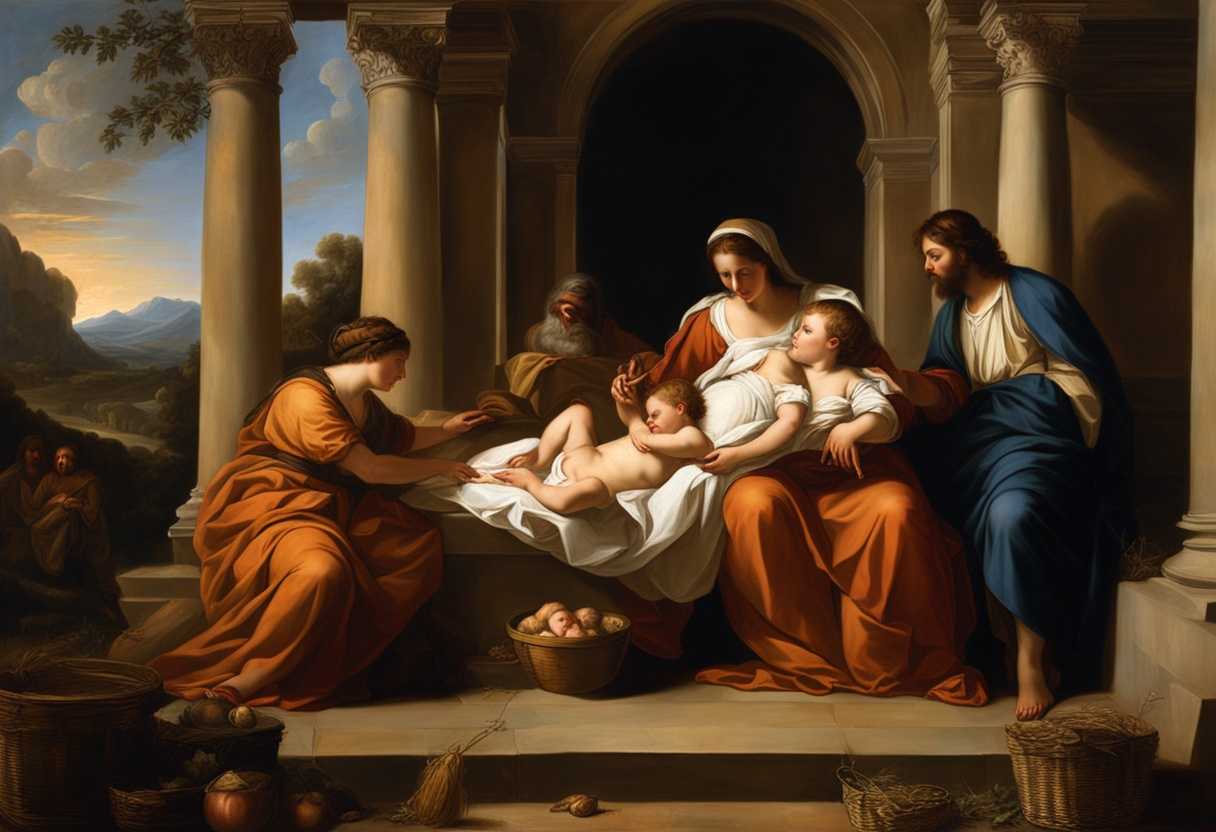
Setting the Scene for Genesis 21-28
In Genesis 21-28, we find the story of Jacob’s ladder. The scene is set in the ancient land of Canaan, where Jacob, the grandson of Abraham, is on the run from his brother Esau after deceiving him to receive their father’s blessing. Jacob finds himself alone in the wilderness, exhausted and seeking rest for the night. He uses a stone as a pillow and falls asleep under the stars.
As Jacob sleeps, he dreams of a ladder reaching from earth to heaven, with angels ascending and descending on it. At the top of the ladder stands the Lord, who reaffirms the covenant made with Abraham and Isaac, promising to bless Jacob and his descendants. When Jacob awakens, he is filled with awe and declares the place to be the house of God and the gate of heaven.
The surroundings are rugged and wild, with the night sky illuminated by countless stars. Jacob’s solitude and vulnerability in the wilderness highlight his need for divine guidance and protection. This powerful encounter with God marks a turning point in Jacob’s life, as he begins to understand the significance of his heritage and the promises made to his forefathers.
What is Genesis 21-28 about?
We witness the fulfillment of God’s promise to Abraham and Sarah to bless them with a son, Isaac in this verse. This momentous event is not only a testament to God’s faithfulness and sovereignty but also a demonstration of His ability to fulfill His promises in His perfect timing. It signifies the power of trusting in God’s plan even when circumstances may seem impossible or uncertain.
Imagine the joy and gratitude Abraham and Sarah must have felt at the arrival of their long-awaited son, knowing that God had been faithful to His word. This verse serves as a reminder that God’s promises are trustworthy and that He is always faithful to His children. It also speaks to the importance of patience, faith, and obedience in our relationship with God, as He is always working behind the scenes to fulfill His purpose in our lives. Let this verse encourage you to trust in God’s promises and timing, knowing that He is always faithful to bring them to fruition in His perfect way.
Understanding what Genesis 21-28 really means
In Genesis 1:21-28, we delve into the intricate tapestry of creation woven by God’s hands. This passage is a snapshot of the divine craftsmanship that brought forth life in its myriad forms. From the majestic sea creatures to the soaring birds of the sky, every living being was meticulously designed by the Creator. The phrase “God created the great sea creatures and every living creature that moves” resonates with the richness of biodiversity, showcasing God’s boundless creativity and mastery over all living things.
As God blesses these creatures, commanding them to “be fruitful and multiply,” we witness His intention for life to thrive and propagate abundantly. This divine injunction underscores the intrinsic value of life and the imperative to nurture and safeguard it. The narrative then shifts to the creation of land animals, each uniquely fashioned by God’s hands, and culminates in the crowning glory of creation—humankind. The profound declaration, “Let us make man in our image, after our likeness,” unveils the sacred imprint of divinity upon humanity, endowing us with a special connection to our Creator.
Moreover, the mandate for humans to have “dominion over the fish of the sea, the birds of the heavens, and every living thing on earth” signifies not a license for exploitation but a call to responsible stewardship. This dominion entails caring for God’s creation with reverence and wisdom, recognizing our role as custodians entrusted with the preservation of the natural world. The interconnectedness of all living beings underscores the harmony and balance inherent in God’s design, calling us to embrace our role as caretakers of this intricate ecosystem.
Drawing parallels from related biblical passages such as Psalm 8:6-8 and Romans 1:20, we glean deeper insights into the significance of human dominion and the revelation of God’s divine attributes through His creation. These verses illuminate the interconnectedness of the natural world with the spiritual realm, inviting us to contemplate the profound mysteries embedded in the fabric of existence.
In today’s context, the message of Genesis 1:21-28 reverberates with renewed urgency and relevance. It beckons us to embrace environmental stewardship as a sacred duty, recognizing our interconnectedness with all living beings and the earth itself. The concept of human dignity and purpose, rooted in our creation in the image of God, underscores the intrinsic worth of every individual and the call to honor and respect one another.
As we reflect on the timeless truths encapsulated in this passage, let us heed the call to stewardship and reverence for God’s creation. Just as a community coming together to restore a polluted river embodies the spirit of responsible caretaking, may we, too, embrace our role as custodians of the earth, fostering a harmonious relationship with all living beings. Genesis 1:21-28 stands as a poignant reminder of our interconnectedness with the natural world and the sacred responsibility entrusted to us by the Creator.
What does it mean to truly trust God?
Truly trusting God means having unwavering faith in His ability to fulfill His promises, even in the face of uncertainty or impossibility. It involves surrendering control and relying solely on His wisdom and power to guide us through every situation. This trust is founded on the deep conviction that God is faithful and true to His word, and His plans for us are ultimately for our good.
Trusting God requires us to let go of doubt, fear, and self-reliance, and instead place our hope and confidence entirely in Him. It means acknowledging our limitations and recognizing that God’s ways are higher than our ways, and His timing is perfect. When we truly trust God, we find peace in the midst of trials, strength in moments of weakness, and confidence in the face of adversity, knowing that He is in control and working all things for our benefit.
Application
Just as in our work or family life, our word should be our bond. Let’s use Genesis 21:28 as a compass to steer us towards keeping our promises with sincerity and dedication. It’s time to show the world the strength of our character by honoring our commitments, just as God faithfully fulfills His vows to us. Will you rise to the occasion and walk the path of integrity, where your actions speak louder than words?

Reverend Michael Johnson is an experienced Church Minister with a profound expertise in spirituality and guidance. With a serene presence and a compassionate heart, he has faithfully served his congregation for over 20 years, leading them on a spiritual journey towards inner peace and enlightenment. Reverend Johnson’s extensive knowledge of religious philosophies and profound understanding of human nature have made him a trusted confidant and mentor to many, as he seamlessly weaves his profound wisdom into life teachings. Reverend Johnson’s calming demeanor and empathetic nature continue to uplift and heal souls, nurturing a sense of unity and tranquility within his community.