
Numbers 13-14 is about the Israelite spies sent to explore the Promised Land, highlighting themes of faith and fear, as the negative reports from the spies lead to rebellion against God, resulting in divine judgment and a prolonging of their wilderness wanderings.
1 The Lord spoke to Moses, saying,
2 “Send men to spy out the land of Canaan, which I am giving to the people of Israel. From each tribe of their fathers you shall send a man, every one a chief among them.”
3 So Moses sent them from the wilderness of Paran, according to the command of the Lord, all of them men who were heads of the people of Israel.
4 These were the names of the men whom Moses sent to spy out the land. And Moses called Hoshea the son of Nun Joshua.
5 from the tribe of Simeon, Shaphat the son of Hori.
6 from the tribe of Judah, Caleb the son of Jephunneh;
7 from the tribe of Issachar, Igal the son of Joseph.
8 from the tribe of Ephraim, Hoshea the son of Nun;
9 from the tribe of Benjamin, Gaddi the son of Susi;
10 and bring some of the fruit of the land.
11 from the tribe of Joseph, from the tribe of Manasseh, Gaddi the son of Susi;
12 From the tribe of Dan, Ammiel the son of Gemalli.
13 from the tribe of Asher, Sethur the son of Michael;
14 from the tribe of Naphtali, Gaddiel the son of Sodi,
15 from the tribe of Gad, Geuel the son of Machi.
16 These were the names of the men whom Moses sent to spy out the land. And Moses called Hoshea the son of Nun Joshua.
17 Moses sent them to spy out the land of Canaan and said to them, “Go up into the Negeb and go up into the hill country,
18 And see what the land is, and whether the people who dwell in it are strong or weak, whether they are few or many,
19 Whether the land is rich or poor, and whether there are trees in it or not. Be of good courage and bring some of the fruit of the land.” Now the time was the season of the first ripe grapes.
20 And whether the land is rich or poor, and whether there are trees in it or not. Be of good courage and bring some of the fruit of the land.” Now the time was the season of the first ripe grapes.
21 So they went up and spied out the land from the wilderness of Zin to Rehob, near Lebo-hamath.
22 They went up into the Negeb and came to Hebron.
23 And they came to the Valley of Eshcol and cut down from there a branch with a single cluster of grapes, and they carried it on a pole between two of them; they also brought some pomegranates and figs.
24 That place was called the Valley of Eshcol, because of the cluster that the people of Israel cut down from there.
25 At the end of forty days they returned from spying out the land.
26 And they came to Moses and Aaron and to all the congregation of the people of Israel in the wilderness of Paran, at Kadesh. They brought back word to them and to all the congregation, and showed them the fruit of the land.
27 And they told him, “We came to the land to which you sent us. It flows with milk and honey, and this is its fruit.
28 However, the people who dwell in the land are strong, and the cities are fortified and very large. And besides, we saw the descendants of Anak there.
29 The Amalekites dwell in the land of the Negeb. The Hittites, the Jebusites, and the Amorites dwell in the hill country. And the Canaanites dwell by the sea, and along the Jordan.”
30 But Caleb quieted the people before Moses and said, “Let us go up at once and occupy it, for we are well able to overcome it.”
13 But the men who had gone up with him said, “We are not able to go up against the people, for they are stronger than we.”
13 And there we saw the Nephilim (the sons of Anak, who come from the Nephilim), and we seemed to ourselves like grasshoppers, and so we seemed to them.”
33 And there we saw the Nephilim (the sons of Anak, who come from the Nephilim), and we seemed to ourselves like grasshoppers, and so we seemed to them.”
1 Then all the congregation raised a loud cry, and the people wept that night.
2 And all the people of Israel grumbled against Moses and Aaron. The whole congregation said to them, “Would that we had died in the land of Egypt! Or would that we had died in this wilderness!
3 Why is the Lord bringing us into this land, to fall by the sword? Our wives and our little ones will become a prey. Would it not be better for us to go back to Egypt?”
4 And they said to one another, “Let us choose a leader and go back to Egypt.”
5 Then Moses and Aaron fell on their faces before all the assembly of the congregation of the people of Israel.
6 And Joshua the son of Nun and Caleb the son of Jephunneh, who were among those who had spied out the land, tore their clothes
7 and said to all the congregation of the people of Israel, “The land, which we passed through to spy it out, is an exceedingly good land.
8 If the Lord delights in us, he will bring us into this land and give it to us, a land that flows with milk and honey.
9 Only do not rebel against the Lord. And do not fear the people of the land, for they are bread for us. Their protection is removed from them, and the Lord is with us; do not fear them.”
14 Then all the congregation said to stone them with stones. But the glory of the Lord appeared at the tent of meeting to all the people of Israel.
11 And the Lord said to Moses, “How long will this people despise me? And how long will they not believe in me, in spite of all the signs that I have done among them?
12 I will strike them with the pestilence and disinherit them, and I will make of you a nation greater and mightier than they.”
14 But Moses said to the Lord, “Then the Egyptians will hear of it, for you brought up this people in your might from among them,
14 And they will tell the inhabitants of this land. They have heard that you, O Lord, are in the midst of this people. For you, O Lord, are seen face to face, and your cloud stands over them and you go before them, in a pillar of cloud by day and in a pillar of fire by night.
15 Now if you kill this people as one man, then the nations who have heard your fame will say,
16 ‘Because the Lord was not able to bring this people into the land that he swore to give to them, he has killed them in the wilderness.’
17 And now, please let the power of the Lord be great as you have promised, saying,
18 ‘The Lord is slow to anger and abounding in steadfast love, forgiving iniquity and transgression, but he will by no means clear the guilty, visiting the iniquity of the fathers on the children, to the third and the fourth generation.’
19 Please pardon the iniquity of this people, according to the greatness of your steadfast love, just as you have forgiven this people, from Egypt until now.”
21 But truly, as I live, and as all the earth shall be filled with the glory of the Lord,
21 But truly, as I live, and as all the earth shall be filled with the glory of the Lord,
22 none of the men who have seen my glory and my signs that I did in Egypt and in the wilderness, and yet have put me to the test these ten times and have not obeyed my voice,
23 shall see the land that I swore to give to their fathers. And none of those who despised me shall see it.
24 But my servant Caleb, because he has a different spirit and has followed me fully, I will bring into the land into which he went, and his descendants shall possess it.
25 Now, since the Amalekites and the Canaanites dwell in the valleys, turn tomorrow and set out for the wilderness by the way to the Red Sea.”
26 And the Lord spoke to Moses and to Aaron, saying,
27 “How long shall this wicked congregation grumble against me? I have heard the grumblings of the people of Israel, which they grumble against me.”
28 Say to them, ‘As I live, declares the Lord, what you have said in my hearing I will do to you:
29 In this wilderness your dead bodies shall fall, and all your number, listed in the census from twenty years old and upward, who have grumbled against me.
30 not one shall come into the land where I swore that I would make you dwell, except Caleb the son of Jephunneh and Joshua the son of Nun.
31 But your little ones, who you said would become a prey, I will bring in, and they shall know the land that you have rejected.
32 But as for you, your dead bodies shall fall in this wilderness.
33 And your children shall be shepherds in the wilderness forty years and shall suffer for your faithlessness, until the last of your dead bodies lies in the wilderness.
34 According to the number of the days in which you spied out the land, forty days, a year for each day, you shall bear your iniquity forty years, and you shall know my displeasure.’
35 I, the Lord, have spoken. Surely this will I do to all this wicked congregation who are gathered together against me: in this wilderness they shall come to a full end, and there they shall die.”
36 And the men whom Moses sent to spy out the land, who returned and made all the congregation grumble against him by bringing up a bad report about the land—
37 the men who brought up a bad report of the land—died by plague before the Lord.
38 But Joshua the son of Nun and Caleb the son of Jephunneh remained alive, of those men who went to spy out the land.
39 And Moses told these words to all the people of Israel, and the people mourned greatly.
14 Then they rose early in the morning and went up to the heights of the hill country, saying, “Here we are. We will go up to the place that the Lord has promised, for we have sinned.”
41 But Moses said, “Why now are you transgressing the command of the Lord, when that will not succeed?
14 Do not go up, for the Lord is not among you, lest you be struck down before your enemies.
43 For there the Amalekites and the Canaanites are facing you, and you shall fall by the sword. Because you have turned back from following the Lord, the Lord will not be with you.”
44 But they dared to go up to the heights of the hill country, although neither the ark of the covenant of the Lord nor Moses departed out of the camp.
45 Then the Amalekites and the Canaanites who lived in that hill country came down and defeated them and pursued them, even to Hormah.
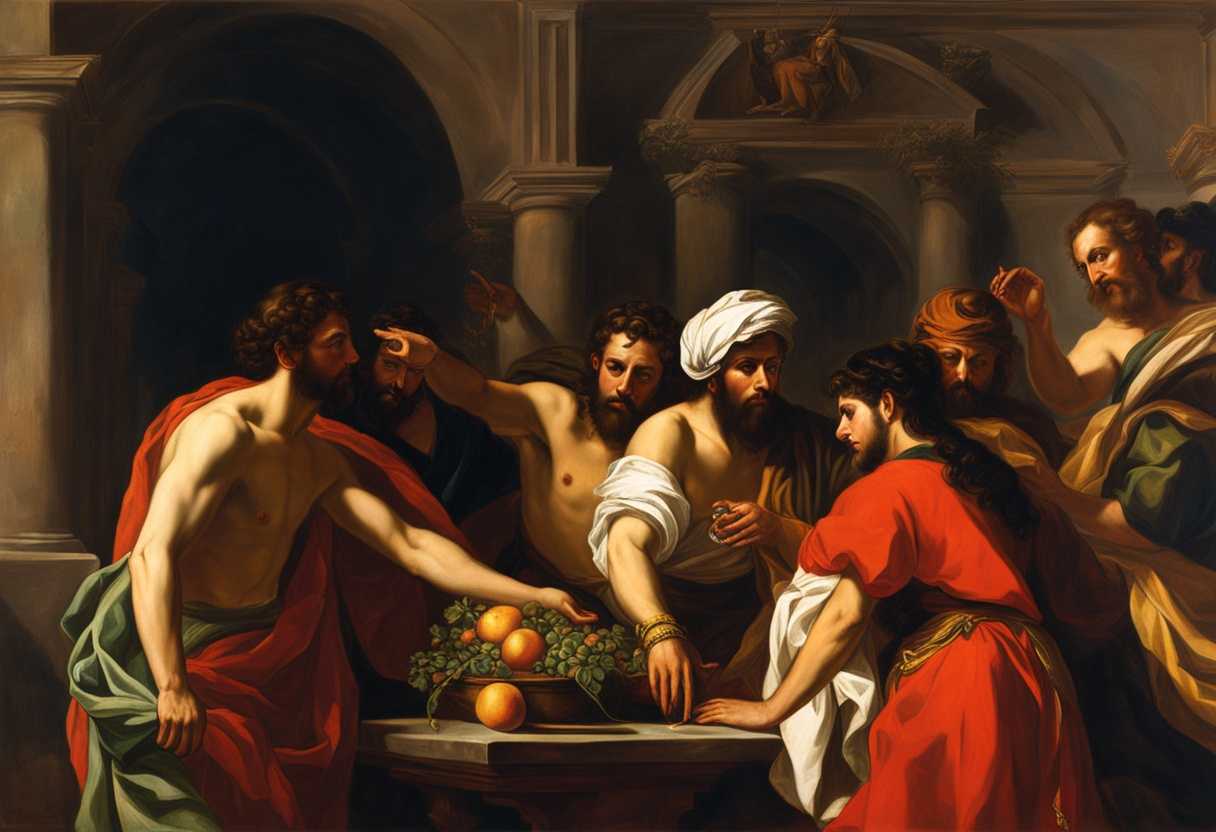
Setting the Scene for Numbers 13-14
In the arid wilderness of Paran, the sun hung high in the sky, casting a relentless heat over the encampment of the Israelites. The air was thick with anticipation and anxiety as Moses, the leader chosen by God, gathered the twelve men he had appointed to scout the Promised Land. Among them were notable figures such as Caleb, from the tribe of Judah, and Joshua, from the tribe of Ephraim. These men were not just any ordinary scouts; they were leaders in their own right, chosen for their strength and faith. The Israelites had been wandering for years, liberated from the bondage of Egypt, and now stood on the brink of a new chapter, a land flowing with milk and honey, as promised by God.
As the twelve men prepared for their mission, the camp was alive with the sounds of murmurs and prayers. Families gathered around their tents, sharing stories of hope and fear, while children played in the dust, unaware of the weight of the moment. The scent of roasted lamb wafted through the air, mingling with the earthy aroma of the desert. Moses instructed the scouts to explore the land of Canaan, to assess its inhabitants, its cities, and its bounty. They were to bring back a report that would determine the fate of the entire nation. The men set off, their hearts filled with a mix of excitement and trepidation, knowing that their findings would either inspire courage or sow seeds of doubt among their people.
After forty days of exploration, the scouts returned, their faces a tapestry of emotions. They carried with them clusters of grapes so large that it took two men to bear them, a testament to the land’s richness. However, as they recounted their journey, the mood shifted dramatically. While Caleb and Joshua spoke of the land’s beauty and the strength of their God, the other ten men painted a picture of fear, describing giants and fortified cities that seemed insurmountable. The camp erupted in chaos, as doubt and despair took root among the Israelites. The very promise that had driven them through the wilderness now hung in the balance, and the cries of the people echoed through the desert, revealing the deep-seated fear that threatened to unravel their faith in the God who had led them thus far.
What is Numbers 13-14 about?
We encounter a pivotal moment in the narrative of the Israelites as we journey through Numbers chapters 13 and 14. Here they stand on the brink of the Promised Land—Canaan—having wandered through the wilderness, sustained by God’s provision. However, the atmosphere changes dramatically as twelve scouts are sent to assess the land. What do they find? Bountiful resources, yes, but also giants—figurative and literal obstacles that seem insurmountable. When the scouts return, ten of them are gripped by fear and promote despair among the people. This begs the question: Why is it that the mere sight of challenges can overshadow the miracles and promises that God has already delivered? Isn’t it fascinating how often we allow our fears to distort our perception of God’s faithfulness?
The fallout from this exploration culminates in severe judgment from God; the Israelites’ lack of trust leads to a year-for-year consequence of wandering in the wilderness for forty years, as well as the loss of an entire generation who were unable to enter the land they so desired. We might pause here to reflect on what this episode teaches us about faith and fear. Is it not human to face moments of doubt, especially when confronted with daunting challenges? However, we also must confront the consequences of allowing fear to govern our decisions. Caleb and Joshua, the two faithful scouts, stand out as voices of hope amidst despair. Their belief in God’s promise raises an important question for us: What giants are we facing in our own lives, and do we see them through the lens of faith or fear? We can find parallels to the Israelites’ experiences in our modern context as we confront our own giants—be it uncertainty in our future, personal challenges, or societal issues. The lessons from Numbers 13-14 remind us that our journey requires not only overt acts of faith but also a deep-seated trust in God’s purposes. Are we willing to bring our concerns to Him, remembering that with God, even the tallest giants can be overcome? Caleb and Joshua boldly championed the vision of hope and possibility as we navigate this terrain. How might our lives change if we choose faith over fear, even in the face of adversity?
Understanding what Numbers 13-14 really means
The passage from Numbers 13-14 presents a pivotal moment in the journey of the Israelites as they stand on the brink of the Promised Land. Sent to scout Canaan, the twelve spies return with contrasting reports that reveal a deep struggle between faith and fear. Caleb and Joshua, filled with confidence in God’s promise, urge the people to take possession of the land. In stark contrast, the other ten spies spread fear, claiming that the inhabitants are giants and that the land devours its residents. This narrative not only highlights the tension between belief and doubt but also sets the stage for the consequences of rebellion against God.
The theme of faith versus fear is central to this account. Caleb and Joshua embody unwavering faith, believing that God will deliver on His promises despite the daunting challenges. Their perspective invites us to reflect: How often do we allow fear to overshadow our faith? The other spies, however, succumb to fear, leading to a collective rebellion among the Israelites. This rebellion results in a 40-year wandering in the desert, illustrating the serious repercussions of disobedience. It raises an important question: What giants are we facing today that might be leading us to doubt God’s faithfulness?
In examining related biblical passages, we find further encouragement. Hebrews 3:19 reminds us that unbelief can prevent us from entering into God’s rest. Similarly, Matthew 17:20 emphasizes the power of even a small amount of faith. Romans 8:31 reassures us that with God on our side, we can confront any challenge. These verses collectively reinforce the idea that faith is not just a passive belief but an active trust in God’s character and promises.
The relevance of Numbers 13-14 extends into our modern lives, where fear and uncertainty often loom large. Many of us face challenges that seem insurmountable, whether in our careers, health, or relationships. The story of Sarah, a young woman navigating a difficult job search, illustrates this struggle. Initially paralyzed by fear, she recalls the faith of Caleb and Joshua and decides to step out of her comfort zone. Her leap of faith leads to unexpected blessings, reminding us that trusting God can yield remarkable outcomes.
The phrases within this passage resonate deeply. When the spies declare, “We seemed like grasshoppers in our own eyes,” it encapsulates the crippling nature of self-doubt. This self-perception can distort our reality and diminish our sense of purpose. Furthermore, the exaggerated claim that “the land we explored devours those living in it” serves as a cautionary tale about how fear can lead to irrational conclusions. It challenges us to consider: Are we allowing fear to cloud our judgment and overlook God’s provision?
Ultimately, the narrative of Numbers 13-14 serves as a powerful reminder of the importance of faith over fear. It challenges us to trust in God’s promises, even when the circumstances appear daunting. As we confront our own “giants,” may we choose to walk in faith, remembering that God is with us every step of the way. In doing so, we align ourselves with His will and open ourselves to the blessings that come from trusting in His unfailing love and guidance.
What fears hold us back from our promised land?
The fears that hold us back from our promised land in the biblical narrative often stem from a lack of faith and an overemphasis on perceived obstacles. When faced with daunting challenges or intimidating circumstances, it’s easy to become overwhelmed by feelings of inadequacy and fear of failure. These fears can manifest as doubts about our abilities or the belief that we are unworthy of the rewards that lie ahead. Such mindset prevents us from taking the necessary steps toward personal growth or achieving our goals.
Additionally, the fear of the unknown plays a significant role in stunting our progress. Many individuals are naturally inclined to cling to familiar circumstances, even if they are not ideal, because change is often perceived as risky. This reluctance can lead to stagnation, as the comfort of the current situation overshadows the possibilities of what could be achieved. The fear of stepping out of one’s comfort zone can stifle ambition and create a barrier to realizing one’s true potential and destiny.
Lastly, there is often a collective fear that arises from the opinions and judgments of others, which can further inhibit our pursuit of the promised land. The fears of disapproval or rejection can lead us to conform to the expectations of our peers, rather than following our own convictions. This fear of judgment can paralyze decision-making and hinder the courage needed to pursue our dreams. Overcoming these fears is crucial for unlocking the transformative opportunities that await us on our journey.
Application
Think of your dreams as a promised land waiting for you to claim them. Just like navigating a tough work project or facing family challenges, doubts can block your path. It’s time to push past those fears and trust in the guidance you’re given. Support each other, lift each other up, and move toward the future you deserve. Are you ready to take that leap and seize what’s meant for you?

Reverend Michael Johnson is an experienced Church Minister with a profound expertise in spirituality and guidance. With a serene presence and a compassionate heart, he has faithfully served his congregation for over 20 years, leading them on a spiritual journey towards inner peace and enlightenment. Reverend Johnson’s extensive knowledge of religious philosophies and profound understanding of human nature have made him a trusted confidant and mentor to many, as he seamlessly weaves his profound wisdom into life teachings. Reverend Johnson’s calming demeanor and empathetic nature continue to uplift and heal souls, nurturing a sense of unity and tranquility within his community.