
4 These are the generations of the heavens and the earth when they were created, in the day that the Lord God made the earth and the heavens.
5 When no bush of the field was yet in the land and no small plant of the field had yet sprung up—for the Lord God had not caused it to rain on the land, and there was no man to work the ground,
6 And a mist was going up from the land and was watering the whole face of the ground.
7 then the Lord God formed the man of dust from the ground and breathed into his nostrils the breath of life, and the man became a living creature.
8 And the Lord God planted a garden in Eden, in the east, and there he put the man whom he had formed.
9 And out of the ground the Lord God made to spring up every tree that is pleasant to the sight and good for food. The tree of life was in the midst of the garden, and the tree of the knowledge of good and evil.
10 A river flowed out of Eden to water the garden, and there it divided and became four rivers.
11 The name of the first is the Pishon. It is the one that flowed around the whole land of Havilah, where there is gold.
12 The gold of that land is good; bdellium and onyx stone are there.
13 The name of the second river is the Gihon. It is the one that flowed around the whole land of Cush.
14 The name of the third river is the Tigris, which flows east of Assyria. And the fourth river is the Euphrates.
15 The Lord God took the man and put him in the garden of Eden to work it and keep it.
16 And the Lord God commanded the man, saying, “You may surely eat of every tree of the garden,
17 but of the tree of the knowledge of good and evil you shall not eat, for in the day that you eat of it you shall surely die.”
18 Then the Lord God said, “It is not good that the man should be alone; I will make him a helper fit for him.”
19 Now out of the ground the Lord God had formed every beast of the field and every bird of the heavens and brought them to the man to see what he would call them. And whatever the man called every living creature, that was its name.
20 The man gave names to all livestock and to the birds of the heavens and to every beast of the field.
21 So the Lord God caused a deep sleep to fall upon the man, and while he slept took one of his ribs and closed up its place with flesh.
22 And the rib that the Lord God had taken from the man he made into a woman and brought her to the man.
23 Then the man said, “This at last is bone of my bones and flesh of my flesh; she shall be called Woman, because she was taken out of Man.”
24 Therefore a man shall leave his father and his mother and hold fast to his wife, and they shall become one flesh.
25 And the man and his wife were both naked and were not ashamed.
1 Now the serpent was more crafty than any other beast of the field that the Lord God had made.
2 And the woman said to the serpent, “We may eat the fruit of the trees of the garden;
3 but God said, ‘You shall not eat of the fruit of the tree that is in the midst of the garden, neither shall you touch it, lest you die.’”
4 But the serpent said to the woman, “You will not surely die.
5 For God knows that when you eat of it your eyes will be opened, and you will be like God, knowing good and evil.
6 So when the woman saw that the tree was good for food, and that it was a delight to the eyes, and that the tree was to be desired to make one wise, she took of its fruit and ate, and she also gave some to her husband who was with her, and he ate.
7 Then the eyes of both were opened, and they knew that they were naked. And they sewed fig leaves together and made themselves loincloths.
8 And they heard the sound of the Lord God walking in the garden in the cool of the day, and the man and his wife hid themselves from the presence of the Lord God among the trees of the garden.
9 But the Lord God called to the man and said to him, “Where are you?”
10 And he said, “I heard the sound of you in the garden, and I was afraid, because I was naked, and I hid myself.”
11 He said, “Who told you that you were naked? Have you eaten of the tree of which I commanded you not to eat?”
12 The man said, “The woman whom you gave to be with me, she gave me fruit of the tree, and I ate.”
13 Then the Lord God said to the woman, “What is this that you have done?” The woman said, “The serpent deceived me, and I ate.”
14 The Lord God said to the serpent, “Because you have done this, cursed are you above all livestock and above all beasts of the field; on your belly you shall go, and dust you shall eat all the days of your life.
15 I will put enmity between you and the woman,
and between your offspring and her offspring;
he shall bruise your head,
and you shall bruise his heel.”
16 To the woman he said, “I will surely multiply your pain in childbearing; in pain you shall bring forth children. Your desire shall be contrary to your husband, but he shall rule over you.”
17 And to Adam he said, “Because you have listened to the voice of your wife and have eaten of the tree of which I commanded you, ‘You shall not eat of it,’ cursed is the ground because of you; in pain you shall eat of it all the days of your life;
18 thorns and thistles it shall bring forth for you; and you shall eat the plants of the field.
19 By the sweat of your face you shall eat bread, till you return to the ground, for out of it you were taken; for you are dust, and to dust you shall return.
20 The man called his wife’s name Eve, because she was the mother of all living.
21 And the Lord God made for Adam and for his wife garments of skins and clothed them.
22 Then the Lord God said, “Behold, the man has become like one of us in knowing good and evil. Now, lest he reach out his hand and take also of the tree of life and eat, and live forever—”
23 therefore the Lord God sent him out from the garden of Eden to work the ground from which he was taken.
24 He drove out the man, and at the east of the garden of Eden he placed the cherubim and a flaming sword that turned every way to guard the way to the tree of life.
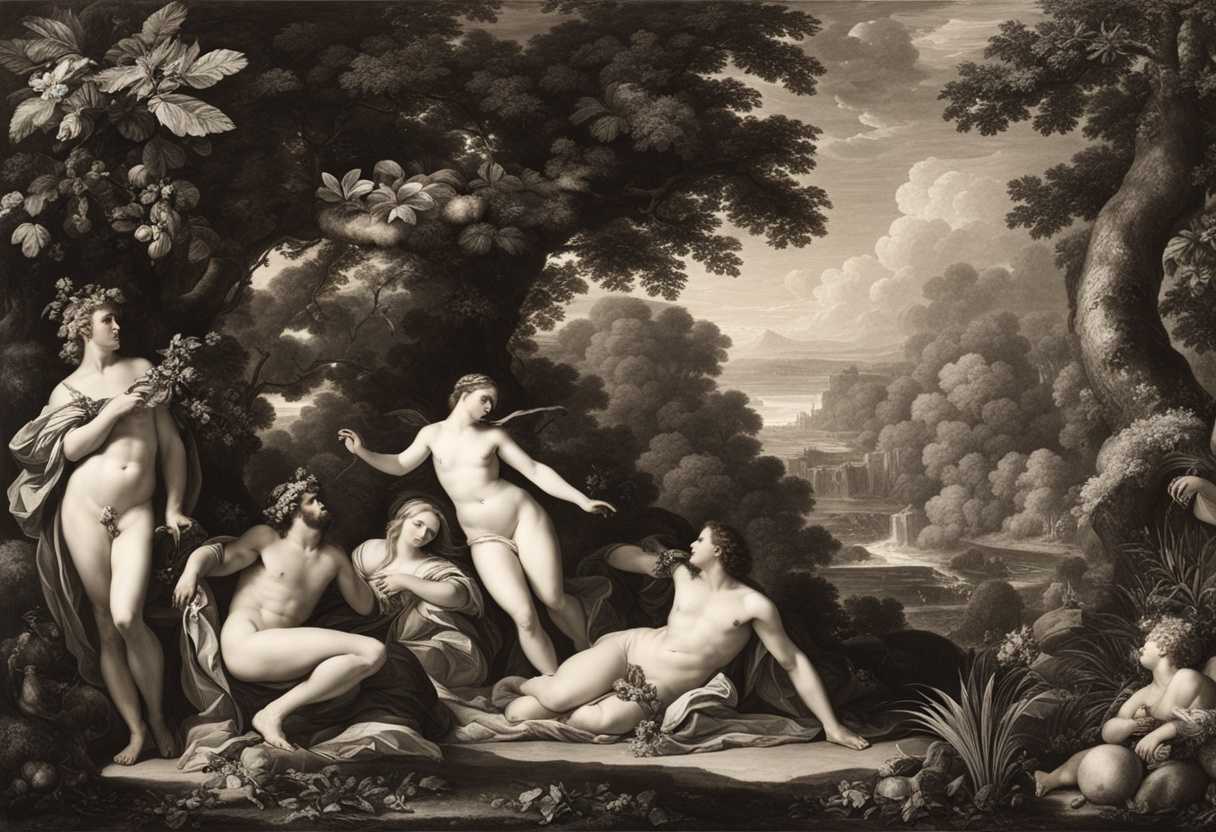
Setting the Scene for Genesis 2:4-3:24
In the scene described in Genesis 2:4-3:24, we find ourselves in the Garden of Eden, a paradise created by God for Adam and Eve. The garden is lush and abundant, filled with all kinds of trees bearing delicious fruits and surrounded by clear rivers. The atmosphere is peaceful and harmonious, with the presence of God felt throughout.
Adam, the first man created by God, is in the garden, tending to the plants and animals. He is in awe of the beauty and wonder of the world around him. Eve, the first woman created from Adam’s rib, joins him in the garden. She is curious and full of life, eager to explore and learn about their surroundings.
The tranquility of the garden is disrupted when the serpent, embodying evil, tempts Eve to eat the forbidden fruit from the Tree of Knowledge of Good and Evil. Eve succumbs to the temptation and shares the fruit with Adam, leading to their disobedience of God’s command. As a consequence, they are banished from the Garden of Eden, marking the beginning of humanity’s journey outside of paradise.
What is Genesis 2:4-3:24 about?
Let’s journey together into the powerful story of Adam and Eve’s creation, temptation, and expulsion from the Garden of Eden. Humanity and divinity have an intricate relationship in this narrative, and disobeying the divine will leads to consequences. Through Adam and Eve’s fall from grace, we can reflect on our own human nature and the choices we make in our lives. Why did they yield to temptation? How did their actions affect their relationship with each other and with their Creator? As we delve into this poignant tale, we can contemplate the themes of free will, temptation, and the pursuit of knowledge. Why did Adam and Eve choose to eat the forbidden fruit, despite being given everything else in the garden? How does their expulsion from Eden symbolize the loss of innocence and the beginning of human suffering? Through their story, we are reminded of the fragility of human nature and the importance of humility and obedience in our relationship with the divine. Let us ponder the lessons we can learn from Adam and Eve’s journey and strive to make wise choices that align with our values and beliefs.
Understanding what Genesis 2:4-3:24 really means
Introduction and Historical Context
Let’s explore the rich narrative of Genesis 2:4-3:24, recounting the creation of man and woman, their life in Eden, and the tragic fall that altered humanity’s destiny. This text serves as a foundational cornerstone for understanding human nature, relationship with God, sin, and redemption. To fully appreciate the depth, it’s crucial to break it down into segments that highlight God’s intentions, humanity’s actions, and the resulting consequences.
Creation and the Garden of Eden
Initially, we see God crafting man and woman and situating them in the Garden of Eden. The detail that God formed man from the dust of the ground breathes meaning into the phrase “breath of life,” signifying a divine connection – a life endowed by God’s spirit. Women, created from man’s rib, signifies equality and partnership. God’s establishment of boundaries in Eden, particularly the command not to eat from the tree of the knowledge of good and evil, underscores His desire for a relationship based on trust and obedience.
The Temptation and the Fall
The narrative then shifts to the serpent’s deceit. The phrases “You will not surely die” and “your eyes will be opened” speak volumes about the nature of temptation – it distorts truth and appeals to pride. Eve’s decision to eat the forbidden fruit, followed by Adam’s compliance, highlights a pivotal moment of human choice. The result was immediate awareness of their nakedness, introducing shame and guilt into human consciousness for the first time.
Consequences of Sin
God’s response is both just and redemptive. He outlines the consequences, such as pain in childbirth and toil in labor, which encapsulate much of our modern struggle. Yet, even in judgment, there is a glimmer of hope – God clothes Adam and Eve, a precursor to His ultimate plan of redemption through Jesus Christ. This first act of covering sin anticipates the sacrificial system, leading ultimately to Christ’s sacrificial death.
Cross-Referencing with Other Scriptures
This passage reverberates throughout scripture. Paul’s reflection in Romans 5:12, “through one man sin entered the world,” provides a theological backbone for understanding the human condition. Also, Revelation 22 echoes the return to a new Eden, a promise of restoration and eternal fellowship with God, demonstrating the Bible’s cohesive narrative pointing towards redemption.
Relevance Today and Reflective Anecdote
Today, this story remains critically relevant. It mirrors our daily battle with choices and the far-reaching consequences they entail. A member of our congregation struggled with a significant moral failing. Through repentance and seeking God’s grace, they found restoration and became a pillar of encouragement for others. This cycle of sin and redemption is a universal experience.
Conclusion
Genesis 2:4-3:24 is more than just an ancient narrative; it’s a profound exploration of human nature, divine relationship, and the genesis of our need for redemption. God’s early interactions with humanity set the stage for His unwavering commitment to restore and redeem. Let’s consider our role in this timeless story as we reflect on these scriptures, drawing strength and direction from God’s enduring love and promises. How do we respond to God’s boundaries and His grace today?
What does man’s disobedience reveal about relationship with God?
Man’s disobedience reveals a breakdown in the relationship between humanity and God. Their choice to eat from the forbidden tree in the Garden of Eden shows a lack of trust in God’s commands and wisdom. This disobedience not only reveals a rebellion against God’s authority but also a desire to go against His will.
Furthermore, man’s disobedience demonstrates a shift in the relationship dynamics between humanity and God. Before their disobedience, Adam and Eve lived in harmony with God, enjoying His presence and provisions. However, their choice to disobey God’s command resulted in a separation from Him and the introduction of sin into the world. This disobedience highlights the consequences of breaking the relationship with God, leading to a sense of shame, guilt, and ultimately, expulsion from the Garden of Eden. Man’s disobedience in the story of Adam and Eve ultimately serves as a cautionary tale about the consequences of turning away from God’s guidance and choosing our own paths. It reveals the fragile nature of the relationship between humanity and God and emphasizes the importance of obedience and trust in maintaining a close and intimate connection with Him.
Application
Imagine getting lost in a crucial project at work; one small mistake can derail everything. The story of Adam and Eve is just that—a reminder of how quickly things can go wrong when we give in to temptation. Think of your own life—how can you avoid those missteps and stay true to your values? Reflect on this lesson, and use it to build a stronger defense against life’s distractions. What steps will you take today to fortify your resolve and stay aligned with your principles?

Reverend Michael Johnson is an experienced Church Minister with a profound expertise in spirituality and guidance. With a serene presence and a compassionate heart, he has faithfully served his congregation for over 20 years, leading them on a spiritual journey towards inner peace and enlightenment. Reverend Johnson’s extensive knowledge of religious philosophies and profound understanding of human nature have made him a trusted confidant and mentor to many, as he seamlessly weaves his profound wisdom into life teachings. Reverend Johnson’s calming demeanor and empathetic nature continue to uplift and heal souls, nurturing a sense of unity and tranquility within his community.