
Isaiah 53:9-12 is about the suffering servant who willingly takes on the sins of others, is unjustly afflicted and oppressed, yet ultimately triumphs through his sacrificial death, offering redemption and salvation to all.
9 And they made his grave with the wicked and with a rich man in his death, although he had done no violence, and there was no deceit in his mouth.
10 Yet it was the will of the Lord to crush him; he has put him to grief; when his soul makes an offering for guilt, he shall see his offspring; he shall prolong his days; the will of the Lord shall prosper in his hand.
11 Out of the anguish of his soul he shall see and be satisfied; by his knowledge shall the righteous one, my servant, make many to be accounted righteous, and he shall bear their iniquities.
12 Therefore I will divide him a portion with the many, and he shall divide the spoil with the strong, because he poured out his soul to death and was numbered with the transgressors; yet he bore the sin of many, and makes intercession for the transgressors.
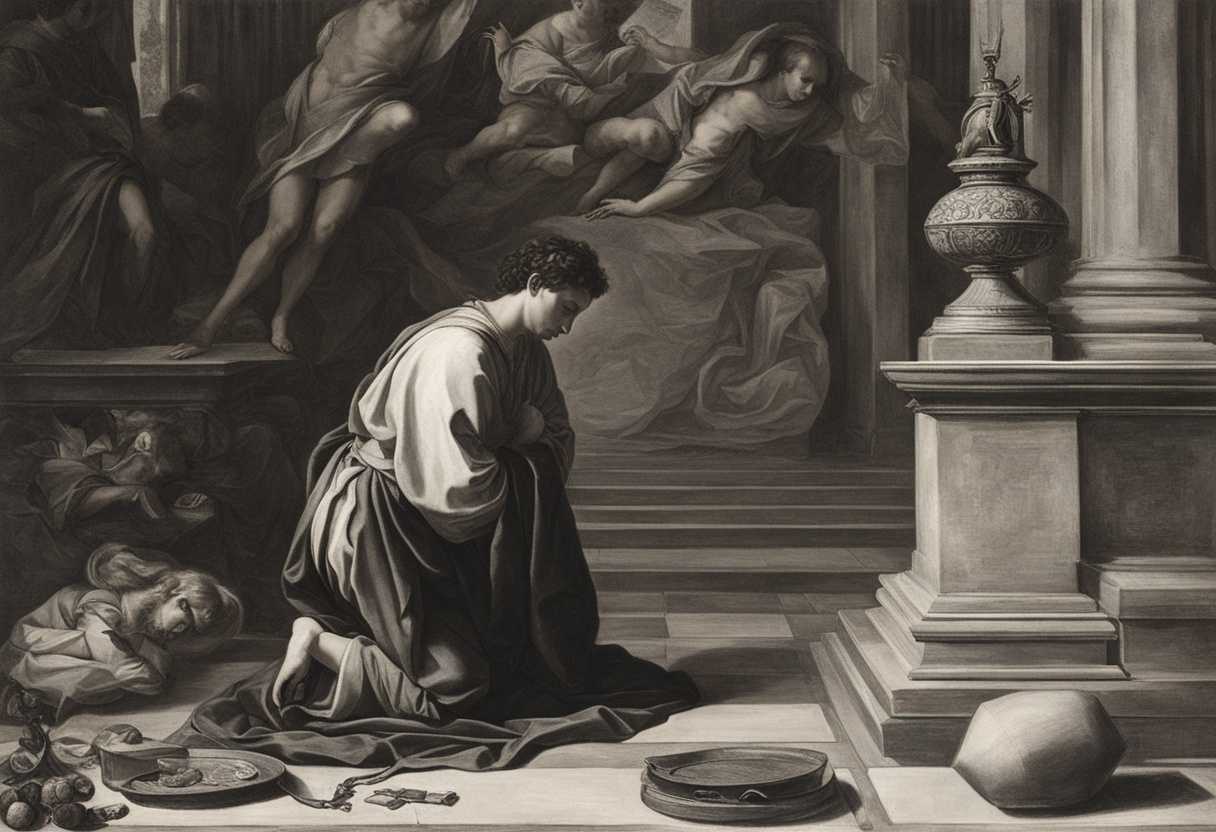
Setting the Scene for Isaiah 53:9-12
The scene in Isaiah 53:9-12 takes place in a quiet garden at dusk, where a group of weary travelers have gathered around a flickering campfire. Among them are Isaiah, a revered prophet, and a small band of faithful followers who have been journeying through the wilderness. The group is huddled together, their faces illuminated by the warm glow of the fire as Isaiah begins to speak.
As the prophet’s voice fills the night air, he recounts a vision he has received from the Lord, foretelling the coming of a suffering servant who will bear the sins of the people. The travelers listen intently, their hearts heavy with the weight of these words. Isaiah speaks of the servant’s sacrifice and the redemption that will come through his suffering, offering hope to those who are downtrodden and oppressed.
In the distance, the stars twinkle brightly overhead, a reminder of the promise of a new dawn. The scene is one of quiet contemplation and profound significance, as Isaiah’s words echo through the garden, planting seeds of faith and expectation in the hearts of those who have gathered around the fire.
What is Isaiah 53:9-12 about?
Indeed, Isaiah 53:9-12 is a profound prophecy that foretells the sacrificial death of Jesus Christ and his ultimate redemption for humanity. It paints a vivid picture of the suffering Messiah who took upon himself the sins of the world, serving as the ultimate sacrificial lamb without blemish. The verses highlight the innocence and humility of Jesus, who accepted his fate willingly and without resistance, paving the way for the salvation of mankind.
Have you ever pondered the immense love and selflessness displayed by Jesus as he bore the weight of our sins on the cross, fulfilling this ancient prophecy? It is truly remarkable to reflect on how each detail in these verses aligns with the life, death, and resurrection of Jesus, depicting a powerful narrative of redemption and hope for all who believe. Christ’s ultimate act of love reminds us of the unparalleled sacrifice made on our behalf and the boundless grace extended to us as we meditate on these words.
Understanding what Isaiah 53:9-12 really means
In the Book of Isaiah, specifically in Isaiah 53:9-12, we encounter a profound prophecy known as the Suffering Servant passage. This prophecy holds significant importance in Christian theology as it foretells the sacrificial suffering and ultimate victory of Jesus Christ. The verses depict the innocence and humility of the Servant, His role as a perfect sacrifice, the divine purpose behind His suffering, and the redemptive impact of His death and resurrection.
“He was assigned a grave with the wicked, and with the rich in his death.” This verse highlights the paradox of the Servant’s burial, emphasizing His humility despite being innocent. In Matthew 27:57-60, we see this fulfilled in Jesus’ burial in a rich man’s tomb, underscoring the unexpected nature of His treatment.
“Though he had done no violence, nor was any deceit in his mouth.” Here, the purity and blameless nature of the Servant are emphasized. This innocence is further affirmed in 1 Peter 2:22, where Jesus is described as sinless, highlighting His role as the perfect sacrifice for humanity’s sins.
“Yet it was the Lord’s will to crush him and cause him to suffer.” This verse reveals the divine purpose behind the Servant’s suffering, aligning with Acts 2:23, which portrays Jesus’ crucifixion as part of God’s redemptive plan. The suffering of the Servant was not in vain but a crucial part of God’s greater plan for humanity’s salvation.
“And though the Lord makes his life an offering for sin.” The Servant’s life is depicted as a sacrificial offering, echoing Hebrews 9:28, which speaks of Christ’s sacrifice for many. This sacrificial act serves as atonement for the sins of humanity, highlighting the depth of God’s love and mercy.
“He will see his offspring and prolong his days.” This verse promises life and legacy beyond death, symbolizing the resurrection and eternal impact of the Servant’s sacrifice. The analogy of the grain of wheat in John 12:24 further illustrates the concept of new life emerging from death, emphasizing the transformative power of the Servant’s sacrifice.
In conclusion, the Suffering Servant prophecy in Isaiah 53:9-12 not only foretells the sacrificial suffering and ultimate victory of Jesus Christ but also conveys a message of hope and redemption through suffering. Understanding the sacrificial love of the Servant can help us find purpose in our own struggles and trust in God’s overarching plan for our lives. As we reflect on the profound sacrifice of the Servant, may we be inspired to live lives of sacrificial love and find comfort in the assurance of ultimate victory through Him.
How can we fully understand the sacrifice of Jesus?
The sacrifice of Jesus can be fully understood by recognizing the depth of His suffering and the purpose behind it. Through His death, Jesus bore the sins of humanity and took on the punishment that we deserved. This act of sacrificial love demonstrates the magnitude of God’s mercy and grace towards mankind, as Jesus willingly surrendered Himself for our redemption. We can grasp the extent of His selflessness and the magnitude of His love for us by reflecting on the meaning of Jesus’ sacrifice as described in Isaiah 53. It reveals the prophesied plan of God to offer His Son as a perfect atoning sacrifice, providing a way for us to be reconciled to Him and receive salvation. Jesus’ sacrifice serves as a powerful reminder of the ultimate price paid for our sins and the incredible gift of forgiveness and eternal life that we have received through His death and resurrection.
Application
Follow in the footsteps of Jesus, carrying the weight of our actions, leading through example. Show gratitude by living with purpose and integrity, mirroring the sacrifice made for us. Let us embrace this opportunity to repay this debt with a conviction that shines in everything we do. Will you rise to this occasion and embody the profound love displayed on that pivotal cross?

Reverend Michael Johnson is an experienced Church Minister with a profound expertise in spirituality and guidance. With a serene presence and a compassionate heart, he has faithfully served his congregation for over 20 years, leading them on a spiritual journey towards inner peace and enlightenment. Reverend Johnson’s extensive knowledge of religious philosophies and profound understanding of human nature have made him a trusted confidant and mentor to many, as he seamlessly weaves his profound wisdom into life teachings. Reverend Johnson’s calming demeanor and empathetic nature continue to uplift and heal souls, nurturing a sense of unity and tranquility within his community.