
Isaiah 7:1-9 is about God’s assurance to King Ahaz of Judah that despite the threat of attack from Israel and Aram, he should trust in God’s protection rather than seeking alliances with foreign nations.
1 In the days of Ahaz the son of Jotham, son of Uzziah, king of Judah, Rezin the king of Syria and Pekah the son of Remaliah the king of Israel came up to Jerusalem to wage war against it, but could not yet mount an attack against it.
2 When the house of David was told, “Syria is in league with Ephraim,” the heart of Ahaz and the heart of his people shook as the trees of the forest shake before the wind.
3 Then the Lord said to Isaiah, “Go out to meet Ahaz, you and Shear-jashub your son, at the end of the conduit of the upper pool on the highway to the Washer’s Field.
4 And say to him, ‘Be careful, be quiet, do not fear, and do not let your heart be faint because of these two smoldering stumps of firebrands, at the fierce anger of Rezin and Syria and the son of Remaliah.
5 Because Syria, with Ephraim and the son of Remaliah, has devised evil against you, saying,
6 “Let us go up against Judah and terrify it, and let us conquer it for ourselves, and set up the son of Tabeel as king in the midst of it,”
7 Thus says the Lord God: It shall not stand, and it shall not come to pass.
8 For the head of Syria is Damascus, and the head of Damascus is Rezin. And within sixty-five years Ephraim will be shattered from being a people.
9 And the head of Ephraim is Samaria, and the head of Samaria is the son of Remaliah. If you are not firm in faith, you will not be firm at all.
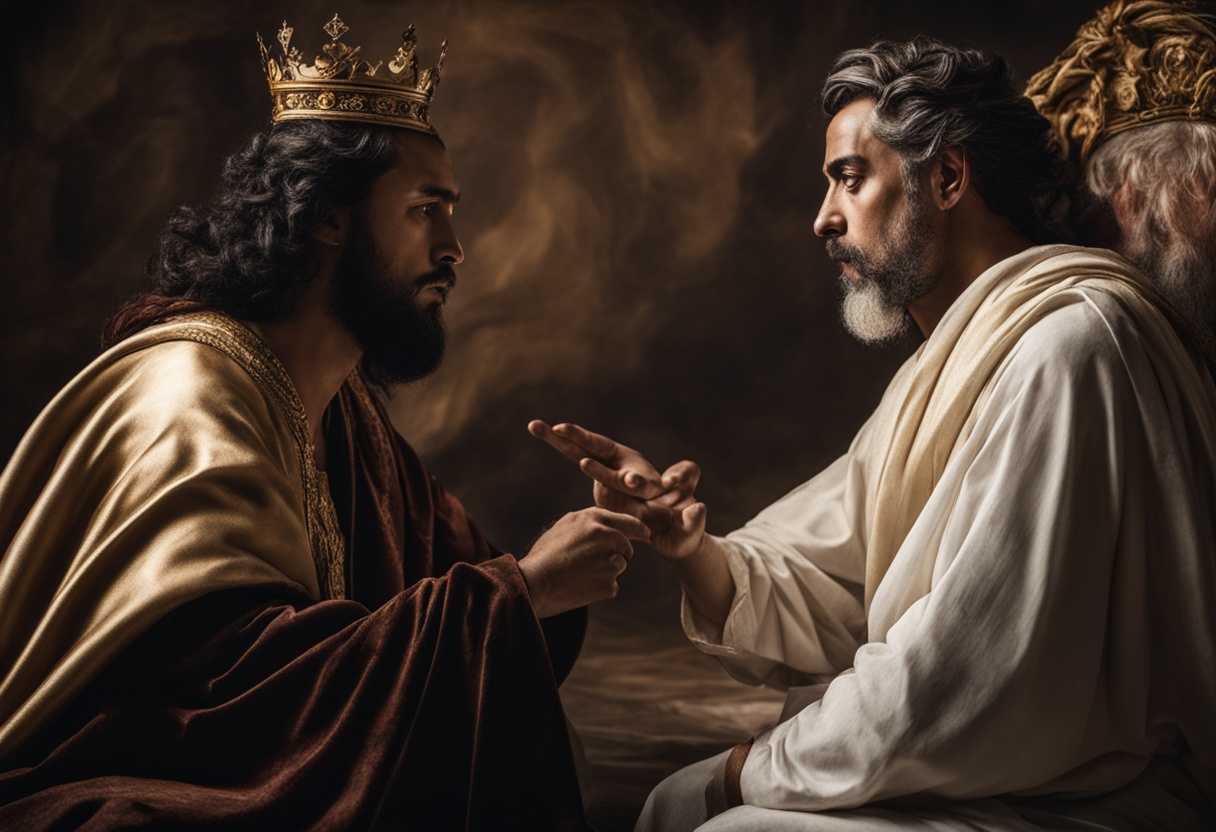
Setting the Scene for Isaiah 7:1-9
In Isaiah chapter 7, we find King Ahaz of Judah facing a significant crisis. The scene is set in Jerusalem, the capital city of the kingdom of Judah. Ahaz is in his royal chambers, surrounded by his advisors and officials. The atmosphere is tense as news has just reached them that the kings of Aram and Israel have formed an alliance against Judah. Ahaz is deeply troubled by this threat to his kingdom and is seeking counsel on how to proceed.
Among Ahaz’s advisors are the prophet Isaiah and other trusted counselors. They are discussing the situation and trying to reassure the king that God is with them. Isaiah, in particular, is urging Ahaz to trust in the Lord and not to be afraid of the threats from their enemies. He is reminding the king of God’s faithfulness to His people in the past and encouraging him to stand firm in his faith.
The room is adorned with rich tapestries and ornate furniture befitting a royal chamber. The air is heavy with the scent of incense burning in the background. Ahaz, with a furrowed brow, listens intently to Isaiah’s words, torn between fear and faith. The fate of the kingdom hangs in the balance as they await Ahaz’s decision on how to respond to the looming threat.
What is Isaiah 7:1-9 about?
This verse from the Book of Isaiah delivers a powerful message about the prophetic events regarding Syria and Israel, leading to their downfall, as well as the promise of the coming of Immanuel, which means “God with us.” It serves as a reminder of the consequences of disobedience and the ultimate faithfulness of God to His people. As we delve into the intricate layers of this prophecy, we must question the significance of these historical events and how they align with the overarching theme of redemption and salvation. How do these prophecies of destruction point towards the need for repentance and faithfulness? And how does the promise of Immanuel offer hope and assurance of God’s presence in the midst of turmoil and uncertainty?
Through Isaiah’s words, we are invited to reflect on the consequences of our actions, the faithfulness of God in fulfilling His promises, and the hope of a future where God will be with us. We may find solace in the fact that Immanuel is not just a promise of the past, but a present reality that we can cling to in times of trouble and despair as we navigate through the complexities of life.
Understanding what Isaiah 7:1-9 really means
The historical backdrop of Isaiah 7:1-9 is essential to grasp its significance. It unfolds amidst the Syro-Ephraimite War, where Aram and Israel unite against Judah. King Ahaz of Judah, gripped by fear, receives reassurance from Isaiah, sent by God.
In this passage, God’s command to “Be careful, keep calm and don’t be afraid” resonates powerfully. It urges Ahaz to maintain composure and rely on God’s protection. The phrase “If you do not stand firm in your faith, you will not stand at all” underscores the pivotal role of faith in navigating life’s trials.
Connecting with related biblical texts enriches our understanding. 2 Kings 16:5-9 offers a historical narrative, while Philippians 4:6-7 echoes the call to trust in God amid anxiety. Hebrews 11:1 emphasizes faith’s essence, aligning with Isaiah’s message to Ahaz.
The timeless relevance of this passage is striking. In a world fraught with challenges akin to Ahaz’s, the directive to “keep calm and don’t be afraid” remains universally applicable. Faith, a source of strength and resilience, sustains many amidst uncertainties.
Illustrating with a modern scenario underscores the enduring relevance of Isaiah’s message. Just as Ahaz found solace in God’s reassurance, a person facing adversity today can draw strength from their faith. For instance, a cancer patient, initially overwhelmed, finds courage through faith to confront treatments with hope.
In conclusion, Isaiah 7:1-9 underscores the significance of faith and trust in God during fearful and uncertain times. By intertwining biblical parallels and contemporary experiences, we glean enduring lessons and encouragement from this ancient text.
How can we trust God’s promises in uncertainty?
Trusting in God’s promises can be challenging in times of uncertainty, but the verse highlights the importance of placing our trust in Him regardless of the circumstances. The passage emphasizes that God’s plans will prevail, despite any human efforts or obstacles that may arise. This serves as a reminder that God’s promises are steadfast and reliable, even when we are faced with uncertainty and challenges. We can find assurance in the fact that God’s promises are trustworthy and will come to fruition in His perfect timing by focusing on the meaning of the verse. It encourages us to look beyond our current circumstances and have faith that God is in control, and His plans will not be thwarted by uncertainty or doubt. Trusting in God’s promises ultimately involves surrendering our fears and concerns to Him, knowing that He is faithful and will always fulfill what He has promised.
Application
Dear friend, in the hustle and bustle of our modern lives, it’s easy to feel overwhelmed by uncertainty and fear. But just like managing a hectic work schedule or caring for our families, we must also learn to trust in God’s promises. Let’s take a moment to pause and reflect on Isaiah 7:1-9, and be encouraged to lean on God in times of trouble. Let’s make the choice today to trust in His unfailing word, knowing that His guidance and wisdom will lead us through any storm. So, will you join me in stepping out in faith and trusting in God’s promises?

Reverend Michael Johnson is an experienced Church Minister with a profound expertise in spirituality and guidance. With a serene presence and a compassionate heart, he has faithfully served his congregation for over 20 years, leading them on a spiritual journey towards inner peace and enlightenment. Reverend Johnson’s extensive knowledge of religious philosophies and profound understanding of human nature have made him a trusted confidant and mentor to many, as he seamlessly weaves his profound wisdom into life teachings. Reverend Johnson’s calming demeanor and empathetic nature continue to uplift and heal souls, nurturing a sense of unity and tranquility within his community.