
1 And the Lord said to Job:
2 “Shall a faultfinder contend with the Almighty? He who argues with God, let him answer it.”
3 Then Job answered the Lord:
4 “Behold, I am of small account; what shall I answer you? I lay my hand on my mouth.
5 I have spoken once, and I will not answer;
twice, but I will proceed no further.”
6 Then the Lord answered Job out of the whirlwind and said:
7 “Dress for action like a man;
I will question you, and you make it known to me.
8 Will you even put me in the wrong?
Will you condemn me that you may be in the right?
9 Have you an arm like God,
and can you thunder with a voice like his?
10 Adorn yourself with majesty and dignity; clothe yourself with glory and splendor.
11 “Pour out the overflowings of your anger,
and look on everyone who is proud and abase him.
12 Look on everyone who is proud and bring him low
and tread down the wicked where they stand.
13 Hide them all in the dust together;
bind their faces in the world below.
14 Then I will also praise you, for your own right hand can save you.
15 “Behold, Behemoth, which I made as I made you; he eats grass like an ox.
16 Behold, his strength in his loins,
and his power in the muscles of his belly.
17 He makes his tail stiff like a cedar;
the sinews of his thighs are knit together.
18 His bones are tubes of bronze,
his limbs like bars of iron.
19 He is the first of the works of God; let him who made him bring near his sword!
20 “Surely the mountains yield food for him, where all the wild beasts play.”
21 Under the lotus plants he lies, in the shelter of the reeds and in the marsh.
22 The lotus trees cover him with their shade;
the willows of the brook surround him.
23 Behold, if the river is turbulent he is not frightened; he is confident though Jordan rushes against his mouth.
24 Can one take him by his eyes,
or pierce his nose with a snare?
25 “When he raises himself up, the mighty are afraid;
at the crashing they are beside themselves.
26 “Look on everyone who is proud and bring him low
and tread down the wicked where they stand.
27 Behold, Behemoth, which I made as I made you; he eats grass like an ox.
28 The light is dark in his tent,
and his lamp above him is put out.
29 Behold, Behemoth,
which I made as I made you;
he eats grass like an ox.
30 Behold, the Behemoth, which I made as I made you; he eats grass like an ox.
31 He makes the deep boil like a pot; he makes the sea like a pot of ointment.
32 He makes a path shine after him;
one would think the deep to be white-haired.
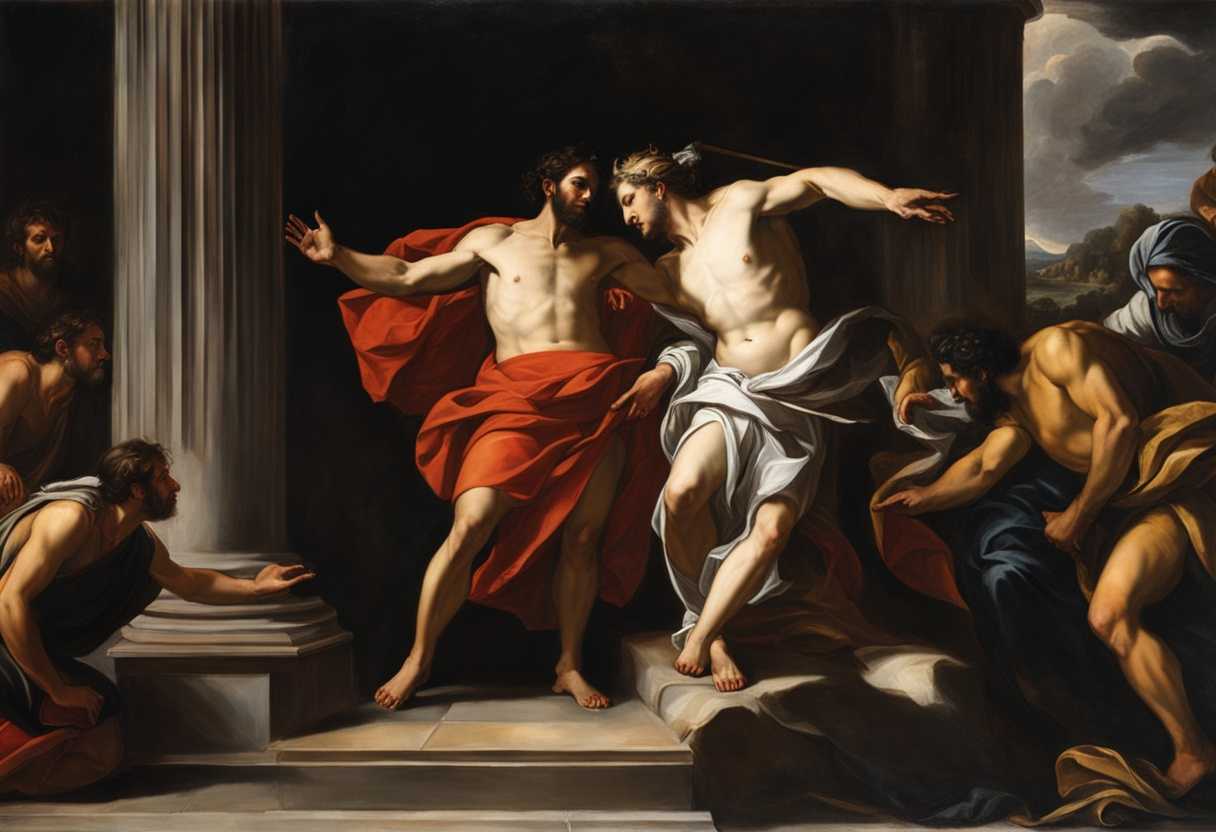
The True Meaning of Job 40
The Book of Job is believed to have been written by the prophet Job himself, though some scholars attribute it to an anonymous author. Job was a righteous man who faced immense suffering and trials, yet remained steadfast in his faith in God. God responds to Job’s questioning and challenges him to consider the vastness of creation and the limits of human understanding in this chapter. The events that unfold here will shed light on the nature of divine sovereignty and the importance of humility before the Almighty. As we delve into this passage, God’s awe-inspiring power and wisdom put Job’s complaints into perspective. This chapter also foreshadows the ultimate resolution of Job’s ordeal, where he comes to a deeper appreciation of God’s ways, even in the midst of life’s most perplexing circumstances. The lessons we glean from this encounter will resonate with all who grapple with the mysteries of suffering and the limits of human knowledge.
Job 40:1-5
Job and God continue their dialogue in Job 40:1-5. God starts by addressing Job with a series of rhetorical questions, “Will the one who contends with the Almighty correct him? Let him who accuses God answer him!” This sets the tone for God’s response to Job’s questioning and complaints. It asserts God’s ultimate authority and wisdom, positioning Him as the one who cannot be corrected or accused by a mere mortal.
This section of the verse highlights the theme of humility and submission before God, trusting in His sovereignty and wisdom even when we may not understand His ways. Job, who has been through immense suffering and hardship, is being reminded of the importance of accepting God’s ultimate authority. This serves as a powerful lesson for readers, urging them to trust in God’s plan even in the midst of trials and tribulations.
The irony in God’s questions lies in the fact that Job, who had been demanding answers from God and questioning His justice throughout the book, now finds himself in a position where he is being challenged to answer to God. This reversal of roles emphasizes the vast difference between God’s knowledge and wisdom compared to human understanding.
This passage also underscores the biblical theme of God’s sovereignty and man’s limited understanding. Proverbs 3:5-6 echoes a similar sentiment, urging believers to trust in the Lord with all their hearts and lean not on their own understanding, acknowledging God’s supremacy in all aspects of life. Job 40:1-5 serves as a powerful reminder of God’s ultimate authority, wisdom, and sovereignty over all creation. It calls for humility and submission in the face of God’s incomprehensible ways, encouraging believers to trust in His plan and purpose even in times of great adversity.
Job 40:6-14
Job and God Himself have a powerful encounter in Job 40:6-14. Let’s break down this passage into sections for a more detailed analysis.
Verse 6 begins with God speaking to Job out of the whirlwind, asserting His divine authority by asking Job a series of questions: “Then the Lord spoke to Job out of the storm: ‘Brace yourself like a man; I will question you, and you shall answer me.’” This sets the tone for the following discourse, where God challenges Job to respond to His inquiries, placing Job in a position where he must recognize the limitations of his understanding compared to the wisdom and power of God. God starts by questioning Job’s ability to challenge Him or instruct Him. Would you condemn me to justify yourself?” God’s questions serve to highlight His sovereignty and righteousness, reminding Job of the vast difference between God’s perfect ways and Job’s limited perspective. This challenges Job’s earlier complaints and prompts him to acknowledge the limitations of human wisdom in understanding the complexities of God’s ways.
Moving on to verses 9-14, God continues to assert His supremacy and might by describing two magnificent creatures, Behemoth and Leviathan, to Job. Behemoth is described as a powerful, large creature, often interpreted as a hippopotamus or an elephant, emphasizing its strength and untamable nature. Leviathan is depicted as a sea monster symbolizing chaos and the uncontrollable forces of nature. These descriptions serve to showcase God’s authority over all creation, including these awe-inspiring and seemingly uncontrollable beings.
The mention of Behemoth and Leviathan in this context underscores God’s unmatched power over the natural world and the forces of chaos. It also serves as a reminder to Job of the divine wisdom manifested in the intricate design of creation, which is beyond human comprehension. God prompts Job to reflect on the beauty and complexity of the world around him by highlighting these remarkable creatures, leading him to a place of humility and awe before the Creator.
This passage in Job 40 illuminates the timeless message of the book of Job, emphasizing the sovereignty, wisdom, and power of God in the face of human suffering and questioning. It reminds us of the importance of acknowledging our limited understanding and trusting in the goodness and righteousness of God, even when we may not fully grasp the reasons for our trials and tribulations. Just as Job ultimately humbled himself before God’s greatness, we are called to surrender our doubts and fears to the all-knowing and all-powerful Creator.
Job 40:15-24
The passage in Job 40:15-24 describes God’s creation of Behemoth, a powerful and mighty creature that cannot be subdued by humans. This section of the book of Job is an essential part of God’s response to Job’s questioning of his suffering and the nature of God’s justice. God uses vivid imagery of Behemoth to remind Job of His supreme power and wisdom. This passage serves as a reminder of God’s sovereignty over all of creation and emphasizes the limitations of human understanding in comparison to God’s infinite wisdom.
Behemoth is described as an enormous and powerful creature, symbolic of God’s creation and authority over nature. Some interpretations suggest that Behemoth may be a reference to a hippopotamus or an elephant. However, the description of Behemoth possessing a tail like a cedar tree and bones like iron suggests that this creature is beyond any known animal, pointing to the idea that Behemoth is a supernatural being created by God to showcase His supremacy.
Understanding Behemoth as a symbol of God’s creation allows for a deeper reflection on the book of Job’s central theme of suffering and the nature of God. Job, who has been enduring immense suffering and loss, is confronted with the majesty and power of Behemoth to remind him of the divine order that governs the world. The passage underscores the idea that there are aspects of the world and God’s plans that transcend human comprehension, and that humans must trust in God’s wisdom and providence, even in times of great hardship and confusion.
Behemoth’s portrayal as a creature that cannot be tamed by humans highlights the idea that there are forces in the world that are beyond human control. This serves as a humbling reminder that humans are finite beings with limited power in the grand scheme of God’s creation. God emphasizes the need for humility and faith in the face of life’s challenges and uncertainties by showcasing Behemoth’s might and grandeur. Behemoth in Job can also be seen as a prelude to the descriptions of other powerful creatures in the book of Revelation, such as the Leviathan, in the broader context of the Bible. These symbolic creatures represent cosmic forces that are beyond human understanding and point to the ultimate victory of God over all evil and chaos. The portrayal of Behemoth in Job serves to deepen the reader’s understanding of God’s sovereignty and the complex nature of His creation. The description of Behemoth in Job 40:15-24 ultimately serves as a powerful reminder of God’s authority and wisdom in the midst of human suffering and questioning. It encourages readers to trust in God’s plan, even when faced with circumstances that seem beyond their comprehension. The imagery of Behemoth invites reflection on the vastness of God’s creation and the need for humility and faith in the face of life’s challenges.
After Job 40
The Lord had spoken to Job, reminding him of His power and wisdom. Job had humbly acknowledged his own limitations and the greatness of God. Now, the Lord continued to challenge Job, inviting him to consider the wonders of His creation. The Lord will present another awe-inspiring display of His might as we turn the page to the next chapter. The Lord will call Job to gaze upon the behemoth, a creature of unparalleled strength and majesty. This encounter will further humble Job, leading him to a deeper understanding of the sovereignty and splendor of the Almighty. The Lord’s words hold the power to transform our hearts and minds; let us now explore them.

Reverend Michael Johnson is an experienced Church Minister with a profound expertise in spirituality and guidance. With a serene presence and a compassionate heart, he has faithfully served his congregation for over 20 years, leading them on a spiritual journey towards inner peace and enlightenment. Reverend Johnson’s extensive knowledge of religious philosophies and profound understanding of human nature have made him a trusted confidant and mentor to many, as he seamlessly weaves his profound wisdom into life teachings. Reverend Johnson’s calming demeanor and empathetic nature continue to uplift and heal souls, nurturing a sense of unity and tranquility within his community.