
1 “Can you draw out Leviathan with a fishhook
or press down his tongue with a cord?
2 Can you put a rope in his nose
or pierce his jaw with a hook?
3 Will he make many pleas to you?
Will he speak to you soft words?
4 Will he make many pleas to you?
Will he speak to you soft words?
5 Will you play with him as with a bird,
or will you put him on a leash for your girls?
6 Will traders bargain over him?
Will they divide him up among the merchants?
7 Can you fill his skin with harpoons
or his head with fishing spears?
8 His sneezings flash forth light,
and his eyes are like the eyelids of the dawn.
9 Behold, the hope of a man is false; he is laid low even at the sight of him.
10 No one is so fierce that he dares to stir him up.
11 Who has first given to me, that I should repay him?
Whatever is under the whole heaven is mine.
12 “I will not keep silence concerning his limbs,
or his mighty strength, or his goodly frame.
13 Who can strip off his outer garment? Who would come near him with a bridle?
14 Who can open the doors of his face?
Around his teeth is terror.
15 His back is made of rows of shields,
shut up closely as with a seal.
16 One is so near to another
that no air can come between them.
17 They are joined one to another; they clasp each other and cannot be separated.
18 Its sneezings flash forth light, and its eyes are like the eyelids of the dawn.
19 Out of his mouth go flaming torches; sparks of fire leap forth.
20 Out of his nostrils comes forth smoke,
as from a boiling pot and burning rushes.
21 His breath kindles coals, and a flame comes out of his mouth.
22 In his neck abides strength,
and terror dances before him.
23 The folds of his flesh stick together,
firmly cast on him and immovable.
24 His heart is hard as a stone, hard as the lower millstone.
25 When it raises itself up, the mighty are afraid; at the crashing they are beside themselves.
26 “Though the sword reaches him, it does not avail, nor the spear, the dart, or the javelin.”
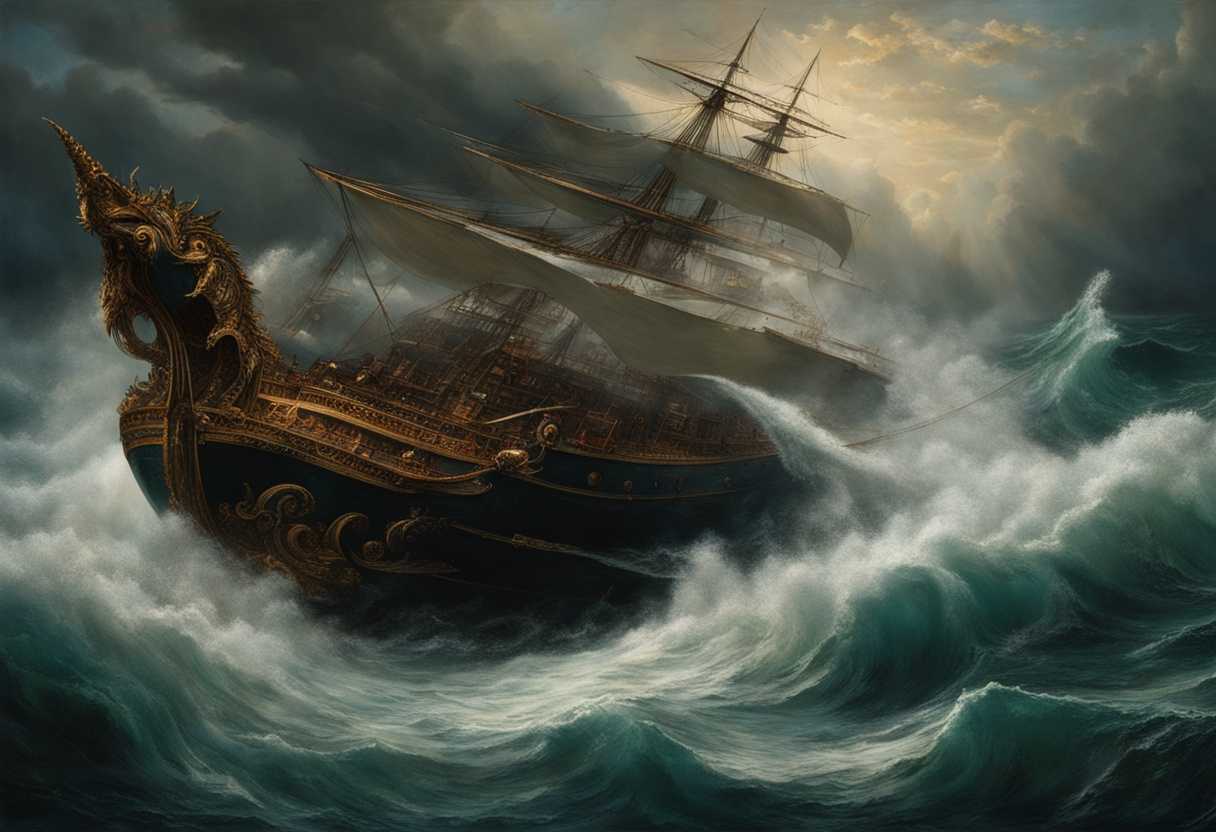
The True Meaning of Job 41
The Book of Job is believed to have been written by the prophet Job himself, though some scholars attribute it to an anonymous author. Job was a righteous man who faced immense suffering and trials, yet remained steadfast in his faith in God. The Almighty reveals the might and majesty of His creation in a powerful discourse between God and Job in this chapter, specifically focusing on the awe-inspiring creature known as Leviathan. This passage serves as a profound reminder of the limitless power and wisdom of the divine, challenging Job’s understanding and inviting him to humble himself before the sovereign Lord. We will witness the unveiling of Leviathan’s formidable attributes as we explore this chapter, which echo the grandeur and authority of the Creator. This encounter will lead Job to a deeper appreciation of God’s sovereignty and a renewed commitment to trust in the divine plan, even amidst the most daunting circumstances. The lessons learned here resonate with the words of the Psalmist, who declared, “The Lord is great and greatly to be praised; and his greatness is unsearchable” (Psalm 145:3).
Job 41:1-11
God continues to speak to Job in Job 41:1-11, drawing his attention to the Leviathan, a creature with which Job would have been familiar. The Leviathan is described as a mighty creature with fearsome teeth and scales. God presents this creature to Job as a symbol of His power and sovereignty over all creation, including creatures that seem untamable and beyond human control.
The Leviathan is a powerful and enigmatic creature mentioned in multiple verses throughout the Bible, often as a symbol of chaos and evil forces. Psalm 104:26 mentions it as one of the many creatures created by God, showcasing the diversity and wonder of His creation. The Leviathan is described as a twisted and elusive serpent that symbolizes God’s power to defeat chaos and evil in the world in Isaiah 27:1. God is reminding Job of the limitations of human understanding and power in comparison to His own infinite wisdom and authority by highlighting the Leviathan. This serves as a humbling lesson for Job, who is grappling with the questions of suffering and justice in the midst of his trials. It prompts Job to recognize the vastness of God’s creation and the complexities of His divine plan, beyond what the human mind can grasp.
The imagery of the Leviathan also serves as a reminder of the ongoing battle between good and evil in the world, a theme that runs throughout the Bible. The Leviathan represents the forces of chaos and destruction that exist in the world, but ultimately are subject to God’s control and will. This message of God’s sovereignty over all things, even the most terrifying and uncontrollable elements of creation, reassures believers that God is ultimately in charge and will bring about justice and order in His perfect timing. The description of the Leviathan in Job 41 serves as a powerful metaphor for God’s supremacy over all creation, His inscrutable ways, and the need for humility and trust in the face of life’s uncertainties. It challenges readers to acknowledge the limits of human knowledge and power, while placing their faith in a God who holds the entire universe in His hands.
Job 41:12-24
Leviathan, a sea monster or creature of the deep, is presented as a powerful and untamable being in a vivid description in Job 41:12-24. This passage describes Leviathan’s fearsome teeth, scales, sneezing, and breathing, illustrating its fierceness and strength. The description emphasizes Leviathan’s ability to strike terror into the hearts of those who encounter it, showcasing its dominance and uncontrollable nature.
Leviathan is a prominent symbol in Hebrew literature, often representing chaos or evil forces. The portrayal of Leviathan in this context underscores the unfathomable might and mystery of God’s creations, highlighting the incomprehensible nature of the divine. The mention of Leviathan in the Book of Job serves as a testament to the vastness of God’s power and the limitations of human understanding in the face of such grandeur.
This passage echoes themes found throughout the Bible regarding the awe-inspiring power of God. The verse in Job 41:10 states that no one is fierce enough to rouse it. Who then is able to stand against me?” This question posed by God in reference to Leviathan reinforces the idea of God’s unrivaled power and the insignificance of human strength in comparison. It prompts introspection on humanity’s place in the grand scheme of creation and the humility required in recognizing the supremacy of God. Leviathan in Job 41 draws parallels to other biblical references of sea monsters, such as the sea creature mentioned in Psalm 104:26, associating them with the mysteries and wonders of the natural world. These depictions serve as a reminder of the divine mastery over all creation, emphasizing the need for reverence and humility before God’s greatness. The portrayal of Leviathan symbolizes the chaotic and unpredictable elements of existence in a broader sense, urging individuals to place their trust in God’s sovereignty amidst the uncertainties of life. The depiction of Leviathan in Job 41:12-24 ultimately reinforces the overarching theme of the Book of Job, which grapples with the age-old question of suffering and the unknowable ways of God. Through the description of Leviathan’s might and untamable nature, the passage encourages readers to contemplate the limitations of human knowledge and the overarching wisdom of God. It serves as a poignant reminder of the vastness and complexity of the divine plan, prompting a sense of awe and reverence in the face of God’s incomprehensible works.
Job 41:25-34
The verses in Job 41:25-34 describe the terrifying beast known as Leviathan. This section vividly portrays the power and fearlessness of this creature. It is detailed how Leviathan’s path through the waters leaves behind a trail of splashing and churning, demonstrating the sheer force and strength it possesses. The verses depict the creature as having no fear, showing its invincibility and dominance in the natural world.
The image of Leviathan in the Bible carries symbolic weight beyond just a sea monster. Scholars and theologians have interpreted Leviathan as a representation of chaos and evil, with some interpretations associating it with Satan. The description of Leviathan in this passage serves as a reminder of the formidable forces of evil that exist in the world, forces that can only be defeated by the power of God.
Throughout the Bible, references to sea monsters like Leviathan often serve as a metaphor for the challenges and obstacles faced by humans. These passages encourage believers to trust in the ultimate power and sovereignty of God in the face of seemingly insurmountable difficulties. The mention of Leviathan in Job serves to highlight the need for faith and humility in the midst of adversity. Leviathan is mentioned in Psalm 74:14 in the context of God’s power over creation, emphasizing His control over even the most fearsome creatures. This echoes the message in Job 41, reinforcing the idea that God is ultimately in control of all things, no matter how powerful or threatening they may seem. The depiction of Leviathan in Job 41:25-34 serves as a powerful reminder of the incomprehensible might of God and the need for unwavering faith in His sovereignty, even in the face of seemingly unbeatable challenges. The description of Leviathan challenges readers to reflect on their own trust in God’s power and ability to overcome the forces of chaos and evil in the world. These verses ultimately point to the overarching theme of God’s supremacy and the importance of submitting to His authority in all circumstances.
After Job 41
The Lord had spoken to Job out of the whirlwind, revealing His power and might. Job had been humbled, realizing his own insignificance before the Almighty. Yet, the Lord’s words did not end there. He had more to say, more for Job to ponder. The Lord turned His attention to a mighty creature, one that struck fear into the hearts of men, as the chapter drew to a close. This was no ordinary beast, but a fearsome leviathan, a creature of awe and wonder. The Lord described its immense strength, its impenetrable scales, and the terror it inspired.
This was no mere animal, but a testament to the Lord’s creative power. What lessons did the leviathan hold for Job, and for all who would seek to understand the ways of the Almighty? The answers lay in the pages to come, waiting to be discovered.

Reverend Michael Johnson is an experienced Church Minister with a profound expertise in spirituality and guidance. With a serene presence and a compassionate heart, he has faithfully served his congregation for over 20 years, leading them on a spiritual journey towards inner peace and enlightenment. Reverend Johnson’s extensive knowledge of religious philosophies and profound understanding of human nature have made him a trusted confidant and mentor to many, as he seamlessly weaves his profound wisdom into life teachings. Reverend Johnson’s calming demeanor and empathetic nature continue to uplift and heal souls, nurturing a sense of unity and tranquility within his community.