
John 12:1-50 is about Jesus’ final days before his crucifixion, showcasing themes of love, sacrifice, and the fulfillment of prophecy as he prepares to lay down his life for the salvation of humanity.
1 Six days before the Passover, Jesus therefore came to Bethany, where Lazarus was, whom Jesus had raised from the dead.
2 So they gave a dinner for him there. Martha served, and Lazarus was one of those reclining with him at table.
3 Mary therefore took a pound of expensive ointment made from pure nard, and anointed the feet of Jesus and wiped his feet with her hair. The house was filled with the fragrance of the perfume.
4 But Judas Iscariot, one of his disciples (he who was about to betray him), said,
5 “Why was this ointment not sold for three hundred denarii and given to the poor?”
6 He said this, not because he cared about the poor, but because he was a thief, and having charge of the moneybag he used to help himself to what was put into it.
7 Jesus said, “Leave her alone, so that she may keep it for the day of my burial.”
8 For the poor you always have with you, but you do not always have me.”
9 When the large crowd of the Jews learned that Jesus was there, they came, not only on account of him but also to see Lazarus, whom he had raised from the dead.
10 So the chief priests made plans to put Lazarus to death as well,
11 because on account of him many of the Jews were going away and believing in Jesus.
12 The next day the large crowd that had come to the feast heard that Jesus was coming to Jerusalem.
12 So they took branches of palm trees and went out to meet him, crying out, “Hosanna! Blessed is he who comes in the name of the Lord, even the King of Israel!”
14 And Jesus found a young donkey and sat on it, just as it is written,
15 “Fear not, daughter of Zion; behold, your king is coming, sitting on a donkey’s colt!”
16 His disciples did not understand these things at first, but when Jesus was glorified, then they remembered that these things had been written about him and had been done to him.
17 So the crowd that had been with him when he called Lazarus out of the tomb and raised him from the dead continued to bear witness.
18 The reason why the crowd went to meet him was that they heard he had done this sign.
19 So the Pharisees said to one another, “You see that you are gaining nothing. Look, the world has gone after him.”
20 Now among those who went up to worship at the feast were some Greeks.
21 So these came to Philip, who was from Bethsaida in Galilee, and asked him, “Sir, we wish to see Jesus.”
22 Philip went and told Andrew; Andrew and Philip went and told Jesus.
23 And Jesus answered them, “The hour has come for the Son of Man to be glorified.
24 Truly, truly, I say to you, unless a grain of wheat falls into the earth and dies, it remains alone; but if it dies, it bears much fruit.
25 Whoever loves his life loses it, and whoever hates his life in this world will keep it for eternal life.
26 If anyone serves me, he must follow me; and where I am, there will my servant be also. If anyone serves me, the Father will honor him.
27 “Now is my soul troubled. And what shall I say? ‘Father, save me from this hour’? But for this purpose I have come to this hour.”
28 Father, glorify your name.” Then a voice came from heaven: “I have glorified it, and I will glorify it again.”
29 The crowd that stood there and heard it said that it had thundered. Others said, “An angel has spoken to him.”
30 Jesus answered, “This voice has come for your sake, not mine.
31 Now is the judgment of this world; now will the ruler of this world be cast out.
32 And I, when I am lifted up from the earth, will draw all people to myself.”
33 He said this to show by what kind of death he was going to die.
34 So the crowd answered him, “We have heard from the Law that the Christ remains forever. How can you say that the Son of Man must be lifted up? Who is this Son of Man?”
35 So Jesus said to them, “The light is among you for a little while longer. Walk while you have the light, lest darkness overtake you. The one who walks in the darkness does not know where he is going.
36 While you have the light, believe in the light, that you may become sons of light.”
Though he had done so many signs before them, they still did not believe in him,
38 so that the word spoken by the prophet Isaiah might be fulfilled: “Lord, who has believed what he heard from us, and to whom has the arm of the Lord been revealed?”
39 Therefore they could not believe. For again Isaiah said,
40 “He has blinded their eyes
and hardened their heart,
lest they see with their eyes,
and understand with their heart, and turn,
and I would heal them.”
41 Isaiah said these things because he saw his glory and spoke of him.
42 Nevertheless, many even of the authorities believed in him, but for fear of the Pharisees they did not confess it, so that they would not be put out of the synagogue;
43 for they loved the glory that comes from man more than the glory that comes from God.
44 And Jesus cried out and said, “Whoever believes in me, believes not in me but in him who sent me.
45 And whoever sees me sees him who sent me.
46 I have come into the world as light, so that whoever believes in me may not remain in darkness.
47 If anyone hears my words and does not keep them, I do not judge him; for I did not come to judge the world but to save the world.
48 The one who rejects me and does not receive my words has a judge; the word that I have spoken will judge him on the last day.
49 For I have not spoken on my own authority, but the Father who sent me has himself given me a commandment—what to say and what to speak.
50 And I know that his commandment is eternal life. What I say, therefore, I say as the Father has told me.”
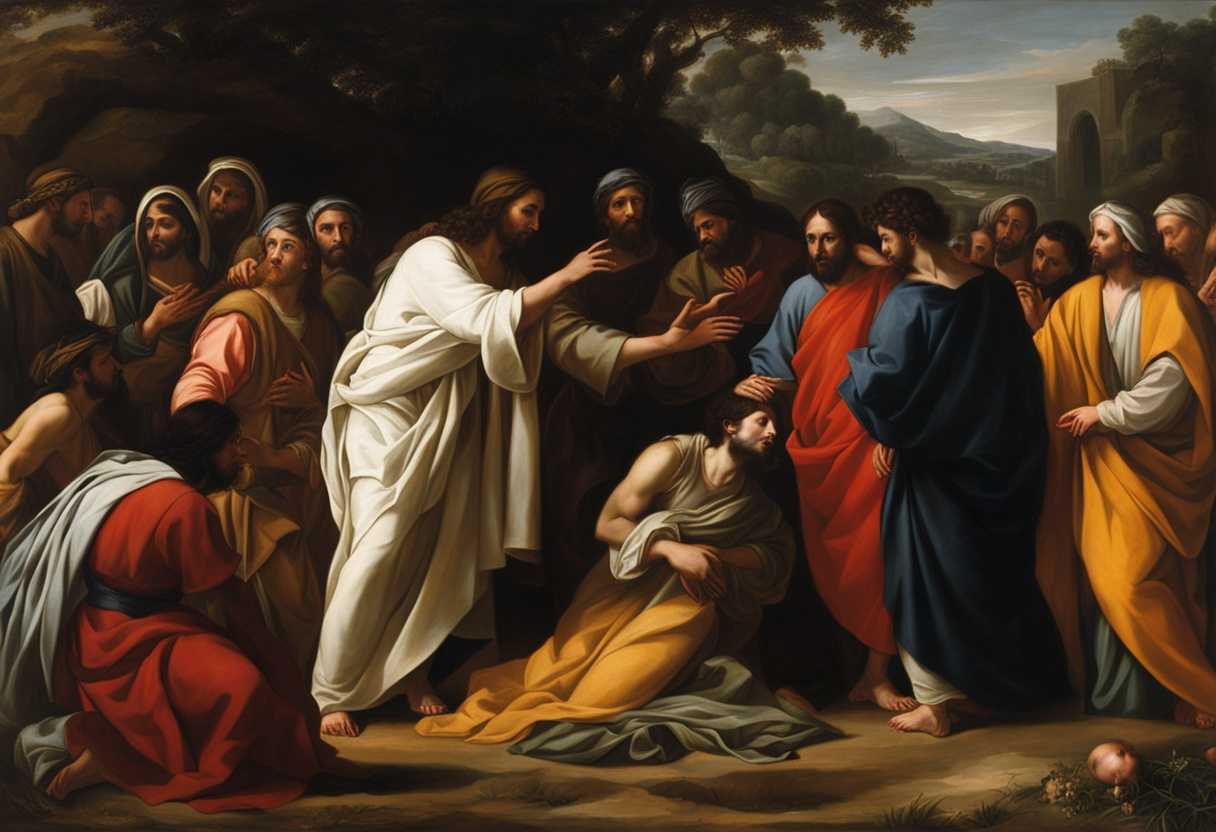
Setting the Scene for John 12:1-50
In John chapter 12, the scene is set in Bethany, a village located near Jerusalem. Jesus is visiting the home of his dear friends, Mary, Martha, and Lazarus. The atmosphere is warm and welcoming as they gather around a table for a meal. The room is filled with the aroma of food being prepared, and the sound of laughter and conversation fills the air.
As they are enjoying their time together, Mary takes a jar of expensive perfume and anoints Jesus’ feet with it, wiping them with her hair. Judas Iscariot, one of Jesus’ disciples, questions the extravagance of the act, but Jesus defends Mary, recognizing her gesture as an expression of love and devotion.
The room is filled with a mix of emotions – gratitude, love, and a sense of foreboding as Jesus speaks about his impending death. The disciples are gathered around him, hanging onto his every word, as he imparts wisdom and prepares them for the trials that lie ahead. The scene is intimate and poignant, capturing the essence of Jesus’ ministry and the deep bond he shares with his followers.
What is John 12:1-50 about?
Jesus is preparing for his impending death by being anointed with a costly perfume in this verse. This act not only shows the love and devotion of the woman who anointed him but also symbolizes Jesus being prepared for his burial. Jesus is highlighting the sacrifice he is about to make for humanity’s sins by acknowledging his death and burial. This act of anointing foreshadows his crucifixion and burial, adding a layer of depth to the significance of his upcoming sacrifice.
Furthermore, Jesus not only acknowledges his impending death but also calls for belief in him. Jesus emphasizes the importance of faith in his teachings and divinity by asking his disciples and the people around him to believe in him. This call for belief is not just about acknowledging Jesus as a historical figure but about accepting him as the Savior and Messiah. Jesus is urging his followers to understand the significance of his sacrifice and to have faith in his teachings even in the face of his impending death by coupling his imminent death with a call for belief. Reflect on the depth of Jesus’ words. How does his acceptance of the anointing demonstrate his divine purpose? What does his call for belief reveal about his mission on earth?
Understanding what John 12:1-50 really means
In John 12:1-50, we delve into a crucial period in Jesus’ ministry, where significant events unfold leading up to His ultimate sacrifice on the cross. The passage captures moments like Jesus’ anointing at Bethany, His triumphant entry into Jerusalem, and His teachings about His impending death. One key theme that resonates throughout this passage is when Jesus declares, “The hour has come for the Son of Man to be glorified” (John 12:23). This statement marks a pivotal moment where Jesus acknowledges the imminent fulfillment of His sacrificial mission, highlighting the centrality of His death and resurrection in the Christian faith.
Moreover, Jesus uses the metaphor of a grain of wheat falling into the earth and dying to illustrate the necessity of His own death for the salvation of many. This imagery emphasizes the transformative power of sacrifice and selflessness, echoing Paul’s words in 1 Corinthians 15:36 about the resurrection of the dead. Jesus also calls for true discipleship, stating, “Whoever serves me must follow me; and where I am, my servant also will be” (John 12:26). This call to follow His example of humility and service is a reminder of the selfless nature of true discipleship, as seen in Matthew 16:24.
Furthermore, Jesus identifies Himself as the light of the world, offering guidance and salvation to all who believe in Him. His proclamation, “I have come into the world as a light, so that no one who believes in me should stay in darkness” (John 12:46), echoes His earlier declaration in John 8:12. This imagery of light dispelling darkness symbolizes Jesus’ role in bringing truth, hope, and deliverance from sin and ignorance to humanity.
The relevance of these themes to people today is profound. In a world often consumed by self-interest, Jesus’ call to sacrifice and serve others stands as a powerful reminder of the transformative impact of selflessness. Stories of modern-day individuals or communities exemplifying sacrificial love and service, such as healthcare workers during crises or volunteers in disaster relief efforts, serve as tangible examples of this principle in action. Additionally, in times of uncertainty and despair, Jesus’ promise of being the light of the world offers hope and direction to those who seek it. Personal anecdotes or well-known narratives of faith providing comfort and guidance during challenging times underscore the enduring relevance of Jesus’ message of hope and light.
In conclusion, John 12:1-50 encapsulates essential teachings about Jesus’ sacrifice, the call to discipleship, and the hope He brings as the light of the world. As readers reflect on these profound truths, they are encouraged to embody Jesus’ teachings in their daily lives, fostering a spirit of service, sacrifice, and hope in a world that yearns for such transformative virtues.
What does it mean to truly follow Jesus?
To truly follow Jesus means to live a life of selflessness and dedication to Him. Being a follower of Jesus requires putting Him first above all else, just as Mary poured expensive perfume on Jesus’ feet as an act of worship and love. It means recognizing His worth and offering our best to Him, even when it may not be understood or valued by others.
Following Jesus also involves acknowledging His teachings and embodying them in our own lives. We are called to serve others with love and humility, just as Jesus humbly washed the feet of His disciples. True followers of Jesus are willing to deny themselves, take up their cross, and walk in His ways, even when it is difficult or goes against the norms of society. Truly following Jesus means trusting in Him completely and allowing His light to shine through us. Jesus mentioned in the verse that when we walk with Him, we become children of light. Following Jesus is not simply a matter of words, but of actions that reflect His love, grace, and truth in all that we do.
Application
Think of your daily grind and the effort you put into your work and family. Now, let the message of John 12:1-50 drive your spiritual journey just like that. Jesus’ words push us to follow Him fully, live by His principles, and make a difference that honors God. Ready to integrate His teachings into your life and touch others with your faith?

Reverend Michael Johnson is an experienced Church Minister with a profound expertise in spirituality and guidance. With a serene presence and a compassionate heart, he has faithfully served his congregation for over 20 years, leading them on a spiritual journey towards inner peace and enlightenment. Reverend Johnson’s extensive knowledge of religious philosophies and profound understanding of human nature have made him a trusted confidant and mentor to many, as he seamlessly weaves his profound wisdom into life teachings. Reverend Johnson’s calming demeanor and empathetic nature continue to uplift and heal souls, nurturing a sense of unity and tranquility within his community.