
John 13:1-15 is about Jesus demonstrating humble servanthood by washing the disciples’ feet, teaching them the importance of serving others with love and humility.
1 Now before the Feast of the Passover, when Jesus knew that his hour had come to depart out of this world to the Father, having loved his own who were in the world, he loved them to the end.
2 During supper, when the devil had already put it into the heart of Judas Iscariot, Simon’s son, to betray him,
3 Jesus, knowing that the Father had given all things into his hands, and that he had come from God and was going back to God,
4 rose from supper. He laid aside his outer garments, and taking a towel, tied it around his waist.
5 Then he poured water into a basin and began to wash the disciples’ feet and to wipe them with the towel that was wrapped around him.
6 He came to Simon Peter, who said to him, “Lord, do you wash my feet?”
7 Jesus answered him, “What I am doing you do not understand now, but afterward you will understand.”
8 Peter said to him, “You shall never wash my feet.” Jesus answered him, “If I do not wash you, you have no share with me.”
9 Simon Peter said to him, “Lord, not my feet only but also my hands and my head!”
10 Jesus said to him, “The one who has bathed does not need to wash, except for his feet, but is completely clean. And you are clean, but not every one of you.”
11 For he knew who was to betray him; that was why he said, “Not all of you are clean.”
12 When he had washed their feet and put on his outer garments and resumed his place, he said to them, “Do you understand what I have done to you?
13 You call me Teacher and Lord, and you are right, for so I am.
14 If I then, your Lord and Teacher, have washed your feet, you also ought to wash one another’s feet.
15 For I have given you an example, that you also should do just as I have done to you.
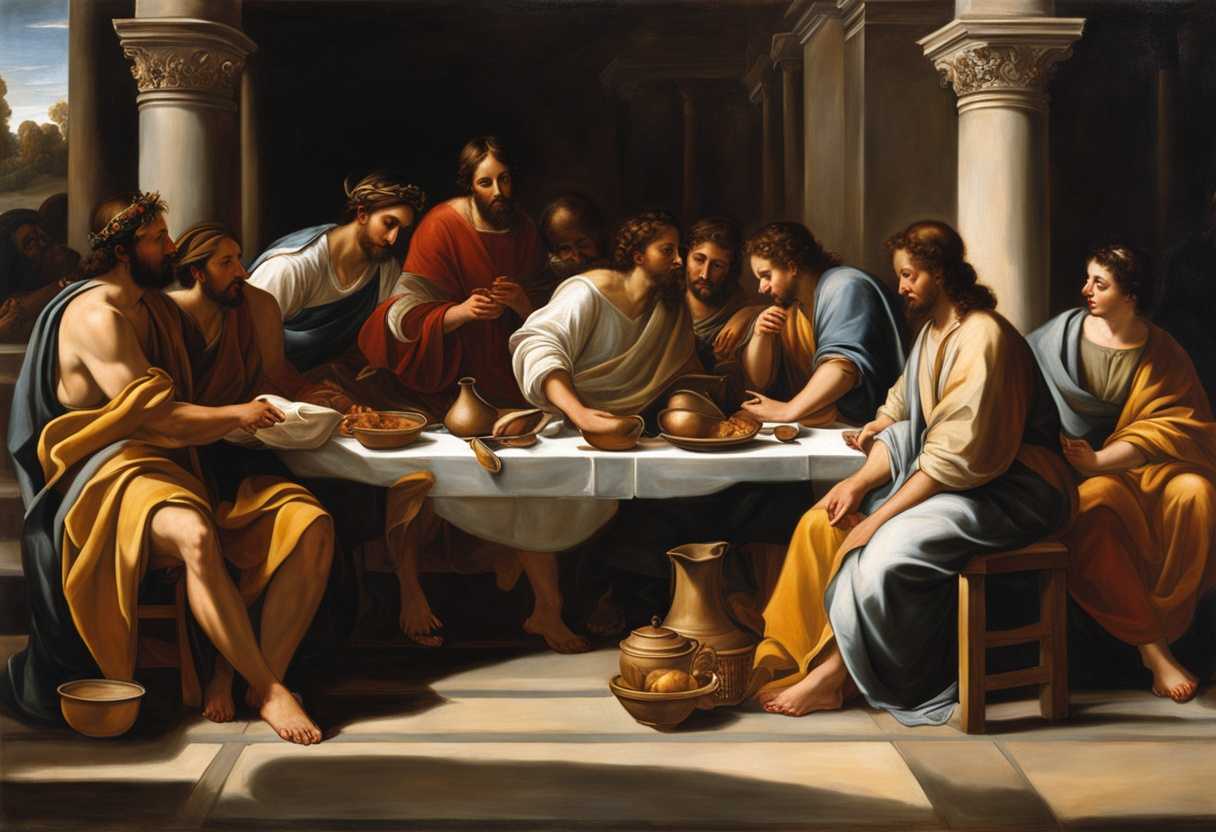
Setting the Scene for John 13:1-15
In John chapter 13, the scene is set in an upper room in Jerusalem where Jesus and his twelve disciples are gathered for the Passover meal. The room is dimly lit by oil lamps, casting a warm glow on the faces of those present. The disciples are reclining at the table, their sandals kicked off, as was the custom of the time. The air is filled with the aroma of roasted lamb, unleavened bread, and bitter herbs, typical of a Passover feast.
Jesus, knowing that his time on earth is coming to an end, rises from the table, removes his outer garment, and wraps a towel around his waist. The disciples watch in confusion as their teacher, the Son of God, takes on the role of a servant. Jesus then begins to wash the feet of his disciples, a task usually reserved for the lowest of servants. The disciples, including Peter, are taken aback by this humble act of service from their revered leader.
As Jesus moves from one disciple to the next, washing their feet and drying them with the towel, he explains to them the importance of humility and servanthood. This powerful moment in the upper room serves as a poignant lesson for the disciples, teaching them that true greatness comes from serving others.
What is John 13:1-15 about?
This verse from the Bible, where Jesus washes the feet of his disciples, holds profound meaning and serves as a powerful lesson in humility and service. Through this humble act, Jesus demonstrates the importance of serving others with love and kindness, regardless of one’s status or position. Jesus shows the ultimate example of selflessness and sacrificial love by taking on the role of a servant and washing the feet of his disciples.
Just imagine the scene: the Son of God, taking on the role of a servant, kneeling before his disciples and washing their feet. This act not only cleanses their bodies but also purifies their hearts, teaching them the value of humility and service. It challenges us to consider how we can humble ourselves and serve others in our daily lives. Jesus’ actions remind us that true greatness lies in serving others with love and humility, rather than seeking power or recognition. So, let us reflect on this powerful lesson and strive to follow Jesus’ example by serving others with a humble and compassionate heart.
Understanding what John 13:1-15 really means
Introduction
During the Last Supper, a poignant moment unfolds just before Jesus’ crucifixion, shedding light on His profound humility and the paramount importance of serving others.
Verse Breakdown and Commentary
“Having loved his own who were in the world, he loved them to the end.” This verse encapsulates the unwavering and eternal love of Jesus, a love so enduring that it surpasses all boundaries. It echoes the sentiment in Romans 8:38-39, emphasizing the inseparable love of Christ, a stark contrast to the conditional love often experienced in the world.
“He got up from the meal, took off his outer clothing, and wrapped a towel around his waist.” Here, Jesus assumes the role of a servant, exemplifying humility in action. This act mirrors the description in Philippians 2:7, where Jesus is portrayed as taking on the form of a servant, challenging societal norms and advocating for humility.
“Now that I, your Lord and Teacher, have washed your feet, you also should wash one another’s feet.” Jesus sets a profound example of servanthood for His disciples to emulate. This directive aligns with the teaching in Matthew 20:26-28, emphasizing that true greatness stems from serving others. In a culture fixated on self-interest, this serves as a poignant reminder of the value of selfless service.
Application to Modern Life
In a contemporary world consumed by self-aggrandizement and personal advancement, this passage beckons us to embrace humility and service. It underscores the notion that authentic leadership and true greatness emanate from selflessly serving others, rather than from the pursuit of power or accolades.
Consider a scenario where a CEO of a prominent corporation eschews the confines of a plush office to toil alongside employees, understanding their struggles and extending acts of service. This CEO garners respect and loyalty akin to how Jesus’ act of washing His disciples’ feet showcased His love and humility, engendering their unwavering devotion.
Meaningful Phrases and Detailed Explanation
“He loved them to the end.” This phrase underscores the completeness and perfection of Jesus’ love, a love that perseveres through all circumstances, even unto death.
“Took off his outer clothing, and wrapped a towel around his waist.” This symbolic gesture signifies Jesus relinquishing His divine prerogatives to embody the essence of a servant, a potent visual representation of humility and service.
“You also should wash one another’s feet.” This injunction serves as a clarion call for all believers, urging them to not only engage in literal foot-washing but to embrace a lifestyle characterized by humility and service.
Conclusion
The narrative in John 13:1-15 imparts a profound lesson on love, humility, and service, urging us to mirror Jesus’ example in our daily interactions by selflessly serving others and extending unconditional love.
How can we fully serve and humble ourselves?
To fully serve and humble ourselves, we can follow the example of Jesus washing the disciples’ feet. We are called to serve others with a similar attitude as Jesus took on the role of a servant and humbly washed the feet of his disciples. This act of service and humility demonstrated by Jesus teaches us to put others before ourselves and to show love through our actions. We should not seek recognition or praise for our deeds when serving others. Instead, we should approach serving with a heart of genuine care and compassion, putting the needs of others above our own. We imitate the humility and selflessness of Jesus by humbling ourselves in service to others, as he came not to be served but to serve.
Fully serving and humbling ourselves involves setting aside our own desires and ego, and focusing on the well-being and happiness of those around us. We are called to follow Jesus’ example by serving others with a heart full of humility and love, just as he set aside his status and position to serve his disciples. We embody the essence of true servanthood and reflect the love of Christ to the world.
Application
Just like tackling a tough project at work or making time for your family, let’s embrace the humble spirit Jesus showed when He washed His disciples’ feet. Think about how you can genuinely help others today, putting their needs before your own. Look around and seize the chance to be selfless and caring, just like Christ. Will you step up and serve with humility and love today?

Reverend Michael Johnson is an experienced Church Minister with a profound expertise in spirituality and guidance. With a serene presence and a compassionate heart, he has faithfully served his congregation for over 20 years, leading them on a spiritual journey towards inner peace and enlightenment. Reverend Johnson’s extensive knowledge of religious philosophies and profound understanding of human nature have made him a trusted confidant and mentor to many, as he seamlessly weaves his profound wisdom into life teachings. Reverend Johnson’s calming demeanor and empathetic nature continue to uplift and heal souls, nurturing a sense of unity and tranquility within his community.