
John 19:25-34 is about the compassionate presence of Mary and the disciple whom Jesus loved at the foot of the cross, symbolizing the enduring faith and love of Christ’s followers even amidst suffering and darkness, culminating in the piercing of Jesus’ side as a fulfillment of scripture and a sign of spiritual birth and redemption.
25 but standing by the cross of Jesus were his mother and his mother’s sister, Mary the wife of Clopas, and Mary Magdalene.
26 When Jesus saw his mother and the disciple whom he loved standing nearby, he said to his mother, “Woman, behold, your son!”
27 Then he said to the disciple, “Behold, your mother!” And from that hour the disciple took her to his own home.
28 After this, Jesus, knowing that all was now finished, said (to fulfill the Scripture), “I thirst.”
29 A jar full of sour wine stood there, so they put a sponge full of the sour wine on a hyssop branch and held it to his mouth.
30 When Jesus had received the sour wine, he said, “It is finished,” and he bowed his head and gave up his spirit.
31 Since it was the day of Preparation, and so that the bodies would not remain on the cross on the Sabbath (for that Sabbath was a high day), the Jews asked Pilate that their legs might be broken and that they might be taken away.
32 So the soldiers came and broke the legs of the first, and of the other who had been crucified with him.
33 But when they came to Jesus and saw that he was already dead, they did not break his legs.
34 But one of the soldiers pierced his side with a spear, and at once there came out blood and water.
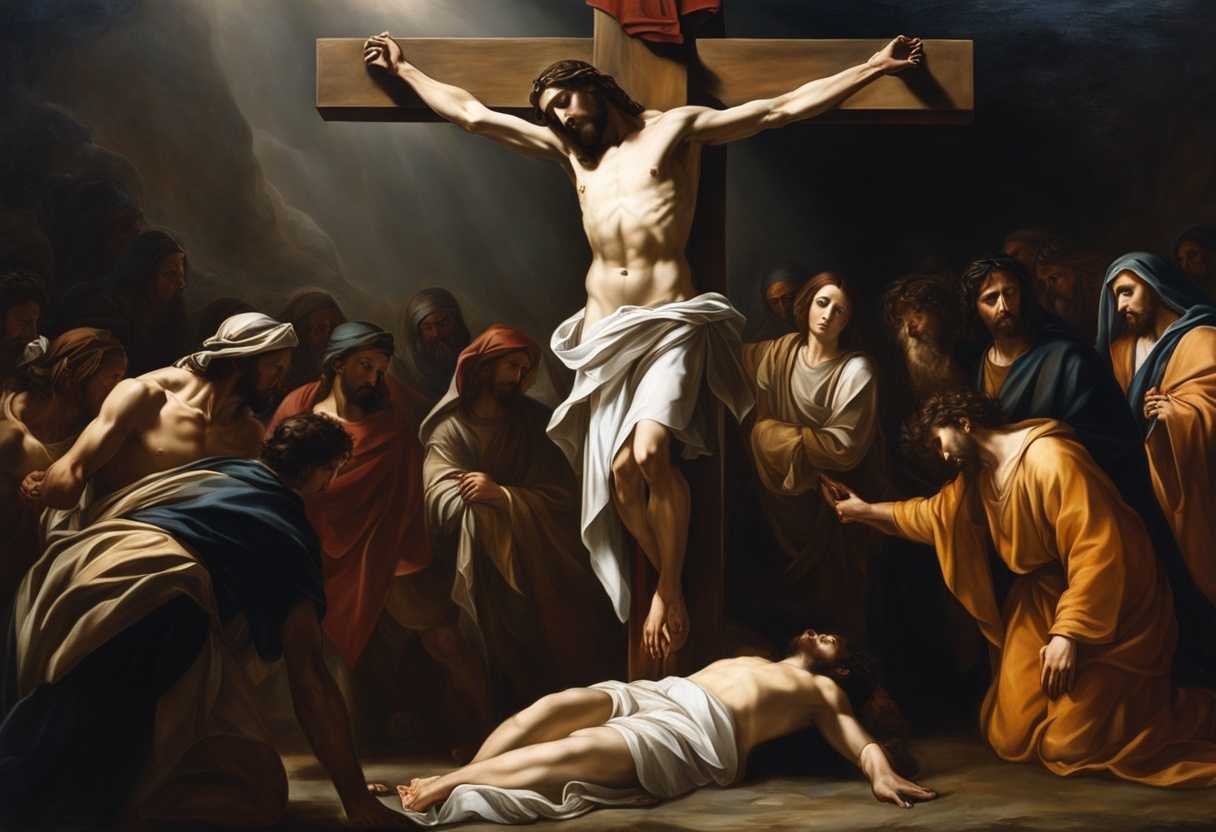
Setting the Scene for John 19:25-34
The scene described in John 19:25-34 takes place at the foot of the cross where Jesus was crucified. Mary, the mother of Jesus, along with Mary Magdalene and the disciple whom Jesus loved (traditionally believed to be John the Apostle) are present. They have come to witness the crucifixion of Jesus, whom they love and follow.
The atmosphere is heavy with sorrow and anguish as they watch Jesus suffer on the cross. The women are weeping, and John is standing by, offering support and comfort to them. The soldiers are also present, carrying out their duties, including the piercing of Jesus’ side with a spear, as described in the passage.
The scene is set on a hill outside Jerusalem, with the crosses of Jesus and the two criminals standing starkly against the sky. The crowd is murmuring and some are mocking Jesus, while others are watching in silence. The sun is setting, casting a somber light over the scene, as the events of Jesus’ crucifixion unfold before the eyes of his loved ones.
What is John 19:25-34 about?
This verse from the story of Jesus’s crucifixion carries profound symbolism and deep emotions. Jesus is not only demonstrating his care and compassion for his mother Mary by entrusting her to the beloved disciple John, but he is also showing the importance of relationships and community. Jesus is highlighting the need for us to support and care for one another, even in times of great suffering and hardship, by entrusting Mary to John. It reminds us that we are all part of a larger family, connected through love and faith.
Furthermore, the piercing of Jesus’s side by the soldiers fulfills the prophecy mentioned in the Old Testament. This act not only shows the fulfillment of divine prophecy but also represents the sacrifice and atonement that Jesus made for humanity. It is a powerful symbol of his love and willingness to endure immense suffering for the redemption of all. This verse prompts us to reflect on the depth of Jesus’s sacrifice and the profound love that drives his actions. It challenges us to consider our own capacity for selflessness and compassion towards others, even in the face of adversity.
Understanding what John 19:25-34 really means
The passage in John 19:25-34 captures the poignant moments during Jesus Christ’s crucifixion, shedding light on His interactions with His mother, Mary, and the disciple John, as well as the fulfillment of prophecies and the declaration of His mission’s completion. In the midst of excruciating pain, Jesus demonstrates His deep care for familial responsibilities by entrusting His mother to John, symbolizing the creation of a new spiritual family among His followers. The phrases “Woman, behold your son!” and “Behold your mother!” resonate with profound meaning, emphasizing Jesus’ attention to both spiritual and earthly relationships even in His final moments.
Moreover, Jesus’ declaration of thirst humanizes His suffering, fulfilling the prophecy in Psalm 69:21 and highlighting His complete understanding of human pain and physical needs. The phrase “It is finished” reverberates with significance, signifying the culmination of Jesus’ redemptive mission to atone for humanity’s sins and fulfill God’s plan of salvation. The piercing of Jesus’ side by a Roman soldier, resulting in the outpouring of blood and water, fulfills the prophecy in Zechariah 12:10 and symbolizes the grace and sacraments of the Church, such as baptism and the Eucharist.
This passage intertwines with other biblical texts, such as Luke 2:34-35, Psalm 22:14-18, and Isaiah 53:5, further emphasizing the prophetic nature of Jesus’ suffering and the fulfillment of Old Testament scriptures. The relevance of these events to contemporary individuals is profound, reminding us of the importance of family and community care, the recognition of human suffering, and the assurance of God’s faithfulness in fulfilling His promises through Jesus Christ.
To illustrate the enduring impact of Jesus’ actions on the cross, one can envision a modern scenario where a dying individual ensures the well-being of their loved ones, mirroring Jesus’ care for His mother amidst His own agony. Just as Jesus provided for His mother’s future by entrusting her to John, individuals facing mortality may seek to secure their family’s stability and support, echoing the sacrificial love exemplified by Christ.
In conclusion, John 19:25-34 encapsulates the depth of Jesus’ love, the extent of His sacrifice, and the fulfillment of God’s redemptive plan through His crucifixion. This passage prompts us to reflect on our responsibilities towards our families, appreciate Jesus’ profound empathy for human suffering, and trust in the reliability of God’s promises as revealed through Scripture.
How can we show compassion and care for others?
We can show compassion and care for others by standing beside them in their times of need and hardship, just as Mary stood by Jesus at the foot of the cross. This means being present for others, offering our support, and showing understanding and empathy for their struggles. Additionally, we can emulate the love and care that Jesus had for His mother by taking care of those who are vulnerable and in need, such as the disciple whom Jesus gave Mary to. This involves looking out for the well-being of others and providing for them in practical ways.
Furthermore, we can show compassion and care for others by recognizing their pain and suffering, and actively seeking to alleviate it. Just like when Jesus received sour wine on a sponge to quench His thirst, we can seek to provide relief and comfort to those who are hurting. This can be done through acts of kindness, words of encouragement, or simply being a listening ear to those who are going through difficult times. We can help lighten their burdens and show them the love of Christ in tangible ways by offering our support and showing compassion towards others.
Application
Think about how Jesus, even from the cross, showed compassion for His mother. Let this be a wake-up call for you to support and love your own family and friends in their times of need. Jesus entrusted Mary to His beloved disciple; can you do the same by caring for those closest to you with dedication? How will you reflect His love in your relationships today?

Reverend Michael Johnson is an experienced Church Minister with a profound expertise in spirituality and guidance. With a serene presence and a compassionate heart, he has faithfully served his congregation for over 20 years, leading them on a spiritual journey towards inner peace and enlightenment. Reverend Johnson’s extensive knowledge of religious philosophies and profound understanding of human nature have made him a trusted confidant and mentor to many, as he seamlessly weaves his profound wisdom into life teachings. Reverend Johnson’s calming demeanor and empathetic nature continue to uplift and heal souls, nurturing a sense of unity and tranquility within his community.