
John 1:29-51 is about the beginning of Jesus’ ministry on earth, where he is revealed as the Lamb of God who takes away the sin of the world, gathers his disciples, and displays his divinity through miracles and intimate encounters with individuals such as Andrew, Simon Peter, Philip, and Nathanael.
29 The next day he saw Jesus coming toward him, and said, “Behold, the Lamb of God, who takes away the sin of the world!
30 This is he of whom I said, ‘After me comes a man who ranks before me, because he was before me.’
31 I myself did not know him, but for this purpose I came baptizing with water, that he might be revealed to Israel.”
32 And John bore witness: “I saw the Spirit descend from heaven like a dove, and it remained on him.
33 I myself did not know him, but he who sent me to baptize with water said to me, ‘He on whom you see the Spirit descend and remain, this is he who baptizes with the Holy Spirit.’
34 And I have seen and have borne witness that this is the Son of God.”
35 The next day again John was standing with two of his disciples,
36 and he looked at Jesus as he walked by and said, “Behold, the Lamb of God!”
37 The two disciples heard him say this, and they followed Jesus.
38 Jesus turned and saw them following and said to them, “What are you seeking?” And they said to him, “Rabbi” (which means Teacher), “where are you staying?”
39 He said to them, “Come and you will see.” So they came and saw where he was staying, and they stayed with him that day, for it was about the tenth hour.
40 One of the two who heard John speak and followed Jesus was Andrew, Simon Peter’s brother.
41 He first found his own brother Simon and said to him, “We have found the Messiah” (which means Christ).
42 He brought him to Jesus. Jesus looked at him and said, “You are Simon the son of John. You shall be called Cephas” (which means Peter).
43 The next day Jesus decided to go to Galilee. He found Philip and said to him, “Follow me.”
44 Now Philip was from Bethsaida, the city of Andrew and Peter.
45 Philip found Nathanael and said to him, “We have found him of whom Moses in the Law and also the prophets wrote, Jesus of Nazareth, the son of Joseph.”
46 Nathanael said to him, “Can anything good come out of Nazareth?” Philip said to him, “Come and see.”
47 Jesus saw Nathanael coming toward him and said of him, “Behold, an Israelite indeed, in whom there is no deceit!”
48 Nathanael said to him, “How do you know me?” Jesus answered him, “Before Philip called you, when you were under the fig tree, I saw you.”
49 Nathanael answered him, “Rabbi, you are the Son of God! You are the King of Israel!”
50 Jesus answered him, “Because I said to you, ‘I saw you under the fig tree,’ do you believe? You will see greater things than these.”
51 And he said to him, “Truly, truly, I say to you, you will see heaven opened, and the angels of God ascending and descending on the Son of Man.”
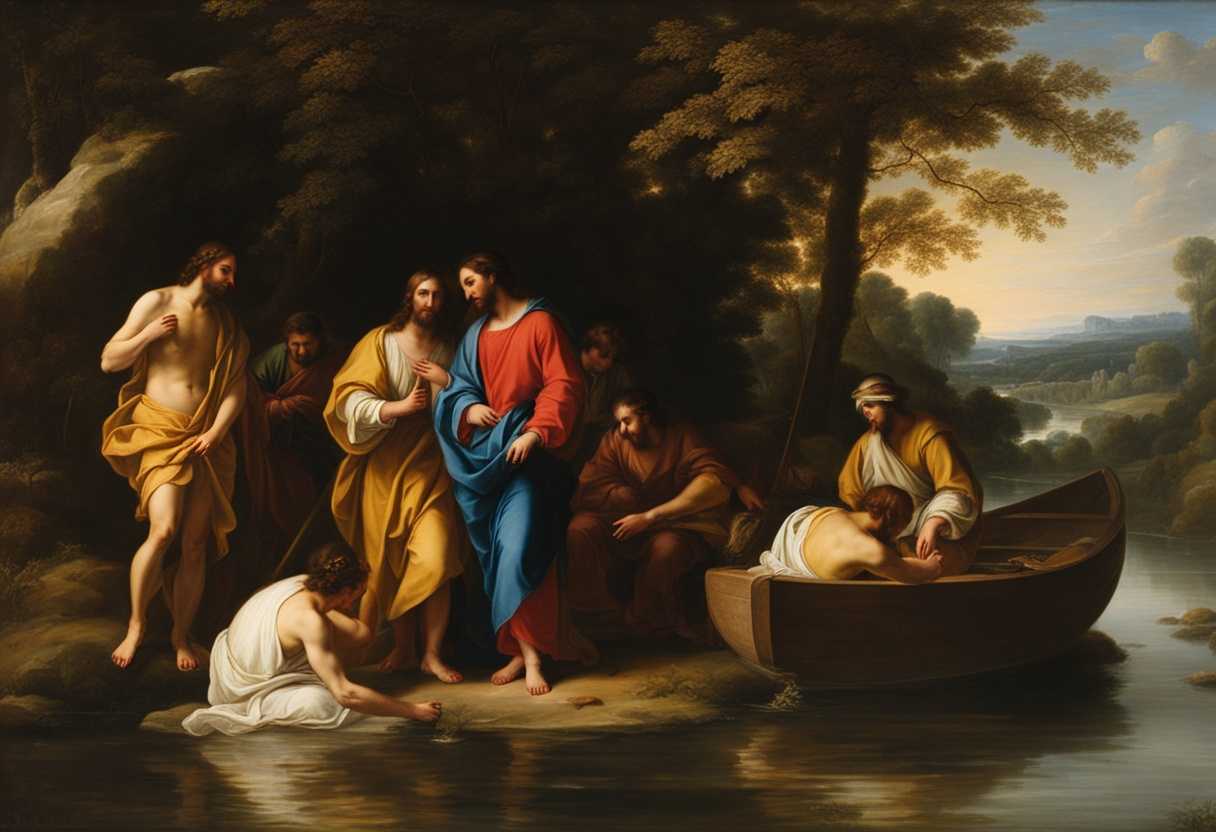
Setting the Scene for John 1:29-51
The scene in John chapter 1 opens with John the Baptist standing by the Jordan River, where he sees Jesus approaching. John had been baptizing people in the river as a sign of repentance, preparing the way for the coming Messiah. As Jesus walks towards him, John declares, “Behold, the Lamb of God, who takes away the sin of the world!” This moment marks the beginning of Jesus’ public ministry.
Two of John’s disciples, Andrew and another disciple (often believed to be John himself), hear John’s proclamation and decide to follow Jesus. Jesus turns and sees them following him, asking them, “What are you seeking?” They respond by asking where he is staying, to which Jesus invites them to “Come and see.” They spend the day with Jesus, experiencing his teachings and presence.
Andrew, filled with excitement, goes to find his brother Simon Peter and tells him, “We have found the Messiah.” Simon Peter is brought to Jesus and receives a new name, Cephas (Peter), which means “rock.” The scene continues with Jesus calling Philip to follow him, who then goes to find Nathanael and tells him about Jesus. Nathanael is initially skeptical but decides to meet Jesus. As Nathanael approaches, Jesus reveals his knowledge of Nathanael’s character, leaving him in awe and belief. This series of encounters sets the stage for the beginning of Jesus’ ministry and the calling of his disciples.
What is John 1:29-51 about?
We witness a profound moment in Jesus’ ministry in this verse where he is identified as the “Lamb of God.”” This title carries great significance and symbolism, as it highlights Jesus’ role as the sacrificial lamb who will take away the sins of the world through his death on the cross. John the Baptist not only points to Jesus’ purity and innocence but also foreshadows his ultimate sacrifice for the redemption of humanity by calling Jesus the Lamb of God. This title underscores the profound sacrifice that Jesus will make for the salvation of all people.
Furthermore, Jesus’ call to his disciples to follow him is a pivotal moment in his ministry. Jesus is seeking companionship and disciples who are willing to learn from him, emulate his teachings, and spread the good news of the Gospel by inviting them to accompany him. This call to follow Jesus is an invitation to a life of faith, discipleship, and service to others. It challenges us to reflect on our own willingness to heed the call of Jesus and follow him wholeheartedly in our own lives. Are we ready to embrace the sacrificial love of the Lamb of God and walk in his footsteps, spreading his message of love and redemption to all we encounter? Let us contemplate this verse and consider how we can respond to Jesus’ call to follow him with courage, faith, and devotion.
Understanding what John 1:29-51 really means
In John 1:29-51, we are presented with a pivotal moment in the early ministry of Jesus, as John the Baptist testifies about Him and the first disciples are called. This passage holds significant weight in the Gospel of John, as it unveils Jesus as the “Lamb of God” and marks the beginning of His public ministry. The imagery of Jesus as the sacrificial Lamb harks back to the Old Testament, where the concept of a spotless lamb being offered for the forgiveness of sins is deeply rooted (Exodus 12:3-13, Isaiah 53:7). Jesus embodies this sacrificial role, offering Himself to take away the sins of the world, bringing hope and redemption to humanity.
The moment when John the Baptist witnesses the Spirit descending on Jesus like a dove during His baptism (John 1:32) signifies divine approval and anointing for His ministry. This event echoes the baptism of Jesus in Matthew 3:16-17, underscoring the divine nature of His mission. The phrase “Come and see” (John 1:39) encapsulates an invitation not just to observe from a distance but to experience Jesus personally. This call to encounter Jesus aligns with the biblical theme of seeking and finding God (Jeremiah 29:13, Matthew 7:7-8), emphasizing the importance of a personal relationship with Him.
Today, the identity of Jesus as the Lamb of God remains central to the Christian faith, offering believers the assurance of forgiveness and redemption. Just as the early disciples responded to Jesus’ invitation to “come and see,” we are also called to seek a personal encounter with Him. This encounter has the power to transform lives, bringing about a profound change as seen in the lives of the first disciples. The prophecy in Isaiah 53:7 further solidifies Jesus’ role as the suffering servant and sacrificial Lamb, highlighting His willingness to bear the sins of humanity.
As we reflect on the significance of Jesus’ identity and the call to follow Him, let us consider our own relationship with Him. May we respond to His invitation to “come and see,” seeking a deeper connection with the Savior who offers forgiveness and redemption. Let us actively pursue a personal encounter with Jesus, knowing that He stands ready to transform our lives just as He did for the disciples. In this journey of faith, may we experience the profound impact of encountering Jesus and find hope, peace, and purpose in His presence.
How can we respond to Jesus’ call to follow?
We can respond to Jesus’ call to follow by recognizing Him as the lamb of God who takes away the sins of the world. This acknowledgment leads us to accept His forgiveness and mercy, allowing us to leave behind our old ways and start anew as His disciples. We demonstrate our faith in His sacrificial love and our desire to walk in the light of righteousness that He offers by following Jesus.
When we respond to Jesus’ call to follow, we are agreeing to journey alongside Him, learning from His teachings, and seeking to become more like Him each day. Our faith in Jesus grows stronger, and our commitment to following Him deepens as we spend time with Him and witness the miracles He performs. We become His disciples, embracing His mission of spreading love, truth, and salvation to all who will receive it. We are invited into a personal relationship with Jesus by responding to His call to follow. This relationship involves not only learning from Him but also abiding in Him and allowing His words to dwell in us richly. Walking in His footsteps allows us to experience the joy of knowing Him more intimately and sharing in the abundant life that He offers to all who follow Him faithfully.
Application
Just like you prioritize family and work, take a moment to reflect on how the disciples responded to Jesus’ simple invitation, “come and see.” They didn’t hesitate—they followed. Your challenge is to actively seek out Jesus, spend time with Him, and learn from His wisdom. Engage with Christ personally, ask questions, deepen your understanding. Are you ready to make following Jesus a part of your daily life?

Reverend Michael Johnson is an experienced Church Minister with a profound expertise in spirituality and guidance. With a serene presence and a compassionate heart, he has faithfully served his congregation for over 20 years, leading them on a spiritual journey towards inner peace and enlightenment. Reverend Johnson’s extensive knowledge of religious philosophies and profound understanding of human nature have made him a trusted confidant and mentor to many, as he seamlessly weaves his profound wisdom into life teachings. Reverend Johnson’s calming demeanor and empathetic nature continue to uplift and heal souls, nurturing a sense of unity and tranquility within his community.