
1 Now on the first day of the week Mary Magdalene came to the tomb early, while it was still dark, and saw that the stone had been taken away from the tomb.
2 So she ran and went to Simon Peter and the other disciple, the one whom Jesus loved, and said to them, “They have taken the Lord out of the tomb, and we do not know where they have laid him.”
3 So Peter went out with the other disciple, and they were going toward the tomb.
4 Both of them were running together, but the other disciple outran Peter and reached the tomb first.
5 And stooping to look in, he saw the linen cloths lying there, but he did not go in.
6 Then Simon Peter came, following him, and went into the tomb. He saw the linen cloths lying there,
7 and the face cloth, which had been on Jesus’ head, not lying with the linen cloths but folded up in a place by itself.
8 Then the other disciple, who had reached the tomb first, also went in, and he saw and believed;
9 for as yet they did not understand the Scripture, that he must rise from the dead.
10 Then the disciples went back to their homes.
11 But Mary stood weeping outside the tomb, and as she wept she stooped to look into the tomb.
12 And she saw two angels in white, sitting where the body of Jesus had lain, one at the head and one at the feet.
13 They said to her, “Woman, why are you weeping?” She said to them, “They have taken away my Lord, and I do not know where they have laid him.”
14 Having said this, she turned around and saw Jesus standing, but she did not know that it was Jesus.
15 Jesus said to her, “Woman, why are you weeping? Whom are you seeking?” Supposing him to be the gardener, she said to him, “Sir, if you have carried him away, tell me where you have laid him, and I will take him away.”
16 Jesus said to her, “Mary.”
17 Jesus said to her, “Do not cling to me, for I have not yet ascended to the Father; but go to my brothers and say to them, ‘I am ascending to my Father and your Father, to my God and your God.’”
18 Mary Magdalene went and announced to the disciples, “I have seen the Lord”—and that he had said these things to her.
Setting the Scene for John 20:1-18
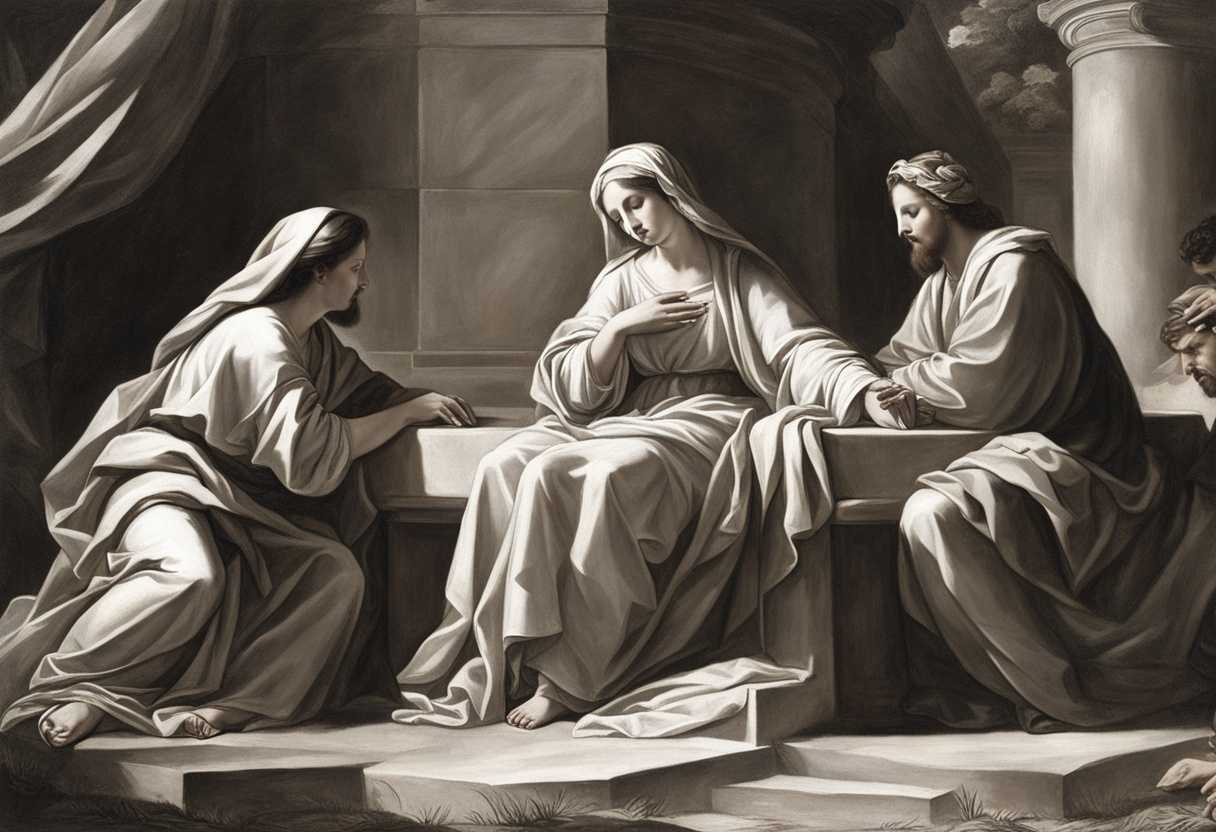
The scene in John chapter 20 opens with Mary Magdalene making her way to the tomb of Jesus early in the morning. She is accompanied by a few other women who had been followers of Jesus. The atmosphere is heavy with grief and confusion as they approach the burial site of their beloved teacher and friend. The surroundings are quiet and somber, with the first light of dawn breaking over the horizon.
As they reach the tomb, they are shocked to find the stone rolled away from the entrance. Mary, in a state of distress, runs to tell Peter and John about the empty tomb. Peter and John, upon hearing the news, rush to the tomb to see for themselves. The two disciples find the burial cloths lying there but no sign of Jesus. The atmosphere is tense with anticipation and wonder as they try to make sense of what they are witnessing.
In the midst of this confusion, Mary remains at the tomb, weeping. It is in this moment of deep sorrow and despair that Jesus appears to her, though she does not recognize him at first. The scene is transformed from one of mourning to one of joy and awe as Mary realizes that Jesus is alive. The surroundings are filled with a sense of wonder and amazement as Mary becomes the first witness to the resurrection, a pivotal moment in the Christian faith.
What is John 20:1-18 about?
This verse captures the profound moment when Jesus reveals himself to Mary Magdalene after his resurrection. It symbolizes the incredible power of faith and the triumph of light over darkness. Imagine the awe and wonder Mary must have felt as she encountered the resurrected Jesus, her teacher and friend, alive again before her eyes. This encounter speaks to the ultimate victory of love and redemption, showing that even death cannot defeat the power of God’s grace and mercy. Reflect on this verse as you consider the significance of Jesus choosing to reveal himself first to Mary Magdalene. This act highlights the importance of women in God’s plan and demonstrates Jesus’ deep compassion and care for his followers. It challenges us to look beyond societal norms and expectations, reminding us that all individuals are valued and loved in the eyes of God. Let the story of Jesus’ resurrection appearance to Mary Magdalene inspire you to seek out moments of divine encounter in your own life, drawing strength and hope from the knowledge that Jesus is ever present, revealing himself to those who seek him with open hearts.
Understanding what John 20:1-18 really means
Introduction and Context
This passage is a powerful and foundational text in Christian belief, recounting the discovery of Jesus’ empty tomb and His appearance to Mary Magdalene. To fully appreciate its significance, we should explore its context, the key moments, and its broader implications.
Key Moments and Phrases
The narrative begins with Mary Magdalene visiting the tomb early in the morning and finding the stone removed. This moment is crucial as it sets the stage for the revelation of Jesus’ resurrection. The phrase “while it was still dark” is symbolic, indicating not just the time of day, but also the spiritual darkness and confusion Mary and the disciples were experiencing.
When Mary sees the empty tomb, she runs to inform Peter and the other disciple, often thought to be John. Their race to the tomb highlights urgency and bewilderment. The detail of the linen wrappings lying there and the cloth that had been on Jesus’ head rolled up in a place by itself (verses 5-7) is particularly significant. It suggests order rather than the chaos of a grave robbery, implying a deliberate act of resurrection.
Encounter with the Angels and Jesus
Mary’s encounter with the angels and then with Jesus Himself is the climax of this passage. Initially, she does not recognize Jesus, mistaking Him for a gardener. It’s only when Jesus calls her by name, “Mary,” that she recognizes Him. This moment is deeply personal and underscores the intimate relationship Jesus has with His followers. It reminds us of John 10:3, where Jesus says, “He calls his own sheep by name and leads them out.”
Theological Implications
The resurrection is the cornerstone of Christian faith, signifying victory over death and the promise of eternal life. Paul writes in 1 Corinthians 15:17, “If Christ has not been raised, your faith is futile; you are still in your sins.”” The empty tomb and Jesus’ appearance validate His divinity and the truth of His teachings.
Relevance Today
So, what does this passage mean for us today? It offers hope and assurance. The resurrection serves as a reminder that despair can be transformed into joy in times of darkness or uncertainty. Our challenges can also lead to renewed faith and purpose, just as Mary’s grief turned into rejoicing.
Anecdote for Reflection
I recall a story from a member of our congregation who faced a dire medical diagnosis. Initially, she felt lost and overwhelmed, much like Mary at the tomb. However, through prayer and community support, she experienced a profound sense of peace and hope, even before any change in her medical condition. This transformation of despair into hope mirrors the resurrection experience, showing us that faith can bring light into the darkest situations. John 20:1-18 is not just a historical account but a living testament to the power of faith, hope, and personal relationship with Christ. Reflect on how the message of the resurrection can bring you light and hope as you consider this passage and the moments of darkness in your own life. How can you, like Mary, recognize Jesus calling you by name in your daily life?
How can we recognize Jesus when He speaks to us?
We can recognize Jesus when He speaks to us through the sense of familiarity, love, and peace that His voice brings. We too can discern His voice by the way it resonates within our hearts and spirits, just as Mary Magdalene recognized Jesus when He called her name. His voice may bring a sense of comfort, assurance, and direction, helping us to know that it is indeed Him speaking to us.
Furthermore, Jesus often speaks with words of truth, wisdom, and grace. When we hear words that align with the teachings of Jesus as recorded in the Bible, we can be confident that it is His voice guiding us. His words are powerful, convicting, and life-transforming, leading us closer to God and stirring our hearts to follow Him faithfully.
Lastly, we can recognize Jesus when He speaks to us through the presence of the Holy Spirit. The Spirit of God helps us discern the voice of Jesus, guiding us into all truth and reminding us of His teachings. We can be receptive to Jesus’ voice speaking to us in various ways, such as through Scripture, prayer, people, and circumstances, by staying attuned to the Spirit’s leading.
Application
Imagine your workday turning around when a colleague’s kind words lift your spirits, just like Mary’s grief turned to joy when she recognized Jesus. You, too, can be that catalyst of hope and change in someone’s life by sharing the message of Christ’s resurrection. When she heard Jesus call her by name, it transformed her life, and now, it’s your turn to spread that hope. With family, friends, or colleagues, your words and actions matter. How will you answer the call to bring hope and redemption into your world today?

Reverend Michael Johnson is an experienced Church Minister with a profound expertise in spirituality and guidance. With a serene presence and a compassionate heart, he has faithfully served his congregation for over 20 years, leading them on a spiritual journey towards inner peace and enlightenment. Reverend Johnson’s extensive knowledge of religious philosophies and profound understanding of human nature have made him a trusted confidant and mentor to many, as he seamlessly weaves his profound wisdom into life teachings. Reverend Johnson’s calming demeanor and empathetic nature continue to uplift and heal souls, nurturing a sense of unity and tranquility within his community.