
John 20:24-31 is about the story of Thomas, who doubted Jesus’ resurrection until he physically saw and touched the wounds of Jesus, leading to Jesus’ affirmation of the faith of those who believe without seeing.
24 Now Thomas, one of the twelve, called the Twin, was not with them when Jesus came.
25 So the other disciples told him, “We have seen the Lord.” But he said to them, “Unless I see in his hands the mark of the nails, and place my finger into the mark of the nails, and place my hand into his side, I will never believe.”
26 Eight days later, his disciples were inside again, and Thomas was with them. Although the doors were locked, Jesus came and stood among them and said, “Peace be with you.”
27 Then he said to Thomas, “Put your finger here, and see my hands; and put out your hand, and place it in my side. Do not disbelieve, but believe.”
28 Thomas answered him, “My Lord and my God!”
29 Jesus said to him, “Have you believed because you have seen me? Blessed are those who have not seen and yet have believed.”
30 Now Jesus did many other signs in the presence of the disciples, which are not written in this book.
31 but these are written so that you may believe that Jesus is the Christ, the Son of God, and that by believing you may have life in his name.
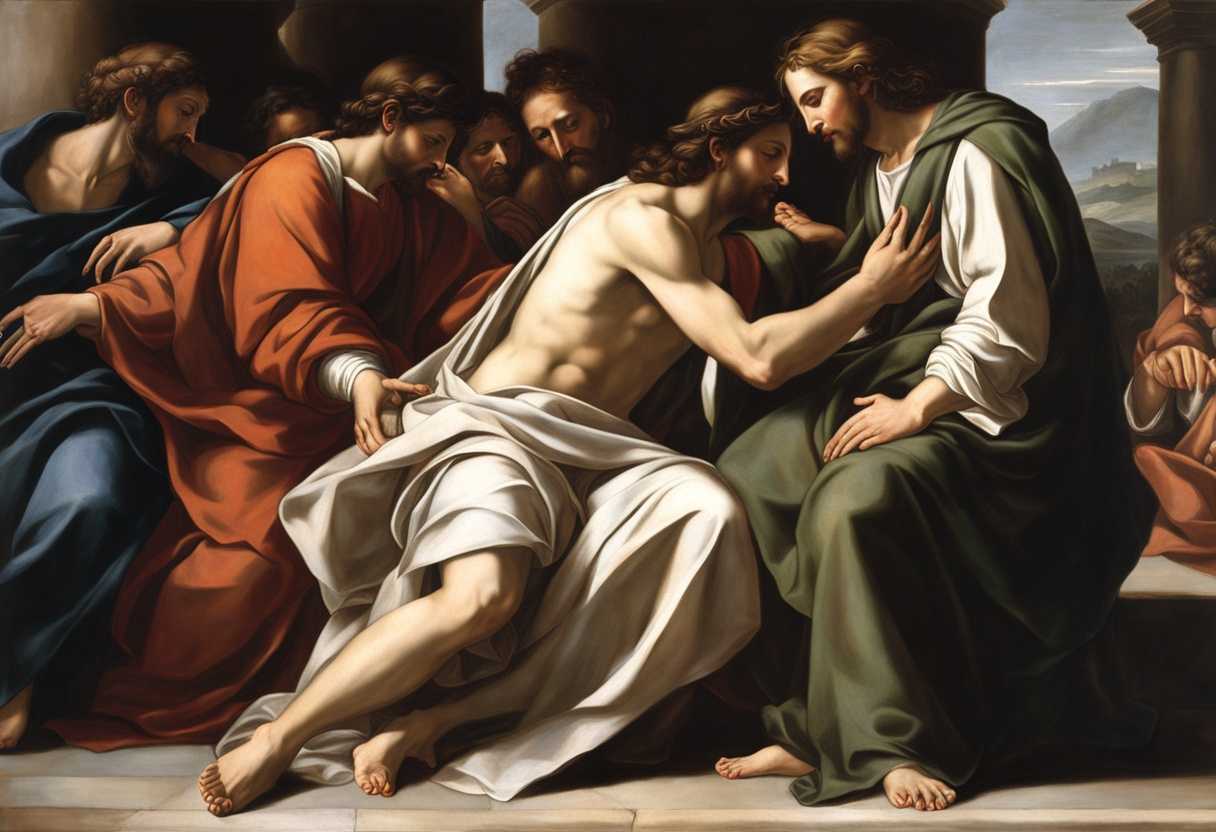
Setting the Scene for John 20:24-31
The scene in John chapter 20:24-31 takes place in a room where the disciples had gathered after the resurrection of Jesus. The disciples were in a state of confusion and fear following the crucifixion of Jesus, and they were discussing the reports of His resurrection. However, Thomas, one of the disciples, was not present when Jesus first appeared to them.
As the disciples were gathered together, Jesus suddenly appeared in their midst, even though the doors were locked. He greeted them with the words, “Peace be with you.” Thomas, who had expressed doubt about the resurrection, was present this time. Jesus invited Thomas to touch His wounds to dispel his doubts. Overwhelmed with emotion and conviction, Thomas exclaimed, “My Lord and my God!”
The room where this scene unfolded was likely a simple dwelling with a few windows allowing light to filter in. The disciples, including Thomas, were seated or standing in a circle, their faces reflecting a mix of awe, disbelief, and joy as they beheld the resurrected Jesus in their midst. The atmosphere was charged with a sense of wonder and reverence as they witnessed the fulfillment of Jesus’ promise to rise from the dead.
What is John 20:24-31 about?
This verse, found in the Gospel of John, speaks to the theme of faith and belief in Christianity. It contrasts the doubting nature of Thomas with the ideal of unwavering faith. Thomas, also known as Doubting Thomas, required physical proof in the form of seeing and touching Jesus’s wounds to believe in his resurrection. On the other hand, Jesus blesses those who believe without the need for physical evidence. This highlights the importance of faith without tangible proof and emphasizes the idea that true belief comes from within, without the need for empirical validation.
When reflecting on this verse, consider the nature of your own faith. Do you find yourself needing tangible proof to believe in something, like Thomas did, or are you able to trust in the unseen? How does this verse challenge you to deepen your faith and trust in the divine, even when the path forward may seem uncertain or unclear? By embracing this mindset, we can experience a deeper spiritual connection and understanding of the mysteries of the universe, often requiring a leap of faith in something greater than ourselves.
Understanding what John 20:24-31 really means
After Jesus’ resurrection, the disciple Thomas, absent during Jesus’ initial appearance to the other disciples, expressed doubt, insisting on physical proof by seeing and touching Jesus’ wounds to believe. This skepticism reflects a common human desire for tangible evidence, a sentiment many can relate to in their own faith journeys. Jesus later appeared to Thomas, inviting him to touch His wounds, leading Thomas to proclaim Jesus as “My Lord and my God!” This encounter highlights the importance of faith, even without physical evidence, as Jesus gently rebuked Thomas, saying, “Stop doubting and believe.”
The phrase “Blessed are those who have not seen and yet have believed” extends a blessing to future believers who will come to faith without firsthand encounters with Jesus. This sentiment resonates with believers today, living in an era where faith often contends with the demand for empirical evidence. The story of Thomas serves as a poignant reminder that doubt is a natural part of faith, and Jesus meets us in our doubts with compassion and understanding. In a world where scientific inquiry dominates, many struggle with faith in the unseen, much like Thomas did.
Hebrews 11:1 emphasizes faith as confidence in the unseen, aligning with Jesus’ message to Thomas. Similarly, 2 Corinthians 5:7 underscores that Christian life is guided by faith, not by sight, reinforcing the idea that faith transcends physical evidence. The relevance of Thomas’ story today lies in its ability to comfort and encourage modern believers who may grapple with doubt and the need for tangible proof of spiritual truths. Jesus’ response to Thomas affirms that faith is valid and blessed even without physical evidence, offering solace to those who seek reassurance in their beliefs.
Consider a person grappling with the concept of an afterlife after losing a loved one, mirroring Thomas’s need for proof to believe in heaven. Through a friend’s shared experience of feeling their loved one’s presence in moments of peace and joy, the grieving individual begins to find comfort and hope in the unseen. Over time, they cultivate faith and connection that transcends physical evidence, illustrating the transformative power of faith in the face of doubt. This anecdote exemplifies how personal experiences and shared stories can nurture faith and provide solace in times of uncertainty.
In conclusion, the story of Thomas invites believers to reflect on their own doubts and faith, encouraging them to trust in the unseen and find strength in the community of fellow believers. Through Thomas’ journey from doubt to belief, we are reminded that faith is a journey marked by questioning and seeking, with Jesus meeting us in our uncertainties with grace. This passage prompts us to recognize the divine presence in our lives, even when tangible evidence may be lacking, fostering a deeper sense of faith and connection with the spiritual realm.
How can we believe in Jesus without physically seeing him?
Believing in Jesus without physically seeing him requires faith in what has been witnessed and proclaimed by others. It involves trusting in the testimonies of those who have encountered Jesus and experienced his presence, teachings, and miracles. Through their accounts and the work of the Holy Spirit, individuals can come to believe in Jesus as the Son of God and Savior, even without direct physical evidence. This faith is not based on sight but on the conviction of the truth revealed through the Scriptures and the hearts of believers.
The passage emphasizes the blessing that comes from believing in Jesus without physically seeing him. It underscores the importance of faith as the key to experiencing the fullness of life and salvation that he offers. Individuals can cultivate a deeper relationship with Jesus and receive the peace, joy, and eternal life that he promises by looking beyond the physical realm and engaging with him on a spiritual level.
Believing in Jesus without physically seeing him also involves experiencing his presence and power in our lives through faith. This kind of belief goes beyond mere acknowledgment of historical facts or intellectual assent. It is a personal encounter with the living Christ, who continues to work in the hearts of believers today. Individuals can walk in faith and experience the transformational love and grace of Jesus by trusting in his word, relying on his promises, and following his teachings, even though he may not be physically present in the same way as he was with his disciples.
Application
Picture your faith like your career or your family, constantly needing time and attention to grow stronger. Just as you trust in a colleague’s word or a loved one’s reassurance, lean on the testimonies of those transformed by Christ’s resurrection. Let this evidence fuel your spirit and deepen your conviction. How will you actively nurture your faith today?

Reverend Michael Johnson is an experienced Church Minister with a profound expertise in spirituality and guidance. With a serene presence and a compassionate heart, he has faithfully served his congregation for over 20 years, leading them on a spiritual journey towards inner peace and enlightenment. Reverend Johnson’s extensive knowledge of religious philosophies and profound understanding of human nature have made him a trusted confidant and mentor to many, as he seamlessly weaves his profound wisdom into life teachings. Reverend Johnson’s calming demeanor and empathetic nature continue to uplift and heal souls, nurturing a sense of unity and tranquility within his community.