
John 5:1-47 is about Jesus healing a man on the Sabbath, demonstrating his authority and revealing his identity as the Son of God, which ultimately leads to a confrontation with the religious leaders who challenge his claims and authority.
1 After this there was a feast of the Jews, and Jesus went up to Jerusalem.
2 Now there is in Jerusalem by the Sheep Gate a pool, in Aramaic called Bethesda, which has five roofed colonnades.
3 In these lay a multitude of invalids—blind, lame, and paralyzed.
4 for an angel of the Lord went down at certain seasons into the pool and stirred up the water; whoever stepped in first after the stirring of the water was healed of whatever disease he had.
5 One man was there who had been an invalid for thirty-eight years.
6 When Jesus saw him lying there and knew that he had already been there a long time, he said to him, “Do you want to be healed?”
7 The sick man answered him, “Sir, I have no one to put me into the pool when the water is stirred up, and while I am going another steps down before me.”
8 Jesus said to him, “Get up, take up your bed, and walk.”
9 And at once the man was healed, and he took up his bed and walked.
10 So the Jews said to the man who had been healed, “It is the Sabbath, and it is not lawful for you to take up your bed.”
11 But he answered them, “The man who healed me, that man said to me, ‘Take up your bed, and walk.’”
12 They asked him, “Who is the man who said to you, ‘Take up your bed and walk’?”
13 Now the man who had been healed did not know who it was, for Jesus had withdrawn, as there was a crowd in the place.
14 Afterward Jesus found him in the temple and said to him, “See, you are well! Sin no more, that nothing worse may happen to you.”
15 The man went away and told the Jews that it was Jesus who had healed him.
16 And this was why the Jews were persecuting Jesus, because he was doing these things on the Sabbath.
17 But Jesus answered them, “My Father is working until now, and I am working.”
18 This was why the Jews were seeking all the more to kill him, because not only was he breaking the Sabbath, but he was even calling God his own Father, making himself equal with God.
19 So Jesus said to them, “Truly, truly, I say to you, the Son can do nothing of his own accord, but only what he sees the Father doing. For whatever the Father does, that the Son does likewise.
20 For the Father loves the Son and shows him all that he himself is doing. And greater works than these will he show him, so that you may marvel.
21 For as the Father raises the dead and gives them life, so also the Son gives life to whom he will.
22 The Father judges no one, but has given all judgment to the Son,
23 that all may honor the Son, just as they honor the Father. Whoever does not honor the Son does not honor the Father who sent him.
24 Truly, truly, I say to you, whoever hears my word and believes him who sent me has eternal life. He does not come into judgment, but has passed from death to life.
25 “Truly, truly, I say to you, an hour is coming, and is now here, when the dead will hear the voice of the Son of God, and those who hear will live.
26 For as the Father has life in himself, so he has granted the Son also to have life in himself.
27 And he has given him authority to execute judgment, because he is the Son of Man.
28 Do not marvel at this, for an hour is coming when all who are in the tombs will hear his voice
29 and come out, those who have done good to the resurrection of life, and those who have done evil to the resurrection of judgment.
30 “I can do nothing on my own. As I hear, I judge, and my judgment is just, because I seek not my own will but the will of him who sent me.”
31 If I alone bear witness about myself, my testimony is not true.
32 There is another who bears witness about me, and I know that the testimony that he bears about me is true.
33 You sent to John, and he has borne witness to the truth.
34 Not that the testimony that I receive is from man, but I say these things so that you may be saved.
35 He was a burning and shining lamp, and you were willing to rejoice for a while in his light.
36 But the testimony that I have is greater than that of John. For the works that the Father has given me to accomplish, the very works that I am doing, bear witness about me that the Father has sent me.
37 And the Father who sent me has himself borne witness about me. His voice you have never heard, his form you have never seen,
38 and you do not have his word abiding in you, for you do not believe the one whom he has sent.
39 You search the Scriptures because you think that in them you have eternal life; and it is they that bear witness about me,
40 yet you refuse to come to me that you may have life.
41 I do not receive glory from people.
42 But I know that you do not have the love of God within you.
43 I have come in my Father’s name, and you do not receive me. If another comes in his own name, you will receive him.
44 How can you believe, when you receive glory from one another and do not seek the glory that comes from the only God?
45 Do not think that I will accuse you to the Father. There is one who accuses you: Moses, on whom you have set your hope.
46 For if you believed Moses, you would believe me; for he wrote of me.
47 But if you do not believe his writings, how will you believe my words?”
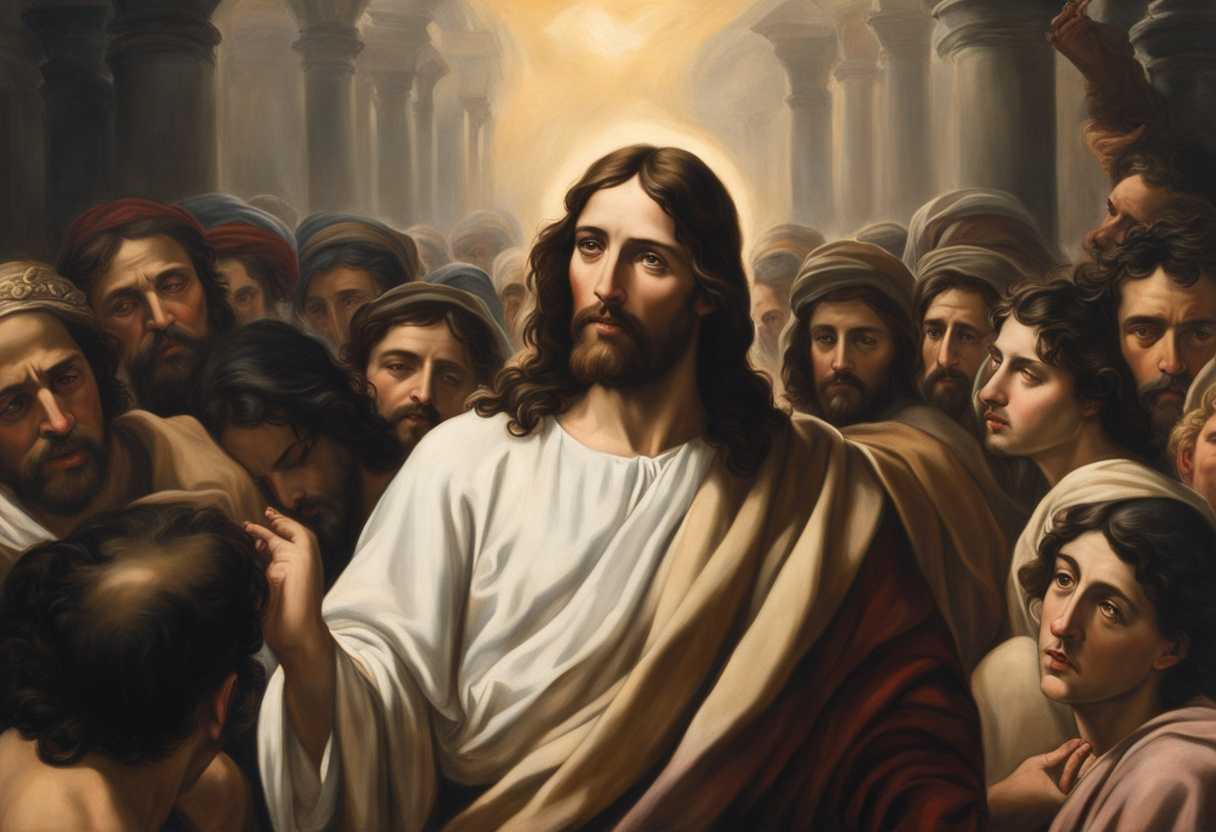
Setting the Scene for John 5:1-47
In John chapter 5, the scene is set at the Pool of Bethesda in Jerusalem. The pool was believed to have healing powers, and it was surrounded by five covered colonnades. The atmosphere is filled with anticipation and desperation as a great number of disabled people, blind, lame, and paralyzed, gather around the pool, hoping to be the first to enter the water when it is stirred, believing that it would bring them healing.
Among the crowd is a man who has been an invalid for thirty-eight years. He lies on a mat, surrounded by others in similar conditions, all waiting for the stirring of the water. Jesus arrives at the pool and approaches the man, asking him if he wants to get well. The man explains his situation, expressing his inability to enter the water when it is stirred. Jesus then tells him to get up, pick up his mat, and walk. The man is immediately healed, picks up his mat, and walks away, rejoicing in his newfound health.
As the events unfold, the Pharisees witness the miraculous healing and question Jesus about it, leading to a deeper discussion about Jesus’ authority and his relationship with God. The scene at the Pool of Bethesda serves as a powerful demonstration of Jesus’ compassion, power, and authority, as well as a moment of revelation for those present.
What is John 5:1-47 about?
Jesus not only demonstrates his miraculous healing power by instantly curing a man who had been crippled for 38 years but also uses the opportunity to teach about his divine authority and the impending day of judgment in this powerful verse. Through this act of healing, Jesus not only shows his compassion for the suffering but also reveals his identity as the Son of God with the power to bring about physical and spiritual restoration. Jesus’ authority and sovereignty over all aspects of life confront us with profound truth as we reflect on this verse. Jesus reveals himself as the ultimate source of healing and restoration by healing the man at the pool of Bethesda, inviting us to trust in his power to bring wholeness to our brokenness. Jesus’ teachings about the coming judgment challenge us to consider the state of our own hearts and the decisions we make in light of eternity. Are we living in alignment with God’s will? Are we prepared for the day when we will all stand before the judgment seat of Christ?
Let this verse serve as a reminder of Jesus’ compassionate healing, his divine authority, and the inevitable day of judgment that awaits us all. May it inspire us to seek restoration in Christ, to submit to his authority in our lives, and to live with a sense of urgency in light of the coming judgment.
Understanding what John 5:1-47 really means
In John 5:1-47, we encounter a pivotal moment in Jesus’ ministry where He performs a miraculous healing at the Pool of Bethesda and engages in a profound discourse on His divine authority and relationship with the Father. This chapter is crucial in understanding Jesus’ identity as the Son of God and the extent of His power to bring about healing and transformation in people’s lives.
At the Pool of Bethesda, we find a man who had been ill for 38 years, highlighting the desperation and suffering present in society. The setting of the pool and the Jewish customs surrounding it provide a backdrop for Jesus’ actions, challenging traditional beliefs about healing and the observance of the Sabbath.
One of the key phrases in this passage is when Jesus asks the man, “Do you want to be made well?” This question underscores the importance of personal desire and faith in receiving healing and transformation from Jesus. His command to “Rise, take up your bed and walk” showcases both His authority and the immediate obedience and healing that follow.
Jesus’ statement, “My Father is working until now, and I am working,” asserts His divine authority and continuous partnership with the Father in their redemptive work. The unity and harmony between Jesus and the Father are further emphasized in His declaration that He only does what He sees the Father doing, highlighting their shared purpose and will.
Through Jesus’ words, “Whoever hears my word and believes him who sent me has eternal life,” we are reminded of the promise of eternal life through faith in Jesus and the transformative power of believing in His message. This promise echoes the foundational truth of John 3:16 and connects to the invitation in Matthew 11:28-30 for all who are weary to find rest in Jesus.
The themes of healing, faith, and divine authority explored in this passage remain relevant today. Just as the man at the Pool of Bethesda found hope and transformation through his encounter with Jesus, people today can also experience healing and renewal by placing their faith in Him.
In our modern world, stories abound of individuals who have encountered physical or spiritual healing through their faith in Jesus. These testimonies serve as powerful reminders of the enduring impact of Jesus’ words and the necessity of personal faith and obedience in experiencing His transformative power.
As we reflect on John 5:1-47, may we consider our own faith and relationship with Jesus. Let us be encouraged to seek Him for healing and transformation, trusting in His authority and love to bring about renewal in our lives. Jesus continues to offer rest and restoration to all who come to Him, inviting us to experience the fullness of life found in Him.
Is faith in God reflected in our actions and beliefs?
Yes, faith in God is reflected in our actions and beliefs. Jesus speaks about bearing witness to the truth and receiving honor from God rather than seeking honor from people in the context of John 5. This highlights the importance of aligning our actions with our belief in God, recognizing that true faith leads us to seek God’s approval rather than man’s. When our faith is genuine, it naturally influences our choices and behavior, demonstrating our commitment to living in accordance with God’s will and teachings. Jesus emphasizes the importance of believing in God’s promises and in the one He has sent in John 5. This underscores the significance of faith as a driving force behind our actions and decisions. Believing in God involves trusting His plans and purposes, which in turn shapes our worldview and guides us in our daily lives. Our beliefs about God directly impact how we interact with others and how we navigate challenges, serving as a testament to our faith in Him. Faith in God ultimately motivates us to live out our convictions and principles, rather than simply being a passive acknowledgment. We demonstrate our trust in God and our commitment to following His guidance in all aspects of our lives by reflecting our faith through our actions and beliefs.
Application
Imagine the wisdom and authority of a beloved mentor guiding you at work. Picture the unconditional love of your family supporting you every day. That’s the power and love of Jesus revealed in John chapter 5. Will you let this truth transform your life? Take a step to deepen your faith and walk in His ways. Are you ready to embrace this journey now?

Reverend Michael Johnson is an experienced Church Minister with a profound expertise in spirituality and guidance. With a serene presence and a compassionate heart, he has faithfully served his congregation for over 20 years, leading them on a spiritual journey towards inner peace and enlightenment. Reverend Johnson’s extensive knowledge of religious philosophies and profound understanding of human nature have made him a trusted confidant and mentor to many, as he seamlessly weaves his profound wisdom into life teachings. Reverend Johnson’s calming demeanor and empathetic nature continue to uplift and heal souls, nurturing a sense of unity and tranquility within his community.