
Jonah 1-4 is about the prophet Jonah’s initial disobedience, God’s relentless pursuit of Jonah to fulfill his mission, and the eventual display of God’s mercy and compassion towards all, including the repentant people of Nineveh.
1 Now the word of the Lord came to Jonah the son of Amittai, saying,
2 “Arise, go to Nineveh, that great city, and call out against it, for their evil has come up before me.”
3 But Jonah rose to flee to Tarshish from the presence of the Lord. He went down to Joppa and found a ship going to Tarshish. So he paid the fare and went down into it, to go with them to Tarshish, away from the presence of the Lord.
4 But the Lord hurled a great wind upon the sea, and there was a mighty tempest on the sea, so that the ship threatened to break up.
5 Then the mariners were afraid, and each cried out to his god. And they hurled the cargo that was in the ship into the sea to lighten it for them. But Jonah had gone down into the inner part of the ship and had lain down and was fast asleep.
6 So the captain came and said to him, “What do you mean, you sleeper? Arise, call out to your god! Perhaps the god will give a thought to us, that we may not perish.”
7 And they said to one another, “Come, let us cast lots, that we may know on whose account this evil has come upon us.” So they cast lots, and the lot fell on Jonah.
8 Then they said to him, “Tell us on whose account this evil has come upon us. What is your occupation? And where do you come from? What is your country? And of what people are you?”
9 And he said to them, “I am a Hebrew, and I fear the Lord, the God of heaven, who made the sea and the dry land.”
10 Then the men were exceedingly afraid and said to him, “What is this that you have done!” For the men knew that he was fleeing from the presence of the Lord, because he had told them.
11 Then they said to him, “What shall we do to you, that the sea may quiet down for us?” for the sea grew more and more tempestuous.
12 He said to them, “Pick me up and hurl me into the sea; then the sea will quiet down for you, for I know it is because of me that this great tempest has come upon you.”
13 Nevertheless, the men rowed hard to get back to dry land, but they could not, for the sea grew more and more tempestuous against them.
14 Therefore they called out to the Lord, “O Lord, let us not perish for this man’s life, and lay not on us innocent blood, for you, O Lord, have done as it pleased you.”
15 So they picked up Jonah and hurled him into the sea, and the sea ceased from its raging.
16 Then the men feared the Lord exceedingly, and they offered a sacrifice to the Lord and made vows.
17 And the Lord appointed a great fish to swallow up Jonah. And Jonah was in the belly of the fish three days and three nights.
1 Then Jonah prayed to the Lord his God from the belly of the fish,
2 saying, “I called out to the Lord, out of my distress, and he answered me; out of the belly of Sheol I cried, and you heard my voice.
3 For you cast me into the deep,
into the heart of the seas,
and the flood surrounded me;
all your waves and your billows
passed over me.
4 Then I said, ‘I am driven away from your sight; yet I shall again look upon your holy temple.’
5 The waters closed in over me to take my life; the deep surrounded me; weeds were wrapped about my head.
6 I went down to the land whose bars closed upon me forever; yet you brought up my life from the pit, O Lord my God.
7 When my life was fainting away,
I remembered the Lord,
and my prayer came to you,
into your holy temple.
8 Those who pay regard to vain idols forsake their hope of steadfast love.
9 But I with the voice of thanksgiving will sacrifice to you; what I have vowed I will pay. Salvation belongs to the Lord!
10 And the Lord spoke to the fish, and it vomited Jonah out upon the dry land.
1 Then the word of the Lord came to Jonah the second time, saying,
2 “Arise, go to Nineveh, that great city, and call out against it the message that I tell you.”
3 So Jonah arose and went to Nineveh, according to the word of the Lord. Now Nineveh was an exceedingly great city, three days’ journey in breadth.
4 Jonah began to go into the city, going a day’s journey. And he called out, “Yet forty days, and Nineveh shall be overthrown!”
5 And the people of Nineveh believed God. They called for a fast and put on sackcloth, from the greatest of them to the least of them.
6 The word reached the king of Nineveh, and he arose from his throne, removed his robe, covered himself with sackcloth, and sat in ashes.
7 And he issued a proclamation and published through Nineveh, “By the decree of the king and his nobles: Let neither man nor beast, herd nor flock, taste anything. Let them not feed or drink water,
8 but let man and beast be covered with sackcloth, and let them call out mightily to God. Let everyone turn from his evil way and from the violence that is in his hands.
9 Who knows? God may turn and relent and turn from his fierce anger, so that we may not perish.”
10 When God saw what they did, how they turned from their evil way, God relented of the disaster that he had said he would do to them, and he did not do it.
1 But it displeased Jonah exceedingly, and he was angry.
2 And he prayed to the Lord and said, “O Lord, is not this what I said when I was yet in my country? That is why I made haste to flee to Tarshish; for I knew that you are a gracious God and merciful, slow to anger and abounding in steadfast love, and relenting from disaster.
3 Therefore now, O Lord, please take my life from me, for it is better for me to die than to live.”
4 And the Lord said, “Do you do well to be angry?”
5 Jonah went out of the city and sat to the east of the city and made a booth for himself there. He sat under it in the shade, till he should see what would become of the city.
6 Now the Lord God appointed a plant and made it come up over Jonah, that it might be a shade over his head, to save him from his discomfort. So Jonah was exceedingly glad because of the plant.
7 But when dawn came up the next day, God appointed a worm that attacked the plant, so that it withered.
8 When the sun rose, God appointed a scorching east wind, and the sun beat down on the head of Jonah so that he was faint. And he asked that he might die and said, “It is better for me to die than to live.”
9 But God said to Jonah, “Do you do well to be angry for the plant?” And he said, “Yes, I do well to be angry, angry enough to die.”
10 And the Lord said, “You pity the plant, for which you did not labor, nor did you make it grow, which came into being in a night and perished in a night.
11 And should not I pity Nineveh, that great city, in which there are more than 120,000 persons who do not know their right hand from their left, and also much cattle?”
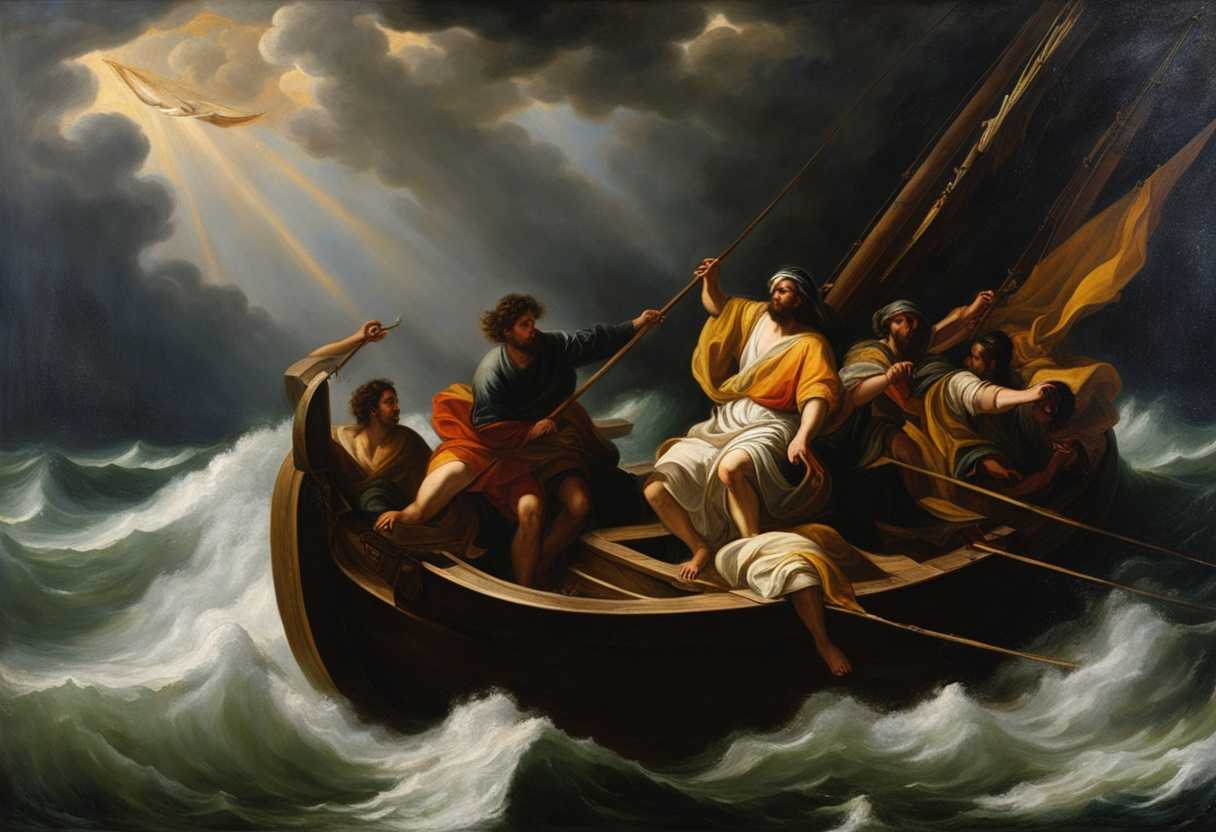
Setting the Scene for Jonah 1-4
The scene opens with Jonah, a prophet of God, standing on the shores of Joppa, a bustling port city in ancient Israel. The sun is setting, casting a warm golden glow over the horizon as ships bob gently in the harbor. Jonah has just received a divine command from God to go to the city of Nineveh and preach against its wickedness. However, Jonah, feeling fearful and reluctant, decides to flee in the opposite direction, boarding a ship bound for Tarshish.
As the ship sets sail, a fierce storm suddenly descends upon them, with waves crashing against the vessel and threatening to break it apart. The sailors, a diverse group of men from different backgrounds and beliefs, are terrified and begin to pray to their respective gods for salvation. Amidst the chaos, Jonah confesses to them that he is the cause of the storm, having disobeyed God’s command. In a desperate attempt to save themselves, the sailors reluctantly throw Jonah overboard, where he is swallowed by a great fish sent by God.
In the belly of the fish, Jonah repents and cries out to God for mercy. After three days and nights, the fish spits Jonah out onto dry land, and he finally obeys God’s command to go to Nineveh. There, he preaches a message of repentance, and to Jonah’s surprise, the entire city, from the king to the common people, heed his words and turn from their wicked ways. Jonah, however, becomes angry and bitter at God’s mercy towards the Ninevites, highlighting his struggle with his own prejudices and the boundless grace of God.
What is Jonah 1-4 about?
This verse from the Bible tells an incredible story of disobedience, consequence, repentance, and redemption. Jonah’s refusal to heed God’s call led to him being swallowed by a great fish—a vivid metaphor for the consequences of going against divine will. However, even in the depths of the sea, Jonah repented and turned back to God, showing that it’s never too late to seek forgiveness and make amends.
Through Jonah’s story, we are reminded of the importance of obedience, humility, and faith. It prompts us to reflect on our own lives—have we ever strayed from our path? Have we resisted what we know is right or tried to run away from our responsibilities? Jonah’s journey serves as a powerful reminder that no matter how dire the situation may seem, there is always a chance for redemption and a way back to grace through repentance and obedience. It challenges us to consider our own willingness to listen to God’s voice and follow His guidance, even when it may lead us to uncomfortable or seemingly impossible situations.
Understanding what Jonah 1-4 really means
The Book of Jonah in the Old Testament introduces us to a unique perspective among the prophetic books, focusing more on the prophet himself rather than his prophecies. Jonah, a minor prophet, is called by God to go to Nineveh, a city known for its wickedness, and preach against it. However, Jonah’s initial reaction is not one of obedience but of fleeing from God’s command, setting the stage for a compelling narrative of divine pursuit and human reluctance.
“The word of the Lord came to Jonah,” a powerful phrase that underscores the divine origin of Jonah’s mission. It serves as a reminder that God communicates with His people and entrusts them with specific tasks, highlighting the importance of obedience to His call. The command to “Arise, go to Nineveh” reveals God’s concern for all nations, emphasizing His desire for repentance and redemption even in the most sinful of cities, showcasing the breadth of His mercy and compassion.
In Jonah’s attempt to flee to Tarshish from the presence of the Lord, we see a vivid portrayal of human reluctance and disobedience. This act of defiance not only showcases Jonah’s struggle but also sets the stage for God’s relentless pursuit of His servant, demonstrating His unwavering grace and love. The interconnected themes of obedience, divine pursuit, and human frailty resonate with readers across time, inviting reflection on their own responses to God’s call and the transformative power of surrendering to His will.
Drawing parallels from related biblical passages such as Psalm 139:7-10 and Matthew 12:39-41, we see echoes of the futility of trying to escape God’s presence and the significance of Jonah’s story in the broader context of salvation history. These connections deepen our understanding of God’s omnipresence, omniscience, and the redemptive work He continues to do in the world through His chosen vessels.
The relevance of Jonah’s narrative to people today is profound. It challenges individuals to embrace obedience to God’s call, even when it leads them out of their comfort zones. Just as Jonah was called to a daunting task, modern-day believers are often summoned to step into challenging situations to fulfill God’s purposes, whether through missions, acts of kindness, or advocacy for justice. The story of Jonah serves as a poignant reminder of God’s boundless mercy and compassion, extending even to those who may seem undeserving.
In a modern-day scenario, envision someone initially resistant to a challenging calling but eventually yielding to God’s will. Through their obedience, they witness remarkable transformations, mirroring Jonah’s journey and underscoring the profound impact of surrendering to God’s plans. The story of Jonah continues to inspire and convict readers, urging them to consider their own responses to God’s call, embrace His relentless pursuit, and rest in the assurance of His unwavering presence and love.
How can we cultivate compassion for our enemies?
One way to cultivate compassion for our enemies is to reflect on our own vulnerabilities and shortcomings. We can begin to empathize with those who may have wronged us by recognizing that we are all flawed and in need of forgiveness. We can extend the same grace to our enemies as we seek understanding and mercy from others.
Additionally, forgiveness and compassion go hand in hand. When we choose to forgive those who have harmed us, we release ourselves from the burden of anger and resentment. This act of forgiveness opens the door to compassion, allowing us to see our enemies not just as adversaries, but as fellow humans who are capable of growth and change.
Lastly, practicing empathy and trying to see things from our enemies’ perspective can also help cultivate compassion. We can begin to understand them on a deeper level by considering the factors that may have influenced their actions or the pain they may be carrying. This shift in perspective can lead to a greater sense of compassion and a willingness to engage in healing and reconciliation.
Application
Are you ignoring your true purpose in life, hiding from opportunities that await you? Just as Jonah faced his fate for turning away, we must embrace our path with determination and faith. Let’s not evade our destiny, but rather confront it boldly, like facing a new challenge at work or supporting our loved ones in difficult times. Will you listen to your inner voice and chase your calling now?

Reverend Michael Johnson is an experienced Church Minister with a profound expertise in spirituality and guidance. With a serene presence and a compassionate heart, he has faithfully served his congregation for over 20 years, leading them on a spiritual journey towards inner peace and enlightenment. Reverend Johnson’s extensive knowledge of religious philosophies and profound understanding of human nature have made him a trusted confidant and mentor to many, as he seamlessly weaves his profound wisdom into life teachings. Reverend Johnson’s calming demeanor and empathetic nature continue to uplift and heal souls, nurturing a sense of unity and tranquility within his community.