
Jonah 1:1-10 is about Jonah’s disobedience towards God’s call, leading to a series of events demonstrating the consequences of trying to run away from one’s divine purpose and the importance of seeking forgiveness and redemption.
1 Now the word of the Lord came to Jonah the son of Amittai, saying,
2 “Arise, go to Nineveh, that great city, and call out against it, for their evil has come up before me.”
3 But Jonah rose to flee to Tarshish from the presence of the Lord. He went down to Joppa and found a ship going to Tarshish. So he paid the fare and went down into it, to go with them to Tarshish, away from the presence of the Lord.
4 But the Lord hurled a great wind upon the sea, and there was a mighty tempest on the sea, so that the ship threatened to break up.
5 Then the mariners were afraid, and each cried out to his god. And they hurled the cargo that was in the ship into the sea to lighten it for them. But Jonah had gone down into the inner part of the ship and had lain down and was fast asleep.
6 So the captain came and said to him, “What do you mean, you sleeper? Arise, call out to your god! Perhaps the god will give a thought to us, that we may not perish.”
7 And they said to one another, “Come, let us cast lots, that we may know on whose account this evil has come upon us.” So they cast lots, and the lot fell on Jonah.
8 Then they said to him, “Tell us on whose account this evil has come upon us. What is your occupation? And where do you come from? What is your country? And of what people are you?”
9 And he said to them, “I am a Hebrew, and I fear the Lord, the God of heaven, who made the sea and the dry land.”
10 Then the men were exceedingly afraid and said to him, “What is this that you have done!” For the men knew that he was fleeing from the presence of the Lord, because he had told them.
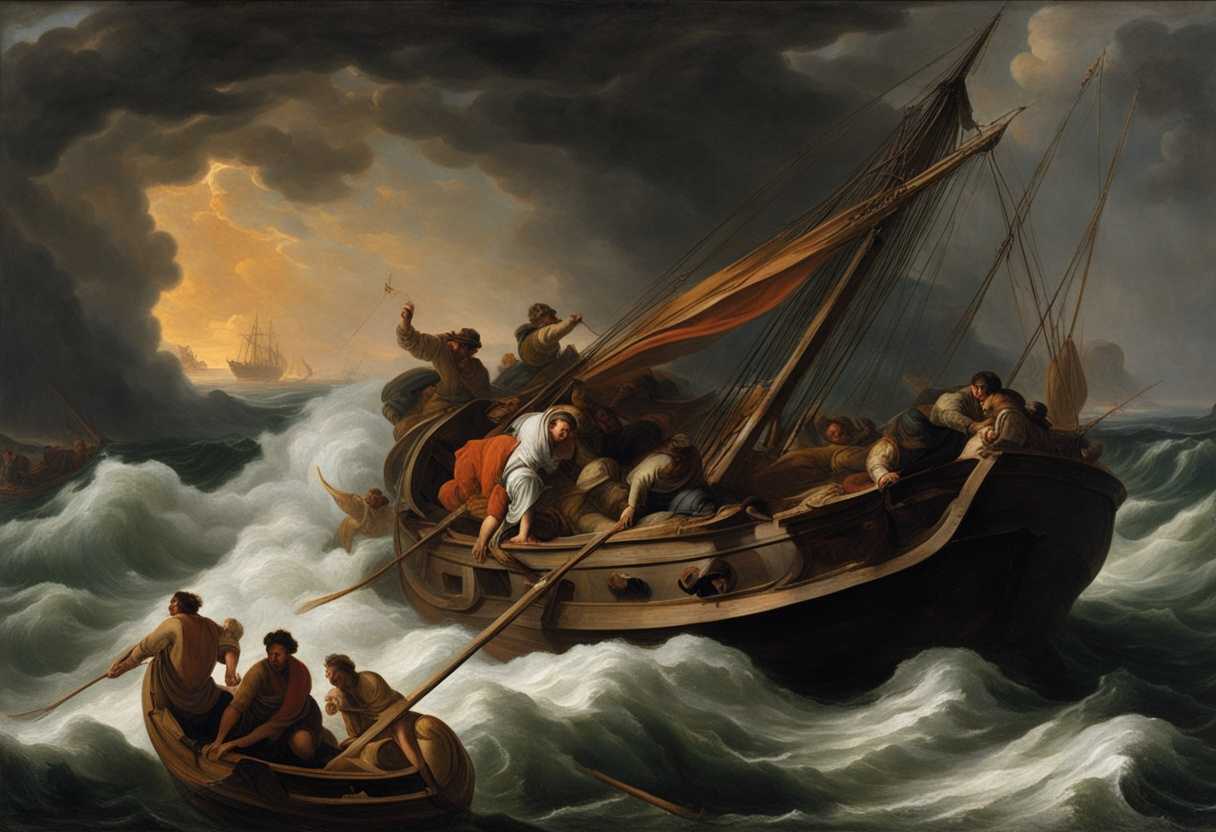
Setting the Scene for Jonah 1:1-10
The scene in Jonah chapter 1 opens with the prophet Jonah receiving a specific command from God to go to the great city of Nineveh and preach against its wickedness. However, instead of obeying God’s instructions, Jonah decides to flee in the opposite direction, boarding a ship bound for Tarshish. The ship is filled with sailors from various backgrounds, each with their own beliefs and customs.
As the journey progresses, a great storm suddenly arises, threatening to break the ship apart. The sailors, in a panic, begin to pray to their respective gods for salvation. In the midst of the chaos, Jonah is found sleeping below deck, oblivious to the danger that surrounds them. The captain of the ship, realizing that this storm is no ordinary one, wakes Jonah and urges him to call on his God for help.
The scene is set on a turbulent sea, with dark clouds looming overhead and waves crashing against the sides of the ship. The sailors are frantic, trying to navigate the vessel through the storm while also seeking divine intervention to save them from impending disaster. Jonah’s disobedience to God’s command has not only put his own life in jeopardy but has also endangered the lives of those around him.
What is Jonah 1:1-10 about?
Let’s think about Jonah and his actions here. When Jonah disobeys God’s call, he is not only turning away from his purpose but also trying to escape from his responsibilities. Have you ever felt like running away from something difficult or challenging in your life? Jonah’s decision to flee on a ship leads him into a storm, which can be seen as a consequence of his disobedience. Just like in life, our actions or decisions can sometimes lead us into rough waters.
Despite trying to run away, Jonah eventually comes to terms with his guilt and admits to his wrongdoing. It’s important to reflect on our own mistakes and take responsibility for them. Only by acknowledging our faults can we begin to make amends and find a sense of peace within ourselves. Jonah’s story teaches us about the consequences of disobedience and the power of repentance. What can we learn from Jonah’s journey and how can we apply it to our own lives? You can always turn back to the right path and seek forgiveness, no matter how late it is.
Understanding what Jonah 1:1-10 really means
Jonah 1:1-10 recounts the pivotal moment when Jonah receives a direct call from God, setting the stage for a narrative rich in themes of obedience, divine intervention, and repentance. The phrase “The word of the Lord came to Jonah” signifies a profound and urgent message from God, emphasizing the significance of the task at hand. God instructs Jonah to go to the sinful city of Nineveh, underscoring His desire for repentance and redemption even among those considered enemies. However, Jonah’s immediate response is to flee from God’s command, symbolizing human reluctance and fear in the face of daunting missions, a sentiment many of us can relate to in our own lives.
As Jonah attempts to escape, a great storm arises at sea, illustrating God’s control over nature and His willingness to intervene to guide and correct His people. This passage resonates with the broader biblical theme of God’s sovereignty over creation and His active involvement in the lives of His followers. The interconnectedness of divine communication, human response, and natural consequences is a powerful reminder of the intricate relationship between God and His creation.
Drawing parallels with other biblical passages such as Psalm 139:7-10 and Matthew 12:39-41 further illuminates the timeless truths embedded in Jonah’s story. These verses emphasize the impossibility of evading God’s presence and the call to repentance echoed by Jesus Himself. Romans 11:29 reinforces the idea of God’s unwavering purpose and calling, highlighting the persistence of His divine plan for individuals like Jonah.
The relevance of Jonah’s narrative extends to contemporary audiences, serving as a poignant reminder of the significance of obedience to God’s call, even in the face of uncertainty or fear. It underscores God’s mercy and forgiveness, urging us to extend the same grace to others. Jonah’s journey from reluctance to obedience mirrors the struggles and triumphs we may encounter when navigating our own paths of faith and service.
Consider the modern-day missionary who initially resisted a dangerous calling but ultimately embraced it, experiencing profound fulfillment and witnessing transformative change in the community they served. This anecdote mirrors Jonah’s transformation from avoidance to obedience, illustrating the profound impact of aligning with God’s will.
In conclusion, Jonah 1:1-10 encapsulates a timeless lesson on the importance of heeding God’s call, the futility of trying to evade His presence, and the transformative power of obedience and repentance. By reflecting on Jonah’s journey, we are encouraged to trust in God’s plan, embrace our divine missions, and extend grace and forgiveness to others, knowing that God’s mercy knows no bounds.
Do I resist God’s calling in my life?
Yes, if you resist God’s calling in your life, you may experience hardship and turmoil, as seen in the story of Jonah. Jonah initially tries to flee from God’s command and ends up facing a difficult journey with consequences for his disobedience. However, through this experience, Jonah ultimately learns the importance of following God’s will and experiences the power of repentance and redemption.
God’s calling may not always align with our own plans or comfort zones, but it is essential to trust in His guidance and surrender to His will. When we resist God’s calling, we risk missing out on the blessings and opportunities He has in store for us. It is important to remain open to God’s leading and seek His direction in all aspects of our lives, trusting that His plans are ultimately for our good and for the fulfillment of His purpose.
Application
In the game of life, are you playing by your own rules or are you listening to the playbook that’s meant for you? Just like dodging responsibilities at work or neglecting our family duties, running away from God’s plan for us will only lead to chaos. It’s time to stop resisting the voice that’s calling you towards your unique purpose. Embrace the challenge and step into the path that’s already carved out for you. Will you choose to follow the calling that’s been echoing in your heart?

Reverend Michael Johnson is an experienced Church Minister with a profound expertise in spirituality and guidance. With a serene presence and a compassionate heart, he has faithfully served his congregation for over 20 years, leading them on a spiritual journey towards inner peace and enlightenment. Reverend Johnson’s extensive knowledge of religious philosophies and profound understanding of human nature have made him a trusted confidant and mentor to many, as he seamlessly weaves his profound wisdom into life teachings. Reverend Johnson’s calming demeanor and empathetic nature continue to uplift and heal souls, nurturing a sense of unity and tranquility within his community.