
Jonah 1:1-15 is about Jonah’s disobedience to God’s calling, resulting in him trying to flee from God’s presence by boarding a ship, only to be met with a powerful storm that reveals his defiance and the need for repentance.
1 Now the word of the Lord came to Jonah the son of Amittai, saying,
2 “Arise, go to Nineveh, that great city, and call out against it, for their evil has come up before me.”
3 But Jonah rose to flee to Tarshish from the presence of the Lord. He went down to Joppa and found a ship going to Tarshish. So he paid the fare and went down into it, to go with them to Tarshish, away from the presence of the Lord.
4 But the Lord hurled a great wind upon the sea, and there was a mighty tempest on the sea, so that the ship threatened to break up.
5 Then the mariners were afraid, and each cried out to his god. And they hurled the cargo that was in the ship into the sea to lighten it for them. But Jonah had gone down into the inner part of the ship and had lain down and was fast asleep.
6 So the captain came and said to him, “What do you mean, you sleeper? Arise, call out to your god! Perhaps the god will give a thought to us, that we may not perish.”
7 And they said to one another, “Come, let us cast lots, that we may know on whose account this evil has come upon us.” So they cast lots, and the lot fell on Jonah.
8 Then they said to him, “Tell us on whose account this evil has come upon us. What is your occupation? And where do you come from? What is your country? And of what people are you?”
9 And he said to them, “I am a Hebrew, and I fear the Lord, the God of heaven, who made the sea and the dry land.”
10 Then the men were exceedingly afraid and said to him, “What is this that you have done!” For the men knew that he was fleeing from the presence of the Lord, because he had told them.
11 Then they said to him, “What shall we do to you, that the sea may quiet down for us?” for the sea grew more and more tempestuous.
12 He said to them, “Pick me up and hurl me into the sea; then the sea will quiet down for you, for I know it is because of me that this great tempest has come upon you.”
13 Nevertheless, the men rowed hard to get back to dry land, but they could not, for the sea grew more and more tempestuous against them.
14 Therefore they called out to the Lord, “O Lord, let us not perish for this man’s life, and lay not on us innocent blood, for you, O Lord, have done as it pleased you.”
15 So they picked up Jonah and hurled him into the sea, and the sea ceased from its raging.
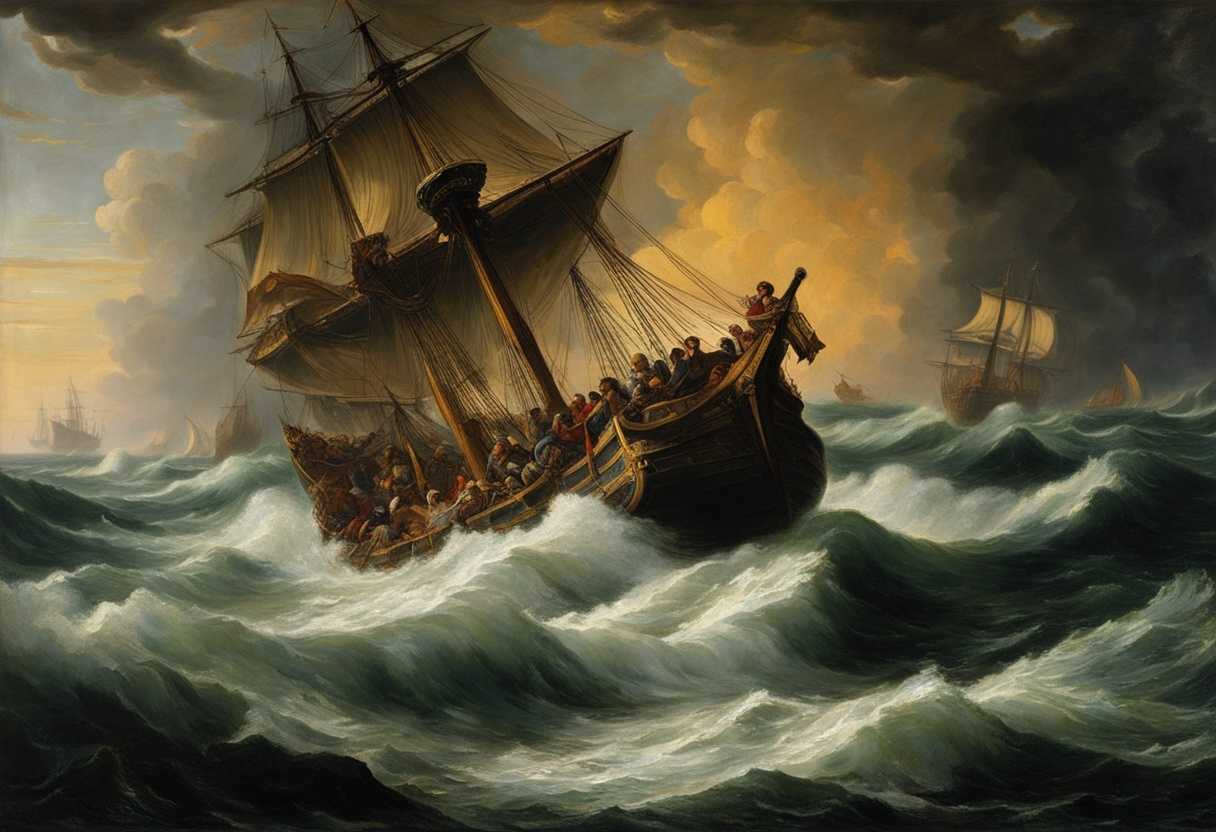
Setting the Scene for Jonah 1:1-15
The scene in Jonah chapter 1 opens with the prophet Jonah receiving a specific command from God to go to the great city of Nineveh and preach against its wickedness. However, Jonah, instead of obeying God’s directive, decides to flee in the opposite direction, boarding a ship bound for Tarshish. The ship sets sail from the port of Joppa, a bustling coastal city in ancient Israel.
Onboard the ship, there are various crew members going about their duties, preparing for the journey ahead. The captain is overseeing the loading of cargo, while the sailors are busy hoisting the sails and navigating the vessel through the waters. Amidst the activity, Jonah is found below deck, fast asleep, trying to escape from the responsibility placed upon him by God.
As the ship sails further away from the land, a great storm suddenly arises, threatening to break the ship apart. The sailors, in a panic, begin to pray to their gods and throw the cargo overboard to lighten the ship. Meanwhile, Jonah is awakened and confronted by the crew about his role in bringing this calamity upon them. The tension mounts as they cast lots to determine who is responsible for the storm, and the lot falls on Jonah, revealing his true identity as the one fleeing from God’s command.
What is Jonah 1:1-15 about?
Ah, the story of Jonah—an example of the consequences of disobedience and the power of God’s sovereignty. Here we see Jonah going against God’s command to preach to the people of Nineveh and attempting to flee. But as we learn, disobedience doesn’t go unnoticed by the Almighty. Jonah faces a fierce storm while aboard a ship, showcasing the repercussions of his defiance in this verse. The storm serves as a symbol of God’s displeasure and an unavoidable confrontation with the consequences of his actions. Jonah’s disobedience not only put himself at risk but also endangered the lives of those around him. Jonah’s story prompts us to consider our own obedience to God’s will as we reflect on it. Are we brave enough to face the storms that come with disobedience, or do we choose to trust in God’s plan and follow His guidance? Let Jonah’s journey serve as a reminder of the importance of obedience and the faithfulness required in our own walks with God.
Understanding what Jonah 1:1-15 really means
Jonah 1:1-15 recounts the beginning of Jonah’s journey, where he receives a divine directive to go to Nineveh and preach against its wickedness. Instead of obeying, Jonah attempts to flee from God’s presence by boarding a ship bound for Tarshish, leading to a tumultuous storm and his eventual casting overboard to calm the sea.
“The word of the Lord came to Jonah” signifies divine communication and Jonah’s calling as a prophet, emphasizing the importance of listening to God’s voice. The command to “Arise, go to Nineveh, that great city, and cry out against it” highlights God’s concern for all nations and the need for repentance. Jonah’s decision to flee to Tarshish showcases human reluctance and disobedience, futile in evading God’s will.
“The Lord sent out a great wind on the sea” demonstrates God’s sovereignty over nature and His intervention in human affairs. Jonah’s self-sacrificial request to be thrown into the sea reflects a moment of repentance and acknowledgment of his wrongdoing.
Related passages like Psalm 139:7-10 affirm the inability to flee from God’s presence, while Matthew 12:39-41 and Romans 11:29 draw parallels to Jonah’s experience, emphasizing repentance and the irrevocability of God’s calling.
The story of Jonah serves as a poignant reminder of the significance of obedience to God’s call, illustrating that avoidance of divine responsibilities can lead to turmoil. In modern contexts, individuals are encouraged to trust in God’s plan and act in faith, even when faced with daunting challenges.
Consider a scenario where someone initially resists a challenging vocation but, upon embracing it, brings healing and hope to many, akin to Jonah’s transformation. Jonah 1:1-15 imparts a timeless lesson on heeding God’s call, the futility of escaping divine purposes, and the power of repentance and obedience, prompting reflection on aligning actions with God’s will.
Why do we resist following God’s calling?
We often resist following God’s calling because it may lead us out of our comfort zones and require us to confront our fears and insecurities. We may fear the unknown or the challenges that come with stepping out in faith. Like Jonah, we may try to run away or ignore God’s prompting because we feel inadequate or overwhelmed by the task ahead. However, God’s calling is a test of our trust and obedience, reminding us that He is in control and will equip us for the journey ahead.
It is natural for us to resist following God’s calling because it may disrupt our plans and desires. We may have our own agendas or ambitions that conflict with what God is asking of us. Jonah’s initial resistance stemmed from his reluctance to go to Nineveh, a city he despised, to deliver a message of repentance. Similarly, we may be resistant to God’s calling because it challenges our preferences or requires sacrifices that we are not willing to make. However, God’s plans are greater than our own, and He knows what is best for us, even when it goes against our own inclinations. A lack of faith and trust in His guidance can ultimately stem our resistance to following God’s calling. We may doubt our abilities, question God’s timing, or struggle to see how His plan fits into our lives. Like Jonah, we may try to flee or ignore God’s voice, only to face the consequences of disobedience. To overcome this resistance, we must surrender our doubts and fears to God, trusting that He will lead us where we need to go and provide what we need along the way.
Application
Reflect on your path and ask yourself, are you running away from your true purpose like Jonah did? Stay obedient to your calling, for ignoring it may lead to unwanted consequences. Trust in the guidance meant for you, even when it shakes you out of your comfort zone. Today, let us align our actions with our destined path. Will you choose to embrace your purpose and follow the path God has laid before you?

Reverend Michael Johnson is an experienced Church Minister with a profound expertise in spirituality and guidance. With a serene presence and a compassionate heart, he has faithfully served his congregation for over 20 years, leading them on a spiritual journey towards inner peace and enlightenment. Reverend Johnson’s extensive knowledge of religious philosophies and profound understanding of human nature have made him a trusted confidant and mentor to many, as he seamlessly weaves his profound wisdom into life teachings. Reverend Johnson’s calming demeanor and empathetic nature continue to uplift and heal souls, nurturing a sense of unity and tranquility within his community.