
Joshua 6:6-11 is about the specific instructions given by God to Joshua for the Israelites to conquer the city of Jericho, illustrating the importance of following divine guidance and instructions in achieving victory against seemingly insurmountable obstacles.
6 So Joshua the son of Nun called the priests and said to them, “Take up the ark of the covenant and let seven priests bear seven trumpets of rams’ horns before the ark of the Lord.”
7 And he said to the people, “Proceed, and march around the city, and let the armed men pass on before the ark of the Lord.”
8 And just as Joshua had commanded the people, the seven priests bearing the seven trumpets of rams’ horns before the Lord went forward, blowing the trumpets, with the ark of the covenant of the Lord following them.
9 And the armed men were walking before the priests who were blowing the trumpets, and the rear guard was walking after the ark, while the trumpets blew continually.
10 But Joshua commanded the people, “You shall not shout or make your voice heard, neither shall any word go out of your mouth, until the day I tell you to shout. Then you shall shout.”
11 So he caused the ark of the Lord to circle the city, going about it once. And they came into the camp and spent the night in the camp.
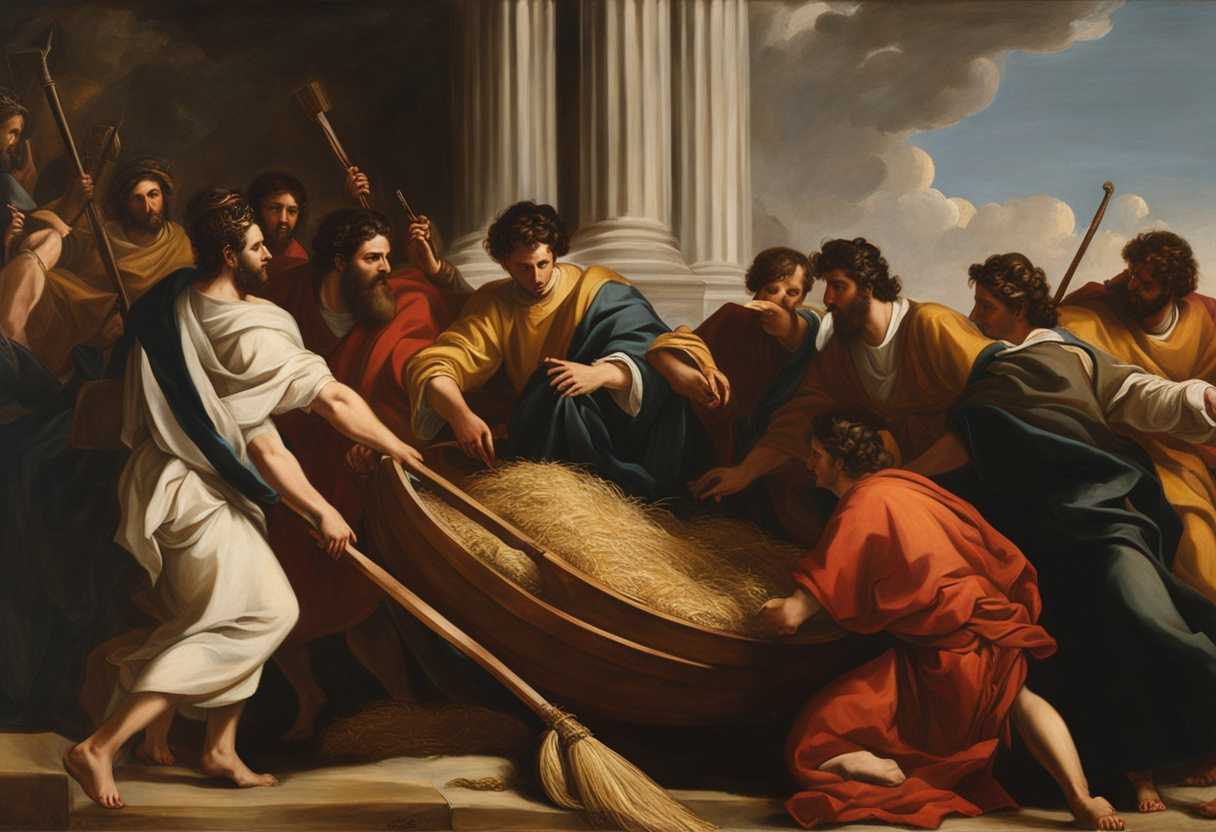
Setting the Scene for Joshua 6:6-11
In Joshua chapter 6, we find the Israelites on the cusp of entering the Promised Land after wandering in the wilderness for forty years. The scene unfolds with Joshua, the appointed leader after Moses, standing before the walls of Jericho, a formidable city with impenetrable defenses. The Israelites had been instructed by God to march around the city once a day for six days, with seven priests carrying ram’s horns before the ark of the covenant. On the seventh day, they were to march around the city seven times, and at the sound of a long blast of the ram’s horn, the people were to shout, and the walls of Jericho would fall down flat.
As the sun rises on the seventh day, the Israelites gather outside the city walls, their anticipation palpable. Joshua stands at the forefront, his faith unwavering as he follows God’s instructions. The priests lift the ark of the covenant, the symbol of God’s presence among them, and the people fall into step behind them. The sound of the ram’s horns fills the air as they march in unison, the city looming large before them. The tension builds with each step, the promise of victory hanging in the balance as they prepare to witness the miraculous power of God.
What is Joshua 6:6-11 about?
Oh, how inspiring it is to witness Joshua’s unwavering faith and obedience as he follows God’s instructions to conquer Jericho! Joshua showcases a deep trust in the divine plan and a willingness to follow it even when it might seem unconventional or challenging by faithfully carrying out God’s command. His actions teach us the importance of trusting in God’s guidance and following it with full obedience, knowing that His plans are always for our ultimate good.
Just like Joshua, we are called to have faith and obedience in our own lives. This verse serves as a reminder that when we trust in God’s wisdom and follow His commands, we can overcome even the most formidable obstacles in our path. Let us reflect on Joshua’s example and consider how we can cultivate our faith and obedience in God, knowing that He will always lead us to victory in the end.
Understanding what Joshua 6:6-11 really means
The Book of Joshua recounts the Israelites’ conquest of Canaan, with Joshua at the helm. In Joshua 6:6-11, we witness the early stages of the Battle of Jericho, where Joshua issues instructions to the priests and the people on how to approach the city. The significance of key phrases in this passage sheds light on the spiritual principles at play. For instance, the command to “take up the ark of the covenant of the Lord” signifies the acknowledgment of God’s presence and leadership in the battle. The act of carrying the Ark symbolizes that the Israelites are under divine direction, emphasizing the importance of seeking God’s guidance in all endeavors.
Furthermore, the directive for “seven priests [to] bear seven trumpets of rams’ horns before the ark” underscores the idea of completeness and God’s intervention. The number seven often represents perfection in the Bible, highlighting the completeness of God’s plan in the unfolding events. As the Israelites are instructed to march around the city, their obedience and faith in God’s unconventional methods are put to the test. This act serves as a reminder of the importance of trusting in God’s wisdom, even when His ways seem unconventional to human understanding.
The involvement of the armed men passing before the ark of the Lord signifies the partnership between divine guidance and human effort. While God leads the way, human readiness and action are also essential components in achieving victory. Drawing parallels to modern-day relevance, the themes of faith, obedience, and unity remain pertinent. Just as the Israelites had to trust and obey God’s instructions, contemporary individuals are called to have faith in God’s plans, even when they may not immediately comprehend the path laid out before them.
In Hebrews 11:30, the walls of Jericho falling by faith serve as a testament to the power of unwavering trust in God’s promises. This New Testament reference reinforces the idea that faith is a crucial element in witnessing God’s miraculous works. Similarly, Exodus 14:14 reassures believers that God fights on their behalf, emphasizing the need for stillness and trust in His sovereignty, even amidst challenging circumstances. The narrative of the Battle of Jericho serves as a timeless example of the triumph that comes from aligning one’s actions with God’s will.
In a practical illustration, envision a struggling church prompted by its pastor to embark on a community outreach initiative despite financial constraints. Through faith and obedience, the congregation rallies together, offering their time and resources. Over time, the outreach program not only impacts the community positively but also revitalizes the church, attracting new members and resources. This anecdote mirrors the Israelites’ unwavering faith and obedience leading to the collapse of Jericho’s walls, showcasing the transformative power of trusting in God’s guidance.
In conclusion, Joshua 6:6-11 serves as a poignant reminder of the potency of faith, obedience, and divine guidance. By embracing these principles and working collectively towards a common goal, individuals can surmount seemingly insurmountable obstacles, echoing the triumph of the Israelites at Jericho.
How can we trust and obey God’s instructions fully?
To trust and obey God’s instructions fully means to have unwavering faith in His plans and commands, regardless of how unconventional or challenging they may seem. It involves wholeheartedly following His guidance without doubt or hesitation, even when the circumstances do not make sense to our human reasoning. The Israelites in Joshua 6:6-11 were instructed to march around the city of Jericho in silence for six days, followed by seven priests carrying trumpets on the seventh day. Despite the unconventional nature of this plan, the Israelites demonstrated their trust and obedience by following God’s instructions precisely.
Trusting and obeying God fully also requires surrendering our own will and desires to His divine wisdom and sovereignty. It means recognizing that His ways are higher than ours and submitting ourselves humbly to His guidance, even if it goes against our own preferences or preconceived notions. We acknowledge God’s authority in our lives and allow Him to work through us for His glory and purposes by doing so. We must make a conscious choice to ultimately trust and obey God’s instructions fully daily. It requires a deep-rooted faith in His goodness and a commitment to follow Him wholeheartedly, even when the path ahead seems uncertain or challenging. We can experience the fulfillment of His promises and the blessings that come from walking in alignment with His perfect plan for our lives as we continue to seek His will and obey His commands with faith and obedience.
Application
Follow God’s plan like the Israelites circling Jericho. Trust His lead in your journey too. When challenges tower, cling to faith. Do you stand steadfast and faithful in the face of obstacles?

Reverend Michael Johnson is an experienced Church Minister with a profound expertise in spirituality and guidance. With a serene presence and a compassionate heart, he has faithfully served his congregation for over 20 years, leading them on a spiritual journey towards inner peace and enlightenment. Reverend Johnson’s extensive knowledge of religious philosophies and profound understanding of human nature have made him a trusted confidant and mentor to many, as he seamlessly weaves his profound wisdom into life teachings. Reverend Johnson’s calming demeanor and empathetic nature continue to uplift and heal souls, nurturing a sense of unity and tranquility within his community.