
Judges 9:30-41 is about the consequences of Abimelech’s tyrannical rule, as the people of Shechem rebel against him leading to his eventual demise.
30 When Zebul the ruler of the city heard the words of Gaal the son of Ebed, his anger was kindled.
31 And he sent messengers to Abimelech secretly, saying, “Behold, Gaal the son of Ebed and his relatives have come to Shechem, and they are stirring up the city against you.
32 Now therefore, go by night, you and the people who are with you, and set an ambush in the field.
33 In the morning, as soon as the sun is up, rise early and rush upon the city. And when he and the people who are with him come out against you, you may do to them as your hand finds to do.”
34 And Abimelech and all the men who were with him rose up by night and set an ambush against Shechem in four companies.
35 And Gaal the son of Ebed went out and stood in the entrance of the gate of the city, and Abimelech and the people who were with him rose from the ambush.
36 And when Gaal saw the people, he said to Zebul, “Look, people are coming down from the mountaintops!” And Zebul said to him, “You mistake the shadow of the mountains for men.”
37 And Gaal spoke again and said, “Look, people are coming down from the center of the land, and one company is coming from the direction of the Diviners’ Oak.”
38 Then Zebul said to him, “Where is your mouth now, you who said, ‘Who is Abimelech, that we should serve him?’ Are not these the people whom you despised? Go out now and fight with them.”
39 And Gaal went out at the head of the leaders of Shechem, and fought with Abimelech.
40 But Abimelech chased him, and he fled before him. And many fell wounded, up to the entrance of the gate.
41 And Abimelech lived at Arumah, and Zebul drove out Gaal and his relatives, so that they could not dwell at Shechem.
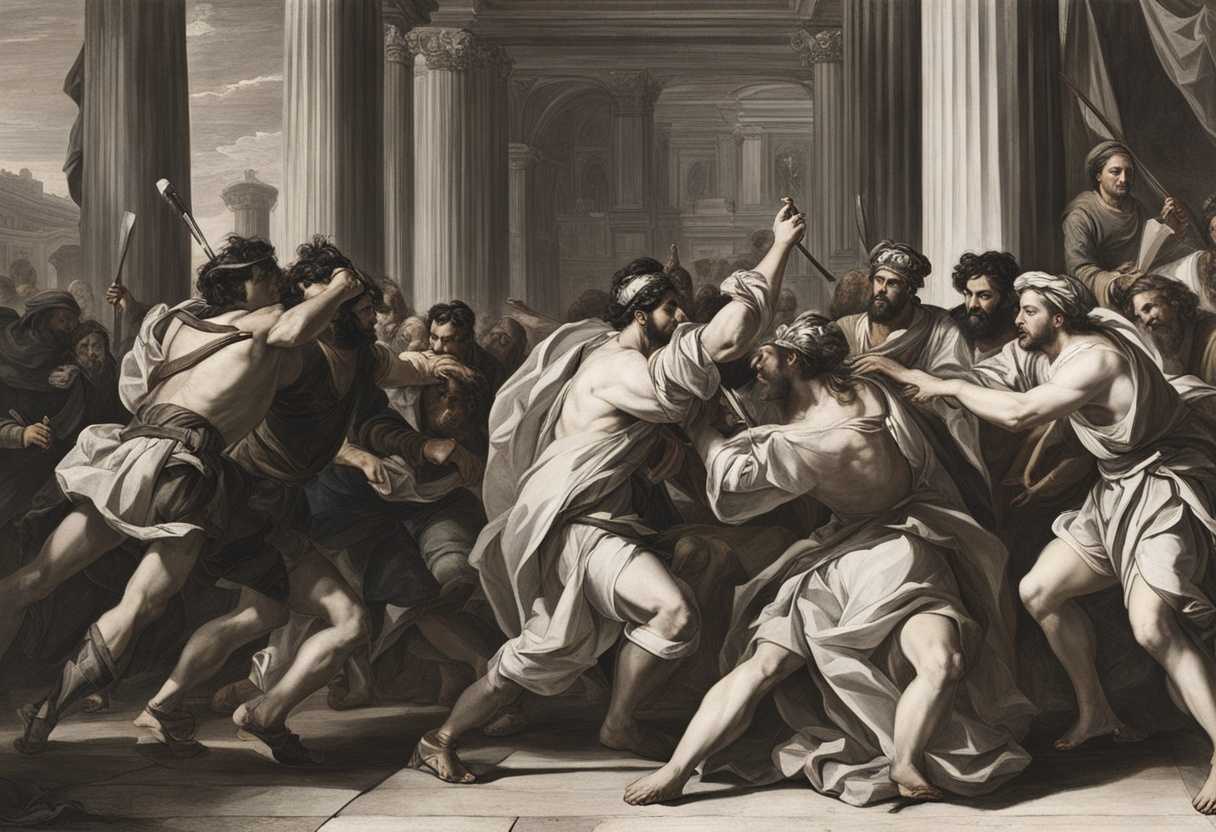
Setting the Scene for Judges 9:30-41
In Judges 9:30-41, we find ourselves in the ancient city of Shechem, a significant location in biblical times. The scene is set in the midst of a tumultuous political situation, with Abimelech, the son of Gideon, vying for power and seeking to establish himself as king. Abimelech’s rise to power was marked by treachery and violence, as he murdered his brothers to secure his position.
The key figures in this scene are Abimelech, the ambitious and ruthless leader, and the people of Shechem who have supported him in his bid for kingship. The people of Shechem had gathered in the temple of their god, Baal-berith, to celebrate and pledge their allegiance to Abimelech. However, tensions quickly escalate as Gaal, a rival leader, challenges Abimelech’s authority and incites rebellion among the people.
The surroundings are tense and charged with anticipation as Abimelech and his forces prepare to confront Gaal and his supporters. The city of Shechem is divided, with factions loyal to either Abimelech or Gaal, leading to a violent clash between the two sides. The scene is chaotic and filled with intrigue, as power dynamics shift and loyalties are tested in the struggle for control.
What is Judges 9:30-41 about?
Abimelech, the ruler of Shechem and the son of Gideon, tragically falls in this verse. Despite his power and authority, Abimelech’s aggression towards the city of Thebez leads to his demise. The text describes how a woman from Thebez throws a millstone from the city wall, hitting Abimelech and causing him mortal injuries. This event symbolizes the consequences of tyranny and unjust leadership, as Abimelech’s violent actions ultimately result in his own destruction. We reflect on this verse, urging us to contemplate the implications of power and how it can be both a tool for good and a source of corruption. Abimelech’s story serves as a cautionary tale about the dangers of pride, greed, and oppressive behavior. It prompts us to consider the importance of humility, justice, and compassion in leadership roles. What lessons can we draw from Abimelech’s downfall? How can we strive to be more conscientious and virtuous in positions of authority? We should ponder these questions as we seek to cultivate a better understanding of how power should be wielded responsibly and ethically.
Understanding what Judges 9:30-41 really means
In the narrative of Abimelech and Gaal found in Judges 9:30-41, we witness a power struggle fueled by ambition, pride, and betrayal. Abimelech, the son of Gideon, seizes power by eliminating his seventy brothers, only to face a challenge from Gaal, who openly defies his authority. The tension between loyalty and betrayal is palpable as Zebul, loyal to Abimelech, secretly informs him of Gaal’s rebellion. This clandestine communication underscores the deceit and intrigue prevalent in the story, mirroring the complexities of human relationships and power dynamics.
As Gaal confronts Abimelech openly before the leaders of Shechem, we see the clash of egos and the consequences of unchecked pride. The phrase “Pride goes before destruction, a haughty spirit before a fall” from Proverbs 16:18 resonates here, highlighting the downfall that awaits the arrogant and power-hungry. The violent conflict depicted in Judges starkly contrasts with the New Testament’s call for peace, as seen in Matthew 5:9, emphasizing the importance of peacemaking and reconciliation over violence and strife.
Romans 12:19’s admonition against seeking personal vengeance echoes the futility of Abimelech and Gaal’s quest for power through bloodshed. Their story serves as a cautionary tale for us today, reminding us of the dangers of unethical behavior and the lasting impact of pride and betrayal. In a world still rife with power struggles and conflicts, this passage prompts us to reflect on our own actions and motivations, urging us to prioritize integrity and humility in our pursuits.
Imagine a modern-day workplace scenario where colleagues vie for a promotion, resorting to deceit and open defiance akin to Abimelech and Gaal. The toxic environment that ensues mirrors the strife in Shechem, emphasizing that true leadership stems from integrity and respect, not underhanded tactics or rebellion. By internalizing the lessons from Judges 9:30-41 and related biblical passages, we are encouraged to lead lives guided by principles of integrity, humility, and peace.
In conclusion, the timeless themes of loyalty, betrayal, and the perils of pride in Judges 9:30-41 offer profound insights for contemporary audiences. As we navigate our own ambitions and relationships, may we heed the warnings of this narrative, seeking God’s guidance in our actions and trusting in His justice rather than succumbing to the pitfalls of pride and conflict.
What are the consequences of envy and strife?
The consequences of envy and strife can be seen in the story of Abimelek and the people of Shechem. Envy and strife led to betrayal, as Abimelek deceived the people of Shechem into following him as their leader. This ultimately resulted in violence and bloodshed, as Abimelek and the people of Shechem engaged in a brutal conflict that led to many deaths.
Envy and strife can also lead to a lack of trust and division among people, as seen in the story where Abimelek turned against the people who had supported him, and the people of Shechem turned against Abimelek. This lack of unity and trust can result in chaos and destruction, as conflicts escalate and individuals seek to protect their own interests at the expense of others.
Furthermore, envy and strife can have long-lasting consequences on individuals and communities. Abimelek and the people of Shechem’s actions resulted in a legacy of violence and suffering that affected future generations. This serves as a warning about the destructive nature of envy and strife, and the importance of promoting peace, unity, and cooperation to avoid such tragic outcomes.
Application
Let’s be vigilant like guardians protecting our loved ones from harm, shielding our hearts from the poison of jealousy and pride that destroy relationships. Embrace humility as a shield and wield service as a sword against the allure of power and self-importance. Are you ready to plant seeds of humility and reap a harvest of harmony and love in your work and family?

Reverend Michael Johnson is an experienced Church Minister with a profound expertise in spirituality and guidance. With a serene presence and a compassionate heart, he has faithfully served his congregation for over 20 years, leading them on a spiritual journey towards inner peace and enlightenment. Reverend Johnson’s extensive knowledge of religious philosophies and profound understanding of human nature have made him a trusted confidant and mentor to many, as he seamlessly weaves his profound wisdom into life teachings. Reverend Johnson’s calming demeanor and empathetic nature continue to uplift and heal souls, nurturing a sense of unity and tranquility within his community.