
Luke 1:46-54 is about Mary magnifying the greatness of God and expressing gratitude for His mercy, showcasing her faith and humility in accepting her divine role in the fulfillment of God’s plan.
46 And Mary said, “My soul magnifies the Lord,
47 and my spirit rejoices in God my Savior,
48 for he has looked on the humble estate of his servant.
49 for he who is mighty has done great things for me,
and holy is his name.
50 And his mercy is for those who fear him from generation to generation.
51 He has shown strength with his arm; he has scattered the proud in the thoughts of their hearts.
52 he has brought down the mighty from their thrones
and exalted those of humble estate;
53 he has filled the hungry with good things, and the rich he has sent away empty.
54 He has helped his servant Israel, in remembrance of his mercy,
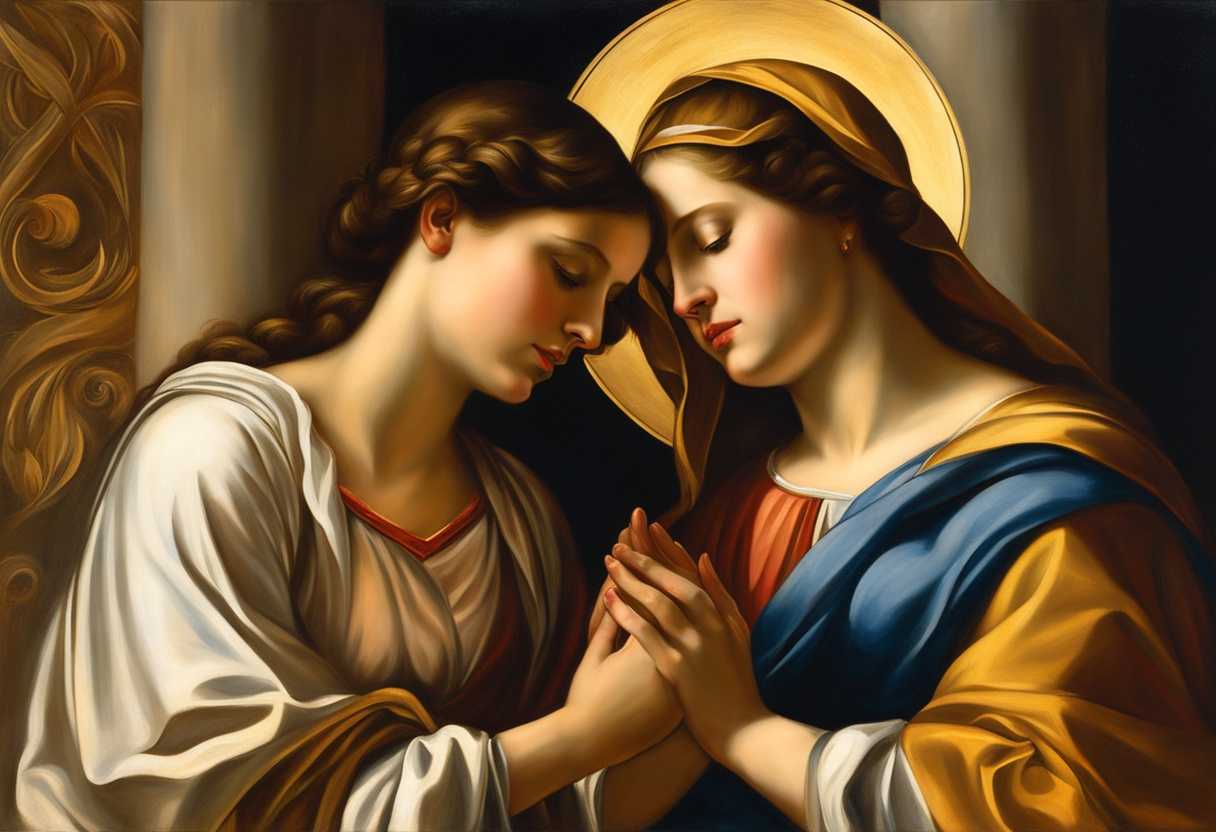
Setting the Scene for Luke 1:46-54
The scene in Luke chapter 1:46-54 takes place in the home of Mary, a young Jewish woman who has just been visited by the angel Gabriel. Mary has been told that she will conceive a child by the Holy Spirit and that her son will be the Son of God. Overwhelmed by this news, Mary goes to visit her relative Elizabeth, who is also miraculously pregnant with John the Baptist.
As Mary enters Elizabeth’s home, she is greeted with joy and excitement. Elizabeth, filled with the Holy Spirit, recognizes the significance of Mary’s visit and the child she carries. The two women share in a moment of deep spiritual connection, praising God for His faithfulness and mercy. The room is filled with a sense of awe and wonder as these two women, both chosen by God for special roles in His plan of salvation, come together in a beautiful display of faith and humility.
Surrounded by the simple comforts of Elizabeth’s home, Mary and Elizabeth’s conversation is filled with prophetic declarations and praises to God. Mary’s song, known as the Magnificat, reflects her deep faith and understanding of God’s power and mercy. The scene is one of profound significance, as these two women, both carrying miraculous pregnancies, come together to support and encourage one another in their unique callings from God.
What is Luke 1:46-54 about?
This verse, often known as “The Magnificat,” captures Mary’s deep sense of gratitude and awe at God’s faithfulness in keeping His promises. Mary acknowledges the greatness of God and the ways He has worked throughout history to lift up the lowly and humble the proud in this song of praise. She rejoices in the mercy and grace that God has shown her personally by choosing her to bear His son, Jesus. Mary’s words remind us of the power of God’s faithfulness and mercy in our own lives as we reflect. God continues to work in our lives, fulfilling His promises to Mary, lifting us up in times of need, and guiding us with His loving hand. This verse challenges us to ponder on the ways that God has shown His faithfulness and mercy to us, and to respond with a heart full of praise and thanksgiving.
So, let us take a moment to meditate on Mary’s song of praise, and consider the ways that God has been faithful and merciful in our own lives. How has He lifted us up in times of struggle? How has He shown us His grace and presence in moments of joy and sorrow? May we, like Mary, respond with a heart of gratitude and a song of praise for the faithfulness and mercy of our loving God.
Understanding what Luke 1:46-54 really means
Introduction
In the passage of Luke 1:46-54, we witness Mary’s Magnificat, a profound song of praise to God uttered by Mary during her visit to Elizabeth. This moment captures Mary’s deep faith and her profound understanding of God’s work in her life and in the world, setting the stage for a reflection on the power of humility and gratitude in the face of divine intervention.
Key Phrases and Their Meanings
“My soul magnifies the Lord” encapsulates Mary’s profound reverence and worship of God, showcasing her humility and acknowledgment of God’s greatness. “My spirit rejoices in God my Savior” reveals Mary’s recognition of God as her Savior, expressing immense joy and gratitude for His saving grace. “He has looked on the humble estate of his servant” portrays Mary’s awareness of her lowly position and her awe at God’s favor towards her.
“He who is mighty has done great things for me” emphasizes God’s power and the miraculous nature of His works in Mary’s life. “His mercy is for those who fear him” underscores God’s compassion and kindness towards those who revere Him. “He has scattered the proud, brought down the mighty, exalted those of humble estate” illustrates God’s justice and His inclination to uplift the humble while humbling the proud. “He has filled the hungry with good things” symbolizes God’s provision and care for those in need, while “He has helped his servant Israel” reflects God’s faithfulness to His promises and His people.
Related Bible Passages
Drawing parallels, 1 Samuel 2:1-10 showcases Hannah’s prayer, akin to Mary’s song, expressing gratitude and acknowledging God’s intervention. Psalm 34:2-3 calls for magnifying the Lord together with the humble, echoing Mary’s exaltation of God. James 4:6 warns against pride, emphasizing God’s grace towards the humble.
Relevance to People Today
This passage serves as a source of encouragement, urging believers to trust in God’s power and mercy amidst life’s challenges. It teaches the vital lesson of humility, prompting us to recognize God’s hand in our lives. Moreover, it reassures us of God’s justice, offering hope that He will uplift the humble and humble the proud.
Anecdote
Consider a young woman from a modest town who, feeling insignificant, dedicates herself to serving at a local shelter. Despite her humble role, she discovers immense joy and purpose in aiding others. Unexpectedly, she receives recognition for her efforts, overwhelmed with gratitude. Through this, she realizes that her small acts of kindness have a significant impact, akin to Mary’s humble beginnings leading to a divine purpose.
Conclusion
Mary’s Magnificat stands as a poignant testament to God’s faithfulness, mercy, and justice. It calls us to embrace humility, trust in God’s plan, and find joy in His salvation, echoing the timeless relevance of Mary’s song in our lives today.
What does true humility look like in practice?
True humility, as depicted in the passage, is expressed through a deep sense of gratitude and praise for God’s blessings. It involves recognizing and acknowledging one’s own limitations and imperfections while exalting the greatness and goodness of God. This humility is demonstrated through a posture of submission and surrender to God’s will and purpose, trusting in His provision and sovereignty. True humility in practice involves putting aside one’s own pride and ego, and instead magnifying God’s glory and faithfulness. It requires a genuine attitude of gratitude, celebrating the ways in which God has shown mercy and favor. This humility is not self-deprecating but rather a recognition of the disparity between human frailty and divine power. True humility manifests in a life that honors and uplifts the Almighty by glorifying God above oneself and expressing gratitude for His blessings.
Application
Embrace gratitude and praise as Mary did in Luke 1:46-54. Reflect on God’s faithfulness and mighty works in your life. Cultivate a heart of worship towards your Creator, honoring His goodness. Will you join in lifting your voice in praise and thanksgiving today?

Reverend Michael Johnson is an experienced Church Minister with a profound expertise in spirituality and guidance. With a serene presence and a compassionate heart, he has faithfully served his congregation for over 20 years, leading them on a spiritual journey towards inner peace and enlightenment. Reverend Johnson’s extensive knowledge of religious philosophies and profound understanding of human nature have made him a trusted confidant and mentor to many, as he seamlessly weaves his profound wisdom into life teachings. Reverend Johnson’s calming demeanor and empathetic nature continue to uplift and heal souls, nurturing a sense of unity and tranquility within his community.