
Luke 22:54-71 is about the fulfillment of Jesus’ prophecy regarding Peter’s denial, the unjust treatment and wrongful accusations against Jesus, and His unwavering faithfulness and commitment to His mission despite the betrayal and rejection He faced.
54 Then they seized him and led him away, bringing him into the high priest’s house, and Peter was following at a distance.
55 And when they had kindled a fire in the middle of the courtyard and sat down together, Peter sat down among them.
56 Then a servant girl, seeing him as he sat in the light and looking closely at him, said, “This man also was with him.”
57 But he denied it, saying, “Woman, I do not know him.”
58 And a little later someone else saw him and said, “You also are one of them.” But Peter said, “Man, I am not.”
59 And after an interval of about an hour still another insisted, saying, “Certainly this man also was with him, for he too is a Galilean.”
60 But Peter said, “Man, I do not know what you are talking about.” And immediately, while he was still speaking, the rooster crowed.
61 And the Lord turned and looked at Peter. And Peter remembered the saying of the Lord, how he had said to him, “Before the rooster crows today, you will deny me three times.”
62 And he went out and wept bitterly.
63 Now the men who were holding Jesus in custody were mocking him as they beat him.
64 They also blindfolded him and kept asking him, “Prophesy! Who is it that struck you?”
65 And they said many other things against him, blaspheming him.
66 When day came, the assembly of the elders of the people gathered together, both chief priests and scribes. And they led him away to their council, and they said,
67 “If you are the Christ, tell us.” But he said to them, “If I tell you, you will not believe,”
68 But from now on the Son of Man shall be seated at the right hand of the power of God.”
69 But from now on the Son of Man shall be seated at the right hand of the power of God.”
70 So they all said, “Are you the Son of God, then?” And he said to them, “You say that I am.”
71 Then they said, “What further testimony do we need? We have heard it ourselves from his own lips.”
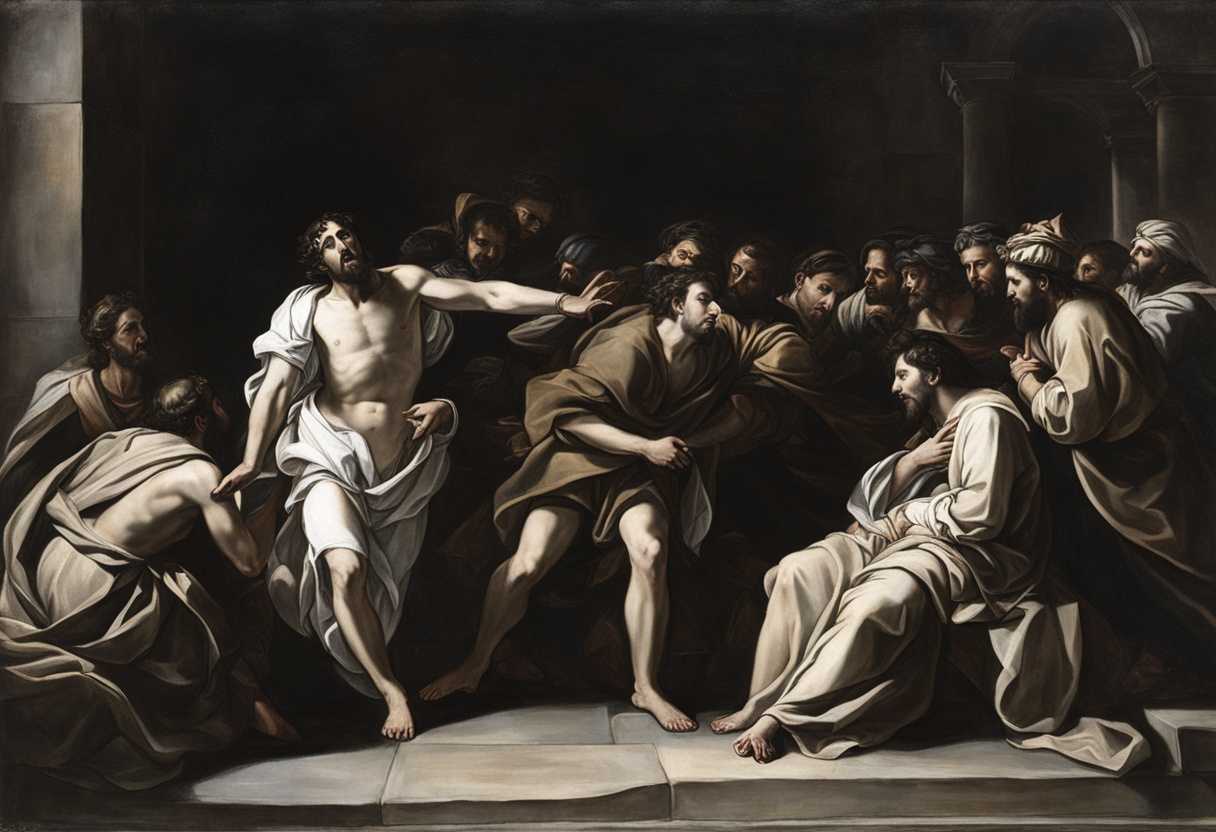
Setting the Scene for Luke 22:54-71
The scene in Luke 22:54-71 takes place in the courtyard of the high priest’s house in Jerusalem. After Jesus was arrested in the Garden of Gethsemane, Peter followed at a distance and ended up in the courtyard along with other onlookers and officials. The atmosphere is tense and charged with emotion as Jesus is being questioned inside the high priest’s house.
Inside, Jesus is being interrogated by the religious leaders, while outside in the courtyard, Peter is recognized as one of Jesus’ disciples three times, just as Jesus had predicted. Each time, Peter denies knowing Jesus, and the rooster crows, fulfilling Jesus’ prophecy. The courtyard is dimly lit by torches, casting flickering shadows on the faces of those gathered around. The air is thick with betrayal and fear as Peter grapples with his denial and Jesus faces his accusers with unwavering resolve. The scene captures the contrast between Peter’s weakness and Jesus’ strength in the face of impending betrayal and crucifixion.
What is Luke 22:54-71 about?
We witness a powerful and poignant moment in the biblical narrative in this verse. Jesus, knowing Peter’s faith would be tested in a time of trial, predicted that his dear disciple would deny him three times before the rooster crowed. Despite Peter’s sincere declaration of loyalty and devotion, when faced with fear and danger, he faltered. This moment is a reminder of the frailty and humanity within us all, showing that even the most devoted followers can waver in their faith when confronted with challenges.
Have you ever found yourself in a situation where your beliefs or convictions were put to the test? Peter’s denial of Jesus serves as a lesson for each of us to reflect on our own vulnerabilities and to consider how we might respond under pressure. It also underscores the importance of humility and forgiveness, as Jesus later forgives Peter and reaffirms his love and faith in him. This verse ultimately offers a message of redemption and hope, showing that we are not defined by our failures, but by our ability to learn, grow, and seek forgiveness even in our moments of weakness.
Understanding what Luke 22:54-71 really means
In the poignant narrative of Luke 22:54-71, we are transported to the tumultuous events preceding Jesus’ crucifixion. The scene unfolds with Peter, one of Jesus’ closest disciples, following at a distance, torn between loyalty and fear. The setting, post-Jesus’ arrest in the Garden of Gethsemane, is fraught with tension, betrayal, and impending injustice, painting a vivid picture of the challenges faced by Jesus and His followers.
As Peter lingers in the shadows, the phrase “Peter followed at a distance” encapsulates his inner turmoil, reflecting the universal struggle between devotion and apprehension. The moment a servant girl spots him by the firelight marks the beginning of Peter’s denial—a pivotal juncture symbolizing exposure and vulnerability in the face of adversity. Jesus’ prophetic words about Peter’s denial ring true as the rooster crows, underscoring the frailty of human nature and the pervasive grip of fear.
The piercing gaze of the Lord upon Peter carries profound significance, embodying understanding, sorrow, and a poignant reminder of earlier forewarnings. Peter’s subsequent outburst of bitter weeping outside signifies his profound remorse and repentance, a raw display of human frailty and the capacity for redemption. This narrative intertwines themes of betrayal, forgiveness, and the enduring struggle between faith and fear, resonating with readers across time and circumstance.
Drawing parallels with related biblical passages such as Matthew 26:69-75, John 18:15-27, and Mark 14:66-72, we glean deeper insights into Peter’s denial and the intricate web of human emotions at play. These accounts offer nuanced perspectives on Peter’s journey, enriching our understanding of his internal conflict and eventual reconciliation with his faith.
In a contemporary context, the themes of human weakness, repentance, and courage reverberate powerfully. Just as Peter grappled with fear and faltered in his allegiance, modern-day believers face similar trials of faith and integrity in a world often at odds with their beliefs. Peter’s story serves as a beacon of hope, reminding us that amidst our failings, there exists a path to redemption and forgiveness, urging us to embrace courage and unwavering faith in the face of adversity.
Consider a scenario where a devout professional compromises their faith in a secular workplace to avoid conflict, only to be consumed by regret and sorrow afterward. This anecdote mirrors Peter’s experience, illustrating the internal struggle between conformity and conviction, ultimately leading to a transformative journey of repentance and renewed courage in living out one’s beliefs authentically.
In conclusion, Luke 22:54-71 stands as a poignant testament to the complexities of human nature, the enduring grace of forgiveness, and the unwavering call to steadfast faith. It beckons readers to introspection, prompting a contemplation of their own spiritual journey and the resilience found in embracing vulnerability, repentance, and the unyielding love of Christ.
Do we stay faithful to Jesus in all circumstances?
The passage from Luke 22:54-71 depicts Peter’s denial of Jesus three times before the rooster crows. Despite Peter’s initial assertion that he would stay faithful to Jesus, fear and pressure got the best of him, causing him to stray from his commitment. Jesus knew this would happen and had even predicted it earlier in the passage. We, as followers of Jesus, are called to stay faithful to Him in all circumstances. This means remaining steadfast in our belief and commitment to Him, even when faced with challenges, persecution, or pressure to conform to the world’s ways. We too must continually seek forgiveness and strive to remain faithful to Jesus regardless of the circumstances, just as Peter eventually repented and returned to his faith.
This passage serves as a reminder that our faith will be tested, but we must trust in Jesus and His strength to help us stay true to Him. Even in moments of weakness or doubt, we can turn to Him for guidance and support, knowing that He is always with us and ready to forgive and restore us.
Application
Reflect on your actions like Peter did when he denied Jesus. Are you staying strong in your beliefs when tested? It’s time to be courageous like never before and stand up for what you truly believe in. Let’s ask for forgiveness and make a conscious effort to exemplify our faith in everything we do. Will you be unwavering in your faith, even in the face of challenges?

Reverend Michael Johnson is an experienced Church Minister with a profound expertise in spirituality and guidance. With a serene presence and a compassionate heart, he has faithfully served his congregation for over 20 years, leading them on a spiritual journey towards inner peace and enlightenment. Reverend Johnson’s extensive knowledge of religious philosophies and profound understanding of human nature have made him a trusted confidant and mentor to many, as he seamlessly weaves his profound wisdom into life teachings. Reverend Johnson’s calming demeanor and empathetic nature continue to uplift and heal souls, nurturing a sense of unity and tranquility within his community.