
Luke 9:10-17 is about Jesus feeding the multitude with five loaves and two fish, demonstrating God’s abundance, provision, and ability to meet the needs of His people even in seemingly impossible circumstances.
10 On their return the apostles told him all that they had done. And he took them and withdrew apart to a town called Bethsaida.
11 When the crowds learned it, they followed him, and he welcomed them and spoke to them of the kingdom of God and cured those who had need of healing.
12 Now the day began to wear away, and the twelve came and said to him, “Send the crowd away to go into the surrounding villages and countryside to find lodging and get provisions, for we are here in a desolate place.”
13 But he said to them, “You give them something to eat.” They said, “We have no more than five loaves and two fish—unless we are to go and buy food for all these people.”
14 For there were about five thousand men. And he said to his disciples, “Have them sit down in groups of about fifty each.”
15 And they did so, and had them all sit down.
16 And taking the five loaves and the two fish, he looked up to heaven and said a blessing over them. Then he broke the loaves and gave them to the disciples to set before the crowd.
17 And they all ate and were satisfied. And what was left over was picked up, twelve baskets of broken pieces.
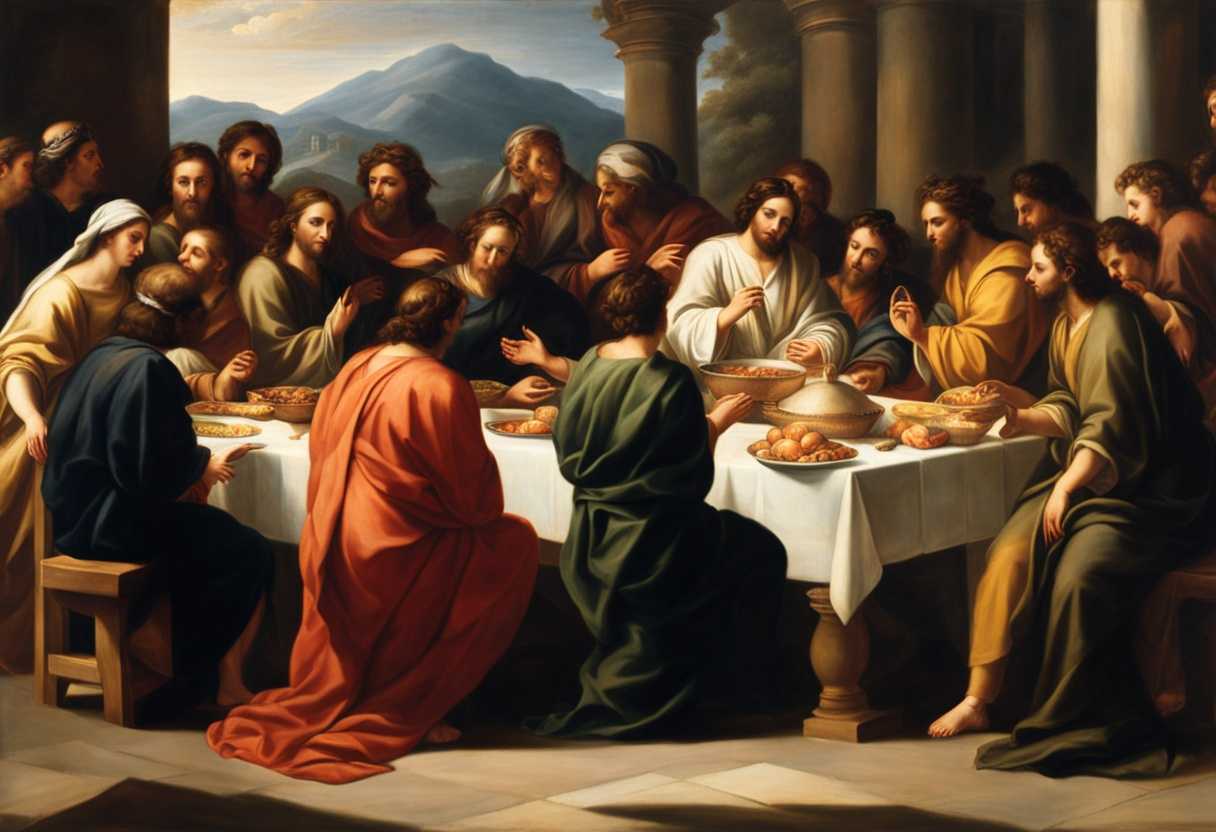
Setting the Scene for Luke 9:10-17
In Luke chapter 9, we find Jesus and his disciples in a remote place near Bethsaida. The disciples had just returned from their mission to preach the Kingdom of God and heal the sick. They were excited to share their experiences with Jesus and were looking forward to some rest and solitude. However, a large crowd had followed them, eager to hear more about Jesus’ teachings and witness his miracles.
As the day wore on, the disciples grew concerned about the people’s hunger. They suggested to Jesus that he send the crowd away to find food in the nearby villages. But Jesus had compassion on the people and instructed his disciples to feed them instead. The disciples were taken aback by this request, as they only had five loaves of bread and two fish among them. Nevertheless, they obeyed Jesus and organized the crowd into groups before witnessing the miraculous multiplication of the loaves and fish, feeding the entire crowd with an abundance of food.
The scene is set in a grassy field overlooking the Sea of Galilee, with the sun beginning to set in the distance. Jesus is seated on a rock, surrounded by his twelve disciples who are distributing the food to the eager crowd. The atmosphere is one of awe and wonder as the people witness this incredible miracle, their faith in Jesus growing with each passing moment. The disciples themselves are amazed at the power and compassion of their teacher, realizing that they are witnessing something truly divine.
What is Luke 9:10-17 about?
Imagine being in the presence of Jesus as He miraculously feeds a crowd of 5,000 people with just five loaves of bread and two fish. This powerful act showcases Jesus’ divine authority and ability to provide abundantly. Jesus is not only satisfying physical hunger but also teaching a profound lesson on faith and reliance on Him by performing this miracle. Jesus takes something seemingly insufficient and transforms it into an overflowing abundance in this verse. This story challenges us to trust in Jesus’ ability to provide for our needs, even when the situation seems impossible. It reminds us that with faith and surrender to Him, nothing is too difficult for God. This miracle serves as a reminder that Jesus is the ultimate source of sustenance and that we can trust Him to meet our needs, no matter how big or small.
Understanding what Luke 9:10-17 really means
The passage in Luke 9:10-17 recounts the miraculous event where Jesus feeds the 5,000 with just five loaves of bread and two fish. It begins with the apostles returning from their mission and reporting to Jesus, who then withdraws with them to Bethsaida. However, the crowds follow, seeking Jesus’ teachings and healing. As the day progresses, the disciples suggest sending the crowd away to find food and lodging, but Jesus challenges them to feed the crowd themselves. Despite their limited resources, Jesus performs a miracle, and everyone is not only fed but satisfied, with twelve baskets of leftovers collected.
In John 6:1-14, a similar account of the feeding of the 5,000 is provided, including the involvement of a boy with the loaves and fish. Matthew 14:13-21 and Mark 6:30-44 also offer parallel narratives, emphasizing Jesus’ compassion and the disciples’ initial doubts. These related passages enrich our understanding of the event and highlight different aspects of the miracle.
The relevance of this passage to people today is profound. It teaches us about dependence on God’s provision, even in times of scarcity. In a world where needs are prevalent, this story reminds us that God can provide abundantly. Furthermore, Jesus’ compassion and service to the crowd serve as a model for us to show compassion and serve others, trusting in God’s multiplication of our efforts. The disciples’ wavering faith and the subsequent miracle underscore the importance of faith in action, showing that God can work through our small acts of faith to accomplish great things.
Consider a scenario where a community center’s food pantry faces an overwhelming demand. Despite limited resources, the volunteers choose to trust in God, and miraculously, the food stretches to feed everyone, with leftovers. This modern-day parallel to the miracle of the loaves and fishes illustrates how faith and compassion can lead to unexpected abundance, echoing the timeless message of God’s provision and generosity.
Key phrases in the passage hold significant meaning for us today. “You give them something to eat” challenges us to take personal responsibility and actively participate in God’s work of provision. “He gave thanks and broke them” highlights the importance of gratitude and recognizing God’s provision, no matter how small it may seem. “They all ate and were satisfied” signifies the completeness of God’s provision, ensuring all needs are met. The “twelve baskets of broken pieces left over” symbolize God’s overflowing generosity, exceeding our expectations and reassuring us of His abundant blessings.
Reflecting on this passage inspires us to trust in God’s provision, show compassion to others, and step out in faith, knowing that God can multiply our efforts beyond what we can imagine. Just as Jesus multiplied the loaves and fish to feed the multitude, He can multiply our acts of faith and compassion to impact those around us in ways we may never anticipate.
How can we trust in God’s provision?
We can trust in God’s provision by remembering that He is a loving and faithful provider. Jesus feeds the five thousand with only five loaves of bread and two fish in this passage. This miracle demonstrates God’s ability to provide abundantly beyond what we can imagine. When we trust in God’s provision, we can have confidence that He will meet our needs, no matter how impossible the situation may seem. We are reminded of God’s power and sovereignty over all things by witnessing how Jesus multiplied the loaves and fish. When we have faith in God’s provision, we are acknowledging His control over the circumstances in our lives and our trust in His ability to provide for us. This passage encourages us to have faith in God’s promises and to rely on Him for our daily needs. Having a humble and dependent heart, like the boy who offered his meager supplies to Jesus, ultimately requires us to trust in God’s provision. When we surrender our resources and circumstances to God, we open ourselves up to experiencing His miraculous provision in our lives. We can have confidence that God will provide for us in ways that exceed our expectations, just as Jesus provided for the five thousand.
Application
Think of Jesus feeding the hungry crowd as a team leader turning a small budget into a big success. You’re part of that team. Just like the disciples, you have the power to make a difference with whatever you have. Picture your energy and skills as seeds that can grow into something amazing with faith and effort. Will you take action and use your talents to help others today?

Reverend Michael Johnson is an experienced Church Minister with a profound expertise in spirituality and guidance. With a serene presence and a compassionate heart, he has faithfully served his congregation for over 20 years, leading them on a spiritual journey towards inner peace and enlightenment. Reverend Johnson’s extensive knowledge of religious philosophies and profound understanding of human nature have made him a trusted confidant and mentor to many, as he seamlessly weaves his profound wisdom into life teachings. Reverend Johnson’s calming demeanor and empathetic nature continue to uplift and heal souls, nurturing a sense of unity and tranquility within his community.