
1 And he began to speak to them in parables. “A man planted a vineyard and put a fence around it and dug a pit for the winepress and built a tower, and leased it to tenants and went into another country.
2 When the season came, he sent a servant to the tenants to get from them some of the fruit of the vineyard.
3 And they took him and beat him and sent him away empty-handed.
4 And he sent another, and him they killed. And so with many others: some they beat, and some they killed.
5 And he sent another, and him they killed. And so with many others: some they beat, and some they killed.
6 He had still one other, a beloved son. Finally he sent him to them, saying, ‘They will respect my son.’
7 But those tenants said to one another, ‘This is the heir. Come, let us kill him, and the inheritance will be ours.’
8 And they took him and killed him and threw him out of the vineyard.
9 What will the owner of the vineyard do? He will come and destroy the tenants and give the vineyard to others.
10 Have you not read this Scripture: “‘The stone that the builders rejected has become the cornerstone;
11 This was the Lord’s doing, and it is marvelous in our eyes.
12 And they were seeking to arrest him but feared the people, for they perceived that he had told the parable against them. So they left him and went away.
13 And they sent to him some of the Pharisees and some of the Herodians, to trap him in his talk.
14 And they came and said to him, “Teacher, we know that you are true and do not care about anyone’s opinion. For you are not swayed by appearances, but truly teach the way of God. Is it lawful to pay taxes to Caesar, or not?
15 But, knowing their hypocrisy, he said to them, “Why put me to the test? Bring me a denarius and let me look at it.”
16 And they brought one. And he said to them, “Whose likeness and inscription is this?” They said to him, “Caesar’s.”
17 Jesus said to them, “Render to Caesar the things that are Caesar’s, and to God the things that are God’s.” And they marveled at him.
18 And Sadducees came to him, who say that there is no resurrection. And they asked him a question, saying:
19 “Teacher, Moses wrote for us that if a man’s brother dies and leaves a wife, but leaves no child, the man must take the widow and raise up offspring for his brother.
20 There were seven brothers; the first took a wife, and when he died left no offspring.
21 And the second took her, and died, leaving no offspring. And the third likewise.
22 The seven had her and left no offspring. Last of all the woman also died.
23 In the resurrection, when they rise again, whose wife will she be? For the seven had her as wife.”
24 Jesus said to them, “Is this not the reason you are wrong, because you know neither the Scriptures nor the power of God?
25 For when they rise from the dead, they neither marry nor are given in marriage, but are like angels in heaven.
26 And as for the dead being raised, have you not read in the book of Moses, in the passage about the bush, how God spoke to him, saying, ‘I am the God of Abraham, and the God of Isaac, and the God of Jacob’?
27 He is not God of the dead, but of the living. You are quite wrong.”
28 And one of the scribes came up and heard them disputing with one another, and seeing that he answered them well, asked him, “Which commandment is the most important of all?”
29 Jesus answered, “The most important is, ‘Hear, O Israel: The Lord our God, the Lord is one.
30 And you shall love the Lord your God with all your heart and with all your soul and with all your mind and with all your strength.’
31 The second is this: ‘You shall love your neighbor as yourself.’ There is no other commandment greater than these.”
32 And the scribe said to him, “You are right, Teacher. You have truly said that he is one, and there is no other besides him.
33 And to love him with all the heart and with all the understanding and with all the strength, and to love one’s neighbor as oneself, is much more than all whole burnt offerings and sacrifices.”
34 And when Jesus saw that he answered wisely, he said to him, “You are not far from the kingdom of God.” And after that no one dared to ask him any more questions.
35 And as Jesus taught in the temple, he said, “How can the scribes say that the Christ is the son of David?
36 David himself, in the Holy Spirit, declared, “‘The Lord said to my Lord, “Sit at my right hand, until I put your enemies under your feet.”’
37 David himself calls him Lord. So how is he his son?” And the great throng heard him gladly.
38 And in his teaching he said, “Beware of the scribes, who like to walk around in long robes and like greetings in the marketplaces
39 and have the best seats in the synagogues and the places of honor at feasts,
40 who devour widows’ houses and for a pretense make long prayers. They will receive the greater condemnation.
41 And he sat down opposite the treasury and watched the people putting money into the offering box. Many rich people put in large sums.
42 And a poor widow came and put in two small copper coins, which make a penny.
43 And he called his disciples to him and said to them, “Truly, I say to you, this poor widow has put in more than all those who are contributing to the offering box.
44 For they all contributed out of their abundance, but she out of her poverty has put in everything she had, all she had to live on.”
The True Meaning of Mark 12
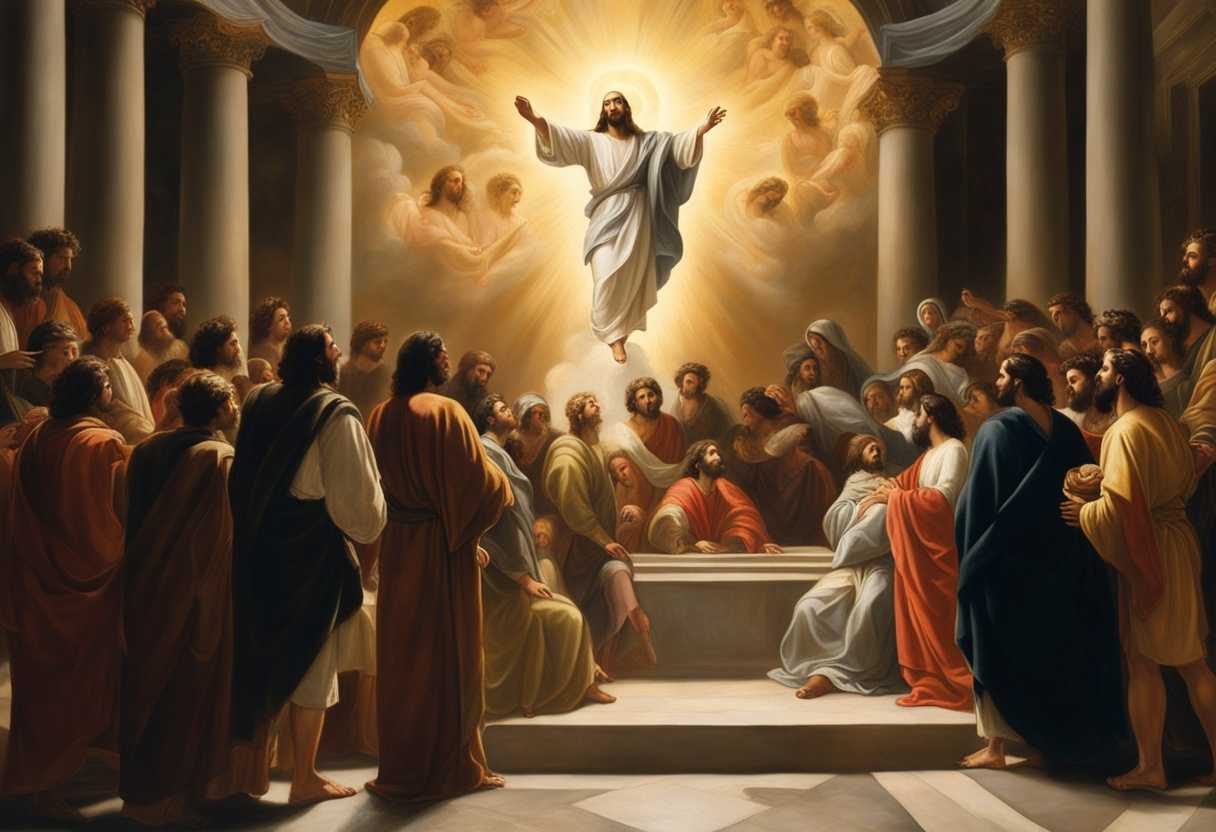
The Gospel of Mark, believed to have been written by John Mark, a companion of the apostle Peter, provides a vivid account of the life and ministry of Jesus Christ. Jesus and the religious authorities in Jerusalem have a series of confrontations in this particular chapter, setting the stage for the pivotal events of his crucifixion and resurrection. The Pharisees, Sadducees, and scribes barrage Jesus with questions and challenges as he continues his teaching in the temple, seeking to trap him with their inquiries. These interactions reveal the growing tension between Jesus and the established religious order, as he exposes their hypocrisy and affirms his own divine authority.
The chapter also includes Jesus’ observation of a poor widow’s offering, which serves as a powerful lesson on true devotion and sacrifice. Additionally, we find Jesus foretelling the destruction of the temple, a prophecy that would have profound implications for the future of the Jewish people.
Throughout this passage, we see Jesus’ unwavering commitment to his mission, even in the face of mounting opposition. His responses to the religious leaders demonstrate his wisdom, compassion, and unwavering dedication to the will of God, foreshadowing the climactic events that will soon unfold.
Mark 12:1-12
Jesus tells the Parable of the Tenants in Mark 12:1-12, which holds significant meaning and teachings within the context of his ministry. To better understand the message behind this parable, let’s break it down into important sections:
-
The Setting (Mark 12:1):
The parable opens with Jesus telling the story of a man who planted a vineyard, put a fence around it, dug a pit for the winepress, and built a watchtower. This setting is significant because it mirrors God’s relationship with Israel in the Old Testament. Vineyards in the Old Testament often symbolize Israel.g., Isaiah 5:1-7), highlighting God’s care and provision for His chosen people. -
The man in the parable rents out the vineyard to tenants and goes away. When the time comes to collect the fruits, he sends a servant to the tenants. However, the tenants mistreat the servant, beating him and sending him away empty-handed. This mistreatment is symbolic of the way God’s prophets were often rejected and even killed throughout Israel’s history (Matthew 23:37). The rejection of the servants represents the rejection of God’s messengers sent to call Israel back to faithfulness.
-
The Son (Mark 12:6):
The man then decides to send his son, thinking that the tenants would respect him. However, the tenants see the son as an opportunity to inherit the vineyard and, in a plot of greed, they kill him. This action of the tenants towards the son foreshadows the rejection and crucifixion of Jesus by the religious leaders of Israel. Jesus, throughout his ministry, was often rejected by those who were supposed to be looking forward to the Messiah. -
The Consequence (Mark 12:9):
Jesus concludes the parable by stating that the owner of the vineyard will come and destroy the tenants, giving the vineyard to others. This points to the impending judgment upon the religious leaders of Israel for their rejection of Jesus. It also signifies the inclusion of the Gentiles in God’s plan of salvation, as the vineyard is given to others who would produce fruit. The Parable of the Tenants in Mark 12:1-12 serves as a warning to the religious leaders of Jesus’ time and conveys the message of God’s judgment on those who reject His messengers and His Son. It also emphasizes the importance of bearing good fruit in response to God’s grace and mercy. This parable echoes themes found throughout the Bible, where God’s chosen people are called to faithfulness and obedience, and the consequences of disobedience and rejection are made clear.
Mark 12:13-17
The incident where the Pharisees and Herodians came together to trap Jesus with a question about paying taxes to Caesar is recounted in Mark, chapter 12, verses 13 to 17. This section can be broken down into several important sections which hold significant meaning and timeless messages.
Firstly, the Pharisees and Herodians, who were usually at odds with each other, came together with a shared goal – to trap Jesus. The Pharisees were a Jewish religious group known for their strict adherence to the law and traditions, while the Herodians were supporters of King Herod and the Roman rule, often seen as collaborators by the Jews. This unlikely alliance illustrates the threat they perceived Jesus to be to their respective interests. Together, they posed a seemingly impossible question to Jesus, asking whether it was lawful to pay taxes to Caesar or not.
Jesus, perceiving their malice and hypocrisy, asks for a denarius, the Roman coin used for paying taxes. Jesus not only exposes the fact that they themselves have the Roman currency, despite their religious objections to Roman rule, but also subtly shifts the focus to a deeper moral and ethical question by doing so. When Jesus asks whose image is on the coin and they reply “Caesar’s,” He delivers the famous line, “Render to Caesar the things that are Caesar’s, and to God the things that are God’s.”
This response is profoundly impactful in its simplicity and wisdom. Jesus distinguishes between the earthly authority represented by Caesar and the spiritual authority of God. Jesus acknowledges the importance of respecting and obeying earthly authorities within reason by affirming the need to pay taxes to Caesar. However, by adding “to God the things that are God’s,” Jesus emphasizes the greater importance of honoring and obeying God in all aspects of life. This statement teaches a timeless lesson about the balance between worldly obligations and spiritual devotion.
This passage also resonates with other biblical teachings such as Romans 13:1-7, where Paul urges Christians to submit to governing authorities. It underscores the idea that while we must fulfill our civic duties and responsibilities as citizens, our ultimate allegiance belongs to God. Jesus’s response challenges us to consider how we navigate the tensions between our earthly obligations and our spiritual priorities, prompting us to reflect on where our true loyalties lie and how we can live faithfully in a complex world. This encounter between Jesus and the Pharisees and Herodians serves as a reminder of the need for discernment, wisdom, and integrity in navigating the challenges of the world. It calls us to consider our obligations as citizens of this world while remaining steadfast in our commitment to God and His principles. Through this interaction, Jesus not only evades the trap set for Him but also imparts a profound lesson that we can apply to our own lives, compelling us to live with a conscientious balance between our earthly duties and our spiritual calling.
Mark 12:18-27
Jesus and the Sadducees have an interaction in Mark 12:18-27, a religious sect that rejected the idea of the resurrection and only accepted the written Torah as authoritative. The Sadducees present Jesus with a hypothetical scenario involving a woman who marries seven brothers successively as each one dies childless. Their question aims to challenge the concept of the resurrection by pointing out the absurdity of the afterlife if multiple individuals are resurrected.
Upon hearing their question, Jesus responds by highlighting their misunderstanding of both the Scriptures and the power of God. He asserts that in the resurrection, people will not marry or be given in marriage but will be like angels in heaven. This statement not only corrects the Sadducees’ misconception but also reveals a deeper truth about the nature of the afterlife: it transcends earthly relationships and is marked by a different form of existence compared to our earthly life.
This interaction with the Sadducees underscores the importance of having a proper understanding of Scripture and God’s power. Jesus emphasizes the significance of the resurrection, a central tenet of Christian faith that guarantees believers eternal life beyond this temporal world. Jesus affirms the validity of the resurrection and teaches a profound lesson about the transformed nature of life after death by addressing the Sadducees’ challenge. God’s ability to overcome seemingly impossible odds and bring about redemption and new life is demonstrated by Jesus’ response, reflecting a theme that runs throughout the Bible. The resurrection of Jesus himself stands as the ultimate example of God’s power over death and his promise of eternal life to those who believe in him. Jesus declares in John 11:25-26, “I am the resurrection and the life.” The one who believes in me will live, even though they die; and whoever lives by believing in me will never die. Do you believe this?” This assertion further reinforces the truth that the resurrection is not merely a future event but a present reality for those who have faith in Christ. The encounter between Jesus and the Sadducees in Mark 12:18-27 serves as a powerful illustration of the resurrection’s significance and the transformative power of God. It challenges us to deepen our understanding of the afterlife, trust in God’s promises, and live in light of the hope of eternal life through Jesus Christ.
Mark 12:28-34
Jesus and a scribe had a significant interaction in Mark 12:28-34, where the scribe asked Him, “Which commandment is the most important of all?”.” This question was a common and important debate among Jewish scholars at the time. The scribe appears to genuinely seek wisdom from Jesus in this encounter, rather than testing or trapping Him like many others had done before.
Jesus responds by quoting the Shema, a central Jewish prayer found in Deuteronomy 6:4-5, “Hear, O Israel: The Lord our God, the Lord is one. Love the Lord your God with all your heart and with all your soul and with all your mind and with all your strength. Jesus reaffirms the foundational principle of the Faith by emphasizing the primacy of loving God with every aspect of one’s being.
Jesus goes on to add a second commandment, quoting from Leviticus 19:18, “Love your neighbor as yourself. Jesus highlights the interconnectedness of loving God and loving others by coupling these two commandments together. This profound truth underlines the importance of the vertical relationship with God and the horizontal relationship with fellow human beings.
The scribe’s response to Jesus shows his deep understanding and wisdom. He affirms what Jesus said and even goes one step further, stating that these two commandments are “much more than all whole burnt offerings and sacrifices.” This statement indicates that genuine love and obedience to God, as demonstrated through these two commandments, hold greater significance and value than religious rituals or external expressions of faith.
This passage emphasizes the core message of the Gospel – love. Love for God and love for others are the foundational principles upon which all of God’s commandments hinge (Matthew 22:40). It reminds us that our faith should not just be a series of rituals or practices, but a genuine expression of love that transforms our hearts and actions. The encounter between Jesus and the scribe in Mark 12:28-34 serves as a powerful reminder for us as believers today. We are called to love God wholeheartedly and to demonstrate that love through our interactions with others. Our faith is not just about following rules or traditions, but about embodying the love of Christ in all that we do.
Mark 12:35-37
Jesus, teaching in the temple, poses a question to the crowd in Mark 12:35-37 that challenges their understanding of the Messiah. The verse reads, “While Jesus was teaching in the temple courts, he asked, ‘Why do the teachers of the law say that the Messiah is the son of David? David himself, speaking by the Holy Spirit, declared: ‘The Lord said to my Lord: ‘Sit at my right hand until I put your enemies under your feet.” David calls him ‘Lord.’ How then can he be his son? The large crowd listened to him with delight.”
This passage is significant in several ways. Firstly, Jesus is pointing out the misconception prevalent at the time that the Messiah would be merely a descendant of David. Jesus is emphasizing that the Messiah is more than just a human offspring of David by referencing Psalm 110:1, where David acknowledges the Messiah as his Lord, and that he is divine, sharing the authority of God Himself. This challenges the conventional understanding of the Messiah’s identity and emphasizes Jesus’ own divine nature as the Son of God.
The interaction in this passage also serves as a reminder of the complexity and depth of the Scriptures. Jesus, as the ultimate teacher, delves into the Psalms to reveal a truth that transcends human understanding. This challenges the religious leaders to look beyond surface-level interpretations and seek a deeper understanding of the Word of God.
Furthermore, this passage underscores the theme of Jesus as the fulfillment of Old Testament prophecies. Throughout the Bible, there are numerous prophecies pointing to the coming of a Messiah who would save and reign over God’s people. Jesus is connecting himself to these prophecies and asserting his authority as the long-awaited Messiah by referencing David’s words in Psalm 110. This challenges the listeners to reexamine their understanding of the Scriptures in light of Jesus’ teachings and actions. Jesus challenges conventional beliefs, reveals his divine identity, and emphasizes the importance of understanding the Scriptures in a deeper, more profound way in Mark 12:35-37. This passage invites us to explore the depths of God’s Word, to seek understanding beyond the surface, and to recognize Jesus as the ultimate fulfillment of God’s promises throughout history.
Mark 12:38-40
Jesus warns his disciples and the crowd about the scribes in Mark 12:38-40, implying that they should not admire or follow them blindly. Jesus starts by saying, “Beware of the scribes, who like to walk around in long robes and like greetings in the marketplaces…” The scribes were known for their outward displays of piety and their love for positions of honor and respect. They would wear distinctive clothing to set themselves apart and enjoyed being greeted with reverence in public places.
Jesus condemns the scribes for their pride and hypocrisy, highlighting how they seek places of honor at feasts and in synagogues and have the best seats in these places. Their desire for recognition and status overshadows their true responsibility as interpreters of the law. Jesus exposes their pretentiousness and emphasizes that true righteousness is not about external appearances or seeking the approval of others, but about humility, sincerity, and obedience to God’s commands.
This warning against hypocritical behavior and self-righteousness is a recurring theme in Jesus’ teachings. Throughout the Gospels, Jesus consistently challenges the religious leaders of his time for their lack of genuine faith and their focus on outward appearances rather than inner transformation. Jesus delivers a similar scathing rebuke against the scribes and Pharisees in Matthew 23:1-36, calling them hypocrites and whitewashed tombs. He exposes their corruption and urges his followers to practice true righteousness from the heart. Jesus underscores the importance of authenticity and humility in following God by calling attention to the scribes’ behavior. He encourages his disciples to prioritize a genuine relationship with God over seeking the approval and recognition of others. This message serves as a timeless reminder for believers to examine their motives and intentions, ensuring that their faith is rooted in sincerity and devotion rather than outward displays of religiosity.
Mark 12:41-44
Jesus observes people putting money into the treasury in the temple in Mark 12:41-44. The passage focuses on a poor widow who puts in two small copper coins, worth only a fraction of a penny. Jesus then calls his disciples over and commends the widow, saying that she has put in more than all the others because she gave out of her poverty, while the others gave out of their wealth.
This passage holds a profound message about the nature of giving and the importance of sincerity and sacrifice in one’s actions. The widow’s offering, though small in monetary value, was deemed greater by Jesus because it represented a significant sacrifice on her part. Her act of giving all she had demonstrated her faith and trust in God’s provision, contrasting with the outward displays of wealth and generosity by others at the temple. This highlights the concept of sacrificial giving, where the intention and heart behind an offering hold more weight than the quantity or value of the gift itself.
The story of the widow’s mite serves as a lesson for believers about the true essence of generosity and devotion. It encourages a deeper reflection on one’s motives for giving and serves as a reminder that God values the sincerity and sacrificial nature of our offerings more than their material significance. This passage challenges the common societal mindset of evaluating generosity based on the amount given, emphasizing instead the significance of giving with a pure heart and humble spirit. Jesus’ compassion for the marginalized and vulnerable members of society, such as widows, is highlighted in this narrative. Throughout the Bible, widows are often highlighted as exemplars of faith and reliance on God’s provision. Ruth and the widow of Zarephath demonstrated great faith amidst their difficult circumstances in the Old Testament, drawing God’s favor and provision. Jesus’ recognition of the widow’s offering in Mark 12 echoes this theme of God’s care for the oppressed and his delight in those who trust in him completely.
The widow’s mite story also corresponds with other teachings of Jesus that emphasize humility, selflessness, and prioritizing spiritual principles over material wealth. Jesus instructs his followers in Matthew 6:1-4 to give in secret, without seeking recognition or praise from others. He emphasizes the importance of storing up treasures in heaven rather than on earth, highlighting the eternal value of acts done with the right motives and attitudes. The account of the widow’s mite in Mark 12:41-44 carries timeless lessons on generosity, faith, humility, and sincerity in giving. It challenges individuals to evaluate the motives behind their actions and emphasizes the importance of sacrificial giving and trusting in God’s provision. This story serves as a poignant reminder of God’s heart for the marginalized and oppressed, as well as his delight in those who demonstrate unwavering faith and commitment in their relationship with Him.
After Mark 12
The chapter concluded with Jesus’ scathing rebuke of the scribes and their hypocrisy. He condemned their love of power and status, their exploitation of the vulnerable, and their empty religious displays. A small but significant event unfolded that would foreshadow the coming events as the crowds listened in awe. A poor widow, with nothing but two small coins to her name, stepped forward and offered them to the temple treasury. Her humble act of faith and sacrifice would not go unnoticed by the one who sees the heart. For in the kingdom of God, the last shall be first, and the greatest among you must become the servant of all.

Reverend Michael Johnson is an experienced Church Minister with a profound expertise in spirituality and guidance. With a serene presence and a compassionate heart, he has faithfully served his congregation for over 20 years, leading them on a spiritual journey towards inner peace and enlightenment. Reverend Johnson’s extensive knowledge of religious philosophies and profound understanding of human nature have made him a trusted confidant and mentor to many, as he seamlessly weaves his profound wisdom into life teachings. Reverend Johnson’s calming demeanor and empathetic nature continue to uplift and heal souls, nurturing a sense of unity and tranquility within his community.