
Mark 12:35-44 is about Jesus challenging the religious leaders’ superficial practices and highlighting the example of the widow who sacrificially gave all she had, emphasizing the importance of genuine faith, humility, and generosity in serving God.
35 And as Jesus taught in the temple, he said, “How can the scribes say that the Christ is the son of David?
36 David himself, in the Holy Spirit, declared, “The Lord said to my Lord, ‘Sit at my right hand, until I put your enemies under your feet.’”
37 David himself calls him Lord. So how is he his son?” And the great throng heard him gladly.
38 And in his teaching he said, “Beware of the scribes, who like to walk around in long robes and like greetings in the marketplaces
39 and have the best seats in the synagogues and the places of honor at feasts,
40 who devour widows’ houses and for a pretense make long prayers. They will receive the greater condemnation.
41 And he sat down opposite the treasury and watched the people putting money into the offering box. Many rich people put in large sums.
42 And a poor widow came and put in two small copper coins, which make a penny.
43 And he called his disciples to him and said to them, “Truly, I say to you, this poor widow has put in more than all those who are contributing to the offering box.
44 For they all contributed out of their abundance, but she out of her poverty has put in everything she had, all she had to live on.”
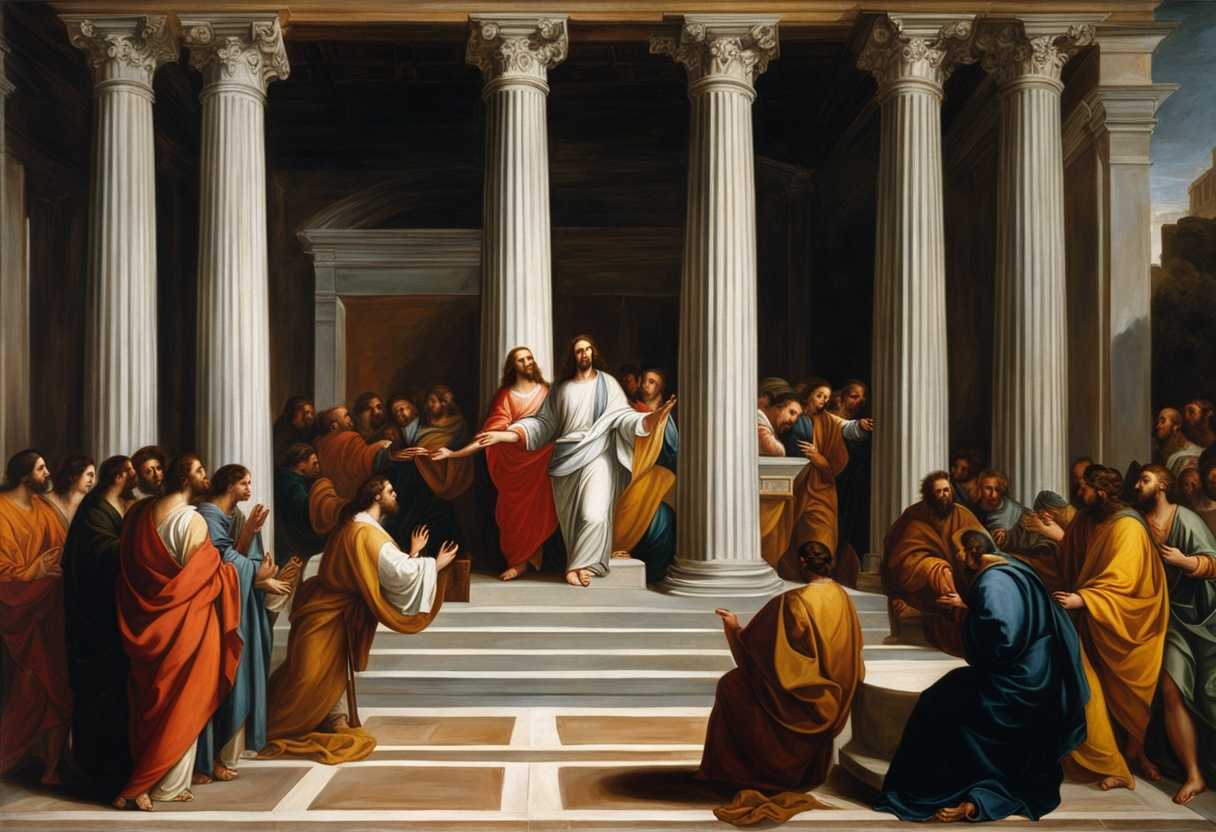
Setting the Scene for Mark 12:35-44
In Mark chapter 12, we find Jesus teaching in the temple in Jerusalem during the final week of his earthly ministry. The scene is bustling with people from all walks of life – Pharisees, scribes, disciples, and ordinary worshippers. Jesus had been engaging in intense debates with the religious leaders, answering their questions and challenging their beliefs.
As Jesus sits down to rest, a group of Pharisees and scribes approach him, seeking to test his wisdom with difficult questions. They ask him about the greatest commandment, trying to trap him in his response. Jesus, in his infinite wisdom, not only answers their question but also goes on to teach about the true nature of the Messiah, quoting from the book of Psalms.
Meanwhile, in the background, a poor widow quietly approaches the temple treasury and drops in two small coins, all she had to live on. Jesus, observing her selfless act of giving, uses this moment to teach his disciples about the true essence of giving and sacrificial love. The contrast between the ostentatious displays of wealth by the religious leaders and the humble offering of the widow serves as a powerful lesson on true devotion and faith.
What is Mark 12:35-44 about?
Let’s take a moment to reflect on this powerful verse. Jesus is shining a light on the hypocrisy of the religious leaders of his time. He is calling attention to their outward displays of righteousness, which may have been impressive to others, but lacked sincerity and genuine faith in God. Jesus challenges us to reflect on our own hearts and motivations when it comes to our acts of faith and worship by pointing out their hypocrisy. Are we seeking to impress others with our religious practices, or are we truly seeking to honor and connect with God in a deep and authentic way? Jesus praises the sacrificial giving of a poor widow in contrast to the flashy displays of the religious leaders. This widow, despite having very little to give, offers all she has to God. Her act of giving is not about impressing others or gaining recognition; it is a pure and selfless expression of her love and devotion to God. Jesus holds up her example as a model of true faith and demonstrates that God values the sincerity and intention behind our actions more than the outward appearance. Let’s examine our own hearts and motivations in our acts of worship and service as we ponder this verse. Are we giving out of obligation or a desire to truly honor God? Let’s strive to emulate the widow’s sacrificial and sincere giving in our own lives.
Understanding what Mark 12:35-44 really means
In Mark 12:35-44, we find Jesus engaging with the crowd in the temple courts, imparting wisdom about the Messiah and observing the actions of individuals, notably the scribes and a destitute widow. The passage unfolds in two distinct parts: Jesus’ discourse on the Messiah (verses 35-37) and His poignant observation of the widow’s offering (verses 38-44).
Jesus challenges the conventional belief that the Messiah is solely a descendant of David, prompting reflection on the Messiah’s divine nature. By referencing Psalm 110:1, where David addresses the Messiah as “Lord,” Jesus underscores the Messiah’s dual identity as both human and divine. This revelation not only reshapes perceptions of the Messiah but also illuminates Jesus’ own identity as the Son of God.
A cautionary tone emerges as Jesus warns against the scribes’ ostentatious displays of piety and their hunger for societal acclaim. Their outward righteousness masks inner hypocrisy, a stark contrast to the genuine humility and sincerity Jesus advocates. This admonition serves as a timeless reminder to prioritize authentic faith over superficial appearances.
The narrative takes a poignant turn as Jesus lauds a poor widow’s sacrificial offering, emphasizing the intrinsic value of heartfelt giving over the monetary sum. Her meager contribution, given out of poverty, resonates more profoundly with Jesus than the grandiose donations of the affluent. This episode underscores the significance of sacrificial generosity and the purity of intent behind our actions.
In contemporary contexts, these teachings retain their relevance and potency. Recognizing Jesus’ dual nature as both human and divine is foundational to understanding His authority and redemptive role. The caution against hypocrisy urges introspection, compelling us to align our beliefs with our actions authentically. The widow’s offering serves as a poignant reminder of the transformative power of sacrificial giving and the profound impact of genuine generosity.
Consider a scenario where a wealthy church member garners praise for a substantial donation, overshadowing the unnoticed offering of a humble elderly woman. This anecdote mirrors the biblical account, illustrating that God values the sincerity and sacrifice behind our gifts more than their material worth. It underscores the enduring truth that true generosity emanates from a heart surrendered to God, irrespective of the gift’s magnitude.
By delving into these profound teachings, we are beckoned to deepen our comprehension of Jesus’ identity, cultivate authenticity in our faith journey, and embrace a spirit of wholehearted generosity. As we ponder these timeless truths, may we be inspired to emulate the widow’s sacrificial spirit, shun hypocrisy, and embody the transformative power of genuine, heartfelt giving.
How can we show genuine devotion to God?
We can show genuine devotion to God by offering our whole selves to Him with sincerity and love. This means not just going through the motions or following rules outwardly, but having a true heart and mind that is fully dedicated to Him. We should seek to have our thoughts, words, and actions aligned with His will and purposes, demonstrating our love for Him through our everyday lives.
One way to display genuine devotion to God is by being sacrificial in our giving, not just in terms of material possessions, but also in our time, talents, and energy. Like the widow in the passage, we can offer all that we have to God, trusting in His provision and sovereignty. We prioritize God above all else and acknowledge that everything we have is ultimately His by giving generously and selflessly.
Furthermore, we can demonstrate our devotion to God by recognizing His authority and glory in all aspects of our lives. This includes submitting ourselves to His will, seeking His guidance in all decisions, and living in a way that brings honor and glory to His name. Through a life of obedience and humility, we can show that He is truly the Lord of our lives and that our devotion to Him is genuine and unwavering.
Application
Let’s dive deeper into Mark’s verse and analyze our intentions when helping and worshiping. Let’s assess if we give with pure intentions, not for praise but from a place of genuine care. Are we ready to elevate our deeds beyond mere obligations and express authentic love for both our faith and those around us?

Reverend Michael Johnson is an experienced Church Minister with a profound expertise in spirituality and guidance. With a serene presence and a compassionate heart, he has faithfully served his congregation for over 20 years, leading them on a spiritual journey towards inner peace and enlightenment. Reverend Johnson’s extensive knowledge of religious philosophies and profound understanding of human nature have made him a trusted confidant and mentor to many, as he seamlessly weaves his profound wisdom into life teachings. Reverend Johnson’s calming demeanor and empathetic nature continue to uplift and heal souls, nurturing a sense of unity and tranquility within his community.