
Mark 15:42-46 is about Joseph of Arimathea’s courage, faith, and devotion in providing Jesus a proper burial, symbolizing both his respect for Jesus as the Son of God and his role as a foreshadowing of the resurrection and victory over death.
42 And when evening had come, since it was the day of Preparation, that is, the day before the Sabbath,
43 Joseph of Arimathea, a respected member of the council, who was also himself looking for the kingdom of God, took courage and went to Pilate and asked for the body of Jesus.
44 Pilate was surprised to hear that he should have already died. And summoning the centurion, he asked him whether he was already dead.
45 And when he learned from the centurion that he was dead, he granted the corpse to Joseph.
46 And Joseph bought a linen shroud, and taking him down, wrapped him in the linen shroud and laid him in a tomb that had been cut out of the rock. And he rolled a stone against the entrance of the tomb.
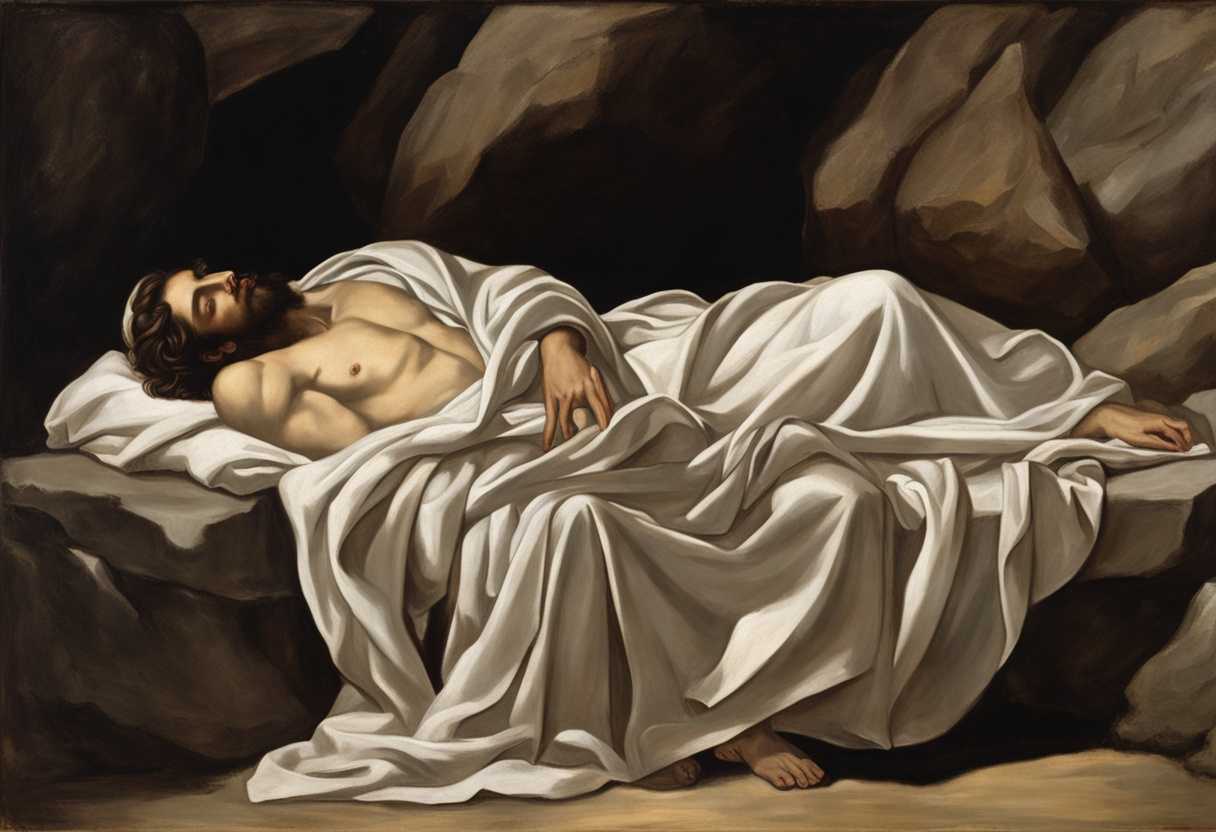
Setting the Scene for Mark 15:42-46
As the sun began to set on the day of Jesus’ crucifixion, a somber atmosphere enveloped the scene at Golgotha. Joseph of Arimathea, a respected member of the Jewish council who had secretly been a follower of Jesus, stepped forward. He had been waiting for an opportunity to honor his beloved teacher in death. With courage and determination, Joseph approached Pontius Pilate, the Roman governor, to request permission to take Jesus’ body down from the cross.
Accompanied by Nicodemus, another member of the council who had come to believe in Jesus, Joseph carefully removed the lifeless body of Jesus from the cross. The weight of grief and disbelief hung heavy in the air as they gently wrapped Jesus’ body in linen cloths. The two men then carried Jesus to a nearby tomb that Joseph had prepared for himself, fulfilling the prophecy that the Messiah would be buried in a rich man’s tomb.
Surrounded by the fading light of day and the echoes of the day’s events, Joseph and Nicodemus laid Jesus to rest in the tomb, sealing it with a large stone. The scene was a poignant reminder of the sacrifice Jesus had made for humanity and the love and devotion of those who had followed him.
What is Mark 15:42-46 about?
We witness a crucial moment in the story of Jesus’ crucifixion and resurrection in this verse. The act of burying Jesus in a tomb by Joseph of Arimathea carries profound symbolism and significance. It showcases the respect and honor given to Jesus even in his death, emphasizing his importance and divinity. The choice of using a tomb for his burial also alludes to the concept of a temporary resting place before his ultimate resurrection, highlighting the power and victory of life over death. Joseph of Arimathea provided a dignified burial for Jesus, asking us to consider his act as we reflect on this verse. What does it say about how we should treat those who have passed away, regardless of their circumstances? How does this act of kindness and reverence towards Jesus inspire us to show compassion and respect towards others, even in times of difficulty or challenge? Joseph of Arimathea buried Jesus in a tomb, serving as a poignant reminder of the importance of honoring the deceased and upholding their dignity, as well as a powerful testament to the hope and promise of resurrection and new life.
Understanding what Mark 15:42-46 really means
The passage in Mark 15:42-46 recounts the aftermath of Jesus’ crucifixion, focusing on Joseph of Arimathea’s bold request for Jesus’ body from Pilate. Joseph, a respected council member, took a risk by associating himself with Jesus, who had been condemned by the same council. His courageous act of asking Pilate for Jesus’ body demonstrates the bravery required to stand up for one’s beliefs, even in the face of opposition. Joseph’s decision to wrap Jesus’ body in a linen cloth and place it in a rock-hewn tomb reflects his deep reverence and honor for Jesus, showcasing the importance of treating others with dignity and respect, even in death.
The key phrases in this passage, such as Joseph’s social standing and his courageous request for Jesus’ body, highlight the themes of bravery and respect. Joseph’s actions align with the prophecy in Isaiah 53:9, emphasizing the fulfillment of Scripture through his burial of Jesus. Additional details in John 19:38-42 and Matthew 27:57-60 enrich our understanding of Joseph’s role in preparing Jesus’ body for burial, emphasizing the collaborative effort and the respect shown to Jesus even in death.
Joseph of Arimathea’s example resonates with people today, serving as a reminder of the courage required to live out one’s faith in challenging circumstances. In a world where expressing one’s beliefs can lead to backlash, Joseph’s actions inspire us to stand firm in our convictions. His care for Jesus’ body also teaches us about the importance of treating others with dignity and respect, especially those who are marginalized or suffering in our communities.
To illustrate the relevance of Joseph’s actions in a modern context, envision a scenario where someone defends a mistreated colleague at work, risking potential repercussions to ensure their dignity is upheld. This contemporary parallel mirrors Joseph of Arimathea’s courage and integrity, showcasing the enduring significance of standing up for what is right, even when faced with adversity.
In conclusion, the story of Joseph of Arimathea in Mark 15:42-46 serves as a poignant reminder of the courage, respect, and faithfulness that should characterize our lives as followers of Christ. By reflecting on Joseph’s example and the related biblical passages, we can draw inspiration and guidance for our own journeys of faith, striving to emulate his unwavering commitment to honoring Jesus, even in the most challenging circumstances.
What legacy will we leave behind after death?
After death, the legacy we leave behind is one of unwavering commitment to our beliefs and values. Joseph of Arimathea laid Jesus in a tomb, and we too can leave behind a legacy of faithfulness and dedication to our convictions. Our actions in life, the way we lived and the values we upheld, will continue to resonate long after we have passed away. Our legacy will be a testament to our character and the impact we had on those around us.
Furthermore, our legacy also includes the impact we have had on others and the memories they hold of us. Jesus was mourned by those who followed him during his life, and his burial was a somber event that left a lasting impression on his disciples. Likewise, the way we have treated others, the relationships we have nurtured, and the love we have shown will be part of the legacy we leave behind. Our memory will live on through the hearts and minds of those we have touched. Our essence and the mark we have made on the world ultimately reflect the legacy we leave behind after death. Our legacy will serve as a lasting reminder of who we were, what we stood for, and the impact we had on the lives of others, just as Jesus’ burial marked the end of his earthly journey. It is a culmination of our life’s work, values, and relationships, ensuring that we are remembered long after we are gone.
Application
Just as Jesus laid down His life for us, let’s be inspired to sacrificially love those around us in our everyday lives. Let’s bury our selfish desires and rise above our own wants to show love and care to others. Reflect on the power of such selfless acts and let’s replicate that love in our own relationships, be it with family, friends, or colleagues. Will you take the leap and answer the call to love others with the same sacrificial love as Christ showed us?

Reverend Michael Johnson is an experienced Church Minister with a profound expertise in spirituality and guidance. With a serene presence and a compassionate heart, he has faithfully served his congregation for over 20 years, leading them on a spiritual journey towards inner peace and enlightenment. Reverend Johnson’s extensive knowledge of religious philosophies and profound understanding of human nature have made him a trusted confidant and mentor to many, as he seamlessly weaves his profound wisdom into life teachings. Reverend Johnson’s calming demeanor and empathetic nature continue to uplift and heal souls, nurturing a sense of unity and tranquility within his community.