
Matthew 12:1-14 is about Jesus challenging the religious leaders’ legalistic interpretation of the Sabbath laws by emphasizing mercy and compassion over strict adherence to rules.
1 At that time Jesus went through the grainfields on the Sabbath. He and his disciples were hungry, and they began to pluck heads of grain and to eat.
2 But when the Pharisees saw it, they said to him, “Look, your disciples are doing what is not lawful to do on the Sabbath.”
3 He said to them, “Have you not read what David did when he was hungry, and those who were with him:
4 how he entered the house of God and ate the bread of the Presence, which it was not lawful for him to eat nor for those who were with him, but only for the priests?
5 Or have you not read in the Law how on the Sabbath the priests in the temple profane the Sabbath and are guiltless?
6 I tell you, something greater than the temple is here.
7 And if you had known what this means, ‘I desire mercy, and not sacrifice,’ you would not have condemned the guiltless.
8 For the Son of Man is lord of the Sabbath.”
9 He went on from there and entered their synagogue.
10 And a man was there with a withered hand. And they asked him, “Is it lawful to heal on the Sabbath?”—so that they might accuse him.
11 He said to them, “Which one of you who has a sheep, if it falls into a pit on the Sabbath, will not take hold of it and lift it out?
12 Of how much more value is a man than a sheep! So it is lawful to do good on the Sabbath.”
13 Then he said to the man, “Stretch out your hand.” And the man stretched it out, and it was restored, healthy like the other.
14 But the Pharisees went out and conspired against him, how to destroy him.
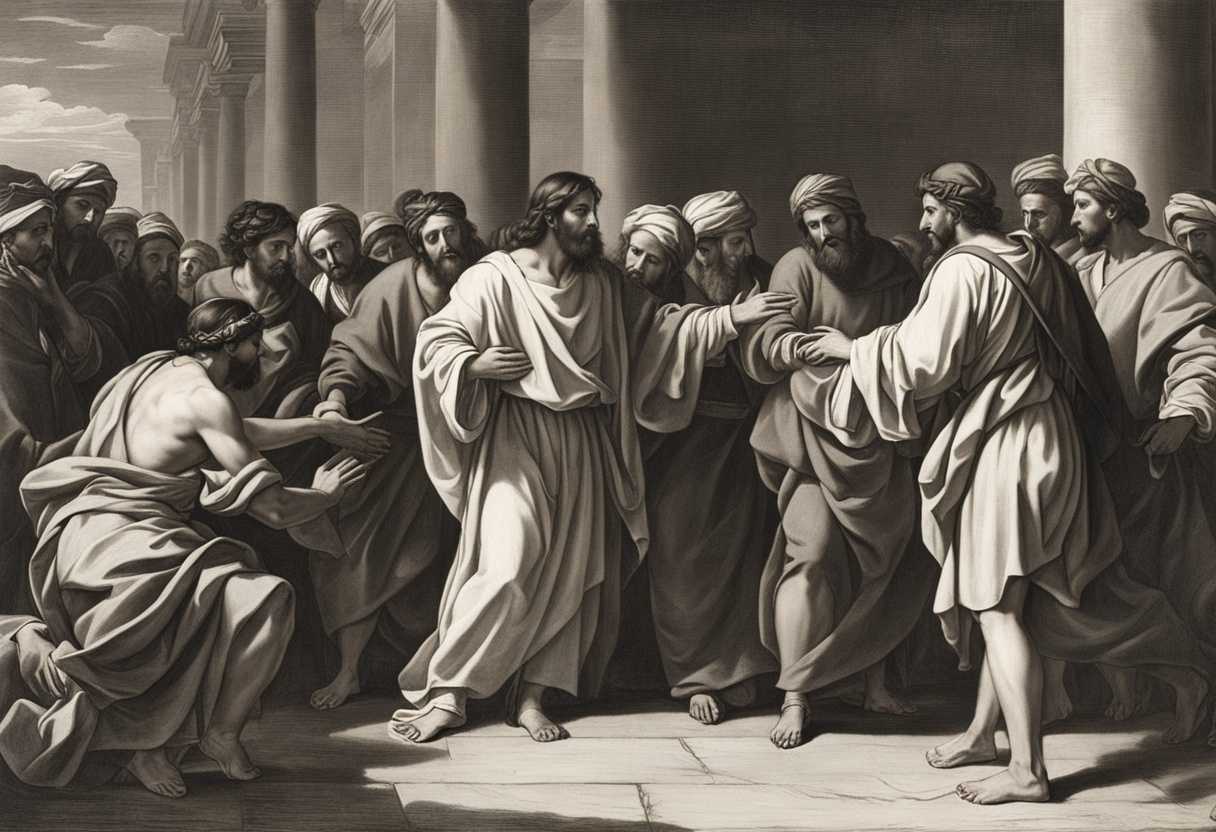
Setting the Scene for Matthew 12:1-14
In Matthew chapter 12, we find Jesus and his disciples walking through a grainfield on a Sabbath day. The disciples, feeling hungry, begin to pluck some heads of grain to eat. This action sparks the attention of the Pharisees, who were always on the lookout to criticize Jesus and his followers for not strictly adhering to the Sabbath laws. The Pharisees confront Jesus, accusing him of allowing his disciples to break the Sabbath by harvesting grain on that day.
The scene is set in the countryside, with the golden grainfield stretching out before them under the bright sun. Jesus, with his disciples by his side, stands calmly facing the Pharisees who are quick to judge and condemn. The tension is palpable as the Pharisees challenge Jesus, questioning his authority and teachings. Despite the Pharisees’ accusations, Jesus uses the opportunity to teach them about the true meaning of the Sabbath and to demonstrate his authority as the Son of God through healing a man with a withered hand on that same Sabbath day. The clash between Jesus and the religious leaders sets the stage for a powerful display of compassion, wisdom, and divine power.
What is Matthew 12:1-14 about?
Jesus is challenging the rigid interpretation of the law that the Pharisees were enforcing in this verse. He is teaching us that acts of mercy and compassion should always take precedence over strict adherence to rules and regulations. Jesus is emphasizing the importance of showing kindness and understanding towards others, even if it means breaking, or bending, the rules, by defending his disciples for picking grain on the Sabbath to alleviate their hunger. It is a powerful reminder that the essence of any law, religious or secular, should be rooted in love, compassion, and empathy. Let us reflect on this verse and ask ourselves: Are we more focused on following rules to the letter, or do we embody the spirit of love and mercy in our actions? Are we quick to judge others based on their adherence to tradition, or do we prioritize showing kindness and understanding towards them? Jesus’s message challenges us to examine our own attitudes and behaviors towards others, reminding us that true righteousness is not found in strict legalism, but in our ability to extend grace and compassion to those around us. Let us prioritize mercy and love above all else as we strive to live out this message in our daily lives.
Understanding what Matthew 12:1-14 really means
In Matthew 12:1-14, we witness a confrontation between Jesus and the Pharisees regarding Sabbath observance. The Pharisees criticize Jesus and His disciples for picking grain on the Sabbath, accusing them of breaking the Sabbath laws. This incident prompts a profound discussion about the true essence and purpose of the Sabbath. Jesus responds to the Pharisees by referencing the actions of David in 1 Samuel 21:1-6, where David ate the consecrated bread meant only for priests when he was hungry. This reference highlights the principle that human need and compassion can supersede strict adherence to ceremonial laws.
Moreover, Jesus quotes Hosea 6:6, stating, “I desire mercy, not sacrifice.” This quotation underscores the importance of showing compassion and kindness over mere ritualistic observance of religious laws. Jesus further asserts His authority over the Sabbath by declaring, “The Son of Man is Lord of the Sabbath,” indicating His ability to interpret the true meaning and intent behind Sabbath regulations.
The passage in Matthew 12:1-14 is complemented by other biblical verses such as Mark 2:27, which emphasizes that the Sabbath was created to benefit humanity, not to burden them. Additionally, Isaiah 58:13-14 delves into the significance of delighting in the Lord and performing acts of goodness on the Sabbath, emphasizing the spiritual essence behind the observance of this day.
Today, this passage challenges us to prioritize compassion and human need over rigid legalism in our religious practices. It urges us to delve deeper into the underlying principles of mercy and love that should guide our actions. In a world filled with busyness and distractions, it serves as a reminder to strike a balance between religious observance and acts of kindness and mercy towards others.
To illustrate the relevance of this teaching, consider a scenario where a person rushes to attend a religious service but encounters someone in need along the way. The lesson from Matthew 12:1-14 would encourage stopping to help, recognizing that demonstrating mercy and compassion reflects true faith. A personal anecdote exemplifies this principle, where a friend chose to assist a neighbor in need instead of attending a church service, embodying the core values of mercy and compassion.
In conclusion, Matthew 12:1-14 guides us to understand that the heart of religious observance lies not in rigid rule-keeping but in embodying the virtues of mercy, compassion, and love. It prompts us to reflect on how we can integrate these values into our daily lives, ensuring that our actions align with the deeper purposes of our faith.
Is it more important to show mercy or uphold rules?
Jesus prioritizes showing mercy over upholding rules in this passage. He illustrates this by healing a man with a withered hand on the Sabbath, which was against the Jewish law. When criticized by the Pharisees for breaking the Sabbath rules, Jesus responds by emphasizing the importance of mercy and compassion over legalistic adherence to rules. He highlights that showing kindness and mercy to others is always more important than rigidly following regulations. Jesus challenges the Pharisees’ strict interpretation of the law and demonstrates that compassion should not be restricted by legalistic boundaries by healing the man on the Sabbath. This action serves as a powerful reminder that love and mercy should always be at the forefront of our interactions with others, even if it means going against established rules or traditions. Jesus’ actions in this passage emphasize the transformative power of love and compassion, showing us that extending mercy to those in need should always take precedence over rigidly enforcing rules or laws.
Application
Imagine a world where your efforts, like seeds, grow into a garden of kindness. As you navigate your busy work and family life, think about how your daily actions can be acts of compassion and mercy. Jesus showed us a powerful example—can you follow in those footsteps? Today, choose to be the person who waters others’ lives with love and grace. Will you take this step to make a difference, right now?

Reverend Michael Johnson is an experienced Church Minister with a profound expertise in spirituality and guidance. With a serene presence and a compassionate heart, he has faithfully served his congregation for over 20 years, leading them on a spiritual journey towards inner peace and enlightenment. Reverend Johnson’s extensive knowledge of religious philosophies and profound understanding of human nature have made him a trusted confidant and mentor to many, as he seamlessly weaves his profound wisdom into life teachings. Reverend Johnson’s calming demeanor and empathetic nature continue to uplift and heal souls, nurturing a sense of unity and tranquility within his community.