
Matthew 12:22-30 is about Jesus casting out demons and confronting the religious leaders who accuse Him of using demonic power, asserting the authority of His ministry and warning about the dangers of being divided against His kingdom.
22 Then a demon-oppressed man who was blind and mute was brought to him, and he healed him, so that the man spoke and saw.
23 And all the people were amazed, and said, “Can this be the Son of David?”
24 But when the Pharisees heard it, they said, “It is only by Beelzebul, the prince of demons, that this man casts out demons.”
25 Knowing their thoughts, he said to them, “Every kingdom divided against itself is laid waste, and no city or house divided against itself will stand.
26 And if Satan casts out Satan, he is divided against himself. How then will his kingdom stand?
27 And if I cast out demons by Beelzebul, by whom do your sons cast them out? Therefore they will be your judges.
28 But if it is by the Spirit of God that I cast out demons, then the kingdom of God has come upon you.
29 Or how can someone enter a strong man’s house and plunder his goods, unless he first binds the strong man? Then indeed he may plunder his house.
30 Whoever is not with me is against me, and whoever does not gather with me scatters.
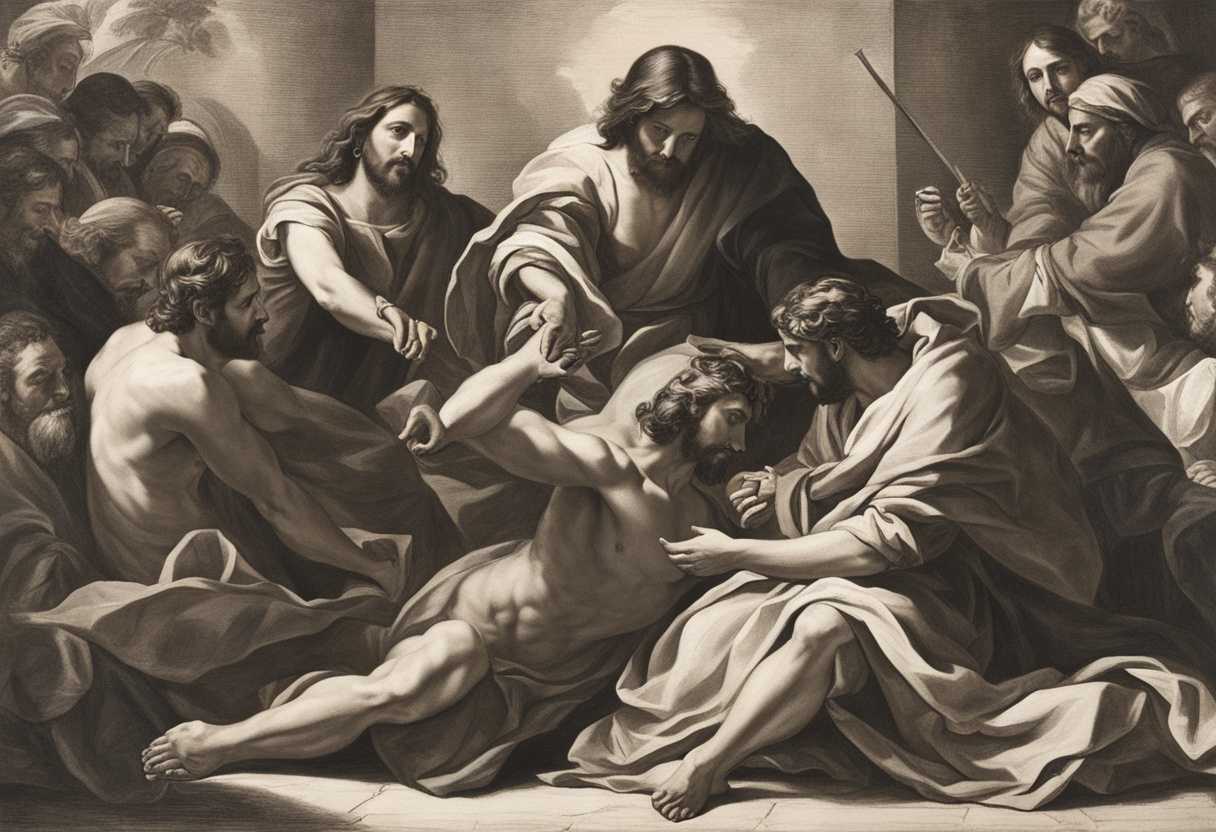
Setting the Scene for Matthew 12:22-30
In the scene described in Matthew 12:22-30, Jesus is surrounded by a crowd of people who have come to witness His teachings and miracles. Among the crowd are also some Pharisees, who are known for their skepticism and opposition to Jesus. The setting is likely outdoors, perhaps in a public square or by the sea, with the sun shining down on the diverse group of individuals gathered around Jesus.
As Jesus is going about His ministry, a man possessed by a demon is brought before Him. The man is blind and mute, tormented by the evil spirit within him. The crowd watches in anticipation as Jesus approaches the man and performs a miraculous healing, casting out the demon and restoring the man’s sight and speech. The people are amazed and begin to wonder if Jesus could be the long-awaited Messiah.
However, the Pharisees, threatened by Jesus’ growing popularity and authority, try to discredit Him by accusing Him of using the power of Beelzebul, the prince of demons, to perform miracles. Jesus responds with wisdom and authority, explaining that a kingdom divided against itself cannot stand. He uses this moment to teach the crowd about the power of good over evil and the importance of recognizing the work of God in their midst.
What is Matthew 12:22-30 about?
Jesus’s actions in this verse highlight his divine power and authority over evil forces. He demonstrates his ability to overcome spiritual darkness and bring about healing and restoration by casting out demons. This miracle serves as a powerful reminder of the unmatched strength and compassion of Jesus, showing that nothing is beyond his control or reach. Jesus’s warning against blaspheming the Holy Spirit underscores the importance of recognizing and honoring the work of the divine in our lives. It urges us to acknowledge and respect the presence of the Holy Spirit, which guides, empowers, and sanctifies us. Jesus emphasizes the sacredness and significance of the Holy Spirit in our spiritual journey by cautioning against blasphemy, reminding us to approach it with reverence and humility. Reflect on this verse as you consider the profound implications of Jesus’s actions and words. How does his demonstration of power and mercy inspire you to trust in his ability to overcome darkness in your own life? How does his warning against blasphemy challenge you to deepen your relationship with the Holy Spirit and honor its transformative work within you? May you be encouraged to embrace the light of Christ and walk in alignment with the Spirit, embracing the fullness of God’s grace and love.
Understanding what Matthew 12:22-30 really means
In Matthew 12:22-30, we witness a powerful encounter where Jesus heals a demon-possessed man who was blind and mute. However, instead of acknowledging the miraculous nature of this act, the Pharisees accuse Jesus of using the power of Beelzebul, the prince of demons, to perform the healing. Jesus responds to their accusation with profound wisdom, highlighting the absurdity of their claims and emphasizing the significance of unity in the kingdom of God.
Jesus uses the analogy that “Every kingdom divided against itself is brought to desolation” to underscore the importance of unity. This principle extends beyond political realms and resonates with the essence of familial, communal, and personal cohesion. A divided entity cannot thrive or endure challenges effectively, emphasizing the necessity of harmony and solidarity in all aspects of life.
Furthermore, Jesus dismantles the Pharisees’ argument by pointing out the inherent contradiction in their logic. If Satan were to cast out his own demons, it would signify a division within his kingdom, ultimately leading to its downfall. This logical flaw exposes the fallacy of attributing Jesus’ miraculous deeds to demonic forces, highlighting the need for discernment and sound reasoning in interpreting spiritual matters.
Moreover, Jesus asserts that His ability to cast out demons by the Spirit of God signifies the arrival of God’s kingdom. This declaration challenges the Pharisees’ understanding of divine authority and power, urging them to reevaluate their beliefs and acknowledge the manifestation of God’s sovereignty through Jesus’ actions.
The message conveyed in this passage transcends its historical context and remains relevant in contemporary society. The call for unity echoes loudly in a world marked by division and discord, reminding us of the strength and resilience that unity fosters in families, communities, and churches. By recognizing the true source of power and authority—God—we are encouraged to work together harmoniously, embodying the principles of cooperation and mutual support exemplified by Jesus.
Consider a sports team where individual talents are overshadowed by internal conflicts and discord. Despite their skills, the team falters due to a lack of unity. Conversely, a cohesive team that values collaboration, mutual respect, and adherence to a common goal often emerges victorious, showcasing the transformative power of unity. This analogy mirrors the teachings of Jesus in Matthew 12:22-30, illustrating the profound impact of unity in achieving collective success and fulfillment.
In conclusion, this passage challenges us to introspect on the sources of our actions and the vitality of unity in our lives. It prompts us to acknowledge the presence of God’s kingdom and strive towards harmonious coexistence, mirroring the unity and purpose exemplified by Jesus. As we navigate the complexities of our modern world, may we heed the timeless wisdom embedded in this passage, embracing unity as a cornerstone of strength, growth, and divine alignment.
Are we unknowingly working against God’s kingdom?
Jesus explains in this passage that a house divided against itself cannot stand. He uses this analogy to illustrate that if Satan is casting out his own demons, then his kingdom is divided and will not stand. Essentially, Jesus is saying that working against Satan’s kingdom is actually working towards God’s kingdom, as anything that weakens the forces of evil ultimately strengthens the forces of good.
Therefore, by actively opposing the works of evil and darkness in the world, we are unknowingly working towards God’s kingdom. When we promote love, compassion, justice, and righteousness, we are contributing to the flourishing of God’s kingdom on earth. It is important to be conscious of our actions and ensure that they align with God’s will, so that we may be effective agents of change in furthering the establishment of His kingdom.
Application
Step into the battleground of Matthew 12:22-30, seeing Christ’s supremacy over darkness. Reflect on your role in this spiritual warfare – are you fighting with the divine forces or unintentionally aiding the opposition? Let these words ignite a fire within you, urging you to stand with God’s Kingdom. Take action now, align yourself with Christ, and commit fully to His cause. Will you choose to stand firm by His side?

Reverend Michael Johnson is an experienced Church Minister with a profound expertise in spirituality and guidance. With a serene presence and a compassionate heart, he has faithfully served his congregation for over 20 years, leading them on a spiritual journey towards inner peace and enlightenment. Reverend Johnson’s extensive knowledge of religious philosophies and profound understanding of human nature have made him a trusted confidant and mentor to many, as he seamlessly weaves his profound wisdom into life teachings. Reverend Johnson’s calming demeanor and empathetic nature continue to uplift and heal souls, nurturing a sense of unity and tranquility within his community.