
Matthew 12:48-50 is about Jesus expanding the definition of family to include those who follow God and do His will, emphasizing the spiritual bond among believers over biological relationships.
48 But he replied to the man who told him, “Who is my mother, and who are my brothers?”
49 And stretching out his hand toward his disciples, he said, “Here are my mother and my brothers!
50 For whoever does the will of my Father in heaven is my brother and sister and mother.”
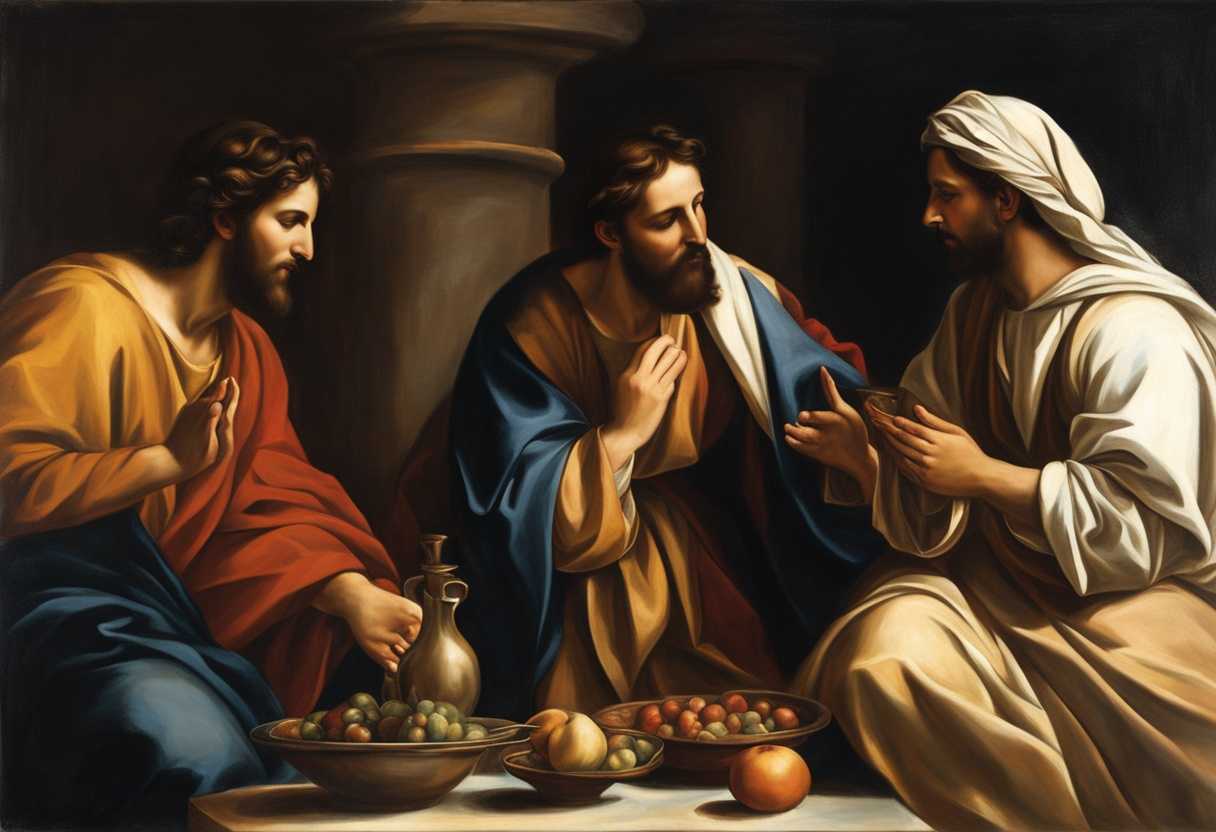
Setting the Scene for Matthew 12:48-50
In Matthew chapter 12, Jesus is teaching a large crowd when his mother Mary and brothers arrive to speak with him. The scene is set in a bustling marketplace in a small town, with people milling about, vendors selling their goods, and the sound of chatter filling the air. Jesus is surrounded by his disciples, who are eagerly listening to his teachings and asking questions.
As Mary and Jesus’ brothers approach, they send word to Jesus, requesting to speak with him. Upon hearing this, Jesus pauses his teaching and looks around, acknowledging their presence. He then uses this moment to teach an important lesson about spiritual family, stating that those who do the will of his Father in heaven are his true brothers and sisters. This interaction highlights the deep spiritual truths that Jesus often shared with his followers, emphasizing the importance of faith and obedience in forming a bond with him that transcends earthly relationships.
The exchange between Jesus, Mary, and his brothers serves as a poignant reminder of the challenges and misunderstandings that can arise even within one’s own family when it comes to matters of faith. It also underscores the radical nature of Jesus’ teachings and the transformative power of following him wholeheartedly. The scene captures a moment of tension and revelation, as Jesus redefines the concept of family and invites his followers to embrace a new way of relating to one another through their shared commitment to God.
What is Matthew 12:48-50 about?
Jesus challenges our traditional understanding of family in this verse. He emphasizes that true family is not solely defined by blood relations, but by shared values and dedication to God’s will. Jesus invites us to broaden our definition of family and deepen our connections with others who share our faith and beliefs by prioritizing spiritual kinship over biological ties. Reflect on how this verse challenges your own understanding of family. Do you prioritize biological relationships over spiritual connections? Are there people in your life who may not be family by blood, but who support you in your faith journey and uphold God’s will alongside you? We can cultivate a stronger sense of community and unity with those who share our commitment to living out God’s purpose in our lives by embracing this radical redefinition of family.
Understanding what Matthew 12:48-50 really means
In Matthew 12:48-50, we find Jesus in the midst of a crowd when His mother and brothers arrive, seeking to speak with Him. This interaction sets the stage for a profound teaching on familial relationships in the context of spiritual kinship. Jesus’ question, “Who is my mother, and who are my brothers?” challenges the traditional understanding of family, highlighting the importance of spiritual bonds over biological ones. By stating, “Here are my mother and my brothers,” Jesus points to His disciples, emphasizing that those who follow Him and do God’s will are His true family. He further clarifies that “whoever does the will of my Father in heaven is my brother and sister and mother,” underscoring that obedience to God’s will is the defining characteristic of His spiritual family.
This passage resonates with other biblical teachings that emphasize the spiritual nature of kinship. John 1:12-13 stresses that those who receive Jesus and believe in His name become children of God, highlighting a familial relationship based on faith. Galatians 3:26-28 proclaims the unity in Christ, where distinctions based on ethnicity, social status, or gender are transcended, emphasizing the oneness of believers in Jesus. Ephesians 2:19 further reinforces this idea by stating that believers are no longer strangers but fellow citizens with the saints, members of God’s household, united in a spiritual family.
The relevance of this teaching extends to contemporary society, where family structures can be complex and fractured. In a world where many may feel isolated or disconnected from their biological families, this passage offers hope and inclusion. It reassures believers that they are part of a larger, spiritual family that transcends earthly ties, fostering a sense of belonging and community within the church. For individuals struggling with strained family relationships, the concept of finding acceptance, support, and love within a faith community can be transformative, mirroring the experience of many who discover a new sense of family and belonging in their spiritual journey.
In conclusion, Jesus’ redefinition of family in Matthew 12:48-50 challenges us to prioritize spiritual kinship over biological relationships. This teaching encourages believers to embrace and support one another as true family members in Christ, emphasizing the importance of doing God’s will as the unifying factor that binds believers together as one family under God. As we reflect on this passage, may we strive to cultivate a sense of community and familial love within our faith communities, embodying the spirit of unity and inclusion that Jesus exemplified in His teachings.
What does it mean to be part of God’s family?
Being part of God’s family means more than just a biological or physical relationship. It means following God’s will and actively participating in His Kingdom. Jesus emphasizes that those who do the will of God are considered family. This implies that being part of God’s family involves a close and obedient relationship with Him, a relationship based on faith and love rather than mere ancestry or blood ties. Believers become siblings of Jesus Christ and are regarded as part of God’s family by doing God’s will. This familial bond signifies a deeper spiritual connection and a shared commitment to following God’s commands and teachings. Individuals as members of God’s family are called to support and love one another as brothers and sisters in Christ, working together to spread the message of salvation and embody God’s love and grace in the world.
Application
Think of your life as a series of decisions, like choosing between taking a crucial work project or spending quality time with family. Matthew 12:48-50 asks us to make a vital decision too – to live out the will of God. It’s not enough to just hear or know it; you need to act on it. Just as you would step up for your loved ones or excel at work, step forward in your faith. Will you take this crucial action and embody the teachings of Christ in your daily life?

Reverend Michael Johnson is an experienced Church Minister with a profound expertise in spirituality and guidance. With a serene presence and a compassionate heart, he has faithfully served his congregation for over 20 years, leading them on a spiritual journey towards inner peace and enlightenment. Reverend Johnson’s extensive knowledge of religious philosophies and profound understanding of human nature have made him a trusted confidant and mentor to many, as he seamlessly weaves his profound wisdom into life teachings. Reverend Johnson’s calming demeanor and empathetic nature continue to uplift and heal souls, nurturing a sense of unity and tranquility within his community.