
Matthew 17:14-23 is about the power of faith and prayer, demonstrating that even the smallest amount of faith can move mountains and that true discipleship involves perseverance and dedication to God through prayer and belief in His power.
14 And when they came to the crowd, a man came up to him and, kneeling before him,
15 “Lord, have mercy on my son, for he is an epileptic and he suffers terribly. For often he falls into the fire, and often into the water.”
16 And I brought him to your disciples, and they could not heal him.”
17 And Jesus answered, “O faithless and twisted generation, how long am I to be with you? How long am I to bear with you? Bring him here to me.”
18 And Jesus rebuked the demon, and it came out of him, and the boy was healed instantly.
19 Then the disciples came to Jesus privately and said, “Why could we not cast it out?”
20 He said to them, “Because of your little faith. For truly, I say to you, if you have faith like a grain of mustard seed, you will say to this mountain, ‘Move from here to there,’ and it will move, and nothing will be impossible for you.”
21 But this kind never comes out except by prayer and fasting.”
22 As they were gathering in Galilee, Jesus said to them, “The Son of Man is about to be delivered into the hands of men,
23 They will kill him, and he will be raised on the third day.” And they were greatly distressed.
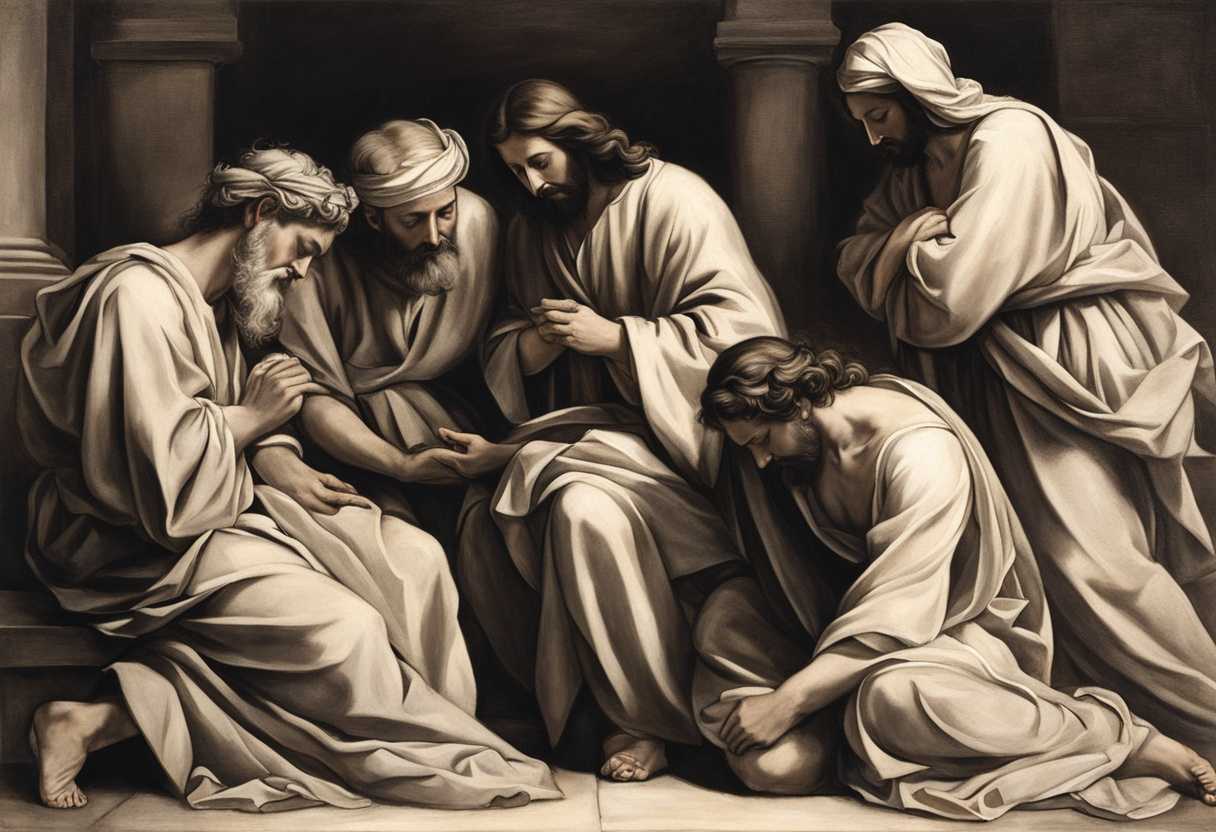
Setting the Scene for Matthew 17:14-23
In Matthew chapter 17, we find Jesus and three of his disciples, Peter, James, and John, coming down from the mountain where they had just experienced the transfiguration. As they descend, they are met by a large crowd. Among the crowd is a man who kneels before Jesus, pleading for help for his son who is suffering from seizures and is often thrown into the fire or water. The man explains that he had brought his son to the disciples, but they were unable to heal him.
The scene is filled with a sense of urgency and desperation as the father begs Jesus to have mercy on his son. The disciples, who had been left behind by Jesus on the mountain, are also present, likely feeling a sense of failure for their inability to heal the boy. The crowd is buzzing with anticipation, hoping to witness a miracle. Jesus, filled with compassion, rebukes the demon causing the boy’s suffering and heals him, leaving the crowd in awe of his power and authority. This moment serves as a powerful demonstration of Jesus’ divine nature and his ability to bring healing and deliverance to those in need.
What is Matthew 17:14-23 about?
Jesus demonstrates his divine power by healing a boy who was possessed by a demon in this verse. This miracle serves as a powerful reminder of Jesus’s ability to overcome any challenges or struggles we may face in life. It is a symbolic representation of how faith in Jesus can bring about healing and deliverance from even the most difficult situations.
Additionally, Jesus uses this moment to teach his disciples about the importance of faith and prayer. He emphasizes the need for unwavering belief in God’s power to move mountains and perform miracles. Through this teaching, Jesus encourages his followers to cultivate a deep and trusting relationship with God through prayer, knowing that their faith can lead to incredible outcomes. Reflect on times in your own life when you have faced challenges that seemed insurmountable. Jesus, who healed the boy with the demon, is also capable of bringing healing and deliverance to your own life. You too can experience the transformative power of God’s love and grace by placing your faith in Him and approaching Him with earnest prayer.
Understanding what Matthew 17:14-23 really means
In Matthew 17:14-23, we witness a powerful display of Jesus’ authority as He heals a demon-possessed boy, a task His disciples had failed to accomplish. This narrative underscores the themes of faith, power, and the foreshadowing of Jesus’ impending death and resurrection. Jesus’ frustration with the lack of faith in the people, labeling them as an “unbelieving and perverse generation,” serves as a poignant reminder of the importance of genuine faith in spiritual matters.
The iconic phrase, “If you have faith as small as a mustard seed,” encapsulates the profound truth that even the tiniest seed of authentic faith can yield miraculous results. Jesus reinforces this by declaring, “Nothing will be impossible for you,” emphasizing the limitless potential of unwavering faith. Moreover, His prediction of being “delivered into the hands of men” hints at the sacrificial journey He is destined to undertake, highlighting the pivotal role of His impending death and resurrection in the grand scheme of salvation.
Parallel accounts like Mark 9:14-29 offer additional insights, such as the father’s plea for strengthened belief, showcasing the ongoing struggle and growth in faith. Similarly, Luke 17:6 reiterates the mustard seed analogy, emphasizing the transformative power of faith. Hebrews 11:1 further defines faith as confidence in the unseen, reinforcing its significance in the Christian walk.
Today, individuals grapple with challenges that test their faith, mirroring the disciples’ struggles. This passage serves as a beacon of hope, urging believers to lean on God’s omnipotence amidst daunting circumstances. The assurance that “nothing will be impossible” with faith inspires perseverance in the face of adversity, fostering a mindset of resilience and trust in divine intervention.
Consider a scenario where a young woman battles a severe illness, her hope waning despite medical interventions. Encouraged by a friend to embrace mustard seed faith, she turns to prayer, finding solace amid uncertainty. As she combines medical treatment with renewed faith, her health gradually improves, attributing her recovery to both medical care and her revitalized belief. This anecdote vividly illustrates how even a small measure of faith can ignite strength and optimism in the midst of life’s trials.
In conclusion, Matthew 17:14-23 underscores the transformative potency of faith, urging believers to anchor themselves in God’s sovereignty and the redemptive work of Jesus. It beckons individuals to trust in the omnipotent nature of faith, reminding them that even the smallest seed of belief can yield extraordinary outcomes. This passage stands as a timeless testament to the enduring power of faith in navigating life’s challenges and embracing the promise of divine intervention.
What does it mean to trust in Jesus completely?
Trusting in Jesus completely means having unwavering faith in his power and ability to work miracles in our lives. It means believing wholeheartedly that nothing is impossible for him and that he is capable of bringing about positive change in any situation. We surrender our fears, doubts, and worries by trusting in Jesus completely, knowing that he is in control and that his plan is greater than our own.
Trusting in Jesus also involves seeking him in prayer and relying on his guidance and wisdom in all aspects of our lives. It means acknowledging that we cannot do everything on our own and leaning on him for support and direction. This level of trust allows us to experience peace and assurance, knowing that Jesus is with us every step of the way, guiding us through both the good times and the challenges we face. Trusting in Jesus completely ultimately requires a deep level of surrender and reliance on his love and power. It means placing our hope and confidence in him above all else, knowing that he will never leave us nor forsake us. Trusting in Jesus completely opens us up to experiencing his grace, mercy, and blessings in our lives in ways we could never imagine.
Application
Embrace the strength of faith! Like Jesus banishing demons, we too can conquer obstacles with unwavering faith in God. Trust in His ability to transform your life. Dare to believe that miracles can happen. Are you prepared to take that leap of faith and witness the extraordinary power of God in your life?

Reverend Michael Johnson is an experienced Church Minister with a profound expertise in spirituality and guidance. With a serene presence and a compassionate heart, he has faithfully served his congregation for over 20 years, leading them on a spiritual journey towards inner peace and enlightenment. Reverend Johnson’s extensive knowledge of religious philosophies and profound understanding of human nature have made him a trusted confidant and mentor to many, as he seamlessly weaves his profound wisdom into life teachings. Reverend Johnson’s calming demeanor and empathetic nature continue to uplift and heal souls, nurturing a sense of unity and tranquility within his community.